
Showing posts with label Catechism of the Catholic Church. Show all posts
Showing posts with label Catechism of the Catholic Church. Show all posts
Tuesday, 18 August 2015


Wednesday, 15 January 2014
POPE FRANCIS MISQUOTES AND FALSEHOODS DISCREDITING THE CATHOLIC CHURCH
 |
| Internet Hoaxes and Lies Regarding Pope Francis and the Catholic Church |
POPE FRANCIS MISQUOTES
AND FALSEHOODS
DISCREDITING
THE CATHOLIC CHURCH
Poor Pope Francis--he has been misquoted so
many times, his words twisted and even complete lies that have been spread
about what he has said or didn’t say since his election in 2013.
There are many ‘antichrists’ who will do
anything in their power to create confusion in the world making statements that
were twisted to suit the desires of those who want changes made in the Catholic
Church…CHANGES THAT WILL NEVER HAPPEN
as they are dogmas from the beginning of the Church coming down from the
Apostles and Christ Himself.
One such article that
I discovered was sent to me as an email-- a
complete invention of it’s writer, Erik Thorsen on his site called "Diversity Chronicle" that went viral
on the internet completely confusing people who are not well-informed as to the
truth of the Catholic Church. Even those
declaring themselves to be Catholic. He
stated that Pope Francis said that there was no hell, that all religions are
true and that the Church has changed it’s teaching on homosexual behavior. All of course these claims are untrue. Mr. Thorsen stated that these new teachings
were from the third Vatican Council…. THERE HAS NOT BEEN A THIRD VATICAN
COUNCIL. Read more at http://www.ncregister.com/blog/jimmy-akin/dont-fall-for-this-pope-francis-hoax-5-things-to-know-and-share/.
Thorsen and many others in this world can’t tolerate
the Catholic Church’s stand on fundamental beliefs such as abortion,
homosexuality, women priests, etc. so they try to confuse the world’s
population with lies to turn their beliefs into an attitude positive to their
whims.
I feel every Catholic should take a stand and
tell the truth about the Church’s teachings.
It’s past time that we truly stood for our beliefs and stop letting the
so called relativism or liberals run atop of us. We have been too lax in standing up for what
is right and letting those with louder voices rule. Hence, the continuing corruptness of the world
today.
The worldly view is that the Catholic Church is
‘behind the times’ and ‘bigoted’. Of
course, the opposite is true. The
teachings that have come down through 2000 years are just a viable as they were
in the beginning. It’s the world that
has changed in a very immoral way—trying to make everything that is ‘sinful’ good and everything good as ‘sinful or evil’.
If we truly believe in
the teachings of the Church and want to follow her, we must know our faith.
Those who just attend Christmas Mass or occasionally come to a Sunday
Mass and even those who are faithfully attending Mass every Sunday and during
the week need to know what the truth is that the Church teaches.
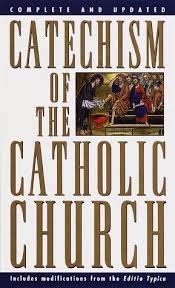 I recommend getting a copy of the Catechism of
the Catholic Church promulgated for the Catholic Church by Pope John Paul II
(soon to be lifted to sainthood this year 2014). In it is all the dogmas and truths that the
Church stands for. (You can even go
on-line as the Catechism of the Catholic Church has been added to the internet
by the Vatican itself. Go to http://www.vatican.va/archive/ENG0015/_INDEX.HTM
. “The decision to publish a catechism
was taken at the Extraordinary Assembly of the Synod of Bishops that was convened
by Pope John Paul II on 25 January 1985 for the 20th anniversary of the close
of the Second Vatican Council, and in 1986, the pope put a commission composed
of 12 bishops and cardinals in charge of the project.[2] The commission was
assisted by a seven member committee including diocesan bishops and experts in
theology and catechesis.[2] Read more
about the conception of the Catechism of the Catholic Church on Wikipedia http://en.wikipedia.org/wiki/Catechism_of_the_Catholic_Church
I recommend getting a copy of the Catechism of
the Catholic Church promulgated for the Catholic Church by Pope John Paul II
(soon to be lifted to sainthood this year 2014). In it is all the dogmas and truths that the
Church stands for. (You can even go
on-line as the Catechism of the Catholic Church has been added to the internet
by the Vatican itself. Go to http://www.vatican.va/archive/ENG0015/_INDEX.HTM
. “The decision to publish a catechism
was taken at the Extraordinary Assembly of the Synod of Bishops that was convened
by Pope John Paul II on 25 January 1985 for the 20th anniversary of the close
of the Second Vatican Council, and in 1986, the pope put a commission composed
of 12 bishops and cardinals in charge of the project.[2] The commission was
assisted by a seven member committee including diocesan bishops and experts in
theology and catechesis.[2] Read more
about the conception of the Catechism of the Catholic Church on Wikipedia http://en.wikipedia.org/wiki/Catechism_of_the_Catholic_Church For news concerning
the Church and the TRUE QUOTES OF POPE FRANCIS, I recommend the National Catholic Register. “With
so much happening in the world that affects Catholics and so many Catholics
making a difference in the world, it's the best source” for truthful
Catholic news--completely true to
the teachings of the Catholic Church and it's Magisterium. Go to http://www.ncregister.com.
For news concerning
the Church and the TRUE QUOTES OF POPE FRANCIS, I recommend the National Catholic Register. “With
so much happening in the world that affects Catholics and so many Catholics
making a difference in the world, it's the best source” for truthful
Catholic news--completely true to
the teachings of the Catholic Church and it's Magisterium. Go to http://www.ncregister.com.
Learn more about the
faith by watching EWTN – Eternal Word Television Network. http://www.ewtn.com/
Now also known at the Global Catholic Network. Cable
companies usually have it for free – others like my cable company charge a mere
$2.95 for the channel. It has true
fundamental Catholic teachings taught by priests such as Father Mitch Pacwa,
religious and laypersons. Daily Masses, programs
on the Pope’s addresses, News from the Vatican, Women’s issues, Saints, Children’s
programming and so much more 24 hours a day- some of their programs can be found
on Youtube as well. EWTN also has

Radio programs with great programs relating to today’s world by
speakers teaching true doctrine. EWTN is supported by the viewers and has been
since it’s conception August 15, 1981 by the much loved Mother Angelica. “EWTN Global Catholic Network, in its 32nd
year, is available in over 228 million television households in more than 140
countries and territories. With its direct broadcast satellite television and
radio services, AM & FM radio networks, worldwide short-wave radio station,
Internet website www.ewtn.com and publishing arm, EWTN, is the largest
religious media network in the world.”
It truly speaks for the Roman Catholic Church and it’s Magisterium.
As you
can see, there is NO REASON why Catholics and non-Catholics cannot find the
TRUTH if they are willing to look for it.
Stop living in an ignorant world,
open your eyes to the reality which is the Catholic Church...be informed…
become knowledgeable—so that when someone asks you a questions concerning your
beliefs you will know the answer or know where to look for the answer.

Written by Rosemary Mullan, creator of the blog
Faith Warriors, One Defender of the Catholic Faith http://catholicfaithwarriors.blogspot.ca/
Friday, 9 November 2012
Year of Faith: Oct. 11, 2012-Nov. 24, 2013

The Year of Faith
is a
“summons to an authentic and renewed conversion to the Lord,
the One Savior of the world”
(Porta Fidei 6).
In other words, the Year of Faith is an opportunity for Catholics to experience a conversion – to turn back to Jesus and enter into a deeper relationship with him.
The “door of faith” is opened at one’s baptism, but during this year Catholics are called to open it again, walk through it and rediscover and renew their relationship with Christ and his Church.
 |
| Venerable Archbishop Fulton Sheen |
Pope Benedict XVI has stated that the Year of Faith is to be a worldwide moment of prayer. One way to fulfill this request is the promotion of the World Mission Rosary. . . that was conceived in 1951 by the Servant of God, Archbishop Fulton Sheen. The World Mission Rosary unites people of the world in a spiritual communion and as Bishop Sheen said, the one who prays it will “embrace all continents, all people in prayer.”
In the Acts of the Apostles, we learn that God has opened the door of faith for the early Church. But did you know that God has opened the door of faith for each one us and he invites us to step through the threshold into a deeper relationship with him.
The upcoming Year of Faith is an opportunity for every Catholic to turn towards Jesus Christ, encounter him in the Sacraments, especially the Eucharist and rediscover the Faith and Church.
 |
| 2nd Vatican Council 1962-1965 |
During the Year of Faith, Catholics are asked to study and reflect on the documents of Vatican II and the catechism so that they may deepen their knowledge of the faith.
"The 'door of faith' (Acts14:27)
is always open for us,
ushering us into
the life of communion with God
and offering entry into his Church."
is always open for us,
ushering us into
the life of communion with God
and offering entry into his Church."
--Pope Benedict XVI,
Apostolic Letter Porta Fidei
for the Indiction of the Year of Faith

Pope Benedict Asks the Faithful to
"Cherish the Rosary
during the Year of Faith"
Before praying the Angelus on
Octctober 7, 2012, Pope Benedict XVI recalled that the traditional annual
"supplication", in which thousands of faithful around the world
participate, is taking place today at the Italian shrine of Pompei, dedicated
to Our Lady of the Rosary.
"As we too spiritually unite
ourselves to that choral invocation, I would like to invite everyone
to cherish
the Rosary during the forthcoming Year of Faith.
 With the Rosary, in fact, we
allow ourselves to be guided by Mary, the model of faith,
With the Rosary, in fact, we
allow ourselves to be guided by Mary, the model of faith,
in meditating upon the mysteries of Christ,
and day after day we are helped to assimilate the
Gospel so that it can shape our lives.
Therefore, in the wake of my
predecessors,
and in particular Blessed John Paul II who ten years ago gave us his Apostolic Letter
'Rosarium Virginis Mariae',
I invite people to pray the
Rosary individually,
in the family and in the community, placing themselves in
the school of Mary who leads us to Christ, the living center of our
faith".
— from Vatican Information Service

Disciples Called To Witness
The New Evangelization
A statement by the Committee on Evangelization and Catechesis
How often do we fail to realize that we are called to be Christ's witnesses to the world? How often do we reach out to our missing brothers and sisters by inviting them to join us at Mass or by asking why they no longer feel welcomed at Church? Did you know that through our baptism, we are called to proclaim the Good News to all people, everywhere and at all times.

PLENARY INDULGENCE
FOR THE YEAR OF FAITH
Vatican City, (VIS) - According to a decree made public today and signed by Cardinal Manuel Monteiro de Castro and Bishop Krzysztof Nykiel, respectively penitentiary major and regent of the Apostolic Penitentiary, Benedict XVI will grant faithful Plenary Indulgence for the occasion of the Year of Faith. The indulgence will be valid from the opening of the Year on 11 October 2012 until its end on 24 November 2013.
 "The day of the fiftieth anniversary of the solemn opening of Vatican Council II", the text reads, "the Supreme Pontiff Benedict XVI has decreed the beginning of a Year especially dedicated to the profession of the true faith and its correct interpretation, through the reading of - or better still the pious meditation upon - the Acts of the Council and the articles of the Catechism of the Catholic Church".
"Since the primary objective is to develop sanctity of life to the highest degree possible on this earth, and thus to attain the most sublime level of pureness of soul, immense benefit may be derived from the great gift of Indulgences which, by virtue of the power conferred upon her by Christ, the Church offers to everyone who, following the due norms, undertakes the special prescripts to obtain them".

"During the Year of Faith, which will last from 11 October 2012 to 24 November 2013, Plenary Indulgence for the temporal punishment of sins, imparted by the mercy of God and applicable also to the souls of deceased faithful, may be obtained by all faithful who, truly penitent, take Sacramental Confession and the Eucharist and pray in accordance with the intentions of the Supreme Pontiff.
"(A) Each time they attend at least three sermons during the Holy Missions, or at least three lessons on the Acts of the Council or the articles of the Catechism of the Catholic Church, in church or any other suitable location.
 "(B) Each time they visit, in the course of a pilgrimage, a papal basilica, a Christian catacomb, a cathedral church or a holy site designated by the local ordinary for the Year of Faith (for example, minor basilicas and shrines dedicated to the Blessed Virgin Mary, the Holy Apostles or patron saints), and there participate in a sacred celebration, or at least remain for a congruous period of time in prayer and pious meditation, concluding with the recitation of the Our Father, the Profession of Faith in any legitimate form, and invocations to the Blessed Virgin Mary and, depending on the circumstances, to the Holy Apostles and patron saints.
"(C) Each time that, on the days designated by the local ordinary for the Year of Faith, ... in any sacred place, they participate in a solemn celebration of the Eucharist or the Liturgy of the Hours, adding thereto the Profession of Faith in any legitimate form.
 "(D) On any day they chose, during the Year of Faith, if they make a pious visit to the baptistery, or other place in which they received the Sacrament of Baptism, and there renew their baptismal promises in any legitimate form.
"Diocesan or eparchal bishops, and those who enjoy the same status in law, on the most appropriate day during that period or on the occasion of the main celebrations, ... may impart the papal blessing with the Plenary Indulgence".
The document concludes by recalling how faithful who, due to illness or other legitimate cause, are unable to leave their place of adobe, may still obtain Plenary Indulgence "if, united in spirit and thought with other faithful, and especially at the times when the words of the Supreme Pontiff and diocesan bishops are transmitted by television or radio, they recite ... the Our Father, the Profession of Faith in any legitimate form, and other prayers that concord with the objectives of the Year of Faith, offering up the suffering and discomfort of their lives".
Official Webpage of the Year of Faith
http://www.annusfidei.va/content/novaevangelizatio/en.html
The official calendar for the Year of Faith
The official calendar
for the Year of Faith lists the events which have been submitted to the
Organizational Secretary from around the world.
http://www.annusfidei.va/content/novaevangelizatio/en/eventi.html
Tuesday, 4 September 2012
Our Father/Lord's Prayer--Catechism of the Catholic Church

 |
| Jesus Teaching the Lord's Prayer by Tissot |
Our Father,
Who Art in Heaven
Hallowed by Thy Name
Thy Kingdom come
Thy Will be done
On earth, as it is in Heaven
Give us this day Our daily bread
And forgive us our trespasses
As we forgive those
Who trespass against us
And lead us not into temptation
But deliver us from evil.
Amen.
(traditional Matthean version)
Source: Catechism of The Roman Catholic Church,
Part Four Christian Prayer, Section Two:The Lord's Prayer
Note: These words are identical to the version found in the Litany section of the U.S. Book of Common Prayer, 1928 edition.
http://www.lords-prayer-words.com/lord_roman_catholic_version.html

CHRISTIAN PRAYER
SECTION TWO
THE LORD'S PRAYER
"OUR FATHER!"
ARTICLE 1
"THE SUMMARY OF THE WHOLE GOSPEL"
2761 The Lord's Prayer "is truly the summary of the whole gospel."7 "Since the Lord . . . after handing over the practice of prayer, said elsewhere, 'Ask and you will receive,' and since everyone has petitions which are peculiar to his circumstances, the regular and appropriate prayer [the Lord's Prayer] is said first, as the foundation of further desires."8
I. AT THE CENTER OF THE SCRIPTURES
2762 After showing how the psalms are the principal food of Christian prayer and flow together in the petitions of the Our Father, St. Augustine concludes:
- Run through all the words of the holy prayers [in Scripture], and I do not think that you will find anything in them that is not contained and included in the Lord's Prayer.9
- The Lord's Prayer is the most perfect of prayers. . . . In it we ask, not only for all the things we can rightly desire, but also in the sequence that they should be desired. This prayer not only teaches us to ask for things, but also in what order we should desire them.12
II. THE LORD'S PRAYER
2765 The traditional expression "the Lord's Prayer" - oratio Dominica - means that the prayer to our Father is taught and given to us by the Lord Jesus. The prayer that comes to us from Jesus is truly unique: it is "of the Lord." On the one hand, in the words of this prayer the only Son gives us the words the Father gave him:13 he is the master of our prayer. On the other, as Word incarnate, he knows in his human heart the needs of his human brothers and sisters and reveals them to us: he is the model of our prayer.
2766 But Jesus does not give us a formula to repeat mechanically.14 As in every vocal prayer, it is through the Word of God that the Holy Spirit teaches the children of God to pray to their Father. Jesus not only gives us the words of our filial prayer; at the same time he gives us the Spirit by whom these words become in us "spirit and life."15 Even more, the proof and possibility of our filial prayer is that the Father "sent the Spirit of his Son into our hearts, crying, 'Abba! Father!'"16 Since our prayer sets forth our desires before God, it is again the Father, "he who searches the hearts of men," who "knows what is the mind of the Spirit, because the Spirit intercedes for the saints according to the will of God."17 The prayer to Our Father is inserted into the mysterious mission of the Son and of the Spirit.
2767 This indivisible gift of the Lord's words and of the Holy Spirit who gives life to them in the hearts of believers has been received and lived by the Church from the beginning. The first communities prayed the Lord's Prayer three times a day,18 in place of the "Eighteen Benedictions" customary in Jewish piety.
2768 According to the apostolic tradition, the Lord's Prayer is essentially rooted in liturgical prayer:
- [The Lord] teaches us to make prayer in common for all our brethren. For he did not say "my Father" who art in heaven, but "our" Father, offering petitions for the common body.19
2769 In Baptism and Confirmation, the handing on (traditio) of the Lord's Prayer signifies new birth into the divine life. Since Christian prayer is our speaking to God with the very word of God, those who are "born anew". . . through the living and abiding word of God"20 learn to invoke their Father by the one Word he always hears. They can henceforth do so, for the seal of the Holy Spirit's anointing is indelibly placed on their hearts, ears, lips, indeed their whole filial being. This is why most of the patristic commentaries on the Our Father are addressed to catechumens and neophytes. When the Church prays the Lord's Prayer, it is always the people made up of the "new-born" who pray and obtain mercy.21
2770 In the Eucharistic liturgy the Lord's Prayer appears as the prayer of the whole Church and there reveals its full meaning and efficacy. Placed between the anaphora (the Eucharistic prayer) and the communion, the Lord's Prayer sums up on the one hand all the petitions and intercessions expressed in the movement of the epiclesis and, on the other, knocks at the door of the Banquet of the kingdom which sacramental communion anticipates.
 2771 In the Eucharist, the
Lord's Prayer also reveals the eschatological character of its petitions.
It is the proper prayer of "the end-time," the time of salvation that began with
the outpouring of the Holy Spirit and will be fulfilled with the Lord's return.
The petitions addressed to our Father, as distinct from the prayers of the old
covenant, rely on the mystery of salvation already accomplished, once for all,
in Christ crucified and risen.
2771 In the Eucharist, the
Lord's Prayer also reveals the eschatological character of its petitions.
It is the proper prayer of "the end-time," the time of salvation that began with
the outpouring of the Holy Spirit and will be fulfilled with the Lord's return.
The petitions addressed to our Father, as distinct from the prayers of the old
covenant, rely on the mystery of salvation already accomplished, once for all,
in Christ crucified and risen.2772 From this unshakeable faith springs forth the hope that sustains each of the seven petitions, which express the groanings of the present age, this time of patience and expectation during which "it does not yet appear what we shall be."22 The Eucharist and the Lord's Prayer look eagerly for the Lord's return, "until he comes."23
IN BRIEF
2773 In response to his disciples' request "Lord, teach us to pray" (Lk 11:1), Jesus entrusts them with the fundamental Christian prayer, the Our Father.
2774 "The Lord's Prayer is truly the summary of the whole gospel,"24 the "most perfect of prayers."25 It is at the center of the Scriptures.
2775 It is called "the Lord's Prayer" because it comes to us from the Lord Jesus, the master and model of our prayer.
2776 The Lord's Prayer is the quintessential prayer of the Church. It is an integral part of the major hours of the Divine Office and of the sacraments of Christian initiation: Baptism, Confirmation, and Eucharist. Integrated into the Eucharist it reveals the eschatological character of its petitions, hoping for the Lord, "until he comes" (1 Cor 11:26).
http://www.vatican.va/archive/ccc_css/archive/catechism/p4s2a1.htm
Subscribe to:
Posts (Atom)