From a letter by Saint Boniface, bishop and martyr
 |
| St. Boniface |
The Careful Shepherd watches over Christ’s flock
In her voyage across the ocean of this world, the Church is
like a great ship being pounded by the waves of life’s different stresses. Our duty is not to abandon ship but to keep
her on her course.
The ancient fathers showed us how we should carry out this duty.
Clement, Cornelius and many others in
the city of Rome, Cyprian at Carthage, Athanasius at Alexandria. They all lived under Emperors who were pages;
they all steered the Christ’s ship—or rather his most dear spouse, the
Church. This they did by teaching and
defending her, by their labors and sufferings, even to the shedding of blood.
I am terrified when I think of all this. Fear and trembling came upon me and the
darkness of my sins almost covered me. I would gladly give up the task of
guiding the Church which I have accepted
if I could find sucha an action warranted by the example of the fathers or by
holy Scripture.
 |
| St. Boniface Icon |
Since this is the case, and since the truth can be assaulted
by never defeated or falsified, with our tired mind let us turn to the words of
Solomon: Trust in the Lord with all your
heart and dod not rely on your own prudence.
Thon on him in all your ways, and he will guide your steps. In another place her says: The name of the Lord is an impregnable
tower. The just man seeks refuge in it and he will be saved.
Let us stand fast in what is right and prepare our souls for
trial. Let us wait upon God’s
strengthening aid and say to him: O Lord,
you have been our refuge in all generations.
Let us trust in him who has placed this burden upon us. What we ourselves cannot bear let us bear
with the help of Christ. For he is
all-powerful and he tells us: My yoke is
easy and my burden is light.
Let us continue the fight on the day of the Lord. The days
of anguish and tribulation have overtaken us; if God so wills, let us die for the holy laws of our
fathers, so that we may deserve to obtain an eternal inheritance with them.
Let us be neither dogs that do not bark nor silent onlookers
nor paid servants who run away before the wolf. Instead let us be careful shepherds watching
over Christ’s flock. Let us preach the
whole of God’s plan to the powerful and to the humble, to rich and to poor, to
men of every rank and age, as far as God gives us the strength, in season and
out of season, as Saint Gregory writes in his book of Pastoral Instruction.
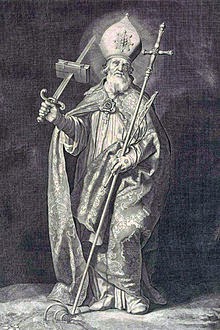
Who is Saint Boniface?
(Latin: Bonifatius) (c. 675? – 5 June 754), born Winfrid,
Wynfrith, or Wynfryth in the kingdom of Wessex, probably at Crediton, was an
Anglo-Saxon missionary who propagated Christianity in the Frankish Empire
during the 8th century. He is the patron saint of Germany, the first archbishop
of Mainz and the "Apostle of the Germans". He was killed in Frisia in
754, along with 52 others. His remains were returned to Fulda, where they rest
in a sarcophagus which became a site of pilgrimage. Facts about Boniface's life
and death as well as his work became widely known, since there is a wealth of
material available—a number of vitae, especially the near-contemporary Vita
Bonifatii auctore Willibaldi, and legal documents, possibly some sermons, and
above all his correspondence.
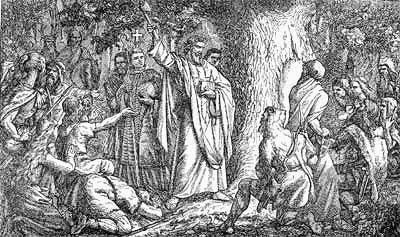 |
| St. Boniface felling the oak tree that was venerated as a God |
The Incident at Thor's Oak
To show the heathens how utterly powerless were the gods in
whom they placed their confidence, Boniface felled the oak sacred to the
thunder-god Thor, at Geismar, near Fritzlar. He had a chapel built out of the
wood and dedicated it to the prince of the Apostles. The heathens were
astonished that no thunderbolt from the hand of Thor destroyed the offender,
and many were converted. The fall of this oak marked the fall of heathenism.
Tradition tells us that Boniface now passed on to the River Werra and there
erected a Church of St. Vitus, around which sprang up a town which to the
present day bears the name of Wannfried. At Eschwege he is said to have
destroyed the statue of the idol Stuffo. Thence he went into Thuringia.
Check out this website for more detailed information regarding this great saint.


