Ad

Showing posts with label bishop. Show all posts

Wednesday, 12 April 2017

Death and Resurrection - St. Basil, bishop

Christ Crucified

By One Death and Resurrection the World was Saved
From the book On the Holy Spirit by Saint Basil, bishop


When mankind was estranged from him by disobedience, God our Savior made a plan for raising us from our fall and restoring us to friendship with himself.  According to this plan Christ came in the flesh, he showed us the gospel way of life, he suffered, died on the cross, was buried and rose from the dead.  He did this so that we could be saved by imitation of him, and recover our original status as sons of God by adoption.

To attain holiness, then, we must not only pattern our lives on Christ’s by being gentle, humble and patient, we must also imitate him in his death.  

Taking Christ for his model, Paul said that he wanted to become like him in his death in the hope that he too would be raised from death to life.


We imitate Christ’s death by being buried with him in baptism.  

If we ask what this kind of burial means and what benefit we may hope to derive from it, it means first of all making a complete break with our former way of life, and our Lord himself said that this cannot be done unless a man is born again.  

In other words, we have to begin a new life, 
and we cannot do so until our previous life 
has been brought to an end.  

When runners reach the turning point on a racecourse, they have to pause briefly before they can go back in the opposite direction.  So also when we wish to reverse the direction of our lives there must be a pause, or a death, to make the end of one life and the beginning of another.


Our descent into hell takes place 
when we imitate the burial of Christ by our baptism.  

The bodies of the baptized are in a sense buried in the water as a symbol of their renunciation of the sins of their unregenerate nature.  As the Apostle says: The circumcision you have undergone is not an operation performed by human hands, but the complete stripping away of your unregenerate nature.  This is the circumcision that Christ gave us, and it is accomplished by our burial with him in baptism.  Baptism cleanses the soul from the pollution of worldly thoughts and inclinations: You will wash me, says the psalmist, and I shall be whiter than snow.  

We receive this saving baptism only once 
because there was only one death and one resurrection 
for the salvation of the world, and baptism is its symbol.

Mary Magdalene meets the Risen Christ

Thursday, 6 April 2017

Through Deeds - Not Words

From an Easter letter by Saint Anthanasius, bishop

We keep the coming feast of the Lord through deeds, 
not words


The Word who became all things for us is close to us, our Lord Jesus Christ who promises to remain with always.  He cries out, saying, “See, I am with you all the days of this age.  He is Himself the shepherd, the high priest, the way and the door, and has become all things at once for us.  In the same way, He has come among us as our feast and holy days as well.  The blessed Apostle says of Him who was awaited: Christ has been sacrificed as our Passover.  It was Christ who shed His light on the psalmist as he prayed: You are my joy, deliver me from those surrounding me. 

True joy, genuine festival, 
means the casting out of wickedness.  
To achieve this one must live a life 
of perfect goodness and, 
in the serenity of the fear of God, 
practice contemplation in one’s heart.

This was the way of the saints, who in their lifetime and at every stage of life rejoiced as at a feast.  Blessed David, for example, not once but seven times rose at night to win God’s favor through prayer.  The great Moses was full of joy as he sang God’s praises in hymns of victory for the defeat of Pharaoh and the oppressors of the Hebrew people.  Others had hearts filled always with gladness as they performed their sacred duty of worship, like the great Samuel and the blessed Elijah.  Because of their holy lives they gained freedom, and now keep festival in heaven.  They rejoice after their pilgrimage in shadows, and now distinguish the reality from the promise.

When we celebrate the feast in our own day, what path are we to take?  As we draw near to this feast, who is to be our guide?  Beloved, it must be none other than Jesus Christ.  He says: I am the way.  As blessed John tells us: it is Christ who takes away the sin of the world. It is He who purifies our souls, as the prophet Jeremiah says: Stand upon the ways; look and see which is the good path, and you will find in it the way of amendment for your souls.


In former times the blood of goats and the ashes of a calf were sprinkled on those who were unclean, but they were able to purify only the body.  Now through the grace of God’s Word everyone is made abundantly clean.  

If we follow Christ closely, we shall be allowed, even on this earth, to stand as it were on the threshold of the heavenly Jerusalem, and enjoy the contemplation of that everlasting feast, like the blessed apostles, who in following the Savior as their leader, showed, and still show, the way to obtain the same gift from God.  

They said: See, we have left all things and followed You. We too follow the Lord, and we keep His feast by deeds rather than by words.

Wednesday, 5 October 2016

Blessed Virgin Mary sermon by St. Sophronius, bishop


Mary, the Mother of  God
From a sermon by Saint Sophronius, bishop

Through Mary 
the Father’s blessing has shone forth on mankind

Hail, full of grace, the Lord is with you. What joy could surpass this, O Virgin Mother?  What grace can excel that which God has granted to you alone?  What could be imagined more dazzling or more delightful?  Before the miracle we witness in you, all else pales; all else is inferior when compared with the grace you have been given.  All else, even what is most desirable, must take second place and enjoy a lesser importance.

The Lord is with you.  Who would dare challenge you?  You are God’s mother; who would not immediately defer to you and be glad to accord you a greater primacy and honor?  For this reason, when I look upon the privilege you have above all creatures, I extol you with the highest praise: Hail, full of grace, the Lord is with you.  On your account joy has not only graced men, but is also granted to the power of heaven.

Truly, you are blessed among women. For you have changed Eva’s curse into a blessing; and Adam, who hitherto lay under a curse, has been blessed because of you.

Truly, you are blessed among women.  Through you the Father’s blessing has shone forth on mankind, setting them free of their ancient curse.

Truly, you are blessed among women, because through you your forebears have found salvation.  For you were to give birth to the Savior who was to win them salvation.

Truly, you are blessed among women, for without seed you have borne, as your fruit, Him who bestows blessings on the whole world and redeems it from the curse that made it sprout thorns.

Truly, you are blessed among women, because, though a woman by nature, you will become, in reality, God’s mother.  If He whom you are to bear us is truly God made flesh, then rightly do we call you God’s mother.  For you have truly given birth to God.

Enclosed within your womb is God Himself.  He makes His abode in you and comes forth from you like a bridegroom, winning joy for all and bestowing God’s light on all.


You, O Virgin, are like a clear and shining sky, in which God has set his tent.  From you he comes forth like a bridegroom leaving his chamber.  Like a giant running His course, He will run the course of His life which will bring salvation for all who will ever live, and extending from the highest heavens to the end of them, to will fill all things with divine warmth and with life-giving brightness.

Saint Sophronius, bishopc. 560 – March 11, 638

Tuesday, 26 July 2016

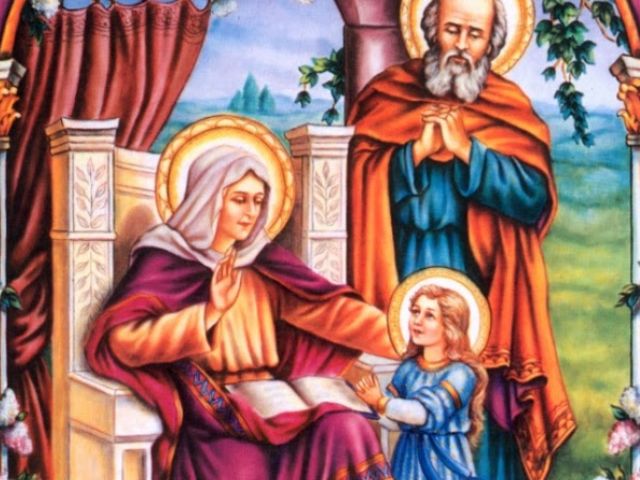
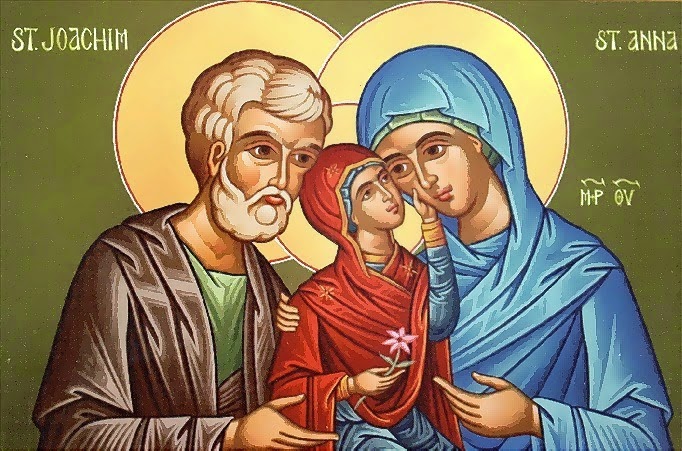
Joachim and Anne, Parents of Mary

Joachim & Anne, parents of the Virgin Mary


Sts. Joachim and Anne
Mary's parents must have been very devout and God-centered people. For God would not have chosen them to be the parents of His Mother from those who were not.  I can imagine how heartbroken Anne and Joachim were on not having children in the days when this was thought shameful.  

But imagine the joy and love that they had when Mary was born! She was their cherished treasure.  They taught her to love and serve God with her whole heart, soul and being.  In humble servitude to help others in need. 

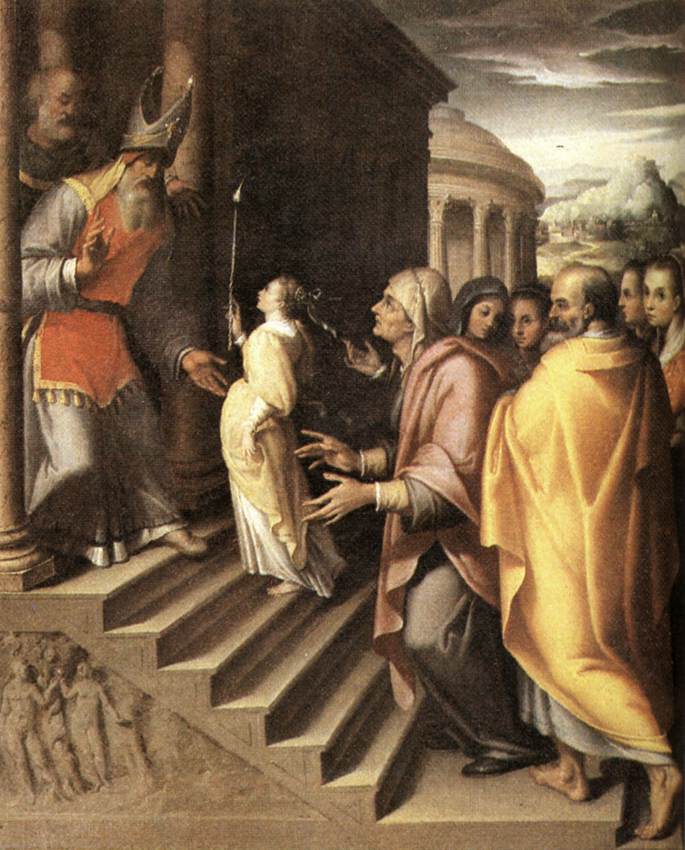
It is said that her parents were so happy when Mary was born that they consecrated her to God.  When she was a very young girl she was taken to the temple to serve as a maiden in the service of God. Seeing her go into the temple must have been a great joy but also a great sacrifice -- the beloved child that they doted on was not with them anymore.  They must have missed her terribly.

The child Mary consecrated to the Temple

We do not know much about St. Joachim and St. Anne - but imagine being the parents of the Virgin Mary -- the chosen Mother of God and the grandparents of Jesus Our Lord, how blessed they are!  

St. Joachim and St. Anne pray for us!  Especially us who are grandparents! Help us be good examples of living the Christian Catholic faith.

The Greek Orthodox Church 
has much more to say about 
the story of Joachim and Anne.  See the website http://www.pravoslavie.ru/english/48783.htm

+ + + + + + + 

By their fruits you will know them
From a sermon by Saint John Damascene, bishop

Sts. Joachim and Anne with the Virgin Mary as a child
Ann was to be the mother of the Virgin Mother of God, and hence nature did not dare to anticipate the flowering of grace.  Thus nature remained sterile, until grace produced its fruit.  For she who was to be born had to be a first-born daughter, since she would be the mother of the first-born of all creation, in whom all things are held together.

Joachim and Ann, how blessed a couple!  All creation is indebted to you.  For at your hands the Creator was offered a gift excelling all other gifts: a chaste mother, who alone was worthy of him.

St. Anne,Virgin Mary & Jesus the Son of God
And so rejoice, Ann, that you were sterile and have not borne children, break forth into shouts, you who have not given birth. Rejoice, Joachim, because from your daughter a child is born for us, a son is given us, whose name is Messenger of great counsel and universal salvation, mighty God. 

For this child is God.

Joachim and Ann, how blessed and spotless a couple!  You will be known by the fruit you have borne, as the Lord says: By their fruits you will know them. The conduct of your life pleased God and was worthy of your daughter.  For by the chaste and holy life you led together, you have fashioned a jewel of virginity: she who remained a virgin before, during and after giving birth.  She alone for all time would maintain her virginity in mind and soul as well as in body.


Joachim and Ann, how chaste a couple!  While safeguarding the chastity prescribed by the law of nature, you achieved with God’s help something which transcends nature in giving the world the Virgin Mother of God as your daughter.  While leading a devout and holy life in your human nature, you gave birth to a daughter nobler than the angels, whose queen she now is.  Girl of utter beauty and delight, daughter of Adam and mother of God, blessed the loins and blessed the womb from which you come!  


Blessed the arms that carried you, 
blessed your parents’ lips, which 
you were allowed to cover 
with chaste kisses, 
ever maintaining your virginity.  

Rejoice in God, all the earth.  Sing, exult and sing hymns.  

Raise your voice, raise it and be not afraid.


taken from the Liturgy of the Hours

Wednesday, 11 June 2014

Living for Christ and not the world

St. Ignatius of Antioch
From a letter to the Romans

by Saint Ignatius of Antioch,
bishop and martyr
My earthly
desires
have been crucified
 
The delights of this world and all its kingdoms will not profit me.  I would prefer to die in Jesus Christ than to rule over all the earth.  I seek him who died for us, I desire him who rose for us.  I am in the throes of being born again.  Bear with me, my brothers; do not keep me from living, do not wish me to die.  I desire to belong to God; do not give me over to the world, and do not seduce me with perishable things.  Let me see the pure light, when I am there, I shall be truly a man at last.  Let me imitate the sufferings of my God.  If anyone has God in him, let him understand what I want and have sympathy for me, knowing what drives me on.
The price of this world would snatch me away and destroy my desire to be with God.  So let none of you who will be there give him help; side rather with me, that is, with God.  Do not have Jesus Christ on your lips and the world in our hearts.  Give envy no place among you.  And if, when I get there, I should beg for your intervention, pay no attention to me; no, believe instead what I am writing to you now.  For I write to you while I yet live, but I long for death.  My early desires have been crucified, and there no long burns in me the love of perishable things, but a living water speaks within me, say: “Come to the Father.”
I take no delight in corruptible food or in the pleasures of this life.  I want the bread of God, which is the flesh of Jesus Christ, who was David’s seed, and for drink I want his blood, the sign of his imperishable love.
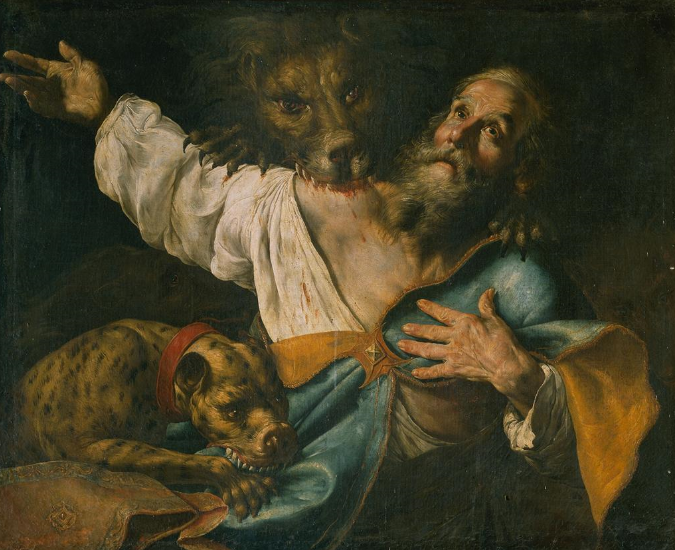
Martyrdom of St. Ignatius of Antioch by Cesar Fracanzano
I no longer wish to live, as men count life.  And I shall have my way, if you wish it so.  Wish it, then, so that you too may have God’s favor.  With these few words I beg you to believe me.  Jesus Christ will make plain to you the truth of what I say; he is the true voice that speaks the Father’s truth.  Pray for me that I may reach my goal.  I have written to you not prompted by merely human feelings and values, but by God’s purpose for me.  If I am to suffer, it will be because you loved me well; if I am rejected, it will be because you hated me.  Remember in your prayers the church of Syria: it now has God for its shepherd instead of me.  Jesus Christ alone will be its bishop, along with your love.  For myself, I am ashamed to be counted among its members, for I do not deserve it, being the least of all, born out of due time.  Yet, if I attain to God, by his mercy I shall be something.  I greet you from the heart, and so do the churches that have welcomed me in love not as a mere passerby but as the representative of Jesus Christ.  Yes, even the churches that were not on my route humanly speaking, though spiritually on the same journey, were there to meet me in city after city.
 
taken from the Liturgy of the Hours (Divine Office) June 10
 
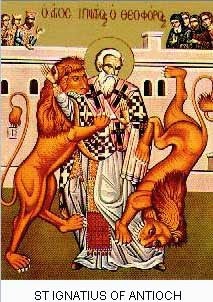
St. Ignatius of Antioch 
St. Ignatius of Antioch
 
Feast Day October 17
St. Ignatius of Antioch was the second bishop of Antioch, Syria.  He was the beloved disciple of John and was consecrated a Bishop around the year 69 by the Apostle Peter, the first Pope.  He was deeply loved by the faithful because of his holiness.  He defended “orthodoxy” (the right teaching) and “orthoproxy” (the right practice) among the early Christians.
He journeyed through Asia Minor and Greece and and wrote sevn letters of encouragement, instruction and inspiration to the Christians in those communities.  The letter written above is a prime example of his great faith and teachings.
St. Ignatius of Antioch was the first to use the term “Catholic” to describe the whole Church.  His letters serve as a unbroken and clear teaching of the Apostles which was given to them directly by Jesus Christ.
In the year 107, under the reign of Emperor Trajan, was sentenced to death because of his refusal to renounce the Christian faith.  He was taken under guard to Rom where he was brutally devoured by wild beasts in a public spectacle.  His holy martyrdom, the shedding of his blood, was a culmination of a life lived conformed to Jesus Christ.
“Permit me to imitate my suffering God… I am God’s wheat and I shall be ground by the teeth of beasts, that I may become the pure bread of Christ.”
Information gathered from Catholic Online

Thursday, 5 June 2014

St. Bonfice - Standing up and Defending the Church


From a letter by Saint Boniface, bishop and martyr
St. Boniface
 
The Careful Shepherd watches over Christ’s flock
 
In her voyage across the ocean of this world, the Church is like a great ship being pounded by the waves of life’s different stresses.  Our duty is not to abandon ship but to keep her on her course.
The ancient fathers showed us how we should carry out this duty.  Clement, Cornelius and many others in the city of Rome, Cyprian at Carthage, Athanasius at Alexandria.  They all lived under Emperors who were pages; they all steered the Christ’s ship—or rather his most dear spouse, the Church.  This they did by teaching and defending her, by their labors and sufferings, even to the shedding of blood.
I am terrified when I think of all this. Fear and trembling came upon me and the darkness of my sins almost covered me. I would gladly give up the task of guiding the Church which I  have accepted if I could find sucha an action warranted by the example of the fathers or by holy Scripture.
St. Boniface Icon
Since this is the case, and since the truth can be assaulted by never defeated or falsified, with our tired mind let us turn to the words of Solomon: Trust in the Lord with all your heart and dod not rely on your own prudence.  Thon on him in all your ways, and he will guide your steps.   In another place her says: The name of the Lord is an impregnable tower. The just man seeks refuge in it and he will be saved.
Let us stand fast in what is right and prepare our souls for trial.  Let us wait upon God’s strengthening aid and say to him: O Lord, you have been our refuge in all generations.
Let us trust in him who has placed this burden upon us.  What we ourselves cannot bear let us bear with the help of Christ.  For he is all-powerful and he tells us: My yoke is easy and my burden is light.
Let us continue the fight on the day of the Lord.  The days of anguish and tribulation have overtaken us; if God so wills, let us die for the holy laws of our fathers, so that we may deserve to obtain an eternal inheritance with them.
Let us be neither dogs that do not bark nor silent onlookers nor paid servants who run away before the wolf.  Instead let us be careful shepherds watching over Christ’s flock.  Let us preach the whole of God’s plan to the powerful and to the humble, to rich and to poor, to men of every rank and age, as far as God gives us the strength, in season and out of season, as Saint Gregory writes in his book of Pastoral Instruction.
 
Who is Saint Boniface?
 
(Latin: Bonifatius) (c. 675? – 5 June 754), born Winfrid, Wynfrith, or Wynfryth in the kingdom of Wessex, probably at Crediton, was an Anglo-Saxon missionary who propagated Christianity in the Frankish Empire during the 8th century. He is the patron saint of Germany, the first archbishop of Mainz and the "Apostle of the Germans". He was killed in Frisia in 754, along with 52 others. His remains were returned to Fulda, where they rest in a sarcophagus which became a site of pilgrimage. Facts about Boniface's life and death as well as his work became widely known, since there is a wealth of material available—a number of vitae, especially the near-contemporary Vita Bonifatii auctore Willibaldi, and legal documents, possibly some sermons, and above all his correspondence.
 ...Through his efforts to reorganize and regulate the church of the Franks, he helped shape Western Christianity, and many of the dioceses he proposed survive today. After his martyrdom, he was quickly hailed as a saint in Fulda and other areas in Germany and in England. His cult is still notably strong today. Boniface is celebrated as a missionary; he is regarded as a unifier of Europe, and he is seen as a German national figure.
 
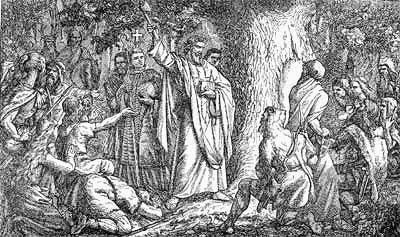
St. Boniface felling the oak tree that was venerated as a God
The Incident at Thor's Oak 
To show the heathens how utterly powerless were the gods in whom they placed their confidence, Boniface felled the oak sacred to the thunder-god Thor, at Geismar, near Fritzlar. He had a chapel built out of the wood and dedicated it to the prince of the Apostles. The heathens were astonished that no thunderbolt from the hand of Thor destroyed the offender, and many were converted. The fall of this oak marked the fall of heathenism. Tradition tells us that Boniface now passed on to the River Werra and there erected a Church of St. Vitus, around which sprang up a town which to the present day bears the name of Wannfried. At Eschwege he is said to have destroyed the statue of the idol Stuffo. Thence he went into Thuringia.
Check out this website for more detailed information regarding this great saint. 

Friday, 20 July 2012

The Story of St. Ambrose of Milan


Life of St. Ambrose of Milan

“If you demand my person, I am ready to submit: carry me to prison or to death, I will not resist; but I will never betray the church of Christ. I will not call upon the people to succour me; I will die at the foot of the altar rather than desert it. The tumult of the people I will not encourage: but God alone can appease it.” Ambrose, 385
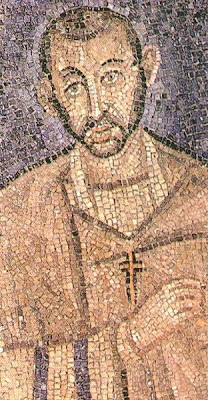
Ambrose was born into a Roman Christian family about 330 and was raised in Trier.  His father was Aurelius Ambrosius, the praetorian prefect of Gaul; his mother was a woman of intellect and piety. Ambrose's siblings, Satyrus (who is the subject of Ambrose's De excessu fratris Satyri) and Marcellina, are also venerated as saints.  There is a legend that as an infant, a swarm of bees settled on his face while he lay in his cradle, leaving behind a drop of honey.  His father considered this a sign of his future eloquence and honeyed tongue. For this reason, bees and beehives often appear in the saint's symbology.

In the late 4th century there was a deep conflict in the diocese of Milan between the Catholics and Arians.   In 374 the bishop of Milan, Auxentius, an Arian, died, and the Arians challenged the succession. Ambrose went to the church where the election was to take place, to prevent an uproar, which was probable in this crisis. His address was interrupted by a call "Ambrose, bishop!", which was taken up by the whole assembly.

In 385 Ambrose, backed by Milan's populace, refused Valentinian II's imperial request to hand over the Portian basilica for the use of Arian troops. In 386 Justina and Valentinian received the Arian bishop Auxentius, and Ambrose was again ordered to hand over a church in Milan for Arian usage.
Ambrose and his congregation barricaded themselves inside the church, and the imperial order was rescinded. 
Theodosius I, the emperor of the East, espoused the cause of Justina, and regained the kingdom. Theodosius was threatened with excommunication by Ambrose for the massacre of 7,000 persons at Thessalonica in 390, after the murder of the Roman governor there by rioters.   Ambrose told Theodosius to imitate David in his repentance as he had imitated him in guilt — Ambrose readmitted the emperor to the Eucharist only after several months of penance . This incident shows the strong position of a bishop in the Western part of the empire, even when facing a strong emperor — the controversy of John Chrysostom with a much weaker emperor a few years later in Constantinople led to a crushing defeat of the bishop.
 Ambrose was known to be Catholic in belief, but also acceptable to Arians due to the charity shown in theological matters in this regard. At first he energetically refused the office, for which he was in no way prepared: Ambrose was neither baptized nor formally trained in theology.  Upon his appointment, St. Ambrose fled to a colleague's home seeking to hide. Upon receiving a letter from the Emperor Gratian praising the appropriateness of Rome appointing individuals evidently worthy of holy positions, St. Ambrose's host gave Ambrose up.   Within a week, Ambrose was baptized, ordained and duly consecrated bishop of Milan.
 As bishop, he immediately adopted an ascetic lifestyle, apportioned his money to the poor, donating all of his land, making only provision for his sister Marcellina (who later became a nun), and committed the care of his family to his brother.  Ambrose also wrote a treatise by the name of "The Goodness Of Death".
According to legend, Ambrose immediately and forcefully stopped Arianism in Milan. He studied theology with Simplician, a presbyter of Rome. Using his excellent knowledge of Greek, which was then rare in the West, to his advantage, he studied the Hebrew Bible and Greek authors like Philo, Origen, Athanasius, and Basil of Caesarea, with whom he was also exchanging letters.   He applied this knowledge as preacher, concentrating especially on exegesis of the Old Testament, and his rhetorical abilities impressed Augustine of Hippo, who hitherto had thought poorly of Christian preachers.

Ambrose ranks with Augustine, Jerome, and Gregory the Great, as one of the Latin Doctors of the Church. Theologians compare him with Hilary, who they claim fell short of Ambrose's administrative excellence but demonstrated greater theological ability. He succeeded as a theologian despite his juridical training and his comparatively late handling of Biblical and doctrinal subjects. His spiritual successor, Augustine, whose conversion was helped by Ambrose's sermons, owes more to him than to any writer except Paul.

Death and legacy

 Soon after acquiring the undisputed possession of the Roman empire, Theodosius died at Milan in 395, and two years later (April 4, 397) Ambrose also died. He was succeeded as bishop of Milan by Simplician. Ambrose's body may still be viewed in the church of S. Ambrogio in Milan, where it has been continuously venerated — along with the bodies identified in his time as being those of Sts. Gervase and Protase — and is one of the oldest extant bodies of historical personages known outside Egypt.
The body of  St. Ambrose (with white vestments) in the crypt of Sant'Ambrogio basilica

Excerpts taken from --- http://en.wikipedia.org/wiki/Ambrose

Thursday, 19 July 2012

Writings of St. Athanasius


Writings from St. Athanasius, bishop
From a Discourse Against the Pagans

All creation was made through Jesus Christ, the first born of all creation
 
The Word of the Father gives order, direction and unity to creation
             
             By his own wisdom and Word, who is our Lord and Savior Christ, the all-holy Father (whose excellence far exceeds that of any creature), like a skillful steersman guides to safety all creation, regulating and keeping it in being, as he judges right.  It is right that creation should exist as he has made it and as we see it happening, because this is his will, which no one would deny.  For it the movement of the universe were irrational, and the world rolled on in random fashion, one would be justified in disbelieving what we say.  But if the world is founded on reason, wisdom and science, and is filled with orderly beauty, then it must owe its origin and order to none other than the Word of God.
 
            He is God, the living and creative God of the universe, the Word of the good God, who is God in his own right.  The Word is different from all created things; he is the unique Word belonging only to the good Father.  This is the Word that created this whole world and enlightens it by his loving wisdom.  He who is the good Word of the good Father produced the order in all creation, joining opposites together, and forming from them one harmonious sound.  He is God, on and only-begotten, who proceeds in goodness from the Father as from the fountain of goodness, and gives order, direction and unity to creation.

            By his eternal Word the Father created all things and implanted a nature in his creatures.  He did not want to see them tossed about at the mercy of their own natures, and so be reduced to nothingness.  But in his goodness he governs and sustains the whole of nature by his Word (who is himself also God), so that under the guidance, providence and ordering of that Word, the whole of nature might remain stable and coherent in his light.  Nature was to share in the Father’s Word, whose reality is true, and be helped by him to exist, for without him it would cease to be.  For unless the Word, who is the very image of the invisible God, the firstborn of all creation, kept it in existence it could not exist.  For whatever exists, whether visible or invisible, remains in existence through him and in him, and he is also the head of the Church, as we are taught by the ministers of truth in their sacred writings.

            The almighty and most holy Word of the Father pervades the whole of reality, everywhere unfolding his power and shining on all things visible and invisible.  He sustains it all and binds it together in himself.  He leaves nothing devoid of his power but gives life and keeps it in being throughout all of creation and in each individual creature.

Taken from The Liturgy of the Hours, Catholic Book Publishing Corporation, 1975