Ad

Showing posts with label St. Ambrose of Milan. Show all posts

Friday, 8 July 2016

Christ gave us His REAL BODY AND BLOOD to eat.

Aurelius Ambrosius,
better known in English
as Saint Ambrose
From the treatise 
On the Mysteries 

by Saint Ambrose, 
bishop 337 AD – 397AD

To the newly baptized on the Eucharist

Fresh from the waters and resplendent in these garments, God’s holy people hasten to the altar of Christ saying: I will go in to the altar of God, to God who gives joy to my youth.  

They have sloughed off the old skin of error, their youth renewed like an eagle’s, and they make haste to approach that heavenly banquet.  They come and, seeing the sacred altar prepared, cry out:  You have prepared a table in my sight.  

David puts these words into their mouths: The Lord is my shepherd and nothing will be lacking to me. He has set me down there in a place of pasture.  He has brought me beside refreshing water.  Further on, we read:  For he has set me beside refreshing water.  Further on, we read: For though I should walk in the midst of the shadow of death, I shall not be afraid of evils, for you are with me.  Your rod and your staff have given me comfort.  You have prepared in my sight a table against those who afflict me.  You have made my head rich in oil, and your cup, which exhilarates, how excellent it is.

It is wonderful that God rained manna on our fathers and they were fed with daily food from heaven.  And so it is written: Man ate the bread of angels.  Yet those who ate that bread all died in the desert.

But the food that you receive, 
that living bread which came down from heaven, 

supplies the very substance of eternal life, 
and whoever will eat it will never die, 

for it is the Body of Christ.

The REALITY of the True Presence of Christ in the Eucharist

Consider now which is the more excellent: the bread of angels or the flesh of Christ, which is indeed that body that gives life.  

The first was manna from heaven, the second is above the heavens.  One was of heaven, the other is of the Lord of the heavens; one subject to corruption if it was kept till the morrow, the other free from all corruption, 

for if anyone tastes of it with reverence 
he will be incapable of corruption. 
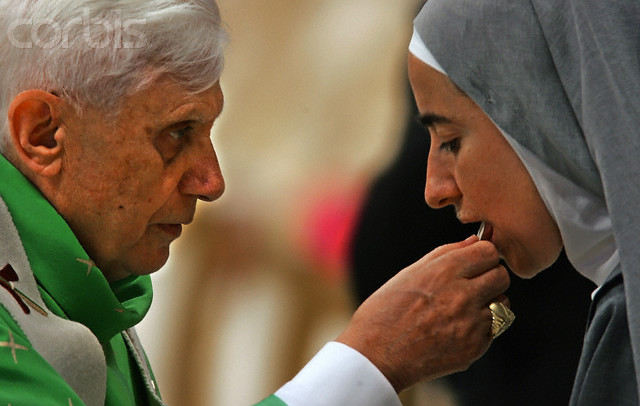
Communion taken with reverence

For our fathers, water flowed from the rock; for you, blood flows from Christ.  Water satisfied their thirst for a time; blood cleanses you for ever.  The Jew drinks and still thirsts, but when you drink you will be incapable of thirst.  

What happened in symbol 
is now fulfilled in reality.


If what we marvel at is a shadow, how great is the reality whose very shadow you marvel at.  

Listen to this, which shows that what happened in the time of our fathers was but a shadow.  They drank, it is written, from the rock that followed them, and the rock was Christ.  All this took place as a symbol for us.  

You know now what is more excellent: 

LIGHT is preferable to its shadow, 
REALITY to its symbol, 

the BODY OF THE GIVER
 to the manna 
He gave them from heaven.

Friday, 20 July 2012

The Story of St. Ambrose of Milan


Life of St. Ambrose of Milan

“If you demand my person, I am ready to submit: carry me to prison or to death, I will not resist; but I will never betray the church of Christ. I will not call upon the people to succour me; I will die at the foot of the altar rather than desert it. The tumult of the people I will not encourage: but God alone can appease it.” Ambrose, 385

Ambrose was born into a Roman Christian family about 330 and was raised in Trier.  His father was Aurelius Ambrosius, the praetorian prefect of Gaul; his mother was a woman of intellect and piety. Ambrose's siblings, Satyrus (who is the subject of Ambrose's De excessu fratris Satyri) and Marcellina, are also venerated as saints.  There is a legend that as an infant, a swarm of bees settled on his face while he lay in his cradle, leaving behind a drop of honey.  His father considered this a sign of his future eloquence and honeyed tongue. For this reason, bees and beehives often appear in the saint's symbology.

In the late 4th century there was a deep conflict in the diocese of Milan between the Catholics and Arians.   In 374 the bishop of Milan, Auxentius, an Arian, died, and the Arians challenged the succession. Ambrose went to the church where the election was to take place, to prevent an uproar, which was probable in this crisis. His address was interrupted by a call "Ambrose, bishop!", which was taken up by the whole assembly.

In 385 Ambrose, backed by Milan's populace, refused Valentinian II's imperial request to hand over the Portian basilica for the use of Arian troops. In 386 Justina and Valentinian received the Arian bishop Auxentius, and Ambrose was again ordered to hand over a church in Milan for Arian usage.
Ambrose and his congregation barricaded themselves inside the church, and the imperial order was rescinded. 
Theodosius I, the emperor of the East, espoused the cause of Justina, and regained the kingdom. Theodosius was threatened with excommunication by Ambrose for the massacre of 7,000 persons at Thessalonica in 390, after the murder of the Roman governor there by rioters.   Ambrose told Theodosius to imitate David in his repentance as he had imitated him in guilt — Ambrose readmitted the emperor to the Eucharist only after several months of penance . This incident shows the strong position of a bishop in the Western part of the empire, even when facing a strong emperor — the controversy of John Chrysostom with a much weaker emperor a few years later in Constantinople led to a crushing defeat of the bishop.
 Ambrose was known to be Catholic in belief, but also acceptable to Arians due to the charity shown in theological matters in this regard. At first he energetically refused the office, for which he was in no way prepared: Ambrose was neither baptized nor formally trained in theology.  Upon his appointment, St. Ambrose fled to a colleague's home seeking to hide. Upon receiving a letter from the Emperor Gratian praising the appropriateness of Rome appointing individuals evidently worthy of holy positions, St. Ambrose's host gave Ambrose up.   Within a week, Ambrose was baptized, ordained and duly consecrated bishop of Milan.
 As bishop, he immediately adopted an ascetic lifestyle, apportioned his money to the poor, donating all of his land, making only provision for his sister Marcellina (who later became a nun), and committed the care of his family to his brother.  Ambrose also wrote a treatise by the name of "The Goodness Of Death".
According to legend, Ambrose immediately and forcefully stopped Arianism in Milan. He studied theology with Simplician, a presbyter of Rome. Using his excellent knowledge of Greek, which was then rare in the West, to his advantage, he studied the Hebrew Bible and Greek authors like Philo, Origen, Athanasius, and Basil of Caesarea, with whom he was also exchanging letters.   He applied this knowledge as preacher, concentrating especially on exegesis of the Old Testament, and his rhetorical abilities impressed Augustine of Hippo, who hitherto had thought poorly of Christian preachers.

Ambrose ranks with Augustine, Jerome, and Gregory the Great, as one of the Latin Doctors of the Church. Theologians compare him with Hilary, who they claim fell short of Ambrose's administrative excellence but demonstrated greater theological ability. He succeeded as a theologian despite his juridical training and his comparatively late handling of Biblical and doctrinal subjects. His spiritual successor, Augustine, whose conversion was helped by Ambrose's sermons, owes more to him than to any writer except Paul.

Death and legacy

 Soon after acquiring the undisputed possession of the Roman empire, Theodosius died at Milan in 395, and two years later (April 4, 397) Ambrose also died. He was succeeded as bishop of Milan by Simplician. Ambrose's body may still be viewed in the church of S. Ambrogio in Milan, where it has been continuously venerated — along with the bodies identified in his time as being those of Sts. Gervase and Protase — and is one of the oldest extant bodies of historical personages known outside Egypt.
The body of  St. Ambrose (with white vestments) in the crypt of Sant'Ambrogio basilica

Excerpts taken from --- http://en.wikipedia.org/wiki/Ambrose