Ad

Showing posts with label Doctor of the Church. Show all posts

Saturday, 22 April 2017

Early Church Father on the Eucharist

The Last Supper the Institution of the Holy Eucharist


The Bread of Heaven

and the Cup of Salvation

St. Cyril of Jerusalem 313-386 A.D.
Early Church Father and Doctor of the Church

From the Jerusalem Catecheses


On the night He was betrayed our Lord Jesus Christ took bread, and when He had given thanks, He broke it and gave it to His disciples and said: “Take, eat: this is my body.”  He took the cup, gave thanks and said: “Take drink: this is my blood.” 

Since Christ Himself has declared the bread to be His body, who can have any further doubt?  

Since He Himself has said quite categorically, This is my blood, who would dare to question it and say that it is not His blood?

Therefore, it is with complete assurance that we receive the bread and wine as the body and blood of Christ.  His body is given to us under the symbol of bread, and his blood is given to us under the symbol of wine, in order to make us by receiving them one body and blood with Him.   Having His body and blood in our members, we become bearers of Christ and sharers, as Saint Peter says, in the divine nature.
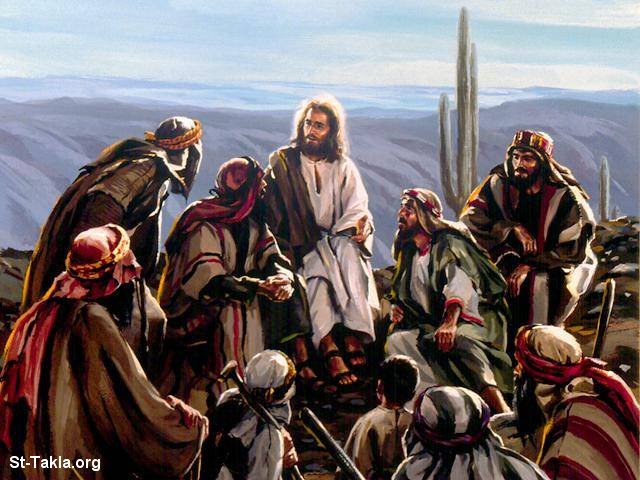
Christ speaking to His Disciples
Once, when speaking to the Jews, Christ said: 

Unless you eat my flesh and drink my blood you shall have no life in you. 

This horrified them and they left Him.  Not understanding His words in a spiritual way, they thought the Savior wished them to practice cannibalism.

Under the old covenant there was showbread, but it came to an end with the old dispensation to which it belonged.  Under the new covenant there is bread from heaven and the cup of salvation.  These sanctify both soul and body, the bread being adapted to the sanctification of the body, the Word, to the sanctification of the soul.

Do not, then, regard the Eucharistic elements as ordinary bread and wine: they are in fact the body and blood of the Lord, as He Himself has declared.  Whatever your senses may tell you, be strong in faith.

You have been taught and you are firmly convinced that what looks and tastes like bread and wine is not bread and wine but the body and the blood of Christ.  You know also how David referred to this long ago when he sang: Bread gives strength to man’s heart and makes his face shine with the oil of gladness.  Strengthen your heart, then, by receiving this bread as spiritual bread, and bring joy to the face of your soul.
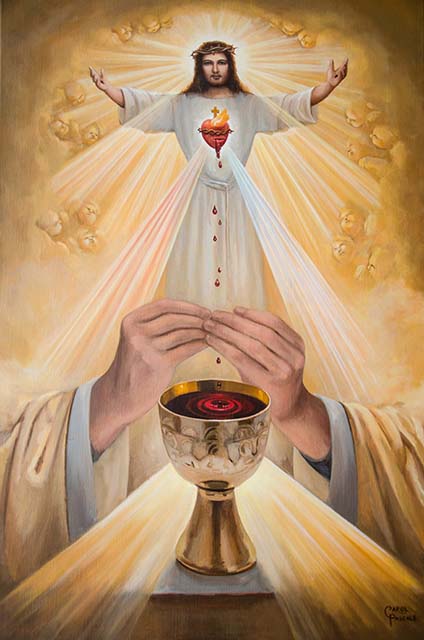
Christ's Body & Blood Present in the Eucharist


May purity of conscience 
remove the veil 
from the face of your soul 
so that by contemplating 
the glory of the Lord, 

as in a mirror, 
you may be transformed 
from glory to glory 
in Christ Jesus our Lord.  

To Him be glory 
forever and ever. 

Amen.


Taken from the Liturgy of the Hours, Saturday within the Octave of Easter


Read more from the Jerusalem Catecheses 

Thursday, 21 July 2016

Announce the Good News to everyone!


St. Lawrence of Brindisi, Priest and Doctor
Preaching 
is an 
Apostolic Duty

From a sermon by 
Saint Lawrence of Brindisi, priest
                                   1559 - 1619
Feast Day July 21

There is a spiritual life that we share with the angels of heaven and with the divine spirits, for like them we have been formed in the image and likeness of God.  The bread that is necessary for living this life is the grace of the Holy Spirit and the love of God.  But grace and love are nothing without faith, since without faith is impossible to please God.  And faith is not conceived unless the word of God is preached.  

Faith comes from hearing, 
and what is heard is the word of Christ.  

The preaching of the word of God, then, is necessary for the spiritual life, just as the planting of seed is necessary for bodily life.

Christ says: The sower went out to so his seed.  The sower goes out as a herald of justice.  On some occasions we read that the herald was God, for example, when with the living voice from heaven he gave the law of justice to a whole people in the desert. 

On other occasions, the herald was an angel of the Lord, as when he accused the people of transgressing the divine law at Bochim, in the place of weeping.  At this all the sons of Israel, when they heard the angel’s address, became sorrowful in their hearts, lifted up their voices, and wept bitterly.  Then again, Moses preached the law of the Lord to the whole people on the plains of Moab, as we read in Deuteronomy.  Finally, Christ came as God and man to preach the word of the Lord, and for the same purpose he sent the apostles, just as he had sent the prophets before them.

Preaching, therefore, is a duty that is apostolic, angelic, Christian, divine.  The word of God is replete with manifold blessings, since it is, so to speak, a treasure of all goods.  It is the source of faith, hope, charity, all virtues, all the gifts of the Holy Spirit, all the beatitudes of the Gospel, all good works, all the rewards of life, all the glory of paradise: 

Welcome the word that has taken root in you, 
with its power to save you.


For the word of God is a light to the mind and a fire to the will.  It enables man to know God and to love him.  And for the interior man who lives by the Spirit of God through grace, it is bread and water, but a bread sweeter than honey and the honeycomb, a water better than wine and milk.  

For the soul it is a spiritual treasure of merits 
yielding as abundance of gold and precious stones.  

Against the hardness of a heart that 
persists in wrongdoing, 
it acts as a hammer.  

Against the world, 
the flesh and the devil 
it serves as a sword that destroys all sin.


Homily About Saint Lawrence Of Brindisi By Father Elias, Franciscan


Detailed Life of the Saint see this website 


Tuesday, 18 August 2015

Catholic Mass -- St. Alphonsus Liguori


St. Alphonsus Liguori


Bishop, Doctor of the Church, and the founder of the Redemptorist Congregation. He was born Alphonsus Marie Antony John Cosmos Damien Michael Gaspard de Liguori on September 27,1696, at Marianella, near Naples, Italy. 

Raised in a pious home, Alphonsus went on retreats with his father, Don Joseph, who was a naval officer and a captain of the Royal Galleys. Alphonsus was the oldest of seven children, raised by a devout mother of Spanish descent. Educated at the University of Naples, Alphonsus received his doctorate at the age of sixteen. By age nineteen he was practicing law, but he saw the transitory nature of the secular world, and after a brief time, retreated from the law courts and his fame. 

Visiting the local Hospital for Incurables on August 28, 1723, he had a vision and was told to consecrate his life solely to God. In response, Alphonsus dedicated himself to the religious life, even while suffering persecution from his family. He finally agreed to become a priest but to live at home as a member of a group of secular missionaries. He was ordained on December 21, 1726, and he spent six years giving missions throughout Naples. 

In April 1729, Alphonsus went to live at the "Chiflese College," founded in Naples by FatherMatthew Ripa, the Apostle of China. There he met Bishop Thomas Falcoia, founder of the Congregation of Pious Workers. This lifelong friendship aided Alphonsus, as did his association with a mystic, SisterMary Celeste. 

With their aid, Aiphonsus founded the Congregation of the Most Holy Redeemer on November 9, 1732. The foundation faced immediate problems, and after just one year, Alphonsus found himself with only one lay brother, his other companions having left to form their own religious group. He started again, recruited new members, and in 1743 became the prior of two new congregations, one for men and one for women. 

Pope Benedict XIV gave his approval for the men's congregation in 1749 and for the women's in 1750. Alphonsus was preaching missions in the rural areas and writing. He refused to become the bishop of Palermo but in 1762 had to accept the papal command to accept the see of St. Agatha of the Goths near Naples. Here he discovered more than thirty thousand uninstructed men and women and four hundred indifferent priests. 

For thirteen years Alphonsus fed the poor, instructed families, reorganized the seminary and religious houses, taught theology, and wrote. His austerities were rigorous, and he suffered daily the pain from rheumatism that was beginning to deform his body. 

He spent several years having to drink from tubes because his head was so bent forward. An attack of rheumatic fever, from May 1768 to June 1769, left him paralyzed. He was not allowed to resign his see, however, until 1775.

In 1780, Alphonsus was tricked into signing a submission for royal approval of his congregation. This submission altered the original rule, and as a result Alphonsus was denied any authority among the Redemptorists. Deposed and excluded from his own congregation, Alphonsus suffered great anguish. 

But he overcame his depression, and he experienced visions, performed miracles, and gave prophecies. He died peacefully on August 1,1787, at Nocera di Pagani, near Naples as the Angelus was ringing. 

He wasbeatified in 1816 and canonized in 1839. In 1871, Alphonsus was declared a Doctor of the Church by Pope Pius IX. His writings on moral, theological, and ascetic matters had great impact and have survived through the years, especially his Moral Theology and his Glories of Mary. 

He was buried at the monastery of the Pagani near Naples. Shrines were built there and at St. Agatha of the Goths. 

He is the patron of confessors, moral theologians, and the lay apostolate. In liturgical art he is depicted as bent over with rheumatism or as a young priest.


http://www.catholic.org/saints/saint.php?saint_id=1284

Friday, 20 July 2012

The Story of St. Ambrose of Milan


Life of St. Ambrose of Milan

“If you demand my person, I am ready to submit: carry me to prison or to death, I will not resist; but I will never betray the church of Christ. I will not call upon the people to succour me; I will die at the foot of the altar rather than desert it. The tumult of the people I will not encourage: but God alone can appease it.” Ambrose, 385

Ambrose was born into a Roman Christian family about 330 and was raised in Trier.  His father was Aurelius Ambrosius, the praetorian prefect of Gaul; his mother was a woman of intellect and piety. Ambrose's siblings, Satyrus (who is the subject of Ambrose's De excessu fratris Satyri) and Marcellina, are also venerated as saints.  There is a legend that as an infant, a swarm of bees settled on his face while he lay in his cradle, leaving behind a drop of honey.  His father considered this a sign of his future eloquence and honeyed tongue. For this reason, bees and beehives often appear in the saint's symbology.

In the late 4th century there was a deep conflict in the diocese of Milan between the Catholics and Arians.   In 374 the bishop of Milan, Auxentius, an Arian, died, and the Arians challenged the succession. Ambrose went to the church where the election was to take place, to prevent an uproar, which was probable in this crisis. His address was interrupted by a call "Ambrose, bishop!", which was taken up by the whole assembly.

In 385 Ambrose, backed by Milan's populace, refused Valentinian II's imperial request to hand over the Portian basilica for the use of Arian troops. In 386 Justina and Valentinian received the Arian bishop Auxentius, and Ambrose was again ordered to hand over a church in Milan for Arian usage.
Ambrose and his congregation barricaded themselves inside the church, and the imperial order was rescinded. 
Theodosius I, the emperor of the East, espoused the cause of Justina, and regained the kingdom. Theodosius was threatened with excommunication by Ambrose for the massacre of 7,000 persons at Thessalonica in 390, after the murder of the Roman governor there by rioters.   Ambrose told Theodosius to imitate David in his repentance as he had imitated him in guilt — Ambrose readmitted the emperor to the Eucharist only after several months of penance . This incident shows the strong position of a bishop in the Western part of the empire, even when facing a strong emperor — the controversy of John Chrysostom with a much weaker emperor a few years later in Constantinople led to a crushing defeat of the bishop.
 Ambrose was known to be Catholic in belief, but also acceptable to Arians due to the charity shown in theological matters in this regard. At first he energetically refused the office, for which he was in no way prepared: Ambrose was neither baptized nor formally trained in theology.  Upon his appointment, St. Ambrose fled to a colleague's home seeking to hide. Upon receiving a letter from the Emperor Gratian praising the appropriateness of Rome appointing individuals evidently worthy of holy positions, St. Ambrose's host gave Ambrose up.   Within a week, Ambrose was baptized, ordained and duly consecrated bishop of Milan.
 As bishop, he immediately adopted an ascetic lifestyle, apportioned his money to the poor, donating all of his land, making only provision for his sister Marcellina (who later became a nun), and committed the care of his family to his brother.  Ambrose also wrote a treatise by the name of "The Goodness Of Death".
According to legend, Ambrose immediately and forcefully stopped Arianism in Milan. He studied theology with Simplician, a presbyter of Rome. Using his excellent knowledge of Greek, which was then rare in the West, to his advantage, he studied the Hebrew Bible and Greek authors like Philo, Origen, Athanasius, and Basil of Caesarea, with whom he was also exchanging letters.   He applied this knowledge as preacher, concentrating especially on exegesis of the Old Testament, and his rhetorical abilities impressed Augustine of Hippo, who hitherto had thought poorly of Christian preachers.

Ambrose ranks with Augustine, Jerome, and Gregory the Great, as one of the Latin Doctors of the Church. Theologians compare him with Hilary, who they claim fell short of Ambrose's administrative excellence but demonstrated greater theological ability. He succeeded as a theologian despite his juridical training and his comparatively late handling of Biblical and doctrinal subjects. His spiritual successor, Augustine, whose conversion was helped by Ambrose's sermons, owes more to him than to any writer except Paul.

Death and legacy

 Soon after acquiring the undisputed possession of the Roman empire, Theodosius died at Milan in 395, and two years later (April 4, 397) Ambrose also died. He was succeeded as bishop of Milan by Simplician. Ambrose's body may still be viewed in the church of S. Ambrogio in Milan, where it has been continuously venerated — along with the bodies identified in his time as being those of Sts. Gervase and Protase — and is one of the oldest extant bodies of historical personages known outside Egypt.
The body of  St. Ambrose (with white vestments) in the crypt of Sant'Ambrogio basilica

Excerpts taken from --- http://en.wikipedia.org/wiki/Ambrose

Friday, 22 June 2012

Writings from Saint Hilary On the Trinity


St. Hilary, Bishop and Doctor of the Church
Saint Hilary, Bishop and Doctor

From a sermon On the Trinity by Saint Hilary, bishop

May I serve you by making you known

               I am aware, almighty God and Father, that in my life I owe you a most particular duty.  It is to make my every thought and word speak of you.
                In fact, you have conferred on me this gift of speech, and it can yield no greater retrun than to be at your service.  It is for making you known as Father, the Father of the only-begotten God, and preaching this to the world that knows you not and to the heretics who refuse to believe in you.
                In this matter of declaration of my intention is only of limited value.  For the rest, I need to pray for the gift of your help and your mercy.  As we spread our sails of trusing faith and public avowal before you, fill them with the breath of your Spirit, to drive us on as we begin this course of proclaiming your truth.  We have been promised, and he who made the promise is trustworthy:  Ask, and it will be given to you; seek, and you will find; knock, and it will be opened to you.
                Yes, in our poverty we will pray for our needs.  We will study the sayings of your prophets and apostles with unflagging attention, and knock for admittance wherever the gift of understanding is safely kept.  But yours it is, Lord, to grant our petitions, to be present when we seek you and to open when we knock.
                There is an inertia in our nature that makes us dull; and in our attempt to penetrate your truth we are held within the bounds of ignorance by the weakness of our minds.  Yet we do comprehend divine ideas by earnest attention to your teaching and by obedience to the faith which carries us beyond mere human apprehension.
                So we trust in you to inspire the beginnings of this ambitious venture, to strengthen its progress, and to call us into a partnership in the spirit with the prophets and the apostles.  To that end, may we grasp precisely what they meant to say, taking each word in its real and authentic  sense.  For we are about to say what they already have declared as part of the mystery of revelation: that you are the eternal God, the Father of the eternal, only-begotten God; that you are one and not born from another; and that the Lord Jesus is also one, born of you from all eternity.  We must not proclaim a change in truth regarding the number of gods.  We must not deny that he is begotten of you who are the one God; nor must we assert that he is other than the true God, born of you who are truly God the Father.
                Impart to us, then, the meaning of the words of Scripture and the light to understand it, with reverence for the doctrine and confidence in its truth.  Grant that we may express what we believe.  Through the prophets and apostles we know about you, the one God the Father, and the one Lord Jesus Christ.  May we have the grace, in the face of heretics who deny you, to honor you as God, who is not alone, and to proclaim this as truth.


Taken from the Liturgy of the Hours, According to the Roman Rite, Ordinary Time, Catholic Book Publishing Corp.  New York, 1975

The Life of St. John Chrysostom


Icon of St. John Chrysostom
The Life of St. John Chrysostom

John was born in Antioch in 349 to Greco-Syrian parents. Different scholars describe his mother and his father was a high ranking military officer.  John's father died soon after his birth and he was raised by his mother.
            He was baptised in 368 or 373 and tonsured as a reader (one of the minor orders of the Church). As a result of his mother's influential connections in the city, John began his education under the pagan teacher Libanius. From Libanius, John acquired the skills for a career in rhetoric, as well as a love of the Greek language and literature.
                As he grew older, however, he became more deeply committed to Christianity and went on to study theology under Diodore of Tarsus, founder of the re-constituted School of Antioch. According to the Christian historian Sozomen, Libanius was supposed to have said on his deathbed that John would have been his successor "if the Christians had not taken him from us".
            He lived with extreme asceticism and became a hermit in about 375; he spent the next two years continually standing, scarcely sleeping, and committing the Bible to memory. As a consequence of these practices, his stomach and kidneys were permanently damaged and poor health forced him to return to Antioch.
John was ordained as a deacon in 381 by Saint Meletius of Antioch who was not then in communion with Alexandria and Rome. After the death of Meletius, John separated himself from the followers of Meletius, without joining Paulinus, the rival of Meletius for the bishopric of Antioch, but after the death of Paulinus he was ordained a presbyter (that is, a priest) in 386 by Evagrius, the successor of Paulinus.   He was destined later to bring about reconciliation between Flavian I of Antioch, the successor of Alexandria and Rome, thus bringing those three sees into communion for the first time in nearly seventy years.
            In Antioch, over the course of twelve years, John gained popularity because of the eloquence of his public speaking, especially his insightful expositions of Bible passages and moral teaching. The most valuable of his works from this period are his Homilies on various books of the Bible. He emphasised charitable giving and was concerned with the spiritual and temporal needs of the poor.  He also spoke against abuse of wealth and personal property:

“Do you wish to honour the body of Christ? Do not ignore him when he is naked. Do not pay him homage in the temple clad in silk, only then to neglect him outside where he is cold and ill-clad. He who said: "This is my body" is the same who said: "You saw me hungry and you gave me no food", and "Whatever you did to the least of my brothers you did also to me"... What good is it if the Eucharistic table is overloaded with golden chalices when your brother is dying of hunger? Start by satisfying his hunger and then with what is left you may adorn the altar as well.”

          He became the Archbishop of Constantinople, was an important Early Church Father. He is known for his eloquence in preaching and public speaking, his denunciation of abuse of authority by both ecclesiastical and political leaders, the Divine Liturgy of St. John Chrysostom, and his ascetic sensibilities.   After his death in 407 (or, according to some sources, during his life) he was given the Greek epithet chrysostomos, meaning "golden mouthed" in English, and Anglicized to Chrysostom.

           The Orthodox and Eastern Catholic Churches honor him as a saint and count him among the Three Holy Hierarchs, together with Basil the Great and Gregory Nazianzus. He is recognized by the Eastern Orthodox Church and the Catholic Church as a saint and as a Doctor of the Church. Churches of the Western tradition, including the Roman Catholic Church, some Anglican provinces, and parts of the Lutheran Church, commemorate him on 13 September. Some Lutheran and many Anglican provinces commemorate him on the traditional Eastern feast day of 27 January. The Coptic Orthodox Church of Alexandria also recognizes John Chrysostom as a saint (with feast days on 16 Thout and 17 Hathor).

        John is known in Christianity chiefly as a preacher, theologian and liturgist. Among his homilies, eight directed against Judaizing Christians remain controversial for their impact on the development of Christian antisemitism. ....


Excerpts taken from Wikipedia http://en.wikipedia.org/wiki/John_Chrysostom
Check also  Catholic Encyclopedia