 |
| Risen Christ and the Eucharist |
CHRIST IN THE EUCHARIST
Protestant attacks on the Catholic Church often focus on the
Eucharist. This demonstrates that opponents of the Church—mainly Evangelicals
and Fundamentalists—recognize one of Catholicism’s core doctrines. What’s more,
the attacks show that Fundamentalists are not always literalists. This is seen
in their interpretation of the key biblical passage, chapter six of John’s
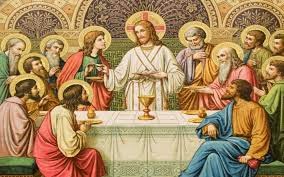
Gospel, in which Christ speaks about the sacrament that will be instituted at
the Last Supper. This tract examines the last half of that chapter.
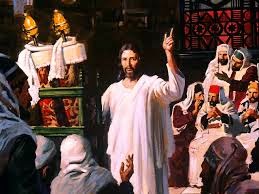
John 6:30 begins a colloquy that took place in the synagogue
at Capernaum. The Jews asked Jesus what sign he could perform so that they
might believe in him. As a challenge, they noted that "our ancestors ate
manna in the desert." Could Jesus top that? He told them the real bread
from heaven comes from the Father. "Give us this bread always," they
said. Jesus replied, "I am the bread of life; whoever comes to me will
never hunger, and whoever believes in me will never thirst." At this point
the Jews understood him to be speaking metaphorically.
.jpg) |
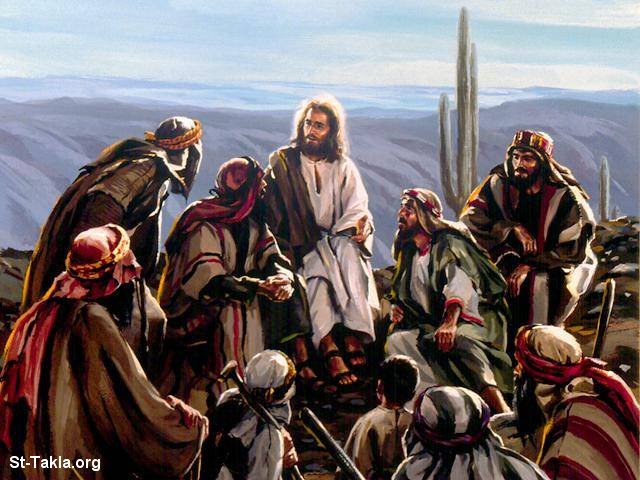
| Christ speaking to the people with authority |
Again and Again
Jesus first repeated what he said, then summarized: "‘I
am the living bread which came down from heaven; if any one eats of this bread,
he will live for ever; and the bread which I shall give for the life of the
world is my flesh.’ The Jews then disputed among themselves, saying, ‘How can
this man give us his flesh to eat?’" (John 6:51–52).
His listeners were stupefied because now they understood
Jesus literally—and correctly. He again repeated his words, but with even
greater emphasis, and introduced the statement about drinking his blood:
"Truly, truly, I say to you, unless you eat the flesh of the Son of man
and drink his blood, you have no life in you; he who eats my flesh and drinks
my blood has eternal life, and I will raise him up at the last day. For my
flesh is food indeed, and my blood is drink indeed. He who eats my flesh and
drinks my blood abides in me, and I in him" (John 6:53–56).
No Corrections
 |
| people listening to Jesus |
Notice that Jesus made no attempt to soften what he said, no
attempt to correct "misunderstandings," for there were none. Our
Lord’s listeners understood him perfectly well. They no longer thought he was
speaking metaphorically. If they had, if they mistook what he said, why no
correction?
On other occasions when there was confusion, Christ
explained just what he meant (cf. Matt. 16:5–12). Here, where any
misunderstanding would be fatal, there was no effort by Jesus to correct.
Instead, he repeated himself for greater emphasis.
In John 6:60 we read: "Many of his disciples, when they
heard it, said, ‘This is a hard saying; who can listen to it?’" These were
his disciples, people used to his remarkable ways. He warned them not to think
carnally, but spiritually: "It is the Spirit that gives life, the flesh is
of no avail; the words that I have spoken to you are spirit and life"
(John 6:63; cf. 1 Cor. 2:12–14).
 |
| John 6:68 |
But he knew some did not believe. (It is here, in the
rejection of the Eucharist, that Judas fell away; look at John 6:64.)
"After this, many of his disciples drew back and no longer went about with
him" (John 6:66).
This is the only record we have of any of Christ’s followers
forsaking him for purely doctrinal reasons. If it had all been a misunderstanding,
if they erred in taking a metaphor in a literal sense, why didn’t he call them
back and straighten things out? Both the Jews, who were suspicious of him, and
his disciples, who had accepted everything up to this point, would have
remained with him had he said he was speaking only symbolically.
But he did not correct these protesters. Twelve times he
said he was the bread that came down from heaven; four times he said they would
have "to eat my flesh and drink my blood." John 6 was an extended promise
of what would be instituted at the Last Supper—and it was a promise that could
not be more explicit. Or so it would seem to a Catholic. But what do
Fundamentalists say?
.jpg) |
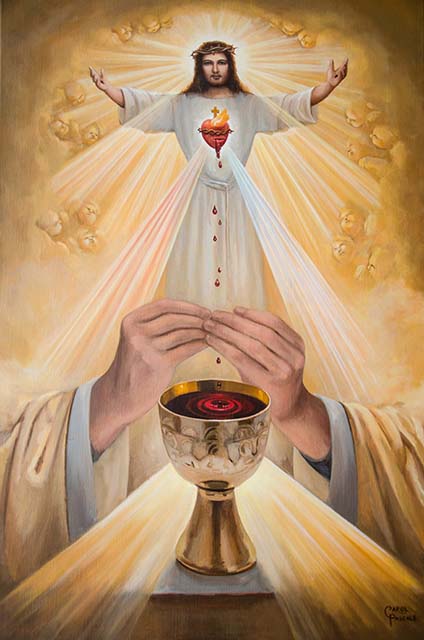
| True Body & Blood of Christ |
They say that in John 6 Jesus was not talking about physical
food and drink, but about spiritual food and drink. They quote John 6:35:
"Jesus said to them, ‘I am the bread of life; he who comes to me shall not
hunger, and he who believes in me shall never thirst.’" They claim that
coming to him is bread, having faith in him is drink. Thus, eating his flesh
and blood merely means believing in Christ.
 |
| True Body & Blood of Christ |
But there is a problem with that interpretation. As Fr. John
A. O’Brien explains, "The phrase ‘to eat the flesh and drink the blood,’
when used figuratively among the Jews, as among the Arabs of today, meant to
inflict upon a person some serious injury, especially by calumny or by false
accusation. To interpret the phrase figuratively then would be to make our Lord
promise life everlasting to the culprit for slandering and hating him, which
would reduce the whole passage to utter nonsense" (O’Brien, The Faith of
Millions, 215). For an example of this use, see Micah 3:3.
Fundamentalist writers who comment on John 6 also assert
that one can show Christ was speaking only metaphorically by comparing verses
like John 10:9 ("I am the door") and John 15:1 ("I am the true
vine"). The problem is that there is not a connection to John 6:35,
"I am the bread of life." "I am the door" and "I am
the vine" make sense as metaphors because Christ is like a door—we go to
heaven through him—and he is also like a vine—we get our spiritual sap through
him. But Christ takes John 6:35 far beyond symbolism by saying, "For my
flesh is food indeed, and my blood is drink indeed" (John 6:55).
He continues: "As the living Father sent me, and I live
because of the Father, so he who eats me will live because of me" (John
6:57). The Greek word used for "eats" (trogon) is very blunt and has
the sense of "chewing" or "gnawing." This is not the language
of metaphor.
Their Main Argument
 |
| Reading scripture |
For Fundamentalist writers, the scriptural argument is
capped by an appeal to John 6:63: "It is the spirit that gives life, the
flesh is of no avail; the words that I have spoken to you are spirit and
life." They say this means that eating real flesh is a waste. But does
this make sense?
Are we to understand that Christ had just commanded his
disciples to eat his flesh, then said their doing so would be pointless? Is
that what "the flesh is of no avail" means? "Eat my flesh, but
you’ll find it’s a waste of time"—is that what he was saying? Hardly.
The fact is that Christ’s flesh avails much! If it were of
no avail, then the Son of God incarnated for no reason, he died for no reason,
and he rose from the dead for no reason. Christ’s flesh profits us more than
anyone else’s in the world. If it profits us nothing, so that the incarnation,
death, and resurrection of Christ are of no avail, then "your faith is
futile and you are still in your sins. Then those also who have fallen asleep
in Christ have perished" (1 Cor. 15:17b–18).
In John 6:63 "flesh profits nothing" refers to
mankind’s inclination to think using only what their natural human reason would
tell them rather than what God would tell them. Thus in John 8:15–16 Jesus
tells his opponents: "You judge according to the flesh, I judge no one.
Yet even if I do judge, my judgment is true, for it is not I alone that judge,
but I and he who sent me." So natural human judgment, unaided by God’s
grace, is unreliable; but God’s judgment is always true.
 |
| The Words I have spoken to you are Spirit & Life |
And were the disciples to understand the line "The
words I have spoken to you are spirit and life" as nothing but a
circumlocution (and a very clumsy one at that) for "symbolic"? No one
can come up with such interpretations unless he first holds to the
Fundamentalist position and thinks it necessary to find a rationale, no matter
how forced, for evading the Catholic interpretation. In John 6:63
"flesh" does not refer to Christ’s own flesh—the context makes this
clear—but to mankind’s inclination to think on a natural, human level. "The
words I have spoken to you are spirit" does not mean "What I have
just said is symbolic." The word "spirit" is never used that way
in the Bible. The line means that what Christ has said will be understood only
through faith; only by the power of the Spirit and the drawing of the Father
(cf. John 6:37, 44–45, 65).
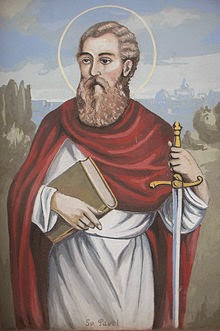 |
| St. Paul |
Paul wrote to the Corinthians: "The cup of blessing
which we bless, is it not a participation in the blood of Christ? The bread
which we break, is it not a participation in the body of Christ?" (1 Cor.
10:16). So when we receive Communion, we actually participate in the body and
blood of Christ, not just eat symbols of them. Paul also said, "Therefore
whoever eats the bread and drinks the cup of the Lord unworthily will have to
answer for the body and blood of the Lord. . . . For any one who eats and
drinks without discerning the body, eats and drinks judgment on himself"
(1 Cor. 11:27, 29). "To answer for the body and blood" of someone
meant to be guilty of a crime as serious as homicide. How could eating mere
bread and wine "unworthily" be so serious? Paul’s comment makes sense
only if the bread and wine became the real body and blood of Christ.
What Did the First Christians Say?
Anti-Catholics also claim the early Church took this chapter
symbolically. Is that so? Let’s see what some early Christians thought, keeping
in mind that we can learn much about how Scripture should be interpreted by
examining the writings of early Christians.
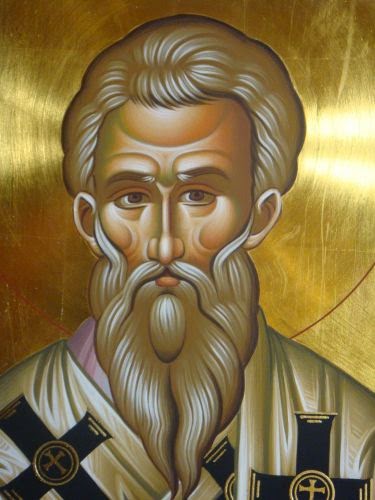 |
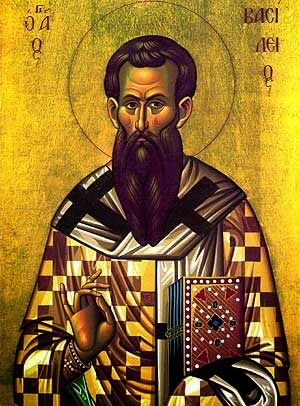
| St. Ignatius of Antioch |
Ignatius of Antioch, who had been a disciple of the apostle
John and who wrote a letter to the Smyrnaeans about A.D. 110, said, referring
to "those who hold heterodox opinions," that "they abstain from
the Eucharist and from prayer, because they do not confess that the Eucharist is
the flesh of our Savior Jesus Christ, flesh which suffered for our sins and
which the Father, in his goodness, raised up again" (6:2, 7:1).
 |
| St. Justin Martyr |
Forty years later, Justin Martyr, wrote, "Not as common
bread or common drink do we receive these; but since Jesus Christ our Savior
was made incarnate by the word of God and had both flesh and blood for our
salvation, so too, as we have been taught, the food which has been made into
the Eucharist by the Eucharistic prayer set down by him, and by the change of
which our blood and flesh is nourished, . . . is both the flesh and the blood
of that incarnated Jesus" (First Apology 66:1–20).
 |
| Origen |
Origen, in a homily written about A.D. 244, attested to
belief in the Real Presence. "I wish to admonish you with examples from
your religion. You are accustomed to take part in the divine mysteries, so you
know how, when you have received the Body of the Lord, you reverently exercise
every care lest a particle of it fall and lest anything of the consecrated gift
perish. You account yourselves guilty, and rightly do you so believe, if any of
it be lost through negligence" (Homilies on Exodus 13:3).
Cyril of Jerusalem, in a catechetical lecture presented in
the mid-300s, said, "Do not, therefore, regard the bread and wine as
simply that, for they are, according to the Master’s declaration, the body and
blood of Christ. Even though the senses suggest to you the other, let faith
make you firm. Do not judge in this matter by taste, but be fully assured by
faith, not doubting that you have been deemed worthy
of the body and blood of Christ" (Catechetical
Discourses: Mystagogic 4:22:9).
 |
| Theodore of Mopsuestia |
In a fifth-century homily, Theodore of Mopsuestia seemed to
be speaking to today’s Evangelicals and Fundamentalists: "When [Christ]
gave the bread he did not say, ‘This is the symbol of my body,’ but, ‘This is
my body.’ In the same way, when he gave the cup of his blood he did not say,
‘This is the symbol of my blood,’ but, ‘This is my blood,’ for he wanted us to
look upon the [Eucharistic elements], after their reception of grace and the
coming of the Holy Spirit, not according to their nature, but to receive them
as they are, the body and blood of our Lord" (Catechetical Homilies 5:1).
 |
| Early Christian worship |
Whatever else might be said, the early Church took John 6
literally. In fact, there is no record from the early centuries that implies
Christians doubted the constant Catholic interpretation. There exists no
document in which the literal interpretation is opposed and only the
metaphorical accepted.
Why do Fundamentalists and Evangelicals reject the plain,
literal interpretation of John 6? For them, Catholic sacraments are out because
they imply a spiritual reality—grace—being conveyed by means of matter. This
seems to them to be a violation of the divine plan. For many Protestants,
matter is not to be used, but overcome or avoided.
One suspects, had they been asked by the Creator their
opinion of how to bring about mankind’s salvation, Fundamentalists would have
advised him to adopt a different approach. How much cleaner things would be if
spirit never dirtied itself with matter! But God approves of matter—he approves
of it because he created it—and he approves of it so much that he comes to us
under the appearances of bread and wine, just as he does in the physical form
of the Incarnate Christ.
NIHIL OBSTAT: I have concluded that the materials
presented in this work are free of doctrinal or moral
errors.
Bernadeane Carr, STL, Censor Librorum, August 10, 2004
IMPRIMATUR: In accord with 1983 CIC 827
permission to publish this work is hereby granted.
+Robert H. Brom, Bishop of San Diego, August 10, 2004
Share on twitterShare
on emailShare on printShare on gmailShare on stumbleuponMore Sharing Services



.jpg)


.jpg)


.jpg)

