Ad

Showing posts with label saints. Show all posts

Friday, 12 May 2017

Writings of St. Augustine -- The Sufferings of Christ


St. Augustine, bishop
From a commentary on the psalms

The sufferings of Christ are not in Christ alone

Jesus Christ is one man with head and body, the Savior of the body and the members of the body, two in one flesh, in one voice, in one passion, and, when wickedness has passed away, in one state of rest.  


The sufferings of Christ are therefore 
not in Christ alone; 
yes, but the sufferings of Christ are only in Christ.

               
If by Christ you mean both head and body, the sufferings of Christ are only in Christ.  But if by Christ you mean only the head, then the sufferings of Christ are not in Christ alone.  For if the sufferings of Christ are in Christ alone, how can the apostle Paul, as a member of Christ, say this: That I may fill up in my flesh what is lacking of the sufferings of Christ?

If then you are among the members of Christ, whatever human being you are, whoever you are that hears this, whoever you are that does not hear this (but if you are among the members of Christ you do hear this), whatever you suffer at the hands of those who are not among the members of Christ was lacking to the sufferings of Christ.

Your sufferings are added because they were lacking.  
You fill up a measure; 
you do not pour something that overflows.  

You suffer as much as needed 
to be added from your sufferings 
to the total suffering of Christ, 
who suffered as our head, and
 suffers in his members, that is, in ourselves.

Each one of us in his own measure 
pays his debt to what may be called 
this commonwealth of ours.  

In proportion to our store of strength we contribute as it were a tax of suffering.  The final reckoning of all suffering will not take place until the world has come to an end.

Do not then imagine, brethren that all the just who suffered persecution at the hands of the wicked, even those who were sent to foretell the coming of the Lord before he came, did not belong to the members of Christ.  God forbid that one who belongs to the city which has Christ for king should not belong to the members of Christ.

In the blood of Abel, the just one, the whole city speaks, and so on until the blood of Zechariah.  From then, it is the same city that goes on speaking in the blood of John (the Baptist), in the blood of the apostles, in the blood of the martyrs, in the blood of Christ’s faithful people.


Taken from the Liturgy of the Hours, According to the Roman Rite, Ordinary Time, Catholic Book Publishing Corp.  New York, 1975

Saturday, 4 March 2017

St. Clement Pope

St/ Clement of Rome
ST CLEMENT, POPE, MARTYR (A.D. 100)

Feast: November 23

St Clement, the son of Faustinus, a Roman by birth, was of Jewish extraction; for he tells us himself that he was of the race of Jacob. He was converted to the faith by St. Peter or St. Paul, and was so constant in his attendance on these apostles, and so active in assisting them in their ministry, that St. Jerome and other fathers call him an apostolic man; St. Clement of Alexandria styles him an apostle; and Rufinus, almost an apostle. Some authors attribute his conversion to St. Peter, whom he met at Cesarea with St. Barnabas; but he attended St. Paul at Philippi in 62, and shared in his sufferings there. We are assured by St. Chrysostom that he was a companion of the latter, with SS. Luke and Timothy, in many of his apostolic journeys, labours, and dangers. St. Paul (Phil. iv, 3) calls him his fellow-labourer, and ranks him among those whose names are written in the book of life; a privilege and matter of joy far beyond the power of commanding devils. (Luke x. 17) St. Clement followed St. Paul to Rome, where he also heard St. Peter preach, and was instructed in his school, as St. Irenaeus and Pope Zosimus testify. Tertullian tells us that St. Peter ordained him bishop, by which some understand that he made him a bishop of nations, to preach the gospel in many countries; others, with Epiphanius, that he made him his vicar at Rome, with an episcopal character to govern that church during his absence in his frequent missions. Others suppose he might at first be made bishop of the Jewish church in that city. After the martyrdom of SS. Peter and Paul, St. Linus was appointed Bishop of Rome, and after eleven years, succeeded by St. Cletus. Upon his demise in 89, or rather in 91, St. Clement was placed in the apostolic chair. According to the Liberian Calendar he sat nine years, eleven months, and twenty days.

At Corinth, an impious and detestable division, as our saint called it, happened amongst the faithful, like that which St. Paul had appeased in the same church; and a party rebelled against holy and irreproachable priests and presumed to depose them. It seems to have been soon after the death of Domitian in 96, that St. Clement, in the name of the church of Rome, wrote to them his excellent epistle, a piece highly extolled and esteemed in the primitive church as an admirable work, as Eusebius calls it. It was placed in rank next to the canonical books of the holy scriptures, and with them read in the churches. Whence it was found in the very ancient Alexandrian manuscript copy of the Bible, which Cyril Lucaris sent to our King James I, from which Patrick Young, the learned keeper of that king's library, published it at Oxford in 1633. St. Clement begins his letter by conciliating the benevolence of those who were at variance, tenderly putting them in mind how edifying their behaviour was when they were all humble-minded, not boasting of anything, desiring rather to be subject than to govern, to give than to receive, content with the portion God had dispensed to them, listening diligently to his word, having an insatiable desire of doing good, and a plentiful effusion of the Holy Ghost upon all of them. At that time they were sincere, without offence, not mindful of injuries, and all sedition and schism was an abomination to them. The saint laments that they had then forsaken the fear of the Lord, and were fallen into pride, envy, strife, and sedition; and pathetically exhorts them to lay aside all pride and anger, for Christ is theirs who are humble and not theirs who exalt themselves. The sceptre of the majesty of God, our Lord Jesus Christ, came not in the show of pride, though he could have done so; but with humility. He bids them look up to the Creator of the world, and think how gentle and patient he is towards his whole creation; also with what peace it all obeys his will, and the heavens, earth, impassable ocean, and worlds beyond it, are governed by the commends of this great master. Considering how near God is to us, and that none of our thoughts are hid from him, how ought we never to do anything contrary to his will, and honour them who are set over us! showing with a sincere affection of meekness, and manifesting the government of our tongues by a love of silence. "Let your children," says the saint, "be bred up in the instruction of the Lord, and learn how great a power humility has with God, how much a pure and holy charity avails with him, and how excellent and great his fear is."


11th-century fresco in the Basilica of San Clemente, Rome: 
Saints Cyril and Methodius bring Saint Clement's relics to Rome
It appears by what follows, that some at Corinth boggled at the belief of a resurrection of the flesh, which the saint beautifully shows to be easy to the Almighty power, and illustrates by the vine which sheds its leaves, then buds, spreads its leaves, flowers, and afterwards produces first sour grapes, then ripe fruit; by the morning rising from night; and corn brought forth from seed. The saint adds a strong exhortation to shake off all sluggishness and laziness, for it is only the good workman who receives the bread of his labour. "We must hasten," says he, "with all earnestness and readiness of mind, to perfect every good work, labouring with cheerfulness; for even the Creator and Lord of all things rejoices in his own works." The latter part of this epistle is a pathetic recommendation of humility, peace, and charity. "Let every one," says the saint, "be subject to another, according to the order in which he is placed by the gift of God. Let not the strong man neglect the care of the weak; let the weak see that he reverence the strong. Let the rich man distribute to the necessity of the poor, and let the poor bless God who give :h him one to supply his want. Let the wise man show forth his wisdom, not in words, but in good works. Let him that is humble, never speak of himself, or make show of his actions. Let him that is pure in the flesh, not grow proud of it, knowing that it was another who gave him the gift of continence. They who are great cannot yet subsist without those that are little; nor the little without the great. In our body, the head without the feet is nothing; neither the feet without the head. And the smallest members of our body are yet both necessary and useful to the whole." Thus the saint teaches that the lowest in the church may be the greatest before God, if they are most faithful in the discharge of their respective duties. St. Clement puts pastors and superiors in mind that, with trembling and humility, they should have nothing but the fear of God in view, and take no pleasure in their own power and authority. "Let us," says he, "pray for all such as fall into any trouble or distress; that being endued with humility and moderation, they may submit, not to us, but to the will of God." Fortunatus, who is mentioned by St. Paul, was come from the church of Corinth to Rome, to inform that holy see of their unhappy schism. St. Clement says, he had dispatched four messengers to Corinth with him, and adds, "Send them back to us again with all speed in peace and joy, that they may the sooner acquaint us with your peace and concord, so much prayed for and desired by us; and that we may rejoice in your good order."

We have a large fragment of a second epistle of St. Clement to the Corinthians, found in the same Alexandrian manuscript of the Bible; from which circumstance it appears to have been also read like the former in many churches, which St. Dionysius of Corinth expressly testifies of that church, though it was not so celebrated among the ancients as the other. In it our saint exhorts the faithful to despise this world and its false enjoyments, and to have those which are promised us always before our eyes; to pursue virtue with all our strength, and its peace will follow us with the inexpressible delights of the promise of what is to come. The necessity of perfectly subduing both the irascible and concupiscible passions of our souls, he lays down as the foundation of a Christian life, in words which St. Clement of Alexandria enforces and illustrates. Besides these letters of St. Clement to the Corinthians, two others have been lately discovered, which are addressed to spiritual eunuchs or virgins. Of these St. Jerome speaks, when he says of certain epistles of St. Clement, "In the epistles which Clement, the successor of the Apostle Peter, wrote to them, that is, to such eunuchs, almost his whole discourse turns upon the excellence of virginity." These two letters were found in a manuscript copy of a Syriac New Testament, by John James Westein, in 1752, and printed by him with a Latin translation at Amsterdam in 1752, and again in 1757. A French translation of them has been published, with short critical notes. These letters are not unworthy this great disciple of St. Peter; and in them the counsels of St. Paul concerning celibacy and virginity are explained, that state is pathetically recommended, without prejudice to the honour due to the holy state of marriage; and the necessity of shunning all familiarity with persons of a different sex, and the like occasions of incontinence is set in a true light.
 
St. Clement celebrating Mass , century unknown
St. Clement with patience and prudence got through the persecution of Domitian. Nerva's peaceable reign being very short, the tempest increased under Trajan, who, even from the beginning of his reign, never allowed the Christian assemblies. It was in the year 100 that the third general persecution was raised by him, which was the more afflicting, as this reign was in other respects generally famed for justice and moderation. Rufin, Pope Zosimus, and the council of Bazas in 452, expressly styles St. Clement a martyr. In the ancient canon of the Roman mass, he is ranked among the martyrs. Eusebius tells us, that St. Clement departed this life in the third year of Trajan, of Christ 100. From this expression some will have it that he died a natural death; but St. Clement says of St. Paul, who certainly died a martyr, that "he departed out of the world."[1] It is also objected, that St. Irenaeus gives the title of martyr only to St. Telesphorus among the popes before St. Eleutherius. But it is certain that some others were martyrs, whatever was the cause of his omission. St. Irenaeus mentions the epistle of St. Clement yet omits those of St. Ignatius, though in some places he quotes him. Shall we hence argue, that St. Ignatius wrote none? When the Emperor Lewis Debonnair founded the great abbey of Cava, in Abruzzo, four miles from Slaerno, in 872, he enriched it with the relics of St. Clement, pope and martyr, which Pope Adrian sent him, as is related at length in the chronicle of that abbey, with a history of many miracles. These relics remain there to this day. The ancient Church of St. Clement in Rome, in which St. Gregory the Great preached several of his homilies, still retains part of his relics. It was repaired by Clement XI, but still shows entire the old structure of Christian churches, divided into three parts: the narthex, the ambo, and the sanctuary.

St. Clement inculcates,[2] that the spirit of Christianity is a spirit of perfect disengagement from the things of this world. "We must," says he, "look upon all the things of this world, as none of ours, and not desire them. This world and that to come are two enemies. We cannot, therefore, be friends to both; but we must resolve which we would forsake, and which we would enjoy. And we think, that it is better to hate the present things, as little, short-lived, and corruptible; and to love those which are to come, which are truly good and incorruptible. Let us contend with all earnestness, knowing that we are now called to the combat. Let us run in the straight road, the race that is incorruptible. This is what Christ saith: keep your bodies pure and your souls without spot, that ye may receive eternal life."


Thursday, 21 July 2016

St. Agnes, Martyr Example for Today's Youth

St. Agnes, Virgin and Martyr

Feastday: January 21

Patron of young girls, chastity, rape survivors, and the Children of Mary

Birth: 291

Death: 304


St. Agnes of Rome was born in 291 AD and raised in a Christian family. Agnes was very beautiful and belonged to a wealthy family. Her hand in marriage was highly sought after, and she had many high ranking men chasing after her. However, Agnes made a promise to God never to stain her purity. Her love for the Lord was great and she hated sin even more than death!

Whenever a man wished to marry Agnes, she would always say, "Jesus Christ is my only Spouse."

According to legend, the young men she turned away became so angry and insulted by her devotion to God and purity that they began to submit her name to authorities as a Christian follower.

In one incident, Procop, the Governor's son, became very angry when she refused him. He tried to win her for his wife with rich gifts and promises, but the beautiful young girl kept saying, "I am already promised to the Lord of the Universe. He is more splendid than the sun and the stars, and He has said He will never leave me!"

In great anger, Procop accused her of being a Christian and brought her to his father, the Governor. The Governor promised Agnes wonderful gifts if she would only deny God, but Agnes refused. He tried to change her mind by putting her in chains, but her lovely face shone with joy.

Next he sent her to a place of sin, but an Angel protected her. At last, she was condemned to death. Even the pagans cried to see such a young and beautiful girl going to death. Yet, Agnes was as happy as a bride on her wedding day. She did not pay attention to those who begged her to save herself. "I would offend my Spouse," she said, "if I were to try to please you. He chose me first and He shall have me!" Then she prayed and bowed her head for the death-stroke of the sword.

St. Agnes hair grew instantly to cover her body
Other accounts of Agnes' life hold the Prefect Sempronius responsible for her martyrdom. It is said he condemned the young girl to be dragged through the streets naked. Some versions of the legend state that Agnes' hair grew instantly to cover her entire body and all the men who attempted to rape the beautiful virgin were immediately struck blind.

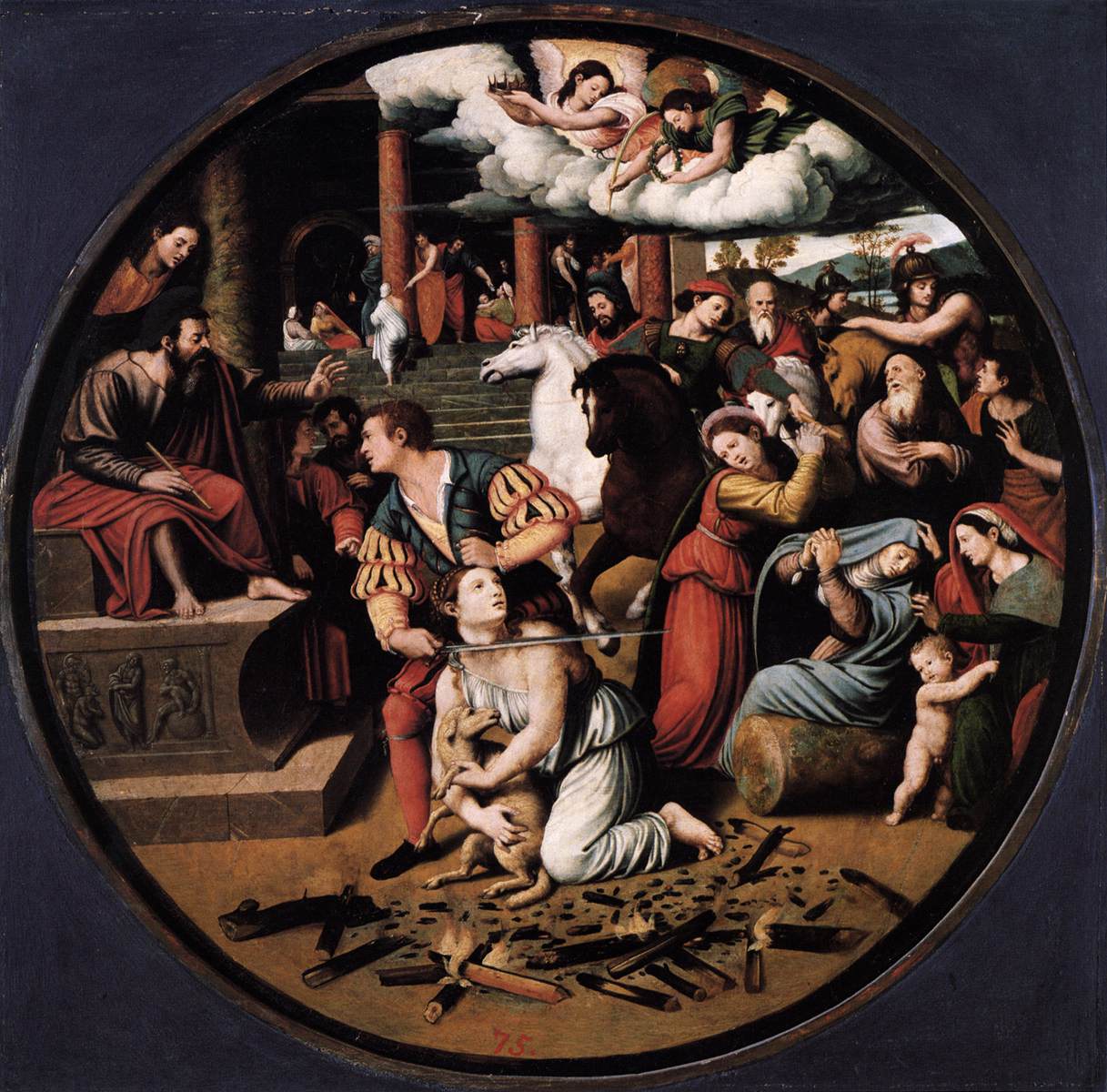
The stories go on to explain that another man presided over Agnes' trial after Sempronius excused himself. The new man sentenced Agnes to death. At first, Agnes was tied to a stake, but either the wood would not burn or the flames parted away from her. This prompted an officer to draw his sword and behead the girl. It is believed that her blood, which poured out to the stadium, was soaked up with cloths by Christians.

She died a virgin-martyr at the age of 12 or 13 on 21 January 304.

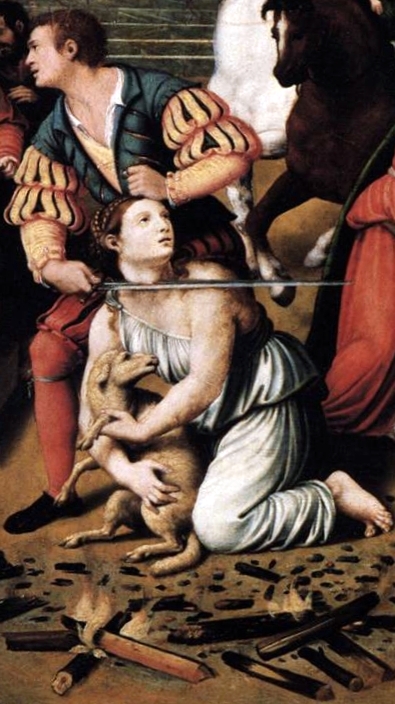
Martyrdom of St. Agnes

Agnes was buried beside the Via Nomentana in Rome. Her bones are currently conserved beneath the high altar in the church of Sant'Angese fuori le mura in Rome, which was built over the catacomb that held her tomb. Her skull is preserved in the church of Sant'Agnese in Agone in Rome's Piazza Navona.

In 1858, Father Caspar Rehrl, an Austrian missionary founded the Congregation of Sisters of St. Agnes.

St. Agnes is widely known as the patron saint of young girls. She is also the patron saint of chastity, rape survivors and the Children of Mary. She is often represented with a lamb, the symbol of her virgin innocence, and a palm branch, like other martyrs. She is shown as a young girl in robes holding a palm branch with the lamb either at her feet or in her arms.

Her feast day is celebrated on January 21. On her feast day, it is customary for two lambs to be brought in to be blessed by the pope. On Holy Thursday the lambs' wool is removed and woven into the pallium the pope gives to a newly consecrated archbishop as a sign of his power and union with the pope.

Above taken from Catholic Online 


YouTube video about St. Agnes

https://youtu.be/5STIRS1FAE8?list=PL58g24NgWPIzvBk2IQVES_xC4WTm6-CDI


St. Agnes, Martyred
Too young to be punished, 
yet old enough 
for a martyr’s crown

From a treatise On Virgins by Saint Ambrose, bishop

Today is the birthday of a virgin; let us imitate her purity  It is the birthday of a martyr; let us offer ourselves in sacrifice.  It is the birthday of Saint Agnes (January 21), who is said to have suffered martyrdom at the age of twelve.  The cruelty that did not spare her youth shows all the more clearly the power of faith in finding one so young to bear it witness.

There was little or no room in that small body for a wound.  Though she could scarcely receive the blow, she could rise superior to it.  Girls of her age cannot bear even their parents’ frowns and, pricked by a needle, weep as for a serious wound.  Yet she shows no fear of the blood stained hands of her executioners.  She stands undaunted by heavy, clanking chains.  She offers her whole body to be put to the sword by fierce soldiers.  She is too young to know of death, yet is ready to face it.  Dragged against her will to the altars, she stretches out her hands to the Lord in the midst of the flames, making the triumphant sign of Christ the victor on the altars of sacrilege.  She puts her neck and hands in iron chains, but no chain can hold fast her tiny limbs.

A new kind of martyrdom!  Too young to be punished, yet old enough for a martyr’s crown; unfitted for the contest, yet effortless in victory, she shows herself a master in valor despite the handicap of youth.  As a bride she would not be hastening to join her husband with the same joy she shows as a virgin on her way to punishment, crowned not with flowers but with holiness of life, adorned not with braided hair but with Christ himself.

In the midst of tears, she sheds no tears herself.  The crowds marvel at her recklessness in throwing away her life untasted, as if she had already lived life to the full.  All are amazed that one not yet of legal age can give her testimony to God.  So she succeeds in convincing others of her testimony about God, though her testimony in human affairs could not yet be accepted.  What is beyond the power of nature, they argue, must come from its creator.

St. Agnes' Martyrdom
What menaces there were from the executioner, to frighten her; what promises made, to win her over; what influential people desired her in marriage!  She answered: “To hope that any other will please me does wrong to my Spouse.  I will be his who first chose me for himself.  Executioner, who do you delay?  If eyes that I do not want can desire this body, then let it perish.”  She stood still, she prayed, she offered her neck.


You should see fear in the eyes of the executioner, as if he were the one condemned; his right hand trembled, his face grew pale as he saw the girl’s peril, while she had no fear herself.  One victim, but a twin martyrdom, to modesty and to religion;  Agnes preserved her virginity, and gained a martyr’s crown.

Pope Damasus adorned her tomb with sacred poetry, and many of the Fathers of the Church, following Saint Ambrose, have honored her in their writings. 
 Taken from the Liturgy of the Hours

Saturday, 15 August 2015

Only the Brave will Survive - Prepare Yourself for the Fight Ahead!

Image result for vortex only brave survive

THE VORTEX—ONLY THE BRAVE WILL SURVIVE

by Michael Voris  •   May 28, 2015  The Vortex 222 COMMENTS
FILED UNDER: DEATHSPIRITUAL WARFARE
TRANSCRIPT
Only heroic Catholics will survive.

In short, in the times that are just ahead for Catholics, only the truly dedicated will not become apostates and thereby lose Heaven. This was the opinion of Fr. John Hardon, a very holy priest who died 15 years ago in Detroit — a man who was remarkable owing to his holiness. What he said has come even sharper into focus in light of the wholesale rejection of the Faith by an overwhelming majority of the Irish last week.

If you are not preparing yourself now, and your family now, bracing yourselves spiritually for the darkness into which civilization is descending, you will not survive. You will inherit Satan for your father. People do not suddenly decide to suffer for the Faith. They prepare themselves to suffer great hardships for the Faith, by undergoing little hardships and sacrifices in advance. You could think of it as a kind of dress rehearsal. Our Blessed Lord Himself said conversely: If you cannot be trusted in small matters, you cannot be trusted in larger ones (Luke 16:10).

Heroes do not miraculously appear. They have the stuff of heroism inside them all along, cultivated and molded and formed, waiting to emerge publicly if and when the correct circumstances arise. In the meantime, they live rather ordinary lives on the outside, perhaps even unaware themselves of the reality that they are heroes in the making.

Such was the course of countless saints — who are, after all, the heroes of the Faith. But not one of them scaled the greater heights of holiness without first mastering the lesser heights. How did they do this? By choosing a life of prayer and sacrifice: prayer to unite themselves to Heaven while still on earth, and sacrifice to unite themselves to Christ suffering. Without the conscious choosing of this route, a person will fall away when the test comes.

We sometimes have this too-nostalgic thought about the age of martyrs in the early centuries. We see the drawings of heroic Catholics standing straight moments before the lions pounced. What we do not see, what is not memorialized in art, is the vast numbers who committed apostasy before the jaws of those same lions, or those in whom the Faith had turned cold. They were more than content to offer incense to the Roman gods.

And they didn't do it necessarily out of hate toward the Church; in all probability, actually, it was just a mild indifference — just enough to get them to officially treat the Church in the same manner in which they had unofficially viewed Her. What the persecution did in them was simply concretize their ambivalence and lack of regard. Some time long before they had lost their love of the truth, but it was the case that circumstances just never prevailed upon them to make a formal announcement — something akin to the husband or wife who long since stopped loving their spouse. He or she plods along, knowing the truth down deep, but not really having any driving reason to deal with it.

And then, suddenly, along comes the lover, the one who ultimately forces the spouse's hand — the one who makes them choose; and they choose to bring into the open what has been the reality all along. And they abandon the marriage. At last, circumstances did prevail upon them — and they chose betrayal, adultery.

This is exactly the same dynamic playing out across the Catholic world right now.

Many lackluster, indifferent Catholics feeling no real love of the Church will abandon Her as soon as the right conditions present themselves. Those conditions are arriving very soon — and very soon, the choice will have to be made. Only the most dedicated, heroic Catholics will choose correctly and be saved — and their number will be very few.

Pray and sacrifice that you and those you love will be among them.

See Michael Voris Video here
http://www.churchmilitant.com/video/episode/the-vortexonly-the-brave-will-survive

Thursday, 24 April 2014

The Passion of Christ - Mary's Own Words


St. Bridget of Sweden
The Revelations of Saint Birgitta, 
Chapter 10:15-33

(Words of Our Holy Mother Mary to St. Birgitta regarding Her Son's Most Bitter Agony & Death)

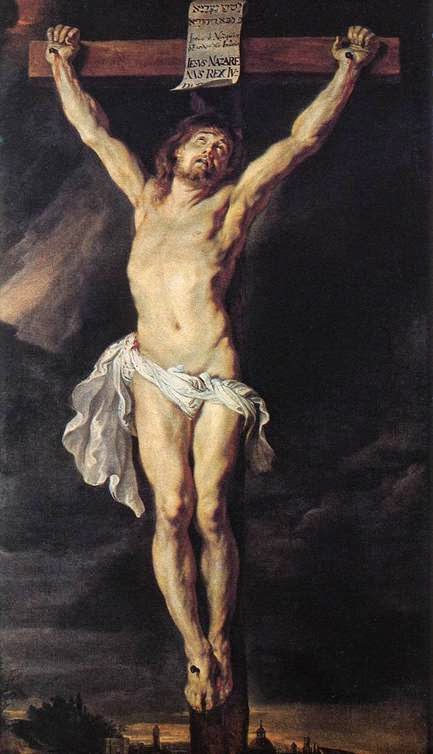
15 When the time of my Son's passion arrived, his enemies seized him. They struck him on his cheek and neck and spat at him as they made sport of him. When he was led to the pillar, he took off his clothes himself and placed his own hands on the pillar, and his enemies then mercilessly bound them. 16 Bound to the pillar, without any kind of covering, just as he had been born, he stood there and suffered the embarrassment of being naked. His friends had fled, but his enemies were ready for action. They stood there on all sides and scourged his body that was clean from every stain and sin. 17 I was standing nearby and, at the first lash, I fell down as if I were dead. When I revived, I could see his body whipped and scourged to the ribs. What was even more horrible was that when they pulled the whips back, the weighted thongs tore his flesh.


Sorrowful Mother Mary
18 As my Son was standing there all bloody and covered with wounds, so that no sound spot was left on him that could be whipped, then someone, aroused in spirit, asked: 'Are you going to kill him thus unsentenced?' And straightaway he cut his bonds. 19 Then my Son himself put his clothes back on. I saw that the place where my Son had been standing was covered with blood, and by his footprints I could tell which way he walked, for the ground seemed to be soaked with blood wherever he went. 20 They had no patience with him to let him get dressed, but pushed and dragged him to hurry him on. As my Son was being led off like a thief, he dried the blood from his eyes. Once he was sentenced, they placed the cross on him to carry. He did carry it for a while, but then someone came along and undertook to carry it for him. 

Instruments of crucifixion
21 As my Son was going to the place of his passion, same people struck him on the neck, while others hit him in the face. He was hit so hard and with so much force that, although I did not see who hit him, I heard the sound of the blow clearly. When I reached the place of the passion with him, I saw all the instruments of his death ready. When my Son got there, he took off his clothes himself, while the servants said to each other: 'These are our clothes and he will not get them back since he is condemned to death.' 

Add caption
22 My Son was standing there, naked as he had been born, when someone came running up and offered him a veil with which he joyfully covered his shame. Then his cruel executioners seized him and stretched him out on the cross, nailing first his right hand to the crossbeam that had a hole in it for the nail. They pierced his hand at the point where the bone was more solid. With a rope they pulled his other hand and attached it to the crossbeam in similar fashion. 

23 Then they crucified his right foot with the left on top of it using two nails so that all his sinews and veins became overstrained and burst. After that they put the crown of thorns on his head and it cut so deeply into my Son's venerable head that the blood filled his eyes as it flowed, blocked up his ears and stained his beard as it ran down.

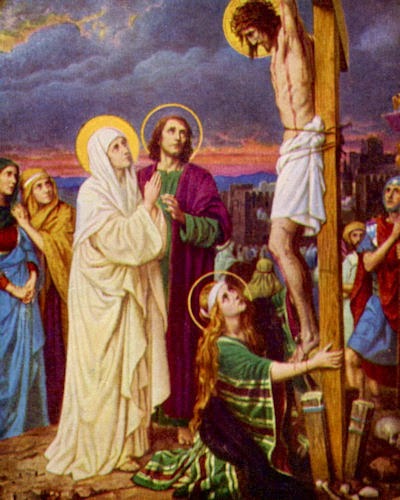
As he stood on the cross wounded and bloody, he felt compassion for me who was standing by in tears and, looking with his bloodied eyes in the direction of John, my nephew, he commended me to him.


24 At the time I could hear some people saying that my Son was a thief, others that he was a liar, still others that no one was more deserving of death than my Son. My sorrow was renewed from hearing all this. But, as I said before, when the first nail was driven into him, that first blow shook me so much that I fell down as if dead, my eyes covered in darkness, my hands trembling, my feet unsteady. In the bitterness of my grief I was not able to watch until he had been fastened entirely to the cross. 

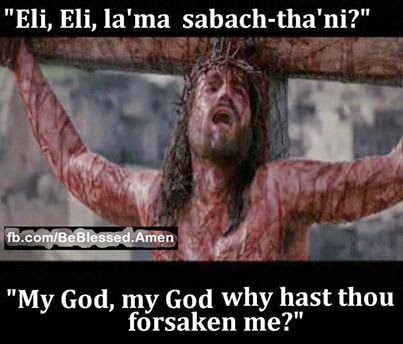
25 When I got up, I saw my Son hanging there in misery and, in my thorough dismay, I his most unhappy Mother, could hardly stand on my feet due to grief. Seeing me and his friends weeping inconsolably, my Son cried out in a loud and doleful voice to his Father, saying, 'Father, why have you abandoned me?' It was as if to say: 'There is no one who takes pity on me but you, Father.' 26 At that stage his eyes looked half-dead, his cheeks were sunken, his face mournful, his mouth open and his tongue bloody. His stomach was sucked in toward his back, all the liquid having been consumed, as if he had no vital organs. All his body was pale and languid due to the loss of blood. His hands and feet were rigidly extended, being pulled toward the cross and shaped like the shape of the cross. His beard and hair were completely covered with blood.


27 There he stood, bruised and livid, and only his heart was still fresh, since it was of the best and strongest constitution. From my flesh he had received a most pure and well-wrought body. 28 His skin was so thin and tender that if it was even slightly scourged the blood would flow out immediately. His blood was so fresh that it could be seen in his pure skin. Precisely because he had the very best constitution, life contended with death in his wounded body. 

29 At certain moments the pain in the limbs and sinews of his wounded body rose up to his still vigorous and unbroken heart and inflicted incredible pain and suffering on him. At other moments the pain went down from his heart into his wounded limbs and, in so doing, bitterly prolonged his death.


30 Surrounded by these sorrows, my Son looked at his friends who were weeping and who would rather have borne his pain themselves through his help or have burned in hell forever than to see him tortured so. His sorrow at his friends' sorrow exceeded all the bitterness and tribulations that he had endured in body and heart, due to the tender love he had for them. Then, out of the exceeding bodily anguish of his human nature, he cried out to the Father: 'Father, into your hands I commend my spirit.' 31 When I his most sorrowful Mother, heard those words, my whole body shook with the bitter pain of my heart. As often as I have thought on that cry since then, it has still remained present and fresh in my ears. As his death drew near and his heart burst from the violence of the pain, his whole body convulsed and his head raised itself a little and then drooped back down again, his mouth fell open and his tongue could be seen to be all bloody. 32 His hands pulled back a little from the place of perforation and his feet had to bear more of the weight of his body. His fingers and arms stretched themselves out somewhat and his back stiffened tightly against the cross.


Jesus's body is pierced with a lance
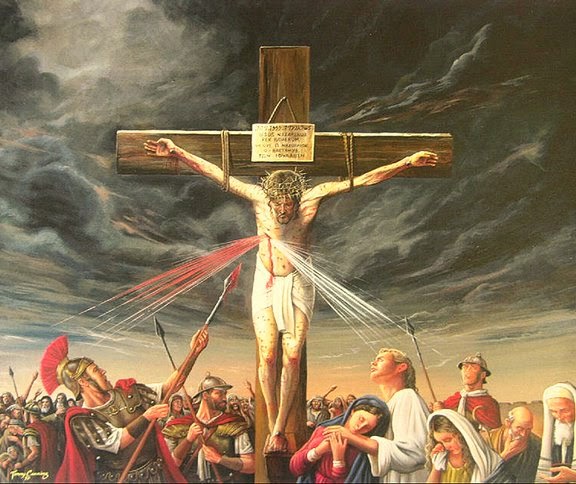
33 Then some people said to me: 'Mary, your Son is dead.' Others said: 'He has died but he will rise again.' As everyone was going away, a man came and drove a lance into his side with such force that it almost went out the other side. When the spear was withdrawn, its point appeared red with blood. And it seemed to me as if my own heart had been pierced when I saw my beloved Son's heart pierced.

34 Then he was taken down from the cross. I took his body on my lap; it was like a leper's, all livid. His eyes were lifeless and full of blood, his mouth as cold as ice, his beard like twine, his face grown stiff. His hands had become so rigid that they could not be bent farther down than to about his naval. I had him on my knee just as he had been on the cross, like a man stiff in all his limbs. 35 After that they laid him in a clean linen and with my linen cloth I dried his wounds and his limbs and then closed his eyes and mouth, which had been opened when he died. 

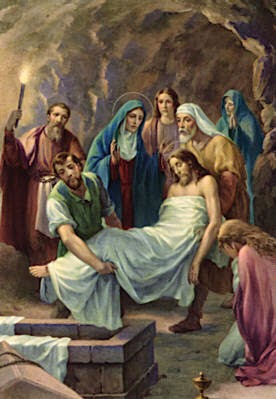
36 Then they placed him in the sepulcher. How I would rather have been placed in there alive with my Son, if it had been his will! 37 These things done, dear John came and brought me to his house. 

See, then, my daughter, [my son]
what my Son has endured for you!


 http://en.wikisource.org/wiki/The_Revelations_of_Saint_Birgitta#Chapter_10_-_On_Mary.27s_Childhood.2C_the_Annunciation.2C_and_Her_Son.27s_Birth_and_Passion