Ad

Showing posts with label Early Church. Show all posts

Saturday, 4 March 2017

St. Clement Pope

St/ Clement of Rome
ST CLEMENT, POPE, MARTYR (A.D. 100)

Feast: November 23

St Clement, the son of Faustinus, a Roman by birth, was of Jewish extraction; for he tells us himself that he was of the race of Jacob. He was converted to the faith by St. Peter or St. Paul, and was so constant in his attendance on these apostles, and so active in assisting them in their ministry, that St. Jerome and other fathers call him an apostolic man; St. Clement of Alexandria styles him an apostle; and Rufinus, almost an apostle. Some authors attribute his conversion to St. Peter, whom he met at Cesarea with St. Barnabas; but he attended St. Paul at Philippi in 62, and shared in his sufferings there. We are assured by St. Chrysostom that he was a companion of the latter, with SS. Luke and Timothy, in many of his apostolic journeys, labours, and dangers. St. Paul (Phil. iv, 3) calls him his fellow-labourer, and ranks him among those whose names are written in the book of life; a privilege and matter of joy far beyond the power of commanding devils. (Luke x. 17) St. Clement followed St. Paul to Rome, where he also heard St. Peter preach, and was instructed in his school, as St. Irenaeus and Pope Zosimus testify. Tertullian tells us that St. Peter ordained him bishop, by which some understand that he made him a bishop of nations, to preach the gospel in many countries; others, with Epiphanius, that he made him his vicar at Rome, with an episcopal character to govern that church during his absence in his frequent missions. Others suppose he might at first be made bishop of the Jewish church in that city. After the martyrdom of SS. Peter and Paul, St. Linus was appointed Bishop of Rome, and after eleven years, succeeded by St. Cletus. Upon his demise in 89, or rather in 91, St. Clement was placed in the apostolic chair. According to the Liberian Calendar he sat nine years, eleven months, and twenty days.

At Corinth, an impious and detestable division, as our saint called it, happened amongst the faithful, like that which St. Paul had appeased in the same church; and a party rebelled against holy and irreproachable priests and presumed to depose them. It seems to have been soon after the death of Domitian in 96, that St. Clement, in the name of the church of Rome, wrote to them his excellent epistle, a piece highly extolled and esteemed in the primitive church as an admirable work, as Eusebius calls it. It was placed in rank next to the canonical books of the holy scriptures, and with them read in the churches. Whence it was found in the very ancient Alexandrian manuscript copy of the Bible, which Cyril Lucaris sent to our King James I, from which Patrick Young, the learned keeper of that king's library, published it at Oxford in 1633. St. Clement begins his letter by conciliating the benevolence of those who were at variance, tenderly putting them in mind how edifying their behaviour was when they were all humble-minded, not boasting of anything, desiring rather to be subject than to govern, to give than to receive, content with the portion God had dispensed to them, listening diligently to his word, having an insatiable desire of doing good, and a plentiful effusion of the Holy Ghost upon all of them. At that time they were sincere, without offence, not mindful of injuries, and all sedition and schism was an abomination to them. The saint laments that they had then forsaken the fear of the Lord, and were fallen into pride, envy, strife, and sedition; and pathetically exhorts them to lay aside all pride and anger, for Christ is theirs who are humble and not theirs who exalt themselves. The sceptre of the majesty of God, our Lord Jesus Christ, came not in the show of pride, though he could have done so; but with humility. He bids them look up to the Creator of the world, and think how gentle and patient he is towards his whole creation; also with what peace it all obeys his will, and the heavens, earth, impassable ocean, and worlds beyond it, are governed by the commends of this great master. Considering how near God is to us, and that none of our thoughts are hid from him, how ought we never to do anything contrary to his will, and honour them who are set over us! showing with a sincere affection of meekness, and manifesting the government of our tongues by a love of silence. "Let your children," says the saint, "be bred up in the instruction of the Lord, and learn how great a power humility has with God, how much a pure and holy charity avails with him, and how excellent and great his fear is."


11th-century fresco in the Basilica of San Clemente, Rome: 
Saints Cyril and Methodius bring Saint Clement's relics to Rome
It appears by what follows, that some at Corinth boggled at the belief of a resurrection of the flesh, which the saint beautifully shows to be easy to the Almighty power, and illustrates by the vine which sheds its leaves, then buds, spreads its leaves, flowers, and afterwards produces first sour grapes, then ripe fruit; by the morning rising from night; and corn brought forth from seed. The saint adds a strong exhortation to shake off all sluggishness and laziness, for it is only the good workman who receives the bread of his labour. "We must hasten," says he, "with all earnestness and readiness of mind, to perfect every good work, labouring with cheerfulness; for even the Creator and Lord of all things rejoices in his own works." The latter part of this epistle is a pathetic recommendation of humility, peace, and charity. "Let every one," says the saint, "be subject to another, according to the order in which he is placed by the gift of God. Let not the strong man neglect the care of the weak; let the weak see that he reverence the strong. Let the rich man distribute to the necessity of the poor, and let the poor bless God who give :h him one to supply his want. Let the wise man show forth his wisdom, not in words, but in good works. Let him that is humble, never speak of himself, or make show of his actions. Let him that is pure in the flesh, not grow proud of it, knowing that it was another who gave him the gift of continence. They who are great cannot yet subsist without those that are little; nor the little without the great. In our body, the head without the feet is nothing; neither the feet without the head. And the smallest members of our body are yet both necessary and useful to the whole." Thus the saint teaches that the lowest in the church may be the greatest before God, if they are most faithful in the discharge of their respective duties. St. Clement puts pastors and superiors in mind that, with trembling and humility, they should have nothing but the fear of God in view, and take no pleasure in their own power and authority. "Let us," says he, "pray for all such as fall into any trouble or distress; that being endued with humility and moderation, they may submit, not to us, but to the will of God." Fortunatus, who is mentioned by St. Paul, was come from the church of Corinth to Rome, to inform that holy see of their unhappy schism. St. Clement says, he had dispatched four messengers to Corinth with him, and adds, "Send them back to us again with all speed in peace and joy, that they may the sooner acquaint us with your peace and concord, so much prayed for and desired by us; and that we may rejoice in your good order."

We have a large fragment of a second epistle of St. Clement to the Corinthians, found in the same Alexandrian manuscript of the Bible; from which circumstance it appears to have been also read like the former in many churches, which St. Dionysius of Corinth expressly testifies of that church, though it was not so celebrated among the ancients as the other. In it our saint exhorts the faithful to despise this world and its false enjoyments, and to have those which are promised us always before our eyes; to pursue virtue with all our strength, and its peace will follow us with the inexpressible delights of the promise of what is to come. The necessity of perfectly subduing both the irascible and concupiscible passions of our souls, he lays down as the foundation of a Christian life, in words which St. Clement of Alexandria enforces and illustrates. Besides these letters of St. Clement to the Corinthians, two others have been lately discovered, which are addressed to spiritual eunuchs or virgins. Of these St. Jerome speaks, when he says of certain epistles of St. Clement, "In the epistles which Clement, the successor of the Apostle Peter, wrote to them, that is, to such eunuchs, almost his whole discourse turns upon the excellence of virginity." These two letters were found in a manuscript copy of a Syriac New Testament, by John James Westein, in 1752, and printed by him with a Latin translation at Amsterdam in 1752, and again in 1757. A French translation of them has been published, with short critical notes. These letters are not unworthy this great disciple of St. Peter; and in them the counsels of St. Paul concerning celibacy and virginity are explained, that state is pathetically recommended, without prejudice to the honour due to the holy state of marriage; and the necessity of shunning all familiarity with persons of a different sex, and the like occasions of incontinence is set in a true light.
 
St. Clement celebrating Mass , century unknown
St. Clement with patience and prudence got through the persecution of Domitian. Nerva's peaceable reign being very short, the tempest increased under Trajan, who, even from the beginning of his reign, never allowed the Christian assemblies. It was in the year 100 that the third general persecution was raised by him, which was the more afflicting, as this reign was in other respects generally famed for justice and moderation. Rufin, Pope Zosimus, and the council of Bazas in 452, expressly styles St. Clement a martyr. In the ancient canon of the Roman mass, he is ranked among the martyrs. Eusebius tells us, that St. Clement departed this life in the third year of Trajan, of Christ 100. From this expression some will have it that he died a natural death; but St. Clement says of St. Paul, who certainly died a martyr, that "he departed out of the world."[1] It is also objected, that St. Irenaeus gives the title of martyr only to St. Telesphorus among the popes before St. Eleutherius. But it is certain that some others were martyrs, whatever was the cause of his omission. St. Irenaeus mentions the epistle of St. Clement yet omits those of St. Ignatius, though in some places he quotes him. Shall we hence argue, that St. Ignatius wrote none? When the Emperor Lewis Debonnair founded the great abbey of Cava, in Abruzzo, four miles from Slaerno, in 872, he enriched it with the relics of St. Clement, pope and martyr, which Pope Adrian sent him, as is related at length in the chronicle of that abbey, with a history of many miracles. These relics remain there to this day. The ancient Church of St. Clement in Rome, in which St. Gregory the Great preached several of his homilies, still retains part of his relics. It was repaired by Clement XI, but still shows entire the old structure of Christian churches, divided into three parts: the narthex, the ambo, and the sanctuary.

St. Clement inculcates,[2] that the spirit of Christianity is a spirit of perfect disengagement from the things of this world. "We must," says he, "look upon all the things of this world, as none of ours, and not desire them. This world and that to come are two enemies. We cannot, therefore, be friends to both; but we must resolve which we would forsake, and which we would enjoy. And we think, that it is better to hate the present things, as little, short-lived, and corruptible; and to love those which are to come, which are truly good and incorruptible. Let us contend with all earnestness, knowing that we are now called to the combat. Let us run in the straight road, the race that is incorruptible. This is what Christ saith: keep your bodies pure and your souls without spot, that ye may receive eternal life."


Thursday, 23 February 2017

Chair of St. Peter Feast Day


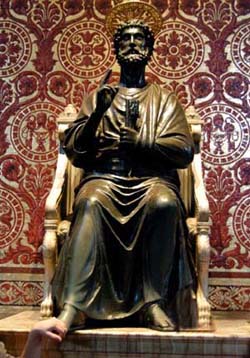
Bronze statue of St. Peter sitting on the Chair of Peter

From the Earliest 
Days of the Church 

a Part of Church History


Chair of St. Peter, Apostle Feast Day
The annual feast of cathedra petri at Rome


From the earliest times the Church at Rome celebrated on 18 January . . .

the memory of the day when the Apostle 
held his first service with the faithful of the Eternal City. 

According to Duchesne and de Rossi, the "Martyrologium Hieronymianum" (Weissenburg manuscript) reads as follows: 

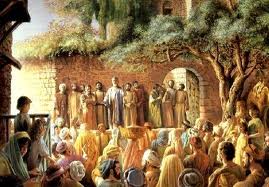
St. Peter teaching

"XV KL. FEBO. Dedicatio cathedræ sci petri apostoli 
qua primo Rome petrus apostolus sedit" 
(fifteenth day before the calends of February, 
the dedication of the Chair of 
St. Peter the Apostle 
in which Peter the Apostle first sat at Rome). 


The Epternach manuscript (Codex Epternacensis) of the same work, says briefly: "cath. petri in roma" (the Chair of Peter in Rome).


In its present (ninth-century) form the "Martyrologium Hieronymianum" gives a second feast of the Chair of St. Peter for 22 February, but all the manuscripts assign it to Antioch, not to Rome. 

Thus the oldest manuscript, that of Berne, says: "VIII kal. mar. cathedræ sci petri apostoli qua sedit apud antiochiam". The Weissenburg manuscript says: "Natl [natale] sci petri apostoli cathedræ qua sedit apud antiocia." 
St. Peter the Apostle

However, the words qua sedit apud antiochiam are seen at once to be a later addition. 

Both feasts are Roman; indeed, that of 22 February was originally the more important. 

This is clear from the Calendar of Philocalus drawn up in the year 354, and going back to the year 311; it makes no mention of the January feast but speaks thus of 22 February: 

"VIII Kl. Martias: natale Petri de cathedra" 
(eighth day before the Calends of March, 
the birthday [i.e. feast] of the Chair of Peter). 

It was not until after the insertion of Antioch in the copies of the "Martyrologium Hieronymianum" that the feast of February gave way in importance to that of January. 

The Roman Church, therefore, at an early date celebrated a first and a second assumption of the episcopal office in Rome by St. Peter. This double celebration was also held in two places, in the Vatican Basilica and in a cemetery (coemeterium) on the Via Salaria. 

At both places a chair (cathedra) was venerated which the Apostle had used as presiding officer of the assembly of the faithful. 

The first of these chairs stood in the Vatican Basilica, in the baptismal chapel built by Pope Damasus; the neophytes in albis (white baptismal robes) were led from the baptistery to the pope seated on this ancient cathedra, and received from him the consignatio, i.e. the Sacrament of Confirmation. 

Reference is made to this custom in an inscription of Damasus which contains the line: "una Petri sedes, unum verumque lavacrum" (one Chair of Peter, one true font of baptism). 

St. Ennodius of Pavia
St. Ennodius of Pavia (d. 521) speaks of it thus ("Libellus pro Synodo", near the end): "Ecce nunc ad gestatoriam sellam apostolicæ confessionis uda mittunt limina candidatos; et uberibus gaudio exactore fletibus collata Dei beneficio dona geminantur" 
(Behold now the neophytes go from the dripping threshold to the portable chair of the Apostolic confession; amid abundant tears called forth by joy the gifts of Divine grace are doubled). 

While therefore in the apse of the Vatican Basilica there stood a cathedra on which the pope sat amid the Roman clergy during the pontifical Mass, there was also in the same building a second cathedra from which the pope administered to the newly baptized the Sacrament of Confirmation. 

The Chair of St. Peter in the apse was made of marble and was built into the wall, that of the baptistery was movable and could be carried. 

Ennodius calls the latter a gestatoria sedes; throughout the Middle Ages it was always brought on 22 February from the above-mentioned consignatorium or place of confirmation to the high altar. 

That day the pope did not use the marble cathedra at the back of the apse but sat on this movable cathedra, which was, consequently, made of wood. 

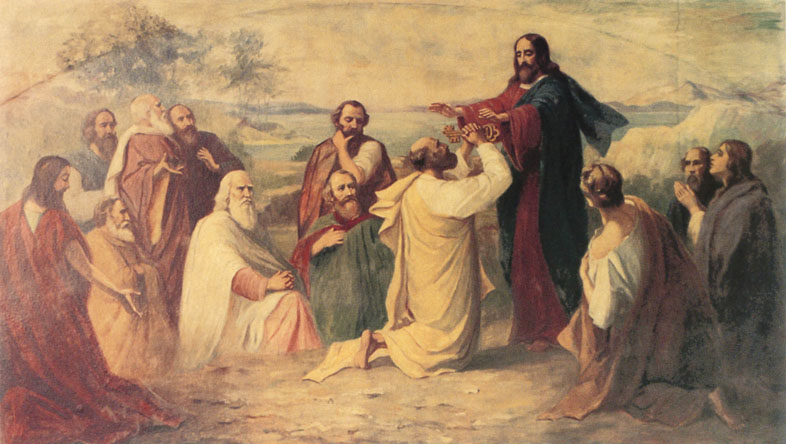
Christ said, Because you have answered thus -Thou art Peter (Cephas) the ROCK on which I will build my Church


The importance of this feast was heightened 
by the fact that 22 February was considered 
the anniversary of the day when Peter bore witness, 
by the Sea of Tiberias, to the Divinity of Christ 
and was again appointed by Christ to be 
the Rock of His Church. 

According to very ancient Western liturgies, 
22 February was the day 
"quo electus est 1. Petrus papa" 
(on which Peter was first chosen pope). 

The Mass of this feast calls it at the beginning: "solemnitatis prædicandæ dies præcipue nobilis in quo . . . . beatus Bar-Jona voce Redemptoris fide devotâ prælatus est et per hanc Petri petram basis ecclesiæ fixus est", i.e. this day is called especially praiseworthy because on it the blessed Bar-Jona, by reason of his devout faith, was raised to pre-eminence by the words of the Redeemer, and through this rock of Peter was established the foundation of the Church. 

And the Oratio (collect) says: "Deus, qui hodiernâ die beatum Petrum post te dedisti caput ecclesiæ, cum te ille vere confessus sit" (O God, who didst this day give us as head of the Church, after Thyself, the Blessed Peter, etc.).

The second of the aforementioned chairs is referred to about 600 by an Abbot Johannes. He had been commissioned by Pope Gregory the Great to collect in special little phials oil from the lamps which burned at the graves of the Roman martyrs for the Lombard queen, Theodolinda. 

According to the manuscript list of these oils preserved in the cathedral treasury of Monza, Italy, one of these vessels had on it the statement: "oleo de sede ubi prius sedit sanctus Petrus" (oils from the chair where St. Peter first sat). 

Other ancient authorities describe the site as "ubi Petrus baptizabat" (where Peter baptized), or "ad fontes sancti Petri; ad Nymphas sancti Petri" (at the fountain of Saint Peter). 

Formerly this site was pointed out in the coemeterium majus (principal cemetery) on the Via Nomentana; it is now certain that it was on the Via Salaria, and was connected with the coemeterium, or cemetery, of Priscilla and the villa of the Acilii (Acilii Glabriones), situated above this catacomb. 

The foundation of this villa, showing masonry of a very early date (opus reticulatum), still exists. Both villa and cemetery, in one of whose burial chambers are several epitaphs of members of the family, or gens, of the Acilii, belong to the Apostolic Period. 

It is most probable that Priscilla, who gave her name as foundress to the catacomb, was the wife of Acilius Glabrio, executed under Domitian. There is hardly any doubt that the site, "ubi prius sedit sanctus Petrus, ubi Petrus baptizabat" (where Saint Peter first sat, where Peter baptized), should be sought, not in an underground cubiculum (chamber) in the catacombs, but in an oratory above ground. At least nothing has been found in the oldest part of the cemetery of Priscilla now fully excavated, referring to a cathedra, or chair.

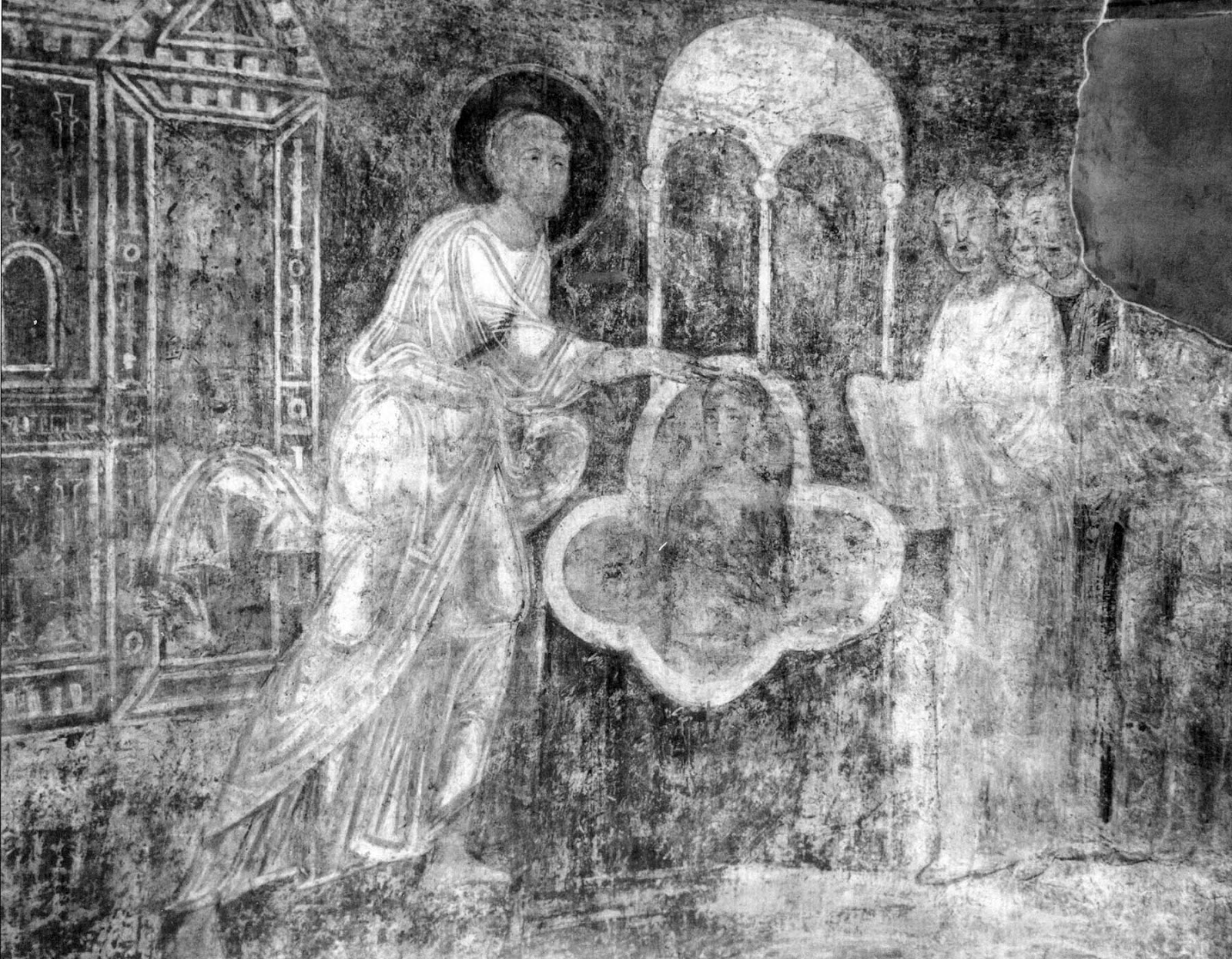
St. Peter Baptizing the Daughter of Centurion Cornelius
The feast of the Cathedra Petri was therefore celebrated on the Via Salaria on 18 January; in the Vatican Basilica it was observed on 22 February. 

It is easy to believe that after the triumph of Christianity the festival could be celebrated with greater pomp in the magnificent basilica erected by Constantine the Great over the confessio, or grave of Peter, than in a chapel far distant from the city on the Via Salaria. 

Yet the latter could rightly boast in its favor that it was there Saint Peter first exercised at Rome the episcopal office ("ubi prius sedit sanctus Petrus", as Abbot Johannes wrote, or "qua primo Rome petrus apostolus sedit", as we read in the "Martyrologium Hieronymianum" at 18 January). 


This double festival of the Chair of St. Peter is generally attributed to a long absence of the Apostle from Rome. As, how ever, the spot, "ubi s. Petrus baptizabat, ubi prius sedit" was distant from the city, it is natural to think that the second feast of the cathedra is connected with the opening of a chapel for Christian worship in the city itself.


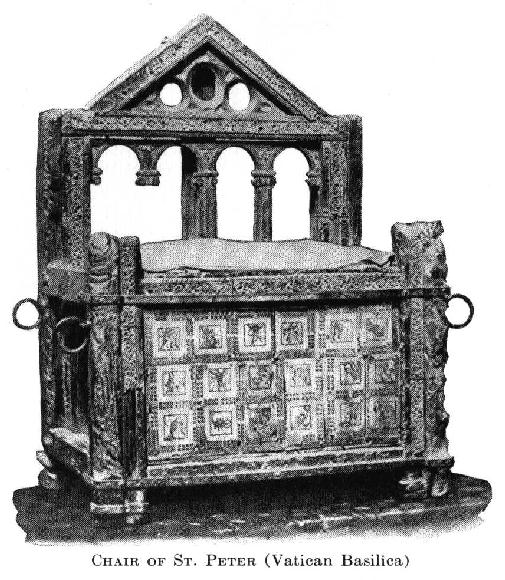
Chair of Peter (Vatican Basilica)
The Chair Itself

The Goths, who conquered and pillaged Rome in 410, advanced toward the city by the Via Salaria and the Via Nomentana; the same roads were traversed in the sixth and seventh centuries by later German invaders of Roman territory. 

Not only the churches, therefore, but even the cemeteries on these thoroughfares were easily given to plunder and devastation. 

We have seen, moreover, that as late as 600 a lamp was burning on the site "ubi prius sedit sanctus Petrus". 

If the original chair of the Apostle had still been there at that time, would it have been saved from destruction in the pillage that did not spare the sarcophagi in the catacombs? 

The words of the Abbot Johannes, "oleo de sede, ubi prius sedit sanctus Petrus", seem to leave scarcely a doubt as to this. The fact, evidenced by the martyrologies (see above), that by the ninth century one of the two feasts of the Roman cathedra had drifted away to Antioch, shows that the cathedra of the Via Salaria must have perished as early as the sixth or seventh century.

We come now to the question, where stood originally the chair shown and venerated in the Vatican Basilica during the fourth century? 

On the strength of ancient tradition it has been customary to designate the church of Santa Pudenziana as the spot where, in the house of the supposed Senator Pudens, the two great Apostles not only received hospitable entertainment, but also held Christian services. 

But the legends connected with Santa Pudenziana do not offer sufficient guarantee for the theory that this church was the cathedral and residence of the popes before Constantine. 

At the close of his Epistle to the Romans (xvi, 5), St. Paul mentions a place where religious services were held, the house of Aquila and Prisca (ten kat oikon auton ekklesian — now Santa Prisca on the Aventine). 

Aquila and Prisca are first among the many to whom the Apostle sends salutations. Aquila's connexion with the Catacomb of Priscilla is still shown by the epitaphs of that burial place. 

Sts Peter and Paul carrying Crown of Martyrdom, fresco of the arcosolium, Catacombs 
In 1776 there was excavated on the Aventine, near the present church of Santa Prisca, a chapel with frescoes of the fourth century; in these frescoes pictures of the two Apostles were still recognizable. 

Among the rubbish was also found a gilded glass with the figures of Peter and Paul. 

The feast of the dedication of this church (an important point) still falls on the same day as the above-described cathedra feast of 22 February; this church, therefore, continued to celebrate the traditional feast even after the destruction of the object from which it sprang. 

In the crypt of Santa Prisca
In the crypt of Santa Prisca is shown a hollowed capital, bearing in thirteenth-century letters the inscription: BAPTISMUS SANCTI PETRI (Baptism of Saint Peter), undoubtedly the echo of an ancient tradition of the administration of baptism here by Peter. 

In this way we have linked together a series of considerations which make it probable that the spot "ubi secundo sedebat sanctus Petrus" (where Saint Peter sat for the second time), must be sought in the present church of Santa Prisca; in other words, that the chair referred to by St. Damasus was kept there in the period before Constantine. It was there, consequently, that was celebrated the "natale Petri de cathedrâ", set for 22 February in the calendars beginning with the year 354. 

It follows also that this is the cathedra referred to in the oldest testimonia which speak of the chair from which Peter taught at Rome. The (third-century) poem, "Adversus Marcionem", says (P.L., II, 1099):

Hâc cathedrâ, Petrus quâ sederat ipse, locatum
Maxima Roma Linum primum considere iussit.

(On this chair, where Peter himself had sat,
great Rome first placed Linus and bade him sit.)

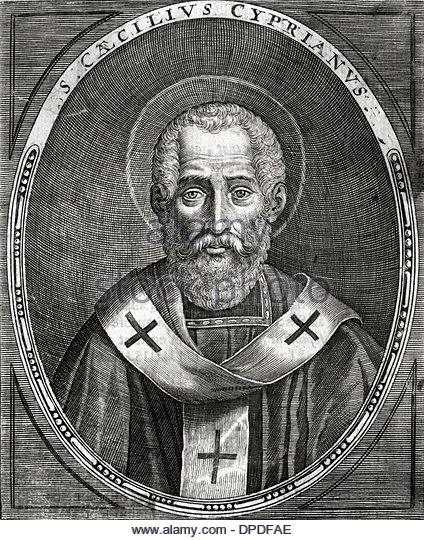
St. Cyprian
Further, St. Cyprian, writing about 250, during the vacancy of the chair after the death of Pope St. Fabian, describes it as follows: "Cum locus Fabiani, id est locus Petri et gradus cathedræ sacerdotalis vacaret" (when the place of Fabian, i.e. the place of Peter and the step of the sacerdotal chair were vacant). 

Still earlier, about 200, Tertullian writes, in his "De præscriptione bæreticorum": "Percurre ecclesias apostolicas, apud quas ipsæ adhuc cathedræ apostolorum suis locis præsident. Si Italiæ adjaces habes Romam" (Visit the Apostolic churches in (among) which the very chairs of the Apostles still preside in their places. If you are near Italy, there is Rome).

How Pope Damasus might be led to transfer the cathedra Petri from Santa Prisca to the Vatican, can be readily understood from the circumstances of that time. 

From the reign of the first Constantine the Lateran had been the residence of the popes, and its magnificent basilica their cathedral, while the neighbouring baptistery of Constantine served for the solemn administration of baptism on the eve of Easter. 

In the half-century from 312 to 366 (date of the accession of Damasus), the importance of Santa Prisca, its baptistery, and its cathedra must naturally have declined. Damasus could therefore be certain of the approval of all Rome when he transferred the venerable Apostolic relic from the small chapel in Santa Prisca to his own new baptistery in the Vatican, where it certainly remained to the first quarter of the sixth century, after which it was kept in different chapels of the Vatican Basilica. 

During the Middle Ages it was customary to exhibit it yearly to the faithful; the newly-elected pope was also solemnly enthroned on this venerable chair, a custom that ceased at the transfer of the papal capital to Avignon, in the early part of the fourteenth century. 

In order to preserve for posterity this precious relic, Alexander VII (1655-67) enclosed, after the designs of Bernini, the Cathedra Petri above the apsidal altar of St. Peter's in a gigantic casing of bronze, supported by four Doctors of the Church (Ambrose, Augustine, Athanasius, Chrysostom). Thenceforth, for 200 years, it was not exhibited to the public. 

In 1867, however, on the occasion of the eighteenth centenary of the martyrdom of the two great Apostles, it was exposed for the veneration of the faithful. 
Chair of St. Peter

At that time the Alessandri brothers photographed the chair, and that photograph is reproduced here. 

The seat is about one foot ten inches above the ground, and two feet eleven and seven-eighths inches wide; the sides are two feet one and one-half inches deep; the height of the back up to the tympanum is three feet five and one-third inches; the entire height of the chair is four feet seven and one-eighth inches. 

According to the examination then made by Padre Garucci and Giovanni Battista de Rossi, the oldest portion (see illustration) is a perfectly plain oaken arm-chair with four legs connected by cross-bars. The wood is much worm-eaten, and pieces have been cut from various spots at different times, evidently for relics. To the right and left of the seat four strong iron rings, intended for carrying-poles, are set into the legs. 

At a later date, perhaps in the ninth century, this famous chair was strengthened by the addition of pieces of acacia wood. The latter wood has inlaid in it a rich ornamentation of ivory. For the adornment of the front of the seat eighteen small panels of ivory have been used, on which the labours of Hercules, also fabulous animals, have been engraved; in like manner it was common at this period to ornament the covers of books and reliquaries with ivory panels or carved stones representing mythological scenes. The back is divided by small columns and arches into four fields and finishes at the top in a tympanum which has for ornamentation a large round opening between two smaller ones. The tympanum is surrounded on all sides by strips of ivory engraved in arabesques. At the centre of the horizontal strip a picture of an emperor (not seen in the illustration) is carved in the ivory; it is held to be a portrait of Charles the Bald. The arabesque of acanthus leaves filled with fantastic representations of animals, and the rough execution of the work, would make the period of this emperor (884) a probable date. 

What still remains of the old cathedra scarcely permits an opinion as to the original form. In any case it was a heavy chair made of plain, straight pieces of wood, so that it cannot be considered a sella curulis of Pudens, as earlier tradition held it to be. If the four rings on the two sides belong to the original chair (Ennodius of Pavia about the sixth century used the term sedes gestatoria as an expression universally understood in reference to this chair), then it was probably an ordinary carrying-chair, such as was commonly used in ancient Rome.

While the two chairs were the visible memorials of the earliest origins of Peter's Apostolic work at Rome, the recollection of his first arrival in the city is still preserved in the litanioe majores (greater litanies) on 25 April. 

On this day is also celebrated the feast of St. Mark, whom St. Peter had sent to Alexandria in Egypt. Antioch and Alexandria, the two most important patriarchates of the East, were, in common with Rome, founded by Peter. 

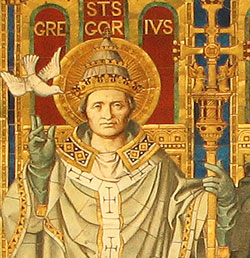
Pope St. Gregory the Great
Gregory the Great refers as follows to this spiritual relationship with the Roman Patriarchate of the West, in a letter to the Patriarch Eulogius (P.L., LXXVII, 899): "Quum multi sint Apostoli, pro ipso autem principatu sola Apostolorum principis sedes in auctoritate convaluit, quæ in tribus locis unius est. Ipse enim sublimavit sedem, in quâ etiam quiescere et præsertim vitam finire dignatus est. Ipse decoravit sedem, in quâ Evangelistam (Marcum) discipulum misit. Ipse firmavit sedem, in quâ septem annis, quamvis discessurus, sedit. Quum ergo unius atque una sit sedes, cui ex auctoritate divinâ tres nunc episcopi præsident, quidquid ego de vobis boni audio, hoc mihi imputo"

(Though there are many Apostles, pre-eminence of authority belongs permanently to none other than the Chair of the Prince of the Apostles, which Chair though established in three places remains nevertheless that of one and the same [Apostle]. 

He lifted it to the highest dignity in the place [Rome] where he deigned to fix his residence and end his life. He honoured it in the city [Alexandria] to which he sent his disciple, the Evangelist Mark. 

He strengthened it in the city [Antioch] where, though destined to depart, he sat for seven years. Since therefore the Chair in which now by divine authority three bishops preside is the identical chair of the self-same [Peter], I take myself whatever good I hear concerning you).

We conclude, therefore, that there is no reason for doubting the genuineness of the relic preserved at the Vatican, and known as the Cathedra Petri. 

Eusebius of Caesarea
According to Eusebius, Jerusalem preserved the cathedra of St. James (Church History VII.19), Alexandria that of St. Mark (G. Secchi, La cattedra alessandrina di San Marco, Venice, 1853). 

Tertullian, in the above quoted passage, refers to the value placed by the Apostolic Churches on the possession of the chairs of their founders (apud quas ipsæ adhuc cathedræ apostolorum suis locis præsident), and in enumerating them he puts Rome first. Moreover, the other writers above quoted, and whose testimony reaches back to the second century, all postulate the presence in Rome of an actual Cathedra Petri, 


Taken from:  New Advent  http://www.newadvent.org/cathen/03551e.htm