Showing posts with label Catholic Saint. Show all posts
Showing posts with label Catholic Saint. Show all posts
Saturday, 12 February 2022


Tuesday, 8 February 2022
Saturday, 5 February 2022
Friday, 4 February 2022
Monday, 29 March 2021
Friday, 26 March 2021
Tuesday, 23 March 2021
Sunday, 28 February 2021
Thursday, 4 October 2018
Saint Francis of Assisi October 4
Saint Francis
of Assisi
 |
Memorial October 4
Saint Francis was born at Assisi in 1182. After a carefree youth, he renounced his
paternal wealth and committed himself to God.
He led a life of evangelical poverty and preached the love of God to
all. He established a rule which a
number of his companions followed and which gained the approval of the Holy
See. Subsequently, he founded an order
of nuns and a society of laypersons who practice penance while living in the
world. He died in 1226 at age 44.
We
must be simple,
humble and pure
From a letter written to all the faithful by Saint Francis
of Assisi
It was through His archangel, Gabriel, that the Father above
made known to the holy and glorious Virgin Mary that the worthy, holy and
glorious Word of the Father would come from heaven and take from her womb the
real flesh of our human frailty. Though
He was wealthy beyond reckoning, He still willingly chose to be poor with His
Blessed Mother. And shortly before His
passion He celebrated he Passover with His disciples. Then He prayed to the Father, if it is possible, let this cup be taken
from Me.
Nevertheless, He reposed His will in the will of the Father. The Father willed that His blessed and
glorious Son, Whom He gave to us and who was born for us, should through His own blood offer Himself as
a sacrificial victim on the altar of the cross.
This was to be done not for Himself through Whom all things are made,
but for our sins. It was intended to
leave us an example of how to follow in His footsteps.
And He desires all of us to be saved
through
Him, and to receive Him
with pure heart and chaste body.

O how happy and blessed are those who love the Lord and do
as the Lord Himself said in the gospel: You
shall love the Lord your God with your whole heart and your whole soul, and
your neighbor as yourself.
Therefore, let us love God and adore Him with pure heart and mind. This is His particular desire when He says: True worshipers adore the Father in spirit
and in truth. For all who adore Him
must do so in the spirit of truth. Let
us also direct to Him our praises and prayers saying: Our Father, who art in heaven, since we
must always pray and never grow slack.
Furthermore, let us produce worthy fruits of penance. Let us also love our neighbors as
ourselves. Let us have charity and
humility. Let us give alms because these
cleanse our souls from the stains of sin.
Men lose all the material things they leave behind in this world, but
they carry with them the reward of their charity and the alms they give. For those they will receive from the Lord the
reward and recompense they deserve.
We
must not be wise and prudent
according to the flesh.
Rather we must be simple, humble and
pure.
We should never desire to be over
others. Instead, we ought to be servants
who are submissive to every human being for God’s sake. The Spirit of the Lord will rest on all who
live in this way and persevere in it to the end. He will permanently dwell in them. They will be the Father’s children who do his
work. They are the spouses, brothers and
mothers of Our Lord Jesus Christ.

Taken from Liturgy of the Hours, Ordinary Time Weeks
18-34. Francis of Assisi Memorial
Saturday, 29 September 2018
St. Therese of the Child Jesus October 1
 |
| St. Therese of the Child Jesus |
St.
Therese of the
Child Jesus, Virgin
Memorial October 1
Saint Therese was born at Alencon in France in 1873. While still a young girl, she entered the
Carmelite monastery at Lisieux. There
she lived a life of humility, evangelical simplicity and trust in God. By word and example she taught those virtues
to the novices of the community.
Offering her life for the salvation of souls and the growth of the Church. She died September 30, 1897.
 |
| St. Therese of the Child Jesus |
In
the Heart of the Church
I will be Love
From the autobiography of Saint Therese of the Child Jesus,
virgin
Since my longing for martyrdom was powerful and unsettling,
I trusted in the epistles of Saint Paul in the hope of finally finding an
answer. By chance the twelfth and thirteenth
chapters of the first epistle to the Corinthians caught my attention, and in
the first section I read that not everyone can be an apostle, prophet or
teacher, that the Church is composed of a variety of members, and that the eye
cannot be the hand. Even with such an
answer revealed to me, I was not satisfied and did not find peace.
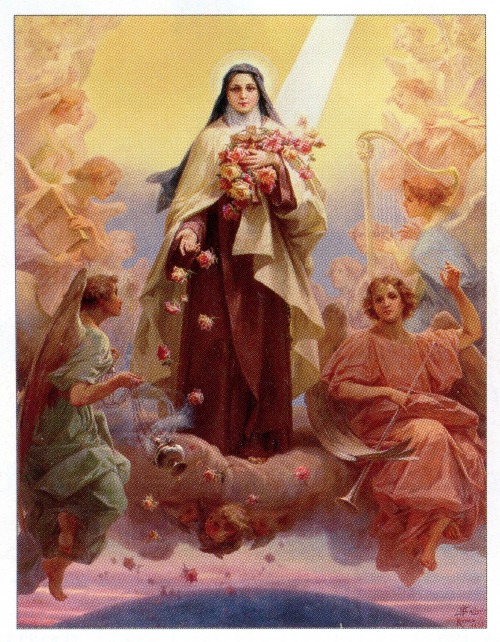 |
| St. Therese of Lisieux |
I persevered in the reading and did let not my mind wander
until I found this encouraging theme: Set
your desires on the greater gifts. And I
will now show you the way which surpasses all others. For the Apostle insists that the greater
gifts are nothing as all without love and that this same love is surely the
best path leading directly to God. At
length I had found peace of mind.
When I looked upon the Mystical body of the Church, I recognized
myself in none of the members which Saint Paul described, and what is more, I
desired to distinguish myself more favorably within the whole body. Love appeared to me to be the hinge for my
vocation. Indeed I knew that the Church
had a body composed of various members, but in this body the necessary and
noble member was not lacking; I knew that the Church had a heart and that such
a heart appeared to be aflame with love.
I knew that the one love drove the members of the Church to action, that
if this love were extinguished, the apostles would have proclaimed the Gospel
no longer, the martyrs would have shed their blood no more. I saw and realized that love sets off the
bounds of all vocation, that love is everyting, that this same love embraces
every time and every place. In one word,
that love is everlasting.
Then, nearly ecstatic with supreme joy in my soul, I
proclaimed:
O Jesus, my love!
at last I have found my calling:
my call is
love!
Certainly I have found my proper
place in the Church, and you gave me the very place, my God. In the heart of the Church, my mother, I will
be love, and thus I will be all things, as my desire finds its direction.

Prayer:
God our Father, you
have promised your kingdom to those who are willing to become like little
children. Help us to follow the way of
Saint Therese with confidence so that by her prayers we may come to know your
eternal glory. Grant this through Our
Lord Jesus Christ, Your Son, Who lives and reigns with you and the Holy Spirit,
one God, for ever and ever.
Taken from Liturgy of the Hours, Ordinary Time 18-34 October 1 Therese of the Child Jesus
Wednesday, 22 August 2018
Suffering, Tribulation From the writings of St. Rose of Lima

St. Rose of Lima, Virgin
From the writings of St. Rose of Lima
Let us know the love of Christ which surpasses all knowledge
Our Lord and Saviour lifted up his voice and said with
incomparable majesty: “Let all men know what grace comes after tribulation. Let them know that without the burden of
afflictions it is impossible to reach the height of grace. Let them know that the gifts of grace
increase as the struggles increase. Let
men take care not to stray and be deceived.
This is the only true stairway to paradise, without the cross they can
find no road to climb to heaven.
When I heard these words, a strong force came upon me and
seemed to place me in the middle of a street, so that I might say in a loud
voice to people of every age, sex and status: “Hear, O people; hear, O
nations. I am warning you about the
commandment of Christ by using words that came from his own lips:
We cannot
obtain grace unless we suffer afflictions.
We must heap trouble upon trouble to attain
a deep participation in the
divine nature,
the glory of the sons of God and perfect happiness of soul.”
That same force urged me to proclaim the beauty of divine
grace. It pressed me so that my breath
came slow and forced me to sweat and pant.
I felt as if my soul could no longer be kept in the prison of the body,
but that it had burst its chains and was free and alone and was going very
swiftly through the whole world saying:
“If only mortals would learn how great
it is to possess divine grace,
how beautiful, how noble, how precious.
How many riches it hides within itself,
how
many joys and delights!
Without doubt
they would devote all their care and concern to winning for themselves pains
and afflictions. All men throughout the
world would seek trouble, infirmities and torments, instead of good fortune, in
order to attain the unfathomable treasure of grace. This is the reward and the final gain of
patience. No one would complain about
his cross or about troubles that may happen to him, if he would come to know
the scales on which they are weighed when they are distributed to men.”

Beheading of John the Baptist, Martyr August 29
 |
| St. John the Baptist |
Precursor of Christ
in Birth and Death
From a homily by Saint Bede the Venerable, priest
As forerunner of our Lord's birth, preaching and death, the
blessed John showed in his struggle a goodness worthy of the sight of
heaven. In the words of scripture: Though in the sight of men he suffered
torments, his hope is full of immortality. We justly commemorate the day of his birth
with a joyful celebration, a day which he himself made festive for us through
his suffering and which he adorned with the crimson splendor of his own
blood. We do rightly revere his memory
with joyful hearts, for he stamped with the seal of martyrdom the testimony
which he delivered on behalf of our Lord.
There is no doubt that blessed John suffered imprisonment
and chains as a witness to our Redeemer, whose forerunner he was, and gave his
life for Him. His persecutor had
demanded not that he should deny Christ, but only that he should be kept silent
about the truth. Nevertheless, he died
for Christ. Does Christ not say: I am
the truth? Therefore, because John shed
his blood for the truth, he surely died for Christ.
Through his birth, preaching and baptizing, he bore witness
to the coming birth, preaching and baptism of Christ, and his own suffering he
showed that Christ also would suffer.
 |
| St. John he Baptist Imprisonment |
Such was the quality and strength of the man who accepted
the end of this present life by shedding his blood after the long
imprisonment. He preached the freedom of
heavenly peace, yet was thrown into irons by ungodly men; he was locked away in
the darkness of prison, though he came bearing witness to the Light itself,
which is Christ. John was baptized in
his own blood, though he had been privileged to baptize the Redeemer of the
world, to hear the voice of the Father above him, and to see the grace of the
Holy Spirit descending upon Him. But to
endure temporal agonies for the sake of the truth was not a heavy burden for
such men as John; rather it was easily borne and even desirable, for he knew
eternal joy would be his reward.
 |
| Beheading of St. John the Baptist |
Since death was ever near at hand through the inescapable
necessity of nature, such men considered it a blessing to embrace it and thus
gain the reward of eternal life by acknowledging Christ’s name. Hence the apostle Paul rightly says: You have been granted the privilege not only
to believe in Christ but also to suffer for his sake. He tells us why it is Christ’s gift that his
chosen ones should suffer for him: The
sufferings of this present time are not worthy to be compared with the glory
that is to be revealed in us.
 |
| Stairway to Heaven |
Thursday, 13 April 2017
Easter homily - St. Melito of Sardis, bishop
 |
| The Lamb Who was slain for us |
The Lamb that was slain
has delivered us from death
and
given us life
From an Easter homily by Saint Melito of Sardis, bishop
 |
| Saint Melito of Sardis, bishop died c180 |
There was much proclaimed by the prophets about the mystery
of the Passover: that mystery is Christ,
and to him be glory for every and ever. Amen.
For the sake of suffering humanity he came down from heaven
to earth, clothed himself in that humanity in the Virgin’s womb, and was born a
man. Having then a body capable of
suffering, he took the pain of fallen man upon himself; he triumphed over the
diseases of soul and body that were its cause, and by his Spirit, which was
incapable of dying, he dealt man’s destroyer, death, a fatal blow.
He was led forth like a lamb; he was slaughtered like a
sheep. He ransomed us from our servitude
to the world, as he had ransomed Israel from the land of Egypt, he freed us
from our slavery to the devil, as he had freed Israel from the hand of
Pharaoh. He sealed our souls with his
own Spirit, and the members of our body with his own blood.
 |
| Pharaoh and his dead son - The Last Plague |
He is the One who covered death with shame and cast the
devil into mourning, as Moses cast Pharaoh into mourning.
He is the One who smote sin and robbed
iniquity of offspring, as Moses robbed the Egyptians of their offspring. He is the One who brought us out of slavery
into freedom, out of darkness into light, out of death into life, out of
tyranny into an eternal kingdom, who made us a new priesthood, a people chosen
to be his own for ever. He is the
Passover that is our salvation.
It is He who endured every kind of suffering
in all those
who foreshadowed him.
In Abel he was
slain, in Isaac bound,
in Jacob exiled, in Joseph sold,
in Moses exposed to
die.
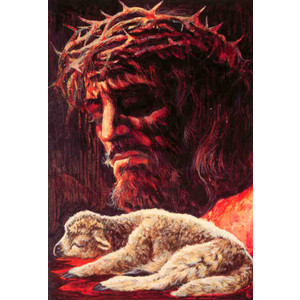
He was sacrificed in the Passover
lamb,
persecuted in David,
dishonored in the prophets.
It is he who was made man of the Virgin, he who was hung on
the tree; it is he who was buried in the earth, raised from the dead, and taken
up to the heights of heaven. He is the
mute lamb, the slain lamb, the lamb born of Mary, the fair ewe. He was seized from the flock, dragged off to
be slaughtered, sacrificed in the evening, and buried at night.
On the tree no bone of his was broken;
in
the earth his body knew no decay.
He is
the One who rose from the dead,
and who raised man from the depths of the tomb.
 |
| CHRIST IS RISEN!!!! |
Thursday, 6 April 2017
Tell the World the GOOD NEWS
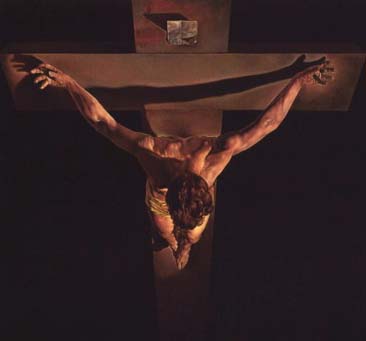 |
| The Crucifixion of Christ |
From the Moral Reflections on Job
by Saint Gregory the
Great, pope
The mystery of our new life in Christ
Holy Job is a type of the Church. At one time he speaks for the body, at
another for the head. As he speaks of
its members he is suddenly caught up to speak in the name of their head. So it is here, where he says: I have suffered this without sin on my
hands, for my prayer to God was pure.

Christ suffered without sin on His hands, for He committed
no sin and deceit was not found on His lips.
Yet He suffered the pain of the cross for our redemption. His prayer to God was pure, His alone out of
all mankind, for in the midst of His suffering He prayed for His persecutors: Father, forgive them, for they do not know
what they are doing.
Is it possible to offer, or even to imagine, a purer kind of
prayer than that which shows mercy to one’s torturers by making intercession
for them? It was thanks to this kind of
prayer that the frenzied persecutors who shed the blood of the Redeemer drank
it afterward in faith and proclaimed Him to be the Son of God.
The text goes on fittingly to speak of Christ’s blood: Earth, do not cover over my blood, do not
let my cry find a hiding place in you.
When man sinned, God had said: Earth
you are, and to earth you will return.
Earth does not cover over the blood of the Redeemer, for every sinner,
as he drinks the Blood that is the price of his redemption, offers praise and
thanksgiving, and to the best of his power makes that Blood known to all around
him.
Earth has not hidden away His blood, for holy Church has
preached in every corner of the world the mystery of its redemption.
 |
| Blood of Christ |
Notice what follows: Do
not let my cry find a hiding place in you.
The Blood that is drunk, the Blood of redemption, is itself the cry of
our Redeemer. Paul speaks of the sprinkled blood that calls out more
eloquently than Abel’s. Of Abel’s
blood Scripture had written: The voice of
your brother’s blood cries out to me from the earth.
The Blood of Jesus
calls out more eloquently
than Abel’s,
for the blood of Abel asked
for the death of Cain the fratricide,
while the Blood of the Lord
has asked for, and obtained,
life for His
persecutors.
If the sacrament of the Lord’s Passion is to work its effect
in us, we must imitate what we receive and proclaim to mankind what we
revere. The cry of the Lord finds a
hiding place in us if our lips fail to speak of this, though our hearts believe
in it. So that His cry may not lie
concealed in us it remains for us all, each in his own measure, to make known
to those around us the mystery of our new life in Christ.
Through Deeds - Not Words
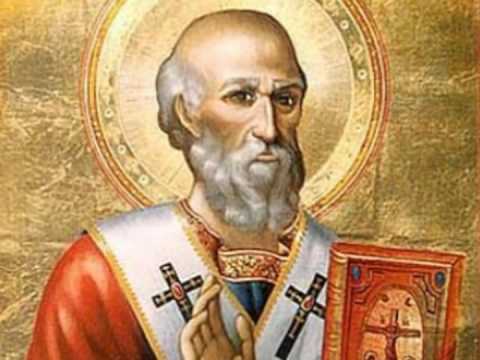
From an Easter letter by Saint Anthanasius, bishop
We keep the coming feast of the Lord through deeds,
not
words
The Word who became all things for us is close to us, our
Lord Jesus Christ who promises to remain with always. He cries out, saying, “See, I am with you all the days of this age. He is Himself the shepherd, the high priest,
the way and the door, and has become all things at once for us. In the same way, He has come among us as our
feast and holy days as well. The blessed
Apostle says of Him who was awaited: Christ
has been sacrificed as our Passover.
It was Christ who shed His light on the psalmist as he prayed: You are my joy, deliver me from those
surrounding me.
True joy, genuine festival,
means the casting out of
wickedness.
To achieve this one must
live a life
of perfect goodness and,
in the serenity of the fear of God,
practice contemplation in one’s heart.
This was the way of the saints, who in their lifetime and at
every stage of life rejoiced as at a feast.
Blessed David, for example, not once but seven times rose at night to
win God’s favor through prayer. The
great Moses was full of joy as he sang God’s praises in hymns of victory for
the defeat of Pharaoh and the oppressors of the Hebrew people. Others had hearts filled always with gladness
as they performed their sacred duty of worship, like the great Samuel and the
blessed Elijah. Because of their holy
lives they gained freedom, and now keep festival in heaven. They rejoice after their pilgrimage in
shadows, and now distinguish the reality from the promise.
When we celebrate the feast in our own day, what path are we
to take? As we draw near to this feast,
who is to be our guide? Beloved, it must
be none other than Jesus Christ. He
says: I am the way. As blessed John tells us: it is Christ who takes away the sin of the world. It
is He who purifies our souls, as the prophet Jeremiah says: Stand upon the ways; look and see which is
the good path, and you will find in it the way of amendment for your souls.
In former times the blood of goats and the ashes of a calf
were sprinkled on those who were unclean, but they were able to purify only the
body. Now through the grace of God’s
Word everyone is made abundantly clean.
If we follow Christ closely, we shall be allowed, even on this earth, to
stand as it were on the threshold of the heavenly Jerusalem, and enjoy the
contemplation of that everlasting feast, like the blessed apostles, who in
following the Savior as their leader, showed, and still show, the way to obtain
the same gift from God.
They said: See, we have left all things and followed You.
We too follow the Lord, and we keep His feast by deeds rather than by
words.
Tuesday, 21 March 2017
Prayer, Fasting, Mercy sermon by Saint Peter Chrysologus
 |
| St. Peter Chrysologus |
Prayer knocks, fasting obtains, mercy receives
From a sermon by Saint Peter Chrysologus, bishop
There are three things, my brethren, by which faith stands
firm, devotion remains constant, and virtue endures. They are prayer, fasting and mercy. Prayer knocks at the door, fasting obtains,
mercy receives. Prayer, mercy and
fasting: these three are one, and they give life to each other.
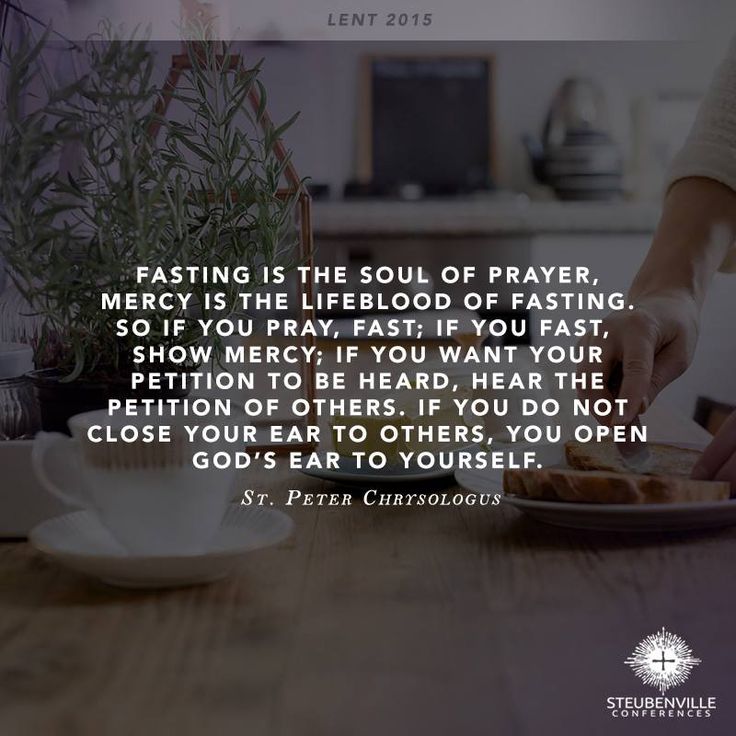
Fasting is the soul of prayer, mercy is the lifeblood of
fasting. Let no one try to separate them;
they cannot be separated. If you have
only one of them or not all together, you have nothing. So if you prayer, fast; if you fast, show
mercy; if you want your petition to be heard, hear the petition of others. If you do not close your ear to others you
open God’s ear to yourself.
When you fast, see the fasting of others. If you want God to know that you are hungry,
know that another is hungry. If you hope
for mercy, show mercy. If you look for
kindness, show kindness. If you want to
receive, give. If you ask for yourself
what you deny to others, your asking is a mockery.
 |
| Saint Peter Chrysologus, Quote |
Let this be the pattern for all men when they practice
mercy: show mercy to others in the same way, with the same generosity, with the
same promptness, as you want others to show mercy to you.
Therefore, let prayer, mercy and fasting the one single plea
to God on our behalf, one speech in our defense, a threefold united prayer in
our favor.
Let us use fasting to make up for what we have lost by
despising others. Let us offer our souls
in sacrifice by means of fasting. There
is nothing more pleasing that we can offer to God, as the psalmist said in
prophecy: A sacrifice to God is a broken
spirit; God does not despise a bruised and humbled heart.
Offer your soul to God, make him an oblation of your
fasting, so that your soul may be a pure offering, a holy sacrifice, a living
victim, remaining your own and at the same time made over to God. Whoever fails to give this to God will not be
excused, for if you are to give him yourself you are never without the means of
giving.
To make these acceptable, mercy must be added. Fasting bears no fruit unless it is watered
by mercy. Fasting dries up when mercy
dries up. Mercy is to fasting as rain is
to the earth. However much you may cultivate
your heart, clear the soil of your nature, root out vices, sow virtues, if you
do not release the springs of mercy, your fasting will bear no fruit.
When you fast, if your mercy is thin your harvest will be
thin; when you fast, what you pour out in mercy overflows into your barn. Therefore, do not lose by saving, but gather
in by scattering. Give to the poor, and
your give to yourself. You will not be
allowed to keep what you have refused to give to others.
St. Joseph, A sermon by St. Bernadine of Siena
 |
| St. Joseph and the Infant Jesus |
The Faithful Foster-Father and Guardian
From a sermon by Saint Bernadine of Siena, priest
There is a general rule concerning all special graces
granted to any human being. Whenever the
divine favor chooses someone to receive a special grace, or to accept a lofty vocation
God adorns the person chosen with all the gifts of the Spirit needed to fulfill
the task at hand.
This general rule is especially verified in the case of
Saint Joseph, the foster-father of Our Lord and the husband of the Queen of our
world, enthroned above the angels. He
was chosen by the eternal Father as the trustworthy guardian and protector of His
greatest treasures, namely, His divine Son and Mary, Joseph’s wife. He carried out this vocation with complete
fidelity until at last God called him, saying: Good and faithful servant, enter into the joy of your Lord.
What then is Joseph’s position in the whole Church of
Christ? Is he not a man chosen and set
apart? Through him and, yes, under him,
Christ was fittingly and honorably introduced into the world. Holy Church in its entirety is indebted to
the Virgin Mother because through her it was judged worthy to receive
Christ. But after her we undoubtedly owe
special gratitude and reverence to Saint Joseph.
In him the Old Testament finds its fitting close.
He brought the noble line of patriarchs and
prophets
to its promised fulfillment.
What the divine goodness had offered
as a promise to them, he held in
his arms.
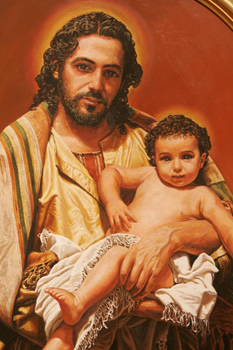 |
| St. Joseph and Child Jesus |
Obviously, Christ does not now deny to Joseph that intimacy,
reverence and very high honor which He gave him on earth, as a son to his
father. Rather we must say that in
heaven Christ completes and perfects all that he gave at Nazareth.
Now we and see how the last summoning words of the Lord
appropriately apply to Saint Joseph: Enter
into the joy of your Lord. In fact,
although the joy of eternal happiness enters into the soul of a man, the Lord
preferred to say to Joseph: Enter into
joy. His intention was that the
words should have a hidden spiritual meaning for us. They convey not only that this holy man
possesses an inward joy, but also that it surrounds him and engulfs him like an
infinite abyss.
Remember us, Saint Joseph, and plead for us to your
foster-child. Ask your most holy bride,
the Virgin Mary, to look kindly upon us, since she is the mother of Him who
with the Father and the Holy Spirit lives and reigns eternally. Amen.
Friday, 17 March 2017
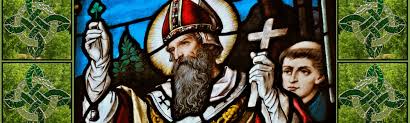
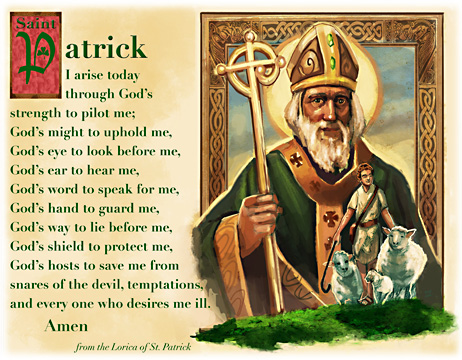
St. Patrick a great man of faith
 |
| Saint Patrick, Great Evangelizer |
St. Patrick
Lived 385 - 461
From the Confessions of Saint Patrick
Through
me
many peoples
have been reborn
in God
I give unceasing thanks to God, who kept me faithful in the day of my testing. Today I can offer Him sacrifice and
confidence, giving myself as a living
victim to Christ, my Lord, who kept
me safe through all my trails.
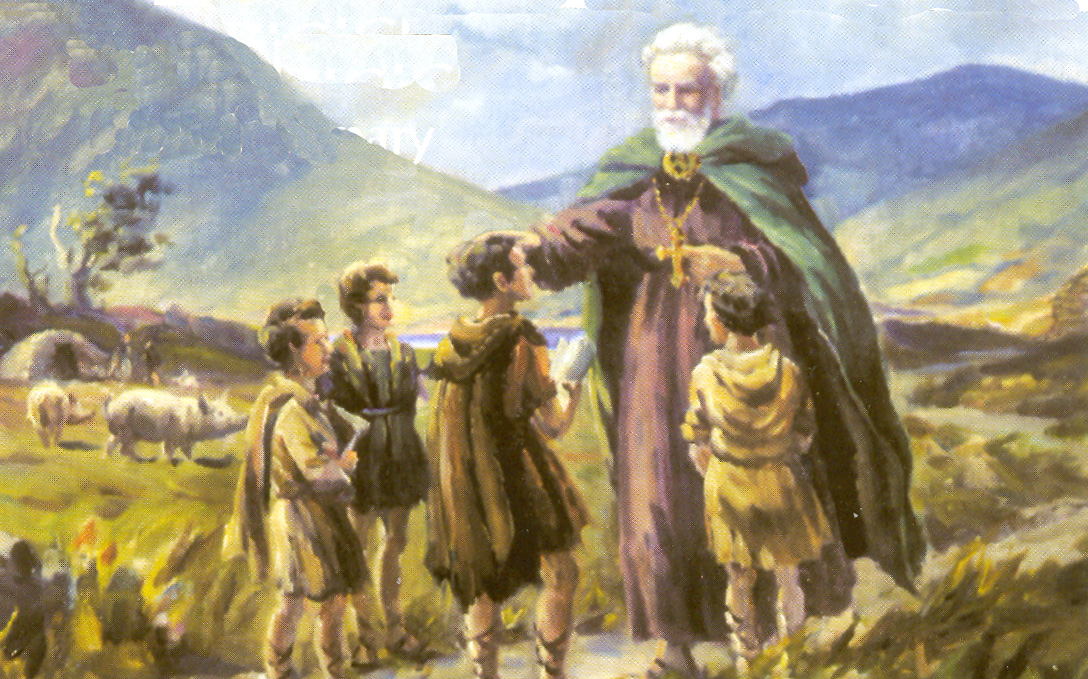 |
| St. Patrick proclaiming Christ to Ireland |
I
can say now: Who am I, Lord, and what
is my calling, that you worked through me with such divine power? You did all this so that today among the Gentiles I might constantly rejoice and glorify Your Name wherever I may be, both in prosperity and in
adversity.
You did it so that, whatever
happened to me, I might accept good and evil equally, always giving thanks to
God. God showed me how to have faith in
Him forever, as one who is never to be doubted.
He answered my prayer in such a way that in the last days, ignorant though I am I might be bold enough to
take up so holy and so wonderful a task, and imitate in some degree those who
the Lord has so long ago foretold as heralds of His Gospel, bearing witness to all nations.
How did I get this wisdom,
that was not mine before? I did not
know the number of my days, or have knowledge of God.
How did so great and salutary a gift come to
me, the gift of knowing and loving God, though at the cost of homeland and
family?
I came to the Irish peoples to
preach the Gospel and endure the taunts of unbelievers, putting up with
reproaches about my earthly pilgrimage, suffering many persecutions, even bondage, and losing my birthright
of freedom for the benefit of others.
 |
| St. Patrick Apostle and Patron of Ireland |
If I am worthy, I am
ready also to give up my life,
without hesitation and most willingly, for His
name.
I want to spend myself in that country,
even
in death,
if the Lord should grant me this favor.
I am deeply in His debt, for He gave me this
favor.
I am deeply in His debt, for He
gave me that great grace that through me many peoples should be reborn in God,
and then made perfect by confirmation and everywhere among them clergy ordained
for a people so recently coming to believe, one people gathered by the Lord from the ends of the earth.
As God had prophesied of old through the
prophets. The nations shall come to you from the ends of the earth, and say: “How
false are the idols made by our fathers: they are useless.” In another prophesy he said, I have set you as a light among the nations, to bring salvation to the ends of
the earth.
It is among that people
that I want to wait for the promise
made by Him,
who assuredly never tells a
lie.
He makes this promise in the
Gospel: They shall come from the east and
west, and sit down with Abraham, Isaac and Jacob. This is our faith: believers are to come
from the world.
The Confessions of St. Patrick … I Patrick …. http://www.confessio.ie/etexts/confessio_english#01
Saturday, 4 March 2017
St. Clement Pope
 |
| St/ Clement of Rome |
ST CLEMENT, POPE, MARTYR (A.D. 100)
Feast: November 23
St Clement, the son of Faustinus, a Roman by birth, was of
Jewish extraction; for he tells us himself that he was of the race of Jacob. He
was converted to the faith by St. Peter or St. Paul, and was so constant in his
attendance on these apostles, and so active in assisting them in their
ministry, that St. Jerome and other fathers call him an apostolic man; St.
Clement of Alexandria styles him an apostle; and Rufinus, almost an apostle.
Some authors attribute his conversion to St. Peter, whom he met at Cesarea with
St. Barnabas; but he attended St. Paul at Philippi in 62, and shared in his
sufferings there. We are assured by St. Chrysostom that he was a companion of
the latter, with SS. Luke and Timothy, in many of his apostolic journeys,
labours, and dangers. St. Paul (Phil. iv, 3) calls him his fellow-labourer, and
ranks him among those whose names are written in the book of life; a privilege
and matter of joy far beyond the power of commanding devils. (Luke x. 17) St.
Clement followed St. Paul to Rome, where he also heard St. Peter preach, and
was instructed in his school, as St. Irenaeus and Pope Zosimus testify.
Tertullian tells us that St. Peter ordained him bishop, by which some
understand that he made him a bishop of nations, to preach the gospel in many
countries; others, with Epiphanius, that he made him his vicar at Rome, with an
episcopal character to govern that church during his absence in his frequent
missions. Others suppose he might at first be made bishop of the Jewish church
in that city. After the martyrdom of SS. Peter and Paul, St. Linus was appointed
Bishop of Rome, and after eleven years, succeeded by St. Cletus. Upon his
demise in 89, or rather in 91, St. Clement was placed in the apostolic chair.
According to the Liberian Calendar he sat nine years, eleven months, and twenty
days.
At Corinth, an impious and detestable division, as our saint
called it, happened amongst the faithful, like that which St. Paul had appeased
in the same church; and a party rebelled against holy and irreproachable
priests and presumed to depose them. It seems to have been soon after the death
of Domitian in 96, that St. Clement, in the name of the church of Rome, wrote
to them his excellent epistle, a piece highly extolled and esteemed in the
primitive church as an admirable work, as Eusebius calls it. It was placed in
rank next to the canonical books of the holy scriptures, and with them read in
the churches. Whence it was found in the very ancient Alexandrian manuscript
copy of the Bible, which Cyril Lucaris sent to our King James I, from which
Patrick Young, the learned keeper of that king's library, published it at
Oxford in 1633. St. Clement begins his letter by conciliating the benevolence
of those who were at variance, tenderly putting them in mind how edifying their
behaviour was when they were all humble-minded, not boasting of anything,
desiring rather to be subject than to govern, to give than to receive, content
with the portion God had dispensed to them, listening diligently to his word,
having an insatiable desire of doing good, and a plentiful effusion of the Holy
Ghost upon all of them. At that time they were sincere, without offence, not
mindful of injuries, and all sedition and schism was an abomination to them.
The saint laments that they had then forsaken the fear of the Lord, and were
fallen into pride, envy, strife, and sedition; and pathetically exhorts them to
lay aside all pride and anger, for Christ is theirs who are humble and not
theirs who exalt themselves. The sceptre of the majesty of God, our Lord Jesus
Christ, came not in the show of pride, though he could have done so; but with
humility. He bids them look up to the Creator of the world, and think how
gentle and patient he is towards his whole creation; also with what peace it
all obeys his will, and the heavens, earth, impassable ocean, and worlds beyond
it, are governed by the commends of this great master. Considering how near God
is to us, and that none of our thoughts are hid from him, how ought we never to
do anything contrary to his will, and honour them who are set over us! showing
with a sincere affection of meekness, and manifesting the government of our
tongues by a love of silence. "Let your children," says the saint,
"be bred up in the instruction of the Lord, and learn how great a power
humility has with God, how much a pure and holy charity avails with him, and
how excellent and great his fear is."
 |
11th-century fresco in the Basilica of San Clemente, Rome:
Saints Cyril and Methodius bring Saint Clement's relics to Rome
|
It appears by what follows, that some at Corinth boggled at
the belief of a resurrection of the flesh, which the saint beautifully shows to
be easy to the Almighty power, and illustrates by the vine which sheds its
leaves, then buds, spreads its leaves, flowers, and afterwards produces first
sour grapes, then ripe fruit; by the morning rising from night; and corn
brought forth from seed. The saint adds a strong exhortation to shake off all
sluggishness and laziness, for it is only the good workman who receives the
bread of his labour. "We must hasten," says he, "with all
earnestness and readiness of mind, to perfect every good work, labouring with
cheerfulness; for even the Creator and Lord of all things rejoices in his own
works." The latter part of this epistle is a pathetic recommendation of
humility, peace, and charity. "Let every one," says the saint,
"be subject to another, according to the order in which he is placed by
the gift of God. Let not the strong man neglect the care of the weak; let the
weak see that he reverence the strong. Let the rich man distribute to the
necessity of the poor, and let the poor bless God who give :h him one to supply
his want. Let the wise man show forth his wisdom, not in words, but in good
works. Let him that is humble, never speak of himself, or make show of his
actions. Let him that is pure in the flesh, not grow proud of it, knowing that
it was another who gave him the gift of continence. They who are great cannot
yet subsist without those that are little; nor the little without the great. In
our body, the head without the feet is nothing; neither the feet without the
head. And the smallest members of our body are yet both necessary and useful to
the whole." Thus the saint teaches that the lowest in the church may be
the greatest before God, if they are most faithful in the discharge of their
respective duties. St. Clement puts pastors and superiors in mind that, with
trembling and humility, they should have nothing but the fear of God in view,
and take no pleasure in their own power and authority. "Let us," says
he, "pray for all such as fall into any trouble or distress; that being
endued with humility and moderation, they may submit, not to us, but to the
will of God." Fortunatus, who is mentioned by St. Paul, was come from the
church of Corinth to Rome, to inform that holy see of their unhappy schism. St.
Clement says, he had dispatched four messengers to Corinth with him, and adds,
"Send them back to us again with all speed in peace and joy, that they may
the sooner acquaint us with your peace and concord, so much prayed for and
desired by us; and that we may rejoice in your good order."
We have a large fragment of a second epistle of St. Clement
to the Corinthians, found in the same Alexandrian manuscript of the Bible; from
which circumstance it appears to have been also read like the former in many
churches, which St. Dionysius of Corinth expressly testifies of that church,
though it was not so celebrated among the ancients as the other. In it our
saint exhorts the faithful to despise this world and its false enjoyments, and
to have those which are promised us always before our eyes; to pursue virtue
with all our strength, and its peace will follow us with the inexpressible
delights of the promise of what is to come. The necessity of perfectly subduing
both the irascible and concupiscible passions of our souls, he lays down as the
foundation of a Christian life, in words which St. Clement of Alexandria
enforces and illustrates. Besides these letters of St. Clement to the
Corinthians, two others have been lately discovered, which are addressed to
spiritual eunuchs or virgins. Of these St. Jerome speaks, when he says of
certain epistles of St. Clement, "In the epistles which Clement, the
successor of the Apostle Peter, wrote to them, that is, to such eunuchs, almost
his whole discourse turns upon the excellence of virginity." These two
letters were found in a manuscript copy of a Syriac New Testament, by John
James Westein, in 1752, and printed by him with a Latin translation at
Amsterdam in 1752, and again in 1757. A French translation of them has been
published, with short critical notes. These letters are not unworthy this great
disciple of St. Peter; and in them the counsels of St. Paul concerning celibacy
and virginity are explained, that state is pathetically recommended, without
prejudice to the honour due to the holy state of marriage; and the necessity of
shunning all familiarity with persons of a different sex, and the like
occasions of incontinence is set in a true light.
 |
| St. Clement celebrating Mass , century unknown |
St. Clement with patience and prudence got through the
persecution of Domitian. Nerva's peaceable reign being very short, the tempest
increased under Trajan, who, even from the beginning of his reign, never
allowed the Christian assemblies. It was in the year 100 that the third general
persecution was raised by him, which was the more afflicting, as this reign was
in other respects generally famed for justice and moderation. Rufin, Pope
Zosimus, and the council of Bazas in 452, expressly styles St. Clement a
martyr. In the ancient canon of the Roman mass, he is ranked among the martyrs.
Eusebius tells us, that St. Clement departed this life in the third year of
Trajan, of Christ 100. From this expression some will have it that he died a
natural death; but St. Clement says of St. Paul, who certainly died a martyr,
that "he departed out of the world."[1] It is also objected, that St.
Irenaeus gives the title of martyr only to St. Telesphorus among the popes
before St. Eleutherius. But it is certain that some others were martyrs,
whatever was the cause of his omission. St. Irenaeus mentions the epistle of
St. Clement yet omits those of St. Ignatius, though in some places he quotes
him. Shall we hence argue, that St. Ignatius wrote none? When the Emperor Lewis
Debonnair founded the great abbey of Cava, in Abruzzo, four miles from Slaerno,
in 872, he enriched it with the relics of St. Clement, pope and martyr, which
Pope Adrian sent him, as is related at length in the chronicle of that abbey,
with a history of many miracles. These relics remain there to this day. The
ancient Church of St. Clement in Rome, in which St. Gregory the Great preached
several of his homilies, still retains part of his relics. It was repaired by
Clement XI, but still shows entire the old structure of Christian churches,
divided into three parts: the narthex, the ambo, and the sanctuary.
St. Clement inculcates,[2] that the spirit of Christianity
is a spirit of perfect disengagement from the things of this world. "We
must," says he, "look upon all the things of this world, as none of
ours, and not desire them. This world and that to come are two enemies. We
cannot, therefore, be friends to both; but we must resolve which we would
forsake, and which we would enjoy. And we think, that it is better to hate the
present things, as little, short-lived, and corruptible; and to love those
which are to come, which are truly good and incorruptible. Let us contend with
all earnestness, knowing that we are now called to the combat. Let us run in
the straight road, the race that is incorruptible. This is what Christ saith:
keep your bodies pure and your souls without spot, that ye may receive eternal
life."
Subscribe to:
Posts (Atom)