Showing posts with label Christian Faith. Show all posts
Showing posts with label Christian Faith. Show all posts
Saturday, 29 January 2022


Friday, 17 March 2017
St. Patrick a great man of faith
 |
| Saint Patrick, Great Evangelizer |
St. Patrick
Lived 385 - 461
From the Confessions of Saint Patrick
Through
me
many peoples
have been reborn
in God
I give unceasing thanks to God, who kept me faithful in the day of my testing. Today I can offer Him sacrifice and
confidence, giving myself as a living
victim to Christ, my Lord, who kept
me safe through all my trails.
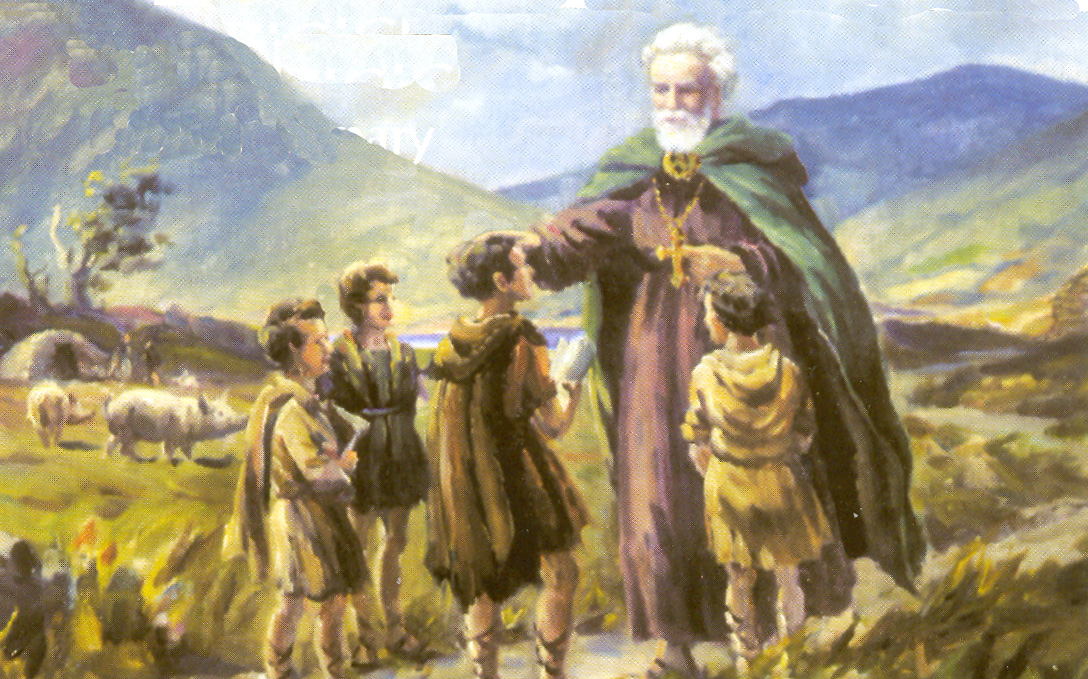 |
| St. Patrick proclaiming Christ to Ireland |
I
can say now: Who am I, Lord, and what
is my calling, that you worked through me with such divine power? You did all this so that today among the Gentiles I might constantly rejoice and glorify Your Name wherever I may be, both in prosperity and in
adversity.
You did it so that, whatever
happened to me, I might accept good and evil equally, always giving thanks to
God. God showed me how to have faith in
Him forever, as one who is never to be doubted.
He answered my prayer in such a way that in the last days, ignorant though I am I might be bold enough to
take up so holy and so wonderful a task, and imitate in some degree those who
the Lord has so long ago foretold as heralds of His Gospel, bearing witness to all nations.
How did I get this wisdom,
that was not mine before? I did not
know the number of my days, or have knowledge of God.
How did so great and salutary a gift come to
me, the gift of knowing and loving God, though at the cost of homeland and
family?
I came to the Irish peoples to
preach the Gospel and endure the taunts of unbelievers, putting up with
reproaches about my earthly pilgrimage, suffering many persecutions, even bondage, and losing my birthright
of freedom for the benefit of others.
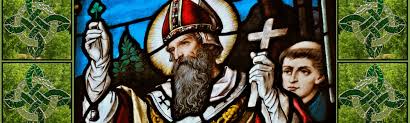 |
| St. Patrick Apostle and Patron of Ireland |
If I am worthy, I am
ready also to give up my life,
without hesitation and most willingly, for His
name.
I want to spend myself in that country,
even
in death,
if the Lord should grant me this favor.
I am deeply in His debt, for He gave me this
favor.
I am deeply in His debt, for He
gave me that great grace that through me many peoples should be reborn in God,
and then made perfect by confirmation and everywhere among them clergy ordained
for a people so recently coming to believe, one people gathered by the Lord from the ends of the earth.
As God had prophesied of old through the
prophets. The nations shall come to you from the ends of the earth, and say: “How
false are the idols made by our fathers: they are useless.” In another prophesy he said, I have set you as a light among the nations, to bring salvation to the ends of
the earth.
It is among that people
that I want to wait for the promise
made by Him,
who assuredly never tells a
lie.
He makes this promise in the
Gospel: They shall come from the east and
west, and sit down with Abraham, Isaac and Jacob. This is our faith: believers are to come
from the world.
The Confessions of St. Patrick … I Patrick …. http://www.confessio.ie/etexts/confessio_english#01
Friday, 2 December 2016
Lights at Christmas
 |
| Jesus Christ the Light of the World |
Christmas is known as the "feast of light",
as
Jesus, the Light of the World,
the Rising Dawn, the Light
to be revealed to the
Nations (Luke 2, 32), is born.
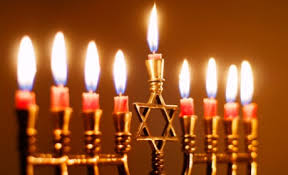
Those of the Jewish faith annually celebrate in December the
anniversary of the Re-dedication of the Temple as a "feast of lights"
(Hanukkah). Christians have made the Nativity their feast of lights in honor of
Him who was born as a Light to illuminate the nations (Luke 2, 32).
In medieval times it was customary to represent Christ the
Lord by a burning candle. This custom is still preserved in the liturgy of the
Church, as for instance, the Easter candle, the last candle at the Tenebrae
services of Holy Week. At Christmas, a large candle symbolizing the Lord used
to be set up in the homes of the faithful on the eve of the Feast. It was
placed in the center of a laurel wreath and kept burning through the Holy
Night, and was lit, thereafter, every night during the holy season.
The custom of the Christmas candle is still kept in its
original form in some countries. In Ireland, the mother or the father of the
household lights a holly-bedecked large candle on Christmas eve while the
entire family prays for all its dear ones, both living and departed. Among the
Slavic nations (Poles, Ukrainians, Russians) the large Christmas candle is put
on the table after it has been blessed by the priest in church. The Ukrainians
do not use candlesticks but stick the candle in a loaf of bread.
 |
| Weihnachtspyramide |
In many sections of South America the candle is placed in a
paper lantern with Christmas symbols and pictures of the Nativity decorating
its sides. In England and France the Christmas light often consisted of three
individual candles molded together at the base, in honor of the holy Trinity.
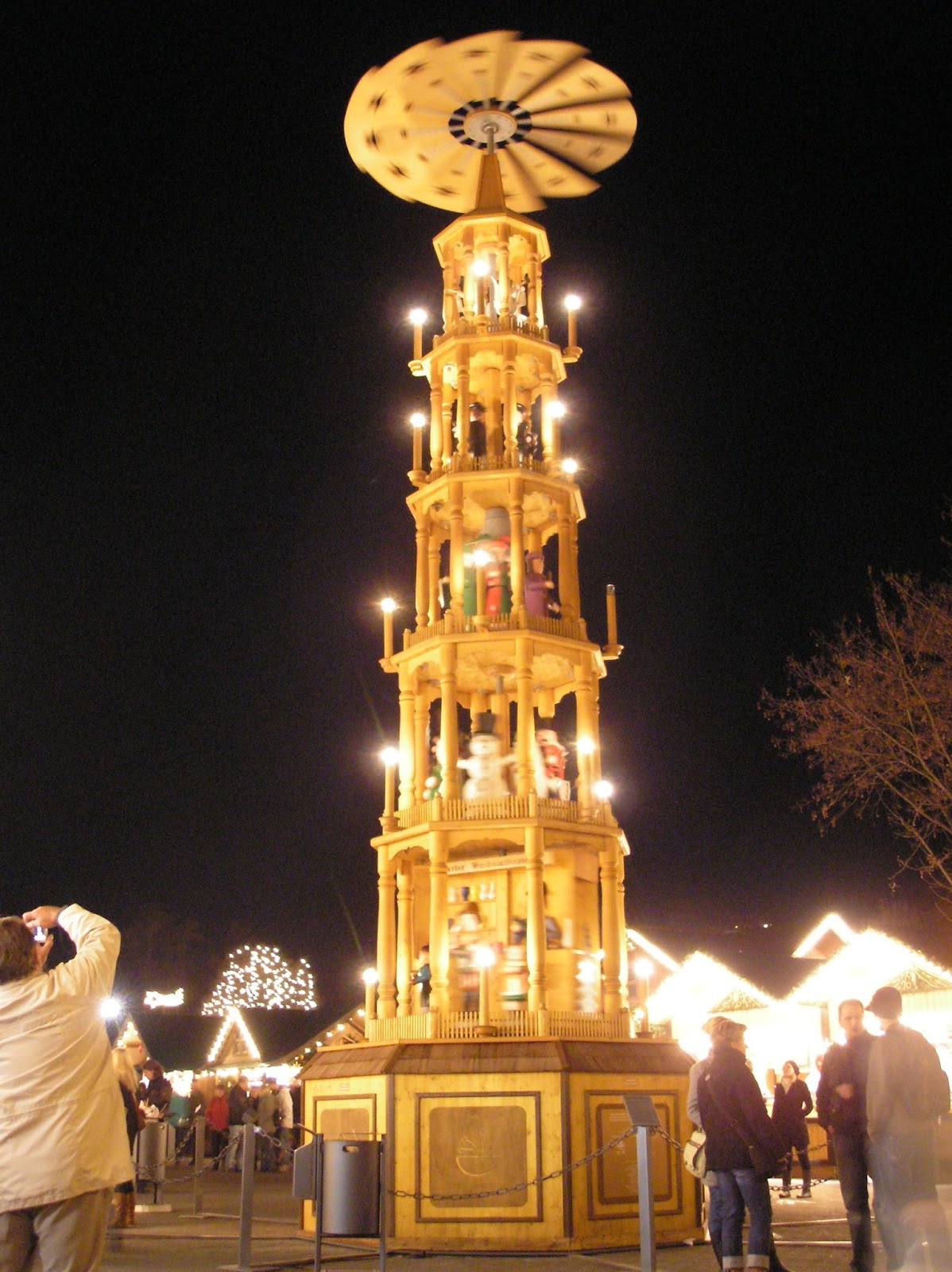
In Germany the Christmas candle used to be placed on top of a wooden pole
decorated with evergreens (Lichtstock), or sometimes many smaller candles were
distributed on the shelves of a wooden structure made in the form of a pyramid,
adorned with fir twigs or laurel, draped with glittering tinsel
(Weihnachtspyramide). (During the seventeenth and eighteenth century this
pyramid was replaced by our Christmas tree.)
In addition to the main candle, it later became a custom to
set up other smaller candles all through the house in honor of the Feast:
Then be ye glad, good people,
This night of all the year,
And light ye up your candles:
His Star is shining near.
 |
| Candle in the window |
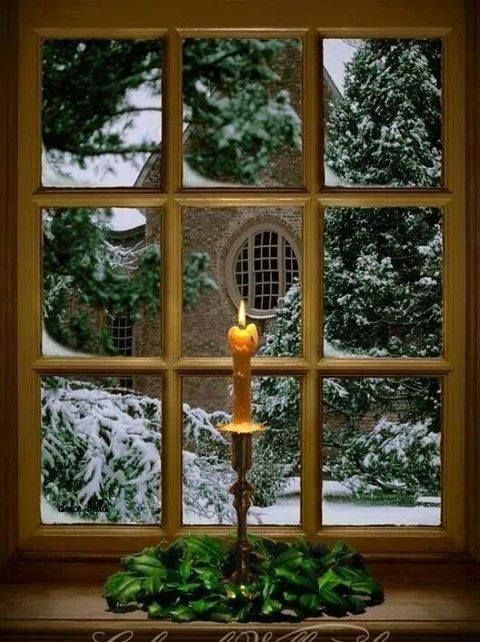
The customs of placing lighted candles in the windows at
Christmas was brought to America by the Irish. The historical background of
this custom is interesting. When religion was suppressed through Ireland during
the English persecution, the people had no churches. Priests hid in forests and
caves and secretly visited the farms and homes to say Mass there during the
night. It was the dearest wish of every Irish family that at least once in
their lifetimes a priest would arrive at Christmas to celebrate the Divine
sacrifice during Holy Night. For this grace they hoped and prayed all through
the year. When Christmas came, they left their doors unlocked and placed
burning candles in the windows so that any priest who happened to be in the
vicinity could be welcomed and guided to their home through the dark night.
Silently he entered through the unlatched door and was received by the devout
with fervent prayers of gratitude and tears of happiness that their home was to
become a church during Holy Night.
To justify this practice in the eyes of the English
soldiers, the Irish people used to explain: "We burn the candles and keep
the doors unlocked, that Mary and Joseph, looking for a place to stay, will
find their way to our home and be welcomed with open doors and open
hearts." The English authorities, finding this Irish "superstition"
harmless, did not bother to suppress it. The candles in the windows have always
remained a cherished practice of the Irish, although many of them have long
since forgotten the earlier significance. The custom was brought to this
country in the early nineteenth century and spread throughout the land, so much
so that in recent years electric candles and lights of all kinds are used in
homes and in public squares during the Christmas season. Business districts as
well as suburban streets spend much time and money to make their decorations
gay and bright with lights.
 |
| Feast of Lights Switzerland |
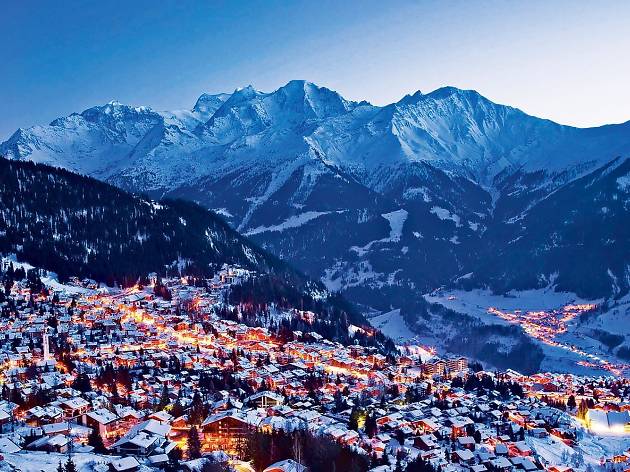
An inspiring and colorful sight are the Christmas fires
burned on the peaks of the Alps in Central Europe. Like flaming stars they hang
in the dark heavens during Holy Night, burning brightly and silently, as the
farmers from around the mountain-sides walk through the winter night down into
the valley for midnight Mass. Each person carries a lantern, swinging it to and
fro; the night seems alive with hundreds of glow-worms converging toward the
great light at the foot of the mountain — the parish church — shining and
sparkling, a "Feast of Lights," indeed. No one who has witnessed this
scene on Christmas Eve in Austria, Bavaria, or Switzerland will ever forget it.
A seasonable Christmas in England and Northern Europe is a
cold one. In past centuries it was even colder than it is now because the
"old Christmas" — before Pope Gregory XIII corrected the Julian
calendar in the sixteenth century — came eleven days later, on January fifth of
the present calendar.
At a time when coal and other modern heating fuels were
unknown, the firewood to be burned during Holy Night and on Christmas assumed
special significance. A huge log was selected and brought to the house with
great ceremony in preparation for the ceremony. It was called the
"Christmas log" or "Yule log," as Herrick sings:
 |
| Yule Log |
Come, bring with a noise,
My merrie, merrie boyes,
The Christmas Log to the firing. . . .
In some places the Yule log was the whole trunk of a tree,
carefully selected on the preceding feast of Candlemas and stored away to dry
out during the summer. Many popular customs and ceremonies were connected with
the Christmas log. The unburnt parts, for instance, were put aside and
preserved because the new log of next year had to be kindled with wood from the
old one. The main purpose of the log, however, was to blaze and burn on the
open hearth during Holy Night and on Christmas day.
In spite of modern heating today the Yule log has survived
in many homes in England and America as an old and cherished Christmas
tradition, though actually it originated among the Germanic tribes as a pagan
celebration for the Yule-god Thor at the time of the solstice.
Activity Source: Christmas Book, The by Francis X. Weiser,
S.J., Harcourt, Brace and Company, New York, 1952
Taken from website Catholic Culture
Tuesday, 26 July 2016
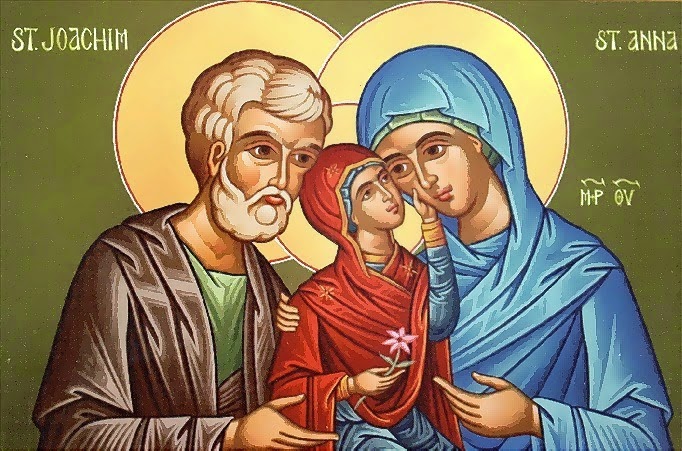
Joachim and Anne, Parents of Mary
 |
| Joachim & Anne, parents of the Virgin Mary |
 |
| Sts. Joachim and Anne |
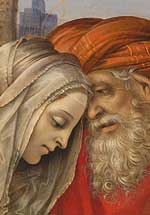
Mary's parents must have been very devout and God-centered people. For God would not have chosen them to be the parents of His Mother from those who were not. I can imagine how heartbroken Anne and Joachim were on not having children in the days when this was thought shameful.
But imagine the joy and love that they had when Mary was born! She was their cherished treasure. They taught her to love and serve God with her whole heart, soul and being. In humble servitude to help others in need.
It is said that her parents were so happy when Mary was born that they consecrated her to God. When she was a very young girl she was taken to the temple to serve as a maiden in the service of God. Seeing her go into the temple must have been a great joy but also a great sacrifice -- the beloved child that they doted on was not with them anymore. They must have missed her terribly.
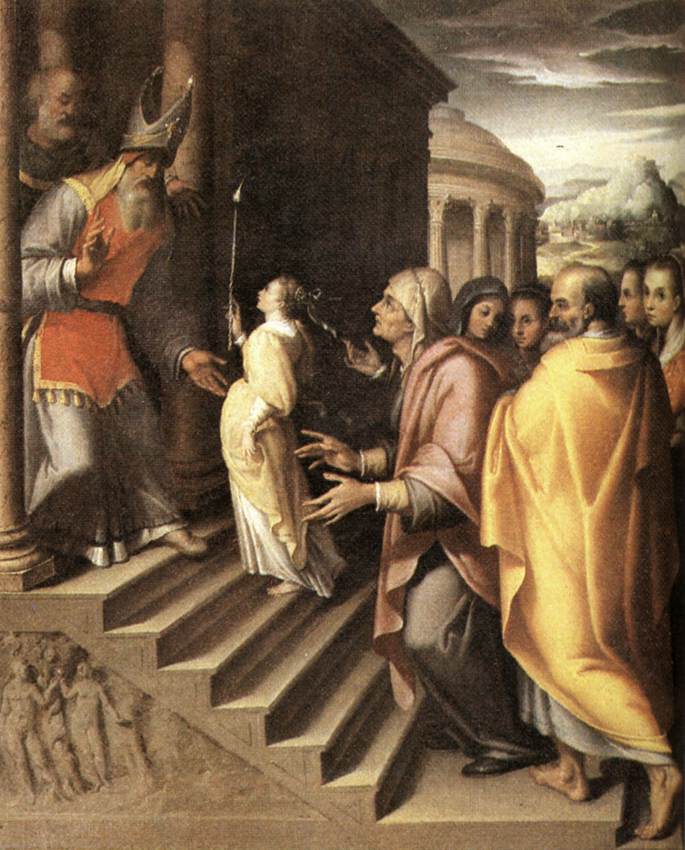 |
| The child Mary consecrated to the Temple |
We do not know much about St. Joachim and St. Anne - but imagine being the parents of the Virgin Mary -- the chosen Mother of God and the grandparents of Jesus Our Lord, how blessed they are!
St. Joachim and St. Anne pray for us! Especially us who are grandparents! Help us be good examples of living the Christian Catholic faith.
The Greek Orthodox Church
has much more to say about
the story of Joachim and Anne. See the website http://www.pravoslavie.ru/english/48783.htm
+ + + + + + +
By their fruits you will know them
From a sermon by Saint John Damascene, bishop
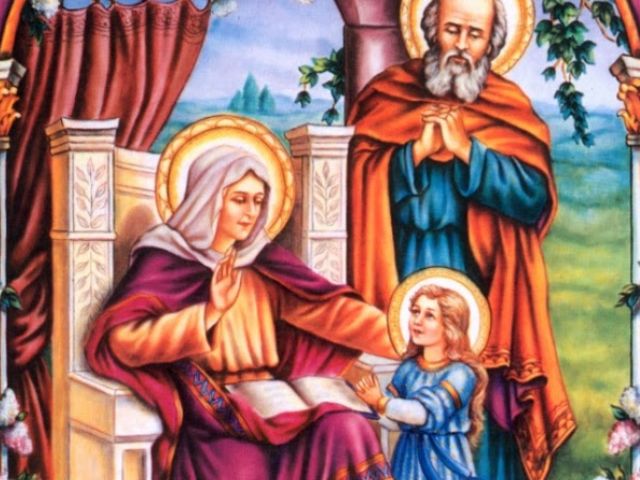 |
| Sts. Joachim and Anne with the Virgin Mary as a child |
Ann was to be the mother of the Virgin Mother of God, and
hence nature did not dare to anticipate the flowering of grace. Thus nature remained sterile, until grace
produced its fruit. For she who was to
be born had to be a first-born daughter, since she would be the mother of the
first-born of all creation, in whom all
things are held together.
Joachim and Ann, how blessed a couple! All creation is indebted to you. For at your hands the Creator was offered a
gift excelling all other gifts: a chaste mother, who alone was worthy of him.
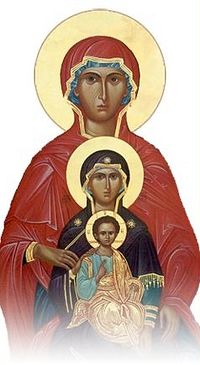 |
| St. Anne,Virgin Mary & Jesus the Son of God |
And so rejoice, Ann, that you were sterile and have not borne children, break forth into shouts,
you who have not given birth. Rejoice, Joachim, because from your daughter a child is born for us, a son is given us,
whose name is Messenger of great counsel and universal salvation, mighty God.
For
this child is God.
Joachim and Ann, how blessed and spotless a couple! You will be known by the fruit you have
borne, as the Lord says: By their fruits
you will know them. The conduct of your life pleased God and was worthy of
your daughter. For by the chaste and
holy life you led together, you have fashioned a jewel of virginity: she who remained
a virgin before, during and after giving birth.
She alone for all time would maintain her virginity in mind and soul as
well as in body.
Joachim and Ann, how chaste a couple! While safeguarding the chastity prescribed by
the law of nature, you achieved with God’s help something which transcends
nature in giving the world the Virgin Mother of God as your daughter. While leading a devout and holy life in your
human nature, you gave birth to a daughter nobler than the angels, whose queen
she now is. Girl of utter beauty and
delight, daughter of Adam and mother of God, blessed the loins and blessed the
womb from which you come!
Blessed the
arms that carried you,
blessed your parents’ lips, which
you were allowed to
cover
with chaste kisses,
ever maintaining your virginity.
Rejoice
in God, all the earth. Sing, exult and
sing hymns.
Raise your voice, raise
it and be not afraid.
taken from the Liturgy of the Hours
Friday, 8 July 2016
The Martyrdom of Peter and Paul
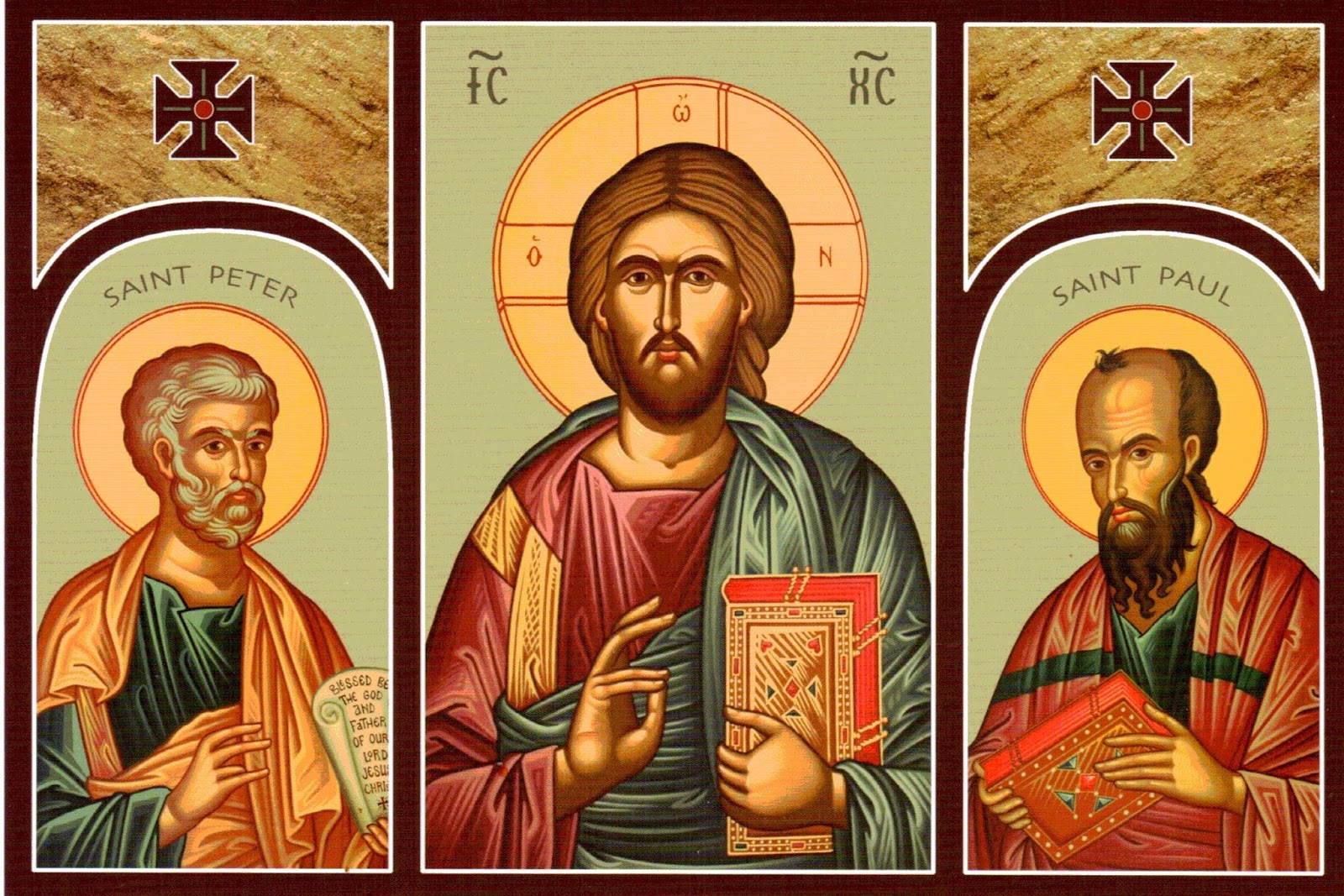 |
| Christ with Sts. Peter and Paul |
From a sermon by Saint Augustine, bishop 354-430 A.D.
The Martyrs realized what they taught
This day (Feast Day Peter and Paul, Apostles, June 29), has
been made holy by the passion of the blessed apostles Peter and Paul.
We are, therefore, not talking about some obscure
martyrs.
For their voice has gone forth to all the world,
and to the ends of the
earth their message.
These martyrs
realized what they taught: they pursued justice they confessed the truth, they
died for it.
Saint Peter, the first of the apostles and a fervent lover
of Christ, merited to hear these words: I
say to you that you are Peter, for he had said: You are the Christ, the Son of the Living God. Then Christ said, I say to you that you are Peter, and on this rock I will build my
Church.
On this rock I will build
the faith that you now confess, and on your words: You are the Christ, the Son of the Living God, I will build my Church.
For you are Peter,
and the name Peter comes
from petra, the word for “rock”,
and
not vice versa.
 |
| I say to you that you are Peter, and on this rock I will build my Church. |
“Peter” comes, therefore,
from petra, just as
“Christian” comes
from Christ.
 |
| To you I shall give the keys of the kingdom of heaven |
As you are aware, Jesus chose His disciples before His
passion and called them apostles; and among these almost everywhere Peter alone
deserved to represent the entire Church.
And because of that role which he alone had, he merited to hear the
words: To you I shall give the keys of
the kingdom of heaven.
For it was
not one man who received the keys, but the entire Church considered as
one. Now insofar as he represented the
unity and universality of the Church, Peter’s pre-eminence is clear from the
words: To you I give, for what was
given was given to all.
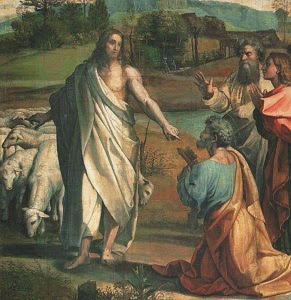 |
| Peter feed My sheep |
For the face
that it was the Church that received the keys of the kingdom of God is clear
from what the Lord says elsewhere to all the apostles: Receive the Holy Spirit, adding immediately, whose sins you forgive, they are forgiven, and whose sins you retain,
they are retained.
Rightly then did the Lord after His resurrection entrust
Peter with the feeding of his sheep. Yet
he was not the only disciple to merit the feeding of the Lord’s sheep; but
Christ in speaking only to one suggests the unity of all;
and so He speaks to
Peter,
because Peter is first among the apostles.
Therefore do not be disheartened, Peter,
reply once, reply twice, reply a third time. The triple confession of your love
is to regain what was lost three times by your fear. You must lose three times what you bound
three times; untie by love that which your fear bound. Once, and again, and a third time did the
Lord entrust his sheep to Peter.
Both apostles share the same feast day, for these two were
one; and even though they suffered on different days, they were as one.
Peter went first, and Paul followed. And so we celebrate this day made holy for us
by the apostle’s blood.
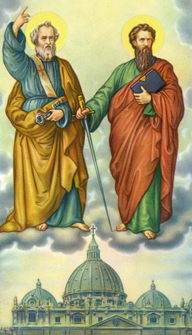 |
| Sts. Peter and Paul |
Let us embrace
what they believed,
their life, their labors, their sufferings,
their preaching
and their confession of faith.
Subscribe to:
Posts (Atom)