Ad

Showing posts with label apostles. Show all posts

Friday, 8 July 2016

The Martyrdom of Peter and Paul

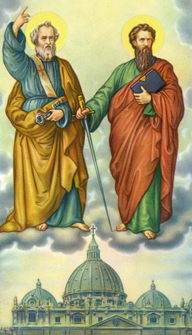
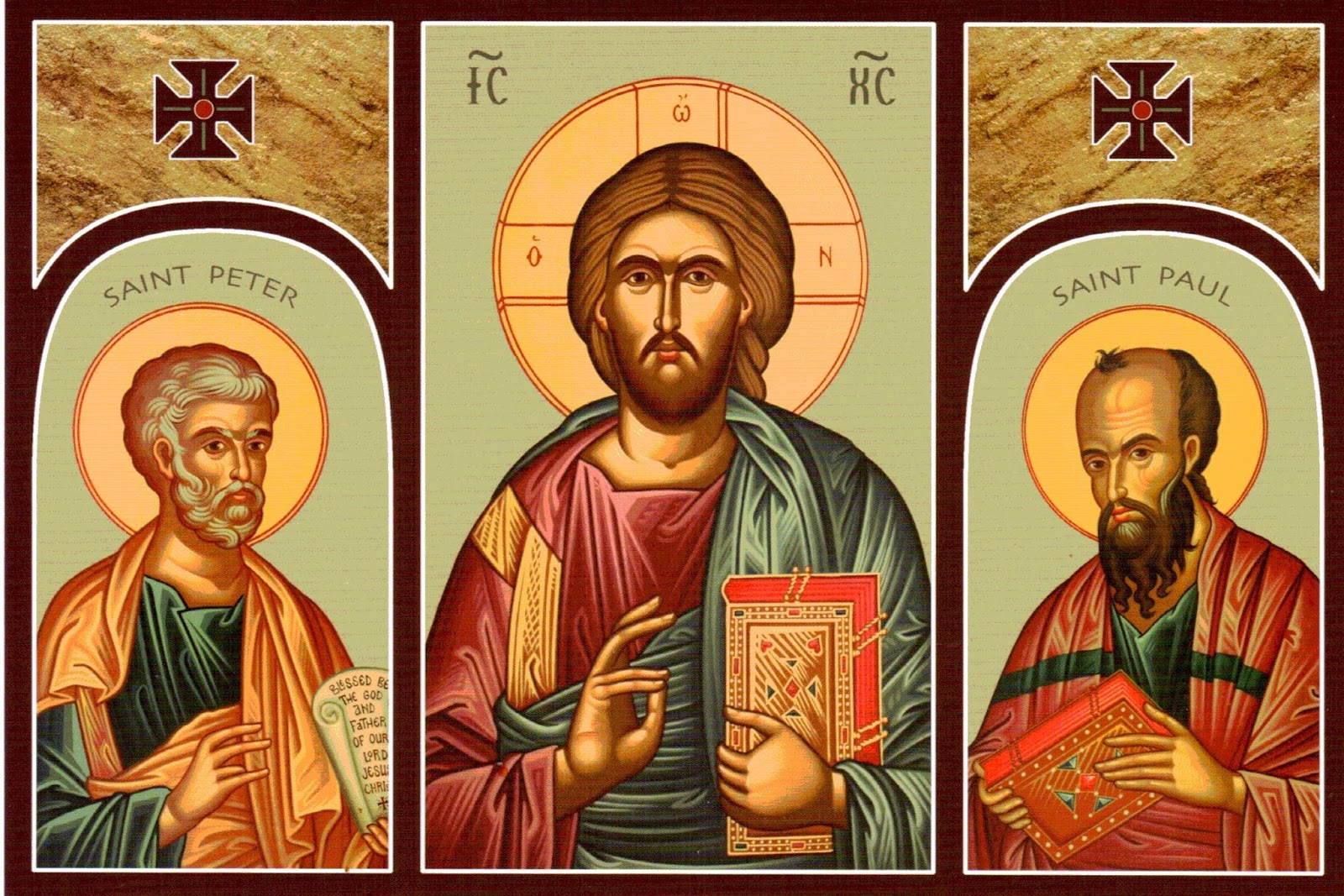
Christ with Sts. Peter and Paul


From a sermon by Saint Augustine, bishop 354-430 A.D.


The Martyrs realized what they taught

This day (Feast Day Peter and Paul, Apostles, June 29), has been made holy by the passion of the blessed apostles Peter and Paul.

We are, therefore, not talking about some obscure martyrs.  

For their voice has gone forth to all the world, 
and to the ends of the earth their message.  

These martyrs realized what they taught: they pursued justice they confessed the truth, they died for it.

Saint Peter, the first of the apostles and a fervent lover of Christ, merited to hear these words: I say to you that you are Peter, for he had said: You are the Christ, the Son of the Living God.  Then Christ said, I say to you that you are Peter, and on this rock I will build my Church.  

On this rock I will build the faith that you now confess, and on your words: You are the Christ, the Son of the Living God,  I will build my Church.  

For you are Peter, 
and the name Peter comes 
from petra, the word for “rock”, 
and not vice versa. 

I say to you that you are Peter,
and on this rock I will build my Church.

“Peter” comes, therefore, 
from petra, just as 
“Christian” comes from Christ.


To you I shall give the keys of the kingdom of heaven  
As you are aware, Jesus chose His disciples before His passion and called them apostles; and among these almost everywhere Peter alone deserved to represent the entire Church.  

And because of that role which he alone had, he merited to hear the words: To you I shall give the keys of the kingdom of heaven.  

For it was not one man who received the keys, but the entire Church considered as one.  Now insofar as he represented the unity and universality of the Church, Peter’s pre-eminence is clear from the words: To you I give, for what was given was given to all.  

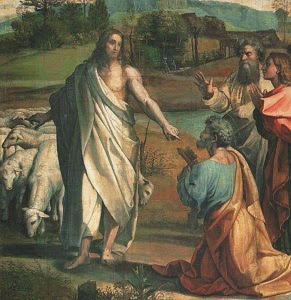
Peter feed My sheep
For the face that it was the Church that received the keys of the kingdom of God is clear from what the Lord says elsewhere to all the apostles: Receive the Holy Spirit, adding immediately, whose sins you forgive, they are forgiven, and whose sins you retain, they are retained.

Rightly then did the Lord after His resurrection entrust Peter with the feeding of his sheep.  Yet he was not the only disciple to merit the feeding of the Lord’s sheep; but Christ in speaking only to one suggests the unity of all; 

and so He speaks to Peter, 
because Peter is first among the apostles.  

Therefore do not be disheartened, Peter, reply once, reply twice, reply a third time. The triple confession of your love is to regain what was lost three times by your fear.  You must lose three times what you bound three times; untie by love that which your fear bound.  Once, and again, and a third time did the Lord entrust his sheep to Peter.

Both apostles share the same feast day, for these two were one; and even though they suffered on different days, they were as one.  

Peter went first, and Paul followed.  And so we celebrate this day made holy for us by the apostle’s blood. 


Sts. Peter and Paul


Let us embrace what they believed, 
their life, their labors, their sufferings, 
their preaching and their confession of faith.


Wednesday, 23 July 2014

Storms of Life -- Trusting in God


Letting Jesus Sleep

Matthew 8:23-27
 
by Father Eamonn Shelly, LC | Source: Catholic.net
 
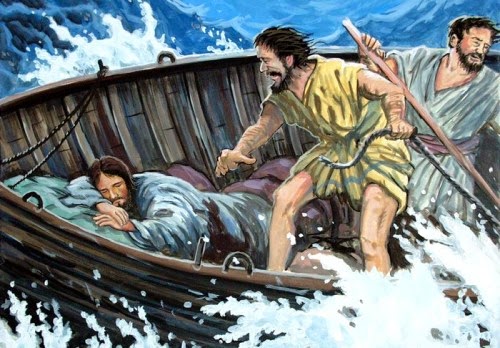
As Jesus got into the boat, his disciples followed him. A windstorm arose on the sea, so great that the boat was being swamped by the waves; but he was asleep. And they went and woke him up, saying, "Lord, save us! We are perishing!" And he said to them, "Why are you afraid, you of little faith?" Then he got up and rebuked the winds and the sea; and there was a dead calm. They were amazed, saying, "What sort of man is this, that even the winds and the sea obey him?"
 
Introductory Prayer:
Lord, I come to you in this meditation ready to do whatever it is you ask. Left to myself I often take the easy and convenient path, yet I know the way of a Christian is through the narrow gate. In you I find the reason to abandon the easy path for a more perfect mission of love. I’m ready to learn the meaning of your command: “Follow me.” Lord as worries tug at my heart, let me learn to rise above them and trust in you. Master of my life, I love the goods you have placed in my hands: my health, family, mission in life…. Grant me faith that can pass through the worst of storms and come through it profoundly enriched, humanly stronger, and more deeply united to you, my protector and guide.
 Petition: Lord, grant me the grace of a mature faith.
 
 1. God’s Silence, Man’s Faith:
We can imagine ourselves in the place of the apostles, in this poor boat tossed by the turbulent waves. The situation instantly speaks to our worst of fears; yet Jesus sleeps. Our temptation is to wake him…and too many souls do so through incessant complaining incessantly, despairing attitudes, withdrawal withdrawing from prayer, or unloaded unloading anger on others. When in a moment of trial we find life is no longer under our complete control, the option of meltdown is always at hand. But I we mustn’t take that route; instead I we must contemplate the power that emanates from the sleeping Christ. Trials are intended by God to draw us closer to him and increase our dependence on him. I We have to live from faith; otherwise all that reigns is fear, insecurity and bitterness. The “Silence of Christ” is powerful. To pass over its meaning lightly is to abandon some of the deepest lessons of Christ’s heart. The “Silence of Christ” must teach us.
 
 2. The “Silence of Christ” Speaks to Our Faith:
What is Christ’s sleep like? As a young mother, Mary watched Jesus sleep many times. Archbishop Martinez writes:
“Jesus was exceedingly beautiful when he spoke the words of eternal life, accomplished wonders, looked with love, pardoned with mercy, and caressed with tenderness. But I would like to have seen him while he was sleeping because I could have contemplated him to my heart’s content, without the fascination of his gaze distracting me, without the perfection of his beauty and the glory of his splendor dazzling my eyes and enrapturing my soul. The beauty of Jesus awake is far too great for my smallness. Who could support it? I felt it more suited to me veiled by sleep, as the glory of the sun is more adapted to my eyes when I look at it through a translucent lens” (When Jesus Sleeps, p.15).
 
May I trust the power of Christ
just as much
when He chooses
not to act -- as when He does.
 
3. God’s Eternal Pedagogy: 
Water, a boat , the apostles, and Christ… this scene repeats itself over and over again in the Gospel. Water is a symbol of the experiences of life taken on a human level; the boat is the experience of faith on a supernatural level -- it is our life with Christ. Christ’s message is that I we can never let my our experiences of life overwhelm my our experience of faith. I/We have to live not from the surface level of impressions of the moment, but open myself up to/from the deep channel of faith that reveals the action of God, the wisdom of his Providence, and the ultimate destiny of eternity.
 
Faith is what reveals Christ’s presence in our boat;
faith is what makes us believe that every wave and wind
gust are blessed invitations to confide in the One who rules all.
 
Faith is what permits God to console our hearts, calm our fears, and preserve our joy in the midst of many problems and difficulties that may take months or years to run their course.
 
Conversation Dialogue with Christ: 
Lord, I know belief makes me vulnerable. To believe is to push out from shore with you in my boat, leaving behind the security I find in my talents and plans, my friends and relatives, my financial and social standing But I know. I will not know your power if I do not know how to truly leave my whole life in your hands. that I will not know your love if I do not believe that you can make me happier than I could can be by myself. I will not know your victory if I do not face the enemies of my soul and my mission with and abandonment myself to your grace, I will not know your victory.
 
 
 Resolution: 
Today I will take a recent problem and, with complete trust and confidence in him, leave it totally in God’s hands today with complete trust and confidence in him.
 
Jesus Calms the Sea
 

Wednesday, 8 August 2012

Writings of Thomas a Kempes on Trust and Prayer


The Imitation of Christ
by Thomas a Kempes

Of the help of God to be asked, and of a Full Trust to recover our former grace thorough devout prayer


Come to Me
My son, I am the Lord who sends comfort in time of tribulation. 

Come, therefore, to Me when it is not well with you.  What hinders you most is that you turn yourself to Me too slowly; before you pray heartily to Me you seek many other comforts, and refresh your spirit in outward things.  And so it comes about that all that you do helps you little, until you can behold and see that I am He who sends comfort to all who faithfully call to Me, and that without Me there can be no profitable counsel or perfect remedy.

But now, take good spirit.  After your trouble, be comforted in Me, and have full trust in the light of My Mercy, for I am near you to help and restore you, not only to the same grace you had at first, but to more grace in great abundance.  Is there anything hard or impossible to Me, or am I like a man who says a thing and does not do it?  Where is your faith?  Stand strongly and perserveringly in Me; be steadfast, awaiting My promise; and you will have comfort when it will be most expedient to you.  Abide, abide and wait for Me, and I will come soon to you and help you.

It is temptation that troubles you, and a vague dread that makes you fear.  But of what avail is such fear or dread of things that perhaps will never come, save that the spiritual enemy desires that you should have sorry upon sorrow.  Bear your present troubles patiently, therefore, and do not fear overmuch those that are to come, for sufficient to the day is the day’s evil.  It is vain and unprofitable to be sad or glad for things which perhaps will never happen or come.  But it is the instability of man that he will be deceived and will so easily follow the suggestion of the enemy, who does not care whether he deceives by true or false suggestion, not whether he deceives by love of things present or by fear of things to come.  Therefore, do not be troubled and do not fear. 
Divine Mercy Image

Trust strongly in Me and have perfect hope in My Mercy.  When you think you are very far from Me, I am often quite close to you; when you think all is lost, then the greater reward often follows.  All is not lost, though some things happen contrary to your will.  You should not judge of them according to your outward feeling, nor should you take any grief so sorely to heart that you do not have good hope to escape it.  You should not think yourself wholly forsaken by Me, though I send you for a time some grief and trouble, for this is the surer way to the kingdom of heaven.

Doubtless, it is more expedient to you and to My other servants sometimes to be proved by adversity than always to have all things according to your will.  I know the hidden features of man, and that it is much more expedient to the health of his soul to be left sometimes to himself without spiritual sweetness or comfort, lest, perhaps, he be raised up by pride, and think himself better than he is.  What I have given I may take away, and may restore it again when it pleases Me.  When I give something to any person, what I have given is My own, and when I take it away again, I take nothing of his, for every good gift, every perfect reward, comes from Me.  If I send you trouble or heaviness, in what way whatsoever, take it gladly and do not despise it, and do not let your heart fail you in the trouble, for I may soon lift you up again, and turn your heaviness into great joy and spiritual gladness, and truly I am just and much to be glorified and praised when I act so with you.

Pray devoutly

If you understand properly and behold yourself truly as you are, you will never be so immediately grieved because of any adversity; rather, you will find joy in it, and think it is the greatest gift that I do not abstain from scourging you with such trouble and adversity. 

I said to My disciples:  As My Father loves Me, so I love you, and yet I sent them forth into the world not to have temporal joy, but to meet great battles; not to have honors, but injuries; not to be idle, but to labor; not to rest, but to bring forth much good fruit in patience and in good works.   

My son, remember well these words I have spoken to you, for they are true and cannot be denied.

Jesus sending His disciples out to preach the Good News

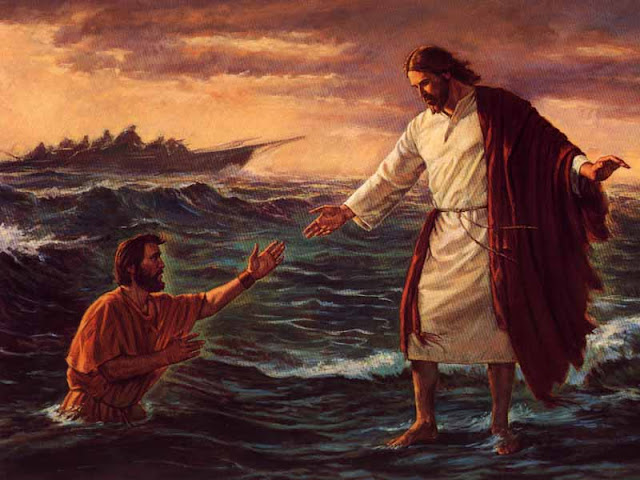
The miracle of Jesus walking on water & Peter's request


Lord, save me!! Oh you of little faith.

Peter Swims with the Fishes : Matthew 14:22-33 
Excerpts from sermons by John Ortberg/Bill Burnett (see below for details)

Recognize God’s presence in the storms.   Jesus wanted to be alone to pray, so they were sent ahead without him.   To them it was no big deal – they used boats for fishing on a daily basis.    But this huge storm blew in – bigger than most storms.   Matthew says that the boat was “buffeted” by the waves.    It was so violent that the only thing the disciples could do was to keep the boat upright. (14:24) 

I can imagine… that they wished the sides were a little higher and the wood a little thicker.   By 3:00 am the storm was getting really bad.   I can imagine that at that point – they weren’t worried about making it to the other side–they just wanted to stay alive.   Let that sink in.  The disciples were in distress.  It is about this time that Jesus decides to come toward them.
It’s interesting… he wasn’t in a boat and the disciples didn’t recognize him. (v. 25) It’s also interesting… being boatless didn’t seem to slow Jesus down at all.  The disciples were convinced he was a ghost, so they were terrified and cried out in fear. (v.26)  But Matthew wants us to know that sometimes it takes eyes of faith to recognize when Jesus is around.
 
Remember, the disciples were in a storm because they were trying to be obedient to Christ.  Now that’s not the only reason storms come in the lives of believers.   Remember Jonah?   He had to go through a storm for correction, but on this occasion, for the disciples, this wasn’t a corrective storm because they were doing what Jesus had commanded them to do.   Verse 22 says “Jesus made the disciples get into the boat and go on ahead of him to the other side.”   And they did, or at least they tried to.   And six hours later they had not made much progress.  So remember first of all, obedient water walkers will face storms. 

Mark tells us that Jesus “intended to pass them by” on the water, but when they saw him walking on the lake, they thought it was a ghost. Why did Jesus want to “pass by them?”  “He saw the disciples straining at the oars, because the wind was against them. 

About the fourth watch of the night he went out to them, walking on the lake. He was about to pass by them” (Mark 6:48)   Did he want to race them?  Did he want to impress them with a really neat trick? The verb “to pass by” (parerchomai) is a greek translation of the old testament “theophanys.”   What is a theophany? “ It is those defining moments when God reveals himself on earth.” 

God put Moses in a cleft in a rock so Moses could see God as his glory passed by.   God told Elijah to stand on the mountain “for the lord is about to pass by.”   There is a pattern to these stories.   In each case – God had to get people’s attention… through a burning bush; wind; fire;  or… walking on water. With each person – God would end up calling him or her to do something extraordinary.   In each situation the person that God called felt afraid. But every time that people said, “yes” to their calling, they experienced the power of God in their lives.   So when Jesus came to the disciples on the water intending “to pass them by,” he was not just doing a neat magic trick.

He was revealing his divine presence and power.   It is interesting that the disciples entered the boat in the first place at Jesus’ command. (Matthew 14:22). They would have to learn that obedience is no guarantee of being spared adversity.   But now… the storm has their full attention.  Jesus decided that it was time for the disciples to get to know a little bit more about the guy who was piloting this storm. 

Basically… Jesus wanted them to be able to trust him also in the storms. The problem was… “they just didn’t get it.”  God was visiting them while walking on the water but they couldn’t see it. 

Matthew wants his readers to know that Jesus often comes when least expected – 3:00 a.m., in the middle of a storm.   I believe that human extremity is a frequent meeting place with God.   These are those divinely appointed defining moments that come into all of our lives.   And… if you’re not looking for him, you just might miss him.

Twelve disciples sat in the boat and we don’t know how the other eleven responded to that voice.   Were they confused?  Did they respond with wonder?  Disbelief?   Or perhaps… a little of each!   But one of them, Peter, was about to become a water walker.  He recognized that God was present – even in the most unlikely place.   He realized that this was an extraordinary opportunity for spiritual adventure and growth.  So he got an idea. He decided to do something religious.

Peter blurted out to the water walker, “if it is you, command me to come to you on the water.” (Matthew 14:28)   Why does Matthew include this detail?   Why doesn’t Peter just plunge into the water? I think it’s for a very important reason.  This is not just a story about risk taking; it is primarily a story about obedience.   That means I will have to discern between an authentic call from God and what might simply be a foolish impulse on my part. 

Courage alone is not enough; it must be accompanied by wisdom and discernment.   Matthew is not just glorifying risk-taking.   This is not a story about extreme sports.   It’s about extreme discipleship!   This means that before Peter gets out of the boat--he had better make sure Jesus thinks it’s good idea.  So he asks for clarity, “if it is you, command me…”    I don’t know… but in that darkness – I think Jesus smiled.  Maybe he laughed because one person got it.   Peter had some inkling of what it is that the master was doing. 

Not only that, Peter had enough faith to believe that he too could share the adventure.   He decided he wanted to be part of history’s original water-walker.  “Command me.”   Water walkers will face storms. Water walkers recognize God’s presence. Water walkers discern between faith and foolishness.

So Peter goes to the side of the boat.  The other disciples are watching closely.  They wonder how far he will take this thing.   He puts one foot over the side, carefully gripping the edge of the boat.  Then he puts the other foot.  He’s holding on with for dear life.

For a while it’s as if Peter and Jesus are present on the water.  Peter is beaming with delight.   Jesus is thrilled with his student.    Like master, like disciple.  Then it happens – Peter” saw the wind.”

Reality sets in, and Peter asks himself, what was I thinking?  He realized he was on the water in the middle of a storm with no boat beneath him – and he’s terrified!

Now… nothing has really changed.  The storm shouldn’t have been a surprise – it had been there the whole time.   What really had taken place was that Peter’s focus had shifted from Jesus to the storm.  

We are all the same.  We start something filled with hope – then reality sets in.  Setbacks.  Opposition.  Unexpected obstacles.  You see the wind.  It should be expected.  The world’s a pretty stormy place.  But somehow trouble still has the power to catch us by surprise.    

Because of the wind – some people decide to never leave the boat. If you get out of the boat, you will face the wind and the storms out there.  But you should know… there is no guarantee that life in the boat is going to be any safer.

Put yourself in the story.   Picture in your mind how violent the storm must have been.  It was strong enough to keep seasoned professionals struggling just to avoid being capsized.  Imagine the size of the waves, the strength of the wind, the darkness of this night – and … no acupressure wrist bands or sea-legs tablets. These were the conditions under which Peter was going to get out of the boat.   It would be tough enough to try to walk on water when the water is calm, the sun is bright, and the air is still. Imagine trying to do it when the waves are crashing, the wind is at gale force, and it’s 3:00 a.m. in the morning… and you are terrified!  

You have a sudden insight into what Jesus is doing – the lord is passing by.   Jesus is inviting you to go the adventure of your life.  But at the same time, you’re scared to death.  What would you choose – the water or the boat?  The boat is safe, secure, and comfortable.   On the other hand, the water is rough.  The waves are high.  The wind is strong.  There’s a storm out there.   And if you get out of the boat – whatever your boat happens to be – there’s a good chance you might sink!   

But… if you don’t get out of the boat – there’s a guaranteed certainty that you will never walk on the water.   If you want to walk on water –you’ve got to get out of the boat.   I believe there is something – someone – inside us who tells us there is more to life than sitting in the boat. 

Peter faced a choice, as we all do. The choice to follow Jesus – the choice to grow – is the choice for the constant recurrence of fear.   You’ve got to get out of the boat a little every day!   Here’s a deep truth about water walking:  the fear will never go away.   Why?  Because each time I want to grow, it will involve going into new territory, taking on new challenges.    And… each time I do that – I will experience fear again.  

As you see in this story… you will always have choices… risk and comfort.  Every time you get out of the boat, you become a little more likely to get out the next time.   It’s not that the fear goes away – but that you get used to living with fear.   You realize that it doesn’t have the power to destroy you.   On the other hand… every time you resist that voice, every time you choose to stay in the boat rather than heed its call, the voice gets a little quieter in you.

When you are serving God, and trying to be obedient to Christ, you will have to face storms.   I’m not talking about physical storms that are common in nature, but the storms of trials and difficulty.   Even sitting here today, you may be going through a storm.   Maybe it’s money problems, or problems in a relationship.   You might be having family problems, or problems at your job or school.   We all have storms in life.   Anyone who tells you Christianity is smooth sailing doesn’t understand what the Bible teaches about serving the Lord. 2 Tim. 3:12 says, “In fact, everyone who wants to live a godly life in Christ Jesus will be persecuted.”

So… did Peter fail?  Probably.  He took his eyes off the Lord and sank.  But I think there were eleven bigger failures sitting in the boat.  At least Peter got out of the water and walked on water – even if it was for a short while.  Why?  Because he got out of the boat.  The worst failure is to never get out of the boat!   Water walkers see failure as an opportunity to grow.
 
As soon as Peter asks for help, Jesus was there.  “Lord… save me.”  Jesus helps him physically by pulling him from the water.   But he also helps Peter grow by pinpointing the problem:  “You of little faith, why did you doubt?”   I don’t think Jesus is being harsh or critical here.   Jesus makes this comment to Peter while they are still out on the water alone.   Jesus didn’t embarrass him in front of his peers.   The problem was clear: whether Peter sank or water walked depended on whether he focused on the storm or on Jesus.

You and I were made for something more than merely avoiding failure.  There’s something inside you that wants to walk on the water – to leave the comfort of routine existence and abandon yourself to the high adventure of following God.   So let me ask you a very important question: 
Jesus calms the storm

What’s your boat? ·
·         *Your boat is whatever represents safety and security to you apart from God himself.
·         *Your boat is whatever you are tempted to put your trust in, especially when life gets a little stormy.
·         *Your boat is whatever keeps you so comfortable that you don’t want to give it up even if it’s keeping you from joining Jesus on the waves. 
          *Your boat is whatever pulls you away from the high adventure of extreme discipleship.

Do you want to know what your boat is?  Your fear will tell you.   Just ask yourself this:  What is it that most produces fear in me – especially when I think of leaving it behind and stepping out in faith?

Vocation?  Relationship?  Successes?  Failures?
]
What area(s) in your life are shrinking back from fully and courageously trusting God?   Fear will tell you what your boat is.   Leaving it may be the hardest thing you ever do.   But if you want to walk on the water, you’ve got to get out of the boat! 

“Lord Jesus help me to walk with you.   Help me to recognize whatever it is that keeps me from coming to you, keeps me from trusting you, keeps me from obeying you.   Help me to face whatever it is that I am afraid of and to trust you to save me.”
Excerpts taken from:  Peter Swims with the Fishes : Matthew 14:22-33  (If you want to walk on water you’ve got to get out of the boat)  http://www.cc-vw.org/sermons/matthew14.htm


Thursday, 21 June 2012

The Story of St. Matthias The Apostle


St. Matthais the Apostle
St. Matthias The Apostle
The Greek Matthias, is a name derived from Mattathias, Hebrew Mattithiah, signifying “Gift of Yahweh“

Patron Saint of alcoholism, carpenters, diocese of Great Falls-Billings Montana, reformed alcoholics, smallpox, tailors 

Matthias was the apostle chosen by the remaining eleven apostles to replace Judas Iscariot following Judas’ betrayal of Jesus and suicide. His calling as an apostle is unique in that his appointment was not made personally by Jesus, who had already ascended to heaven, and, it was made before the descending of the Holy Spirit upon the early Church.
According to Acts 1, in the days following the Ascension of Jesus, to the assembled disciples, who numbered about one hundred and twenty, that they nominated two men to replace Judas: Joseph called Barsabbas (also known as Justus) and Matthias. Then they prayed, “Lord, you know everyone’s heart. Show us which of these two you have chosen to take over this apostolic ministry, which Judas left to go where he belongs.” Then they cast lots, and the lot fell to Matthias; so he was added to the eleven apostles. (Acts 1:23-26)
                All further information concerning the life and death of Matthias is vague and contradictory. According to Nicephorus, he first preached the Gospel in Judea, then in Ethiopia and was crucified. The Synopsis of Dorotheus contains this tradition:  Matthias preached the Gospel to barbarians and cannibals in the interior of Ethiopia, at the harbour of the sea of Hyssus, at the mouth of the river Phasis. He was stoned at Sebastopolis in 80 AD and was buried there, near the Temple of the Sun. Some relics can be found in the abatical church of Triers, others in Saint Mary Major in Rome
                Still another tradition maintains that Matthias was stoned at Jerusalem by the Jews, and then beheaded.  It is said that St. Helena brought the relics of St. Matthias to Rome, and that a portion of them was at Trier. Bollandus doubts if the relics that are in Rome are not rather those of the St. Matthias who was Bishop of Jerusalem about the year 120, and whose history would seem to have been confounded with that of the Apostle.  The Latin Church celebrates the feast of St. Matthias on 24 February and the Greek Church on 9 August. L ater, the Latin Church moved the feast of St. Matthias to 14 May.

From a homily on the Acts of the Apostles 
St. Matthais the Apostle
by Saint John Chrysostom 

"In those days, Peter stood up in the midst of the disciples and said..." As the fiery spirit to whom the flock was entrusted by Christ and as the leader in the band of the apostles, Peter always took the initiative in speaking: "My brothers, we must choose from among our number." He left the decision to the whole body, at once augmenting the honor of those elected and avoiding any suspicion of partiality.
Did not Peter then have the right to make the choice himself? Certainly he had the right, but he did not want to give the appearance of showing special favor to anyone. "And they nominated two," we read, "Joseph, who was called Barsabbas and surnamed Justus, and Matthias." He himself did not nominate them; all present did. But it was he who brought the issue forward, pointing out that it was not his own idea but had been suggested to him by a scriptural prophecy.
And they all prayed together, saying: "You, Lord, know the hearts of men; make your choice known to us. You, not we." Appropriately they said that he knew the hearts of men, because the choice was to be made by him, not by others.
They spoke with such confidence, because someone had to be appointed. They did not say "choose" but "make known to us" the chosen one; "the one you choose," they said, fully aware that everything was being preordained by God.
from a homily on the Acts of the Apostles by Saint John Chrysostom