 |
| St. George, Martyr |
St. George, Martyr
From a sermon by Saint Peter Damian, bishop
Invincibly defended by the banner of the cross
Dear brothers, our joy in today’s feast is heightened by our
joy in the glory of Easter, just as the splendor of a precious jewel enhances
the beauty of its gold setting.
Saint George was a man who abandoned one army for another:
he gave up the rank of tribune to enlist as a soldier for Christ. Eager to encounter the enemy, he first
stripped away his worldly wealth by giving all he had to the poor. Then, free and unencumbered, bearing the
shield of faith, he plunged into the thick of the battle, as ardent soldier for
Christ.
Clearly what he did serves to teach us a valuable lesson: if
we are afraid to strip ourselves of our worldly possessions, then we are unfit
to make a strong defense of the faith.
As for Saint George, he was consumed with the fire of the
Holy Spirit. Armed with the invincible
standard of the cross, he did battle with an evil king and acquitted himself so
well that, in vanquishing the king, he overcame the prince of all wicked
spirits, and encouraged other soldiers of Christ to perform brave deeds in his
cause.
Of course, the supreme invisible arbiter was there, who
sometimes permits evil men to prevail so that his will may be accomplished. And although he surrendered the body of his
martyr into the hands of murderers, yet he continued to take care of his soul,
which was supported by the unshakable defense of its faith.
Dear brothers, let us not only admire the courage of this
fighter in heaven’s army but follow his example. Let us be inspired to strive for the reward
of heavenly glory, keeping in mind his example, so that we will not be swayed
from our path, though the world seduce us with its smile or try to terrify us
with naked threats of its trials and tribulations.
We must now cleanse ourselves, as Saint Paul tells us, from
all defilement of body and spirit, so that one day we too may deserve to enter
that temple of blessedness to which we now aspire.
Anyone who wishes to offer himself to God in the tent of
Christ, which is the Church, must first bathe in the spring of holy baptism;
then he must put on the various garments of the virtues. As it says in the Scriptures: Let your priests be clothed in justice. He who is reborn in baptism is a new
man. He may no longer wear the things
that signify mortality. He has discarded
the old self and must put on the new. He
must live continually renewed in his commitment to a holy sojourn in this
world.
Truly we must be cleansed of the stains of our past sins and
be resplendent in the virtue of our new way of life. Then we can be confident of celebrating Easter worthily and of truly following the example of the blessed martyrs.
What is known about
St. George
It is uncertain when Saint George was born and historians
continue to debate to this day. However, his death date is estimated to be
April 23 303 A.D.
The first piece of evidence of George's existance appeared
within the works of the Bollandists Daniel Papebroch, Jean Bolland, and Godfrey
Henschen's Bibliotheca Hagiographica Graeca.
George was one of several names
listed in the historical text, and Pope Gelasius claimed George was one of the
saints
"whose names are justly reverenced among men,
but whose actions are
known only to God."
George was born to a Gerontios and Polychronia, a Roman
officer and a Greek native of Lydda. Both were Christians from noble families
of the Anici and George, Georgios in the original Greek, was raised to follow
their faith.
When George was old enough, he was welcomed into
Diocletian's army. By his late 20s, George became a Tribunus and served as an
imperial guard for the Emperor at Nicomedia.
On February 24, 303 A.D., Diocletian, who hated Christians,
announced that every Christian the army passed would be arrested and every
other soldier should offer a sacrifice to the Roman gods.
George refused to abide by the order and told Diocletian,
who was angry but greatly valued his friendship with George's father.
When George announced his beliefs before his peers,
Diocletian was unable to keep the news to himself.
In an effort to save George, Diocletian attempted to convert
him to believe in the Roman gods, offered him land, money and slaves in
exchange for offering a sacrifice to the Roman gods, and made several other
offers that George refused.
 |
| Wheel of swords |
Finally, after exhausting all other options, Diocletian
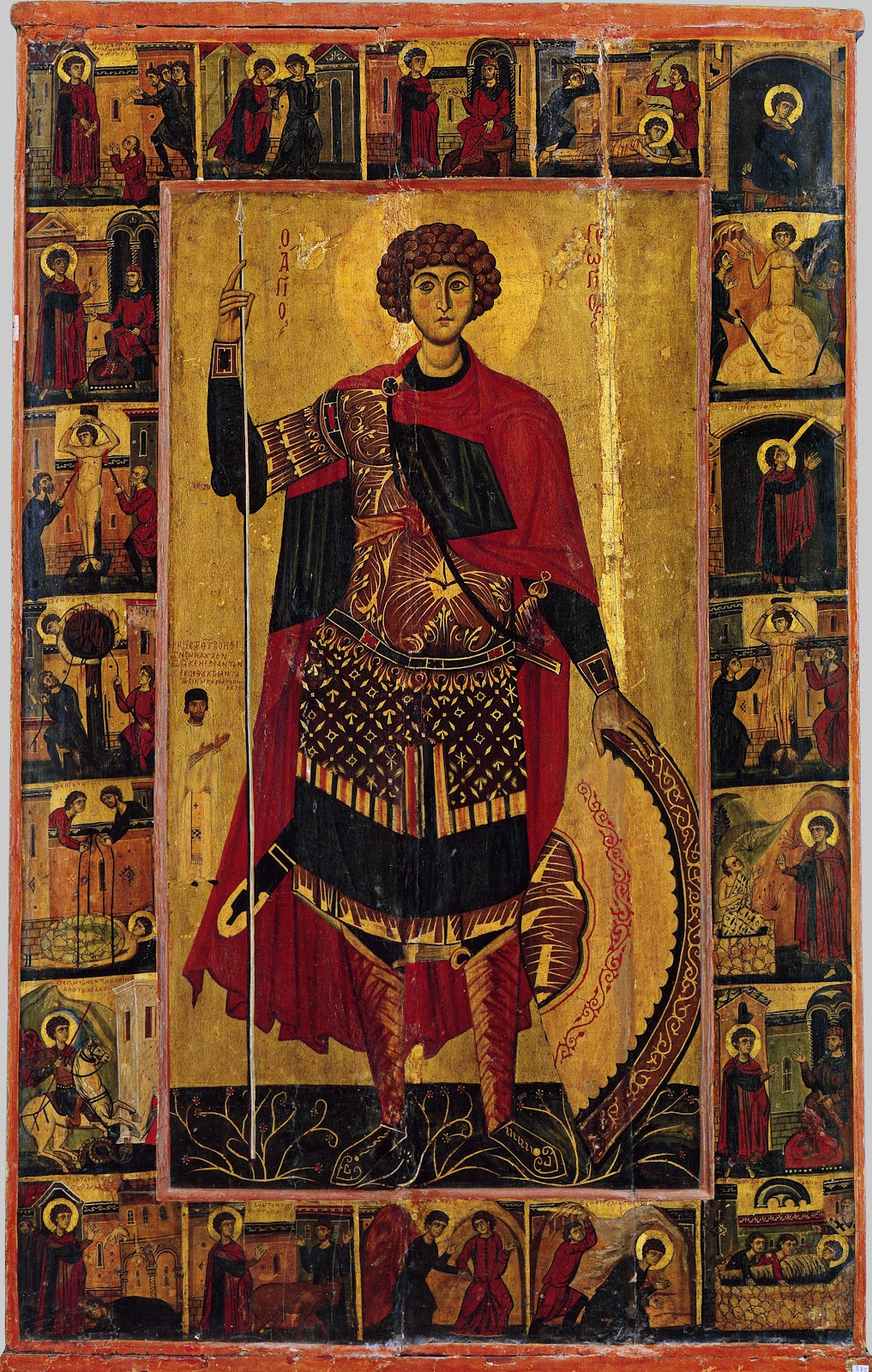
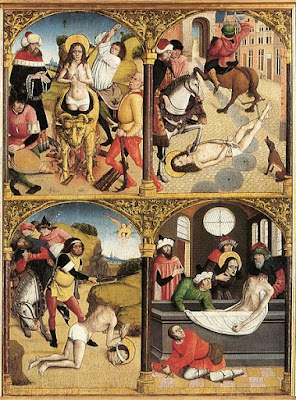
ordered George's execution. In preparation for his death, George gave his money
to the poor and was sent for several torture sessions. He was lacerated on a
wheel of swords and required resuscitation three times, but still George did
not turn from God.
On April 23, 303 A.D., George was decapitated before
Nicomedia's outer wall. His body was sent to Lydda for burial, and other Christians
went to honor George as a martyr.
Saint George and the Dragon
There are several stories about George fighting dragons, but
in the Western version, a dragon or crocodile made its nest at a spring that
provided water to Silene, believed to be modern-day Lcyrene in Libya.
The people were unable to collect water and so attempted to
remove the dragon from its nest on several occasions. It would temporarily
leave its nest when they offered it a sheep each day, until the sheep
disappeared and the people were distraught.
This was when they decided that a maiden would be just as
effective as sending a sheep. The townspeople chose the victim by drawing
straws. This continued until one day the princess' straw was drawn.
The monarch begged for her to be spared but the people would
not have it. She was offered to the dragon, but before she could be devoured,
George appeared. He faced the dragon, protected himself with the sign of the
Cross, and slayed the dragon.
After saving the town, the citizens abandoned their paganism
and were all converted to Christianity.
Interesting Facts
 |
| Martyrdom of St. George |
Saint George stands out among other saints and legends
because he is known and revered by both Muslims and Christians.
It is said Saint George killed the dragon near the sea in
Beirut, thus Saint George bay was named in his honor.
Saint George's feast day is celebrated on April 23, but if
it falls before Easter, it is celebrated Easter Monday.
The Russian Orthodox Church celebrates three St. George
feast days each year -April 23 as is expected, November 3, to commemorate the
consecration of a cathedral dedicated to him in Lydda, and on November 26, for
when a church in Kiev was dedicated to him.
In Bulgaria, his feast day is celebrated May 6 with the
slaughter and roasting of a lamb.
In Egypt, the Coptic Orthodox Church of Alexandria calls St.
George the "Prince of Martyrs" and celebrates on May 1. There is a
second celebration November 17, in honor of the first church dedicated to him.