Ad

Showing posts with label Catholic Mass. Show all posts

Tuesday, 26 April 2016

Padre Pio Saint, Prophet, Stigmatist


"In order to attract us, 
the Lord grants us many graces 
that we believe can easily 
obtain Heaven for us. 
We do not know, however, 
that in order to grow, 
we need hard bread: 
the cross, humiliation, 
trials and denials."
Padre Pio


Padre Pio (Francesco Forgione) at 14
From his earliest years Francesco Forgione was a man of prayer. Considered a quiet boy by the other youngsters he would seldom play with them "because they blaspheme." 


This aversion to sin would cause him to run away to pray in the church of St. Pius V. 


At other times he would sit under a tree on his father's property and "think about God." 


By age five Francesco had already determined to become a Franciscan Capuchin, in part because of the habit and the beard, which he liked greatly, but also moved by the grace of God to seek perfection.


His climb of the ladder of holiness, however, involved more than pious aspirations and flight from the bad example of the world. 
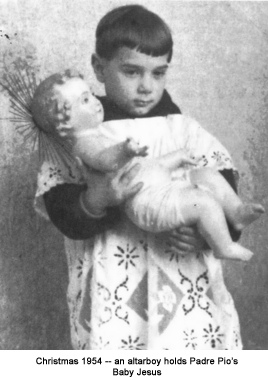

Padre Pio as altar boy 1954
Even very young it encompassed to a remarkable degree the battle against the flesh and against the devil. For example, the child Francis was no stranger to mortification. Although the family had meager rations as it was, Francesco nonetheless occasionally deprived himself of food. And, at age nine his mother discovered him sleeping on the floor with a rock for his pillow, a practice which apparently had been going on for some time. Such austerity would become a hallmark of his entire life.


He also experienced the assaults of the devil, who appeared in horrible forms in his dreams. Later in life these attacks would take a more direct form, even physical assaults.

January 1903 saw Francesco Forgione, age 15, enter religious life or the state of perfection in the Franciscan Order. While religious are not by the fact of their state necessarily perfect, the life of the three evangelical counsels (poverty, chastity and obedience) is ordered to making them so. 


Our Lord, counseling those who wished to be perfect, offered them a means of complete surrender to God, the giving up of the right to marry (Mt 19:12), to own material goods (Mt 19:21a),  and to do what one chooses (Mt 19:21b).

It was at this time, the entrance to the novitiate, that Francesco received the name of Fra. Pio (Brother Pius); Fra. to indicate that he was a religious Fratello (Italian) or Frater (Latin) and Pio to indicate by his change of name that a new life was beginning. Only later, with priestly ordination in 1910, would he assume the name by which he will probably be forever known, Padre Pio.

In 1910, Brother Pio was ordained a priest by Archbishop Paolo Schinosi at the Cathedral of Benevento. Four days later, he offered his first Mass at the parish church of Our Lady of the Angels.

The Holy Sacrifice of the Mass, the Eucharist was of upmost importance to a priest.  Father Pio was no exception...so in touch with the Sacrifice of Calvary that is celebrated in the Mass, his Masses would many times last over 3 hours.


"To this Holy Sacrifice, offered visibly by way of signs - bread and wine - but presenting the invisible and eternal sacrifice of Christ (Heb. 10:14, Rev. 5:6), Padre Pio dedicated His most intense acts of piety, and obtained from the Father perfect conformity to the crucified Lord.


Padre Pio dedicating long hours in the Confessional
So, close was this conformity that he lived it out even outside of the Holy Sacrifice of the Mass, through the immolation of the service of the confessional, dedicating long hours to the reconciliation of sinners, through a ministry of intense sufferings offered on behalf of others, through enduring the assaults of the devil that his spiritual children might not, and through the mystical conformity of the stigmata, the wounds of Christ's crucifixion, as the first priest in the history of the Church to do so.

In all these ways Padre Pio
was both priest and Victim
like our  High Priest Jesus Christ."


The Stigmata - Padre Pio


The Stigmata


On the 20th September, 1918, Padre Pio collapsed in the chapel and was found to be bleeding profusely from five deep wounds in his hands, feet and side. When he regained consciousness he begged his fellow monks to keep the event secret, but word soon spread and people flocked to the monastery from all over the country to see the stigmata for themselves, and to confess their sins to this ‘living saint’.


During the next few years Padre Pio was forced to endure a series of medical investigations and attempted cures, none of which changed the character of the wounds. He never talked about himself or complained, but when someone foolishly asked him if his wounds hurt, he replied:


‘Do you think that the Lord gave them
to me for a decoration?’


This phenomenon continued for fifty years, until the end of his life. The blood flowing from the stigmata smelled of perfume or flowers, a phenomenon mentioned in stories of the lives of several saints and often referred to as the odour of sanctity.


Padre Pio's Sufferings 
During Mass
An interview by 

Fr. Tarcisio with 

Padre Pio:

Fr. Tarcisio: At what hour of the day do you suffer most?

Padre Pio: During the offering of the Mass.

Fr. Tarcisio: At what moment of the Divine Sacrifice (of the Mass) do you suffer Most?

Padre Pio: Always and increasingly.

Fr. Tarcisio: During the offering of the Mass, at what moment do you suffer most?

Padre Pio: From the Consecration to Communion.

Fr. Tarcisio: At what part of the Mass are you scourged?

Padre Pio: From the beginning to the end, but more intensely after the Consecrations.

Fr. Tarcisio: During the Mass, are the pricks of thorns from the crown and the scourging real?

Padre Pio: What do you mean? The results are the same.

Fr. Tarcisio: What should we do during Mass?

Padre Pio: Repent and love.

Fr. Tarcisio: How should we hear Mass?

Padre Pio: In the same way that the Most Holy Virgin and the Holy women assisted.  In the same way that St. John assisted at the Eucharistic Sacrifice and the bloody one of the Cross.  We priests are the sacrificers of Jesus, the Lamb of God during the Mass, while all of paradise reverently descends on the altar.

Padre Pio celebrating Mass
Fr. Tarcisio: What benefits do we receive on hearing it?

Padre Pio: It is not possible to number them.  You will see them in Paradise.

So, in the actual life experience of Padre Pio, we see that the Holy Mass is truly the Sacrifice of Jesus on Calvary for the conversion of sinners and salvation of souls.

Excerpts from “Padre Pio’s Mass” written by Fr. Tarcisio of Cervinara

Many thanks to Traditional Catholic Priest for the above information 

http://www.traditionalcatholicpriest.com/2014/01/24/padre-pio-proves-that-the-holy-mass-is-jesus-sacrifice-on-calvary/

Padre Pio with child
Padre Pio  and 
Pro-Life

St. Padre Pio demonstrated the depth of his love and loyalty to the Church when he publicly praised and defended Pope Paul VI for his encyclical Humanae Vitae, “Of Human Life.” 1  


Upon its release in the summer of 1968, a torrent of vilification and disobedience was unleashed upon the Pontiff from within the Church, as well as mockery and scorn from without.  Such open rebellion against Peter’s successor was unprecedented, and yet he had done nothing more than his solemn duty to uphold the infallible, magisterial teaching of Catholicism against unnatural methods of birth control.
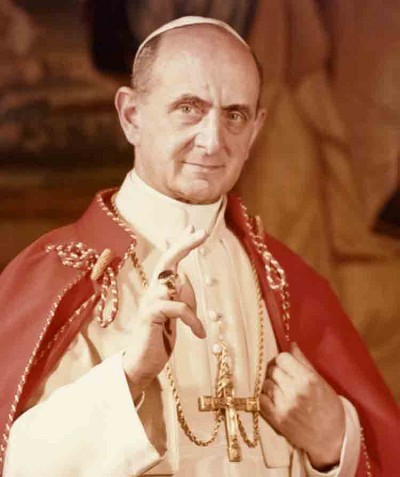

Pope Paul VI
Only two weeks before his own death in September of that year, St. Padre Pio wrote an inspired and moving letter to the Holy Father which was printed in the Vatican’s official newspaper L’Osservatore Romano. 2   It is an epistle of great significance, and will likely be part of the evidence put forth in his favor should St. Pio be declared a Doctor of the Church.  He is effusive in his praise of the Pope’s encyclical, referring to its “lofty teachings,” “eternal truths,” “clear and decisive words,” and its “inspired directives.”
In his letter, St. Pio recognizes that the source of the pope’s greatest suffering is the disobedience of so many within the Church to his magisterial teachings.

"I know that Your heart suffers much these days on account of the happenings in the Church: for peace in the world, for the great needs of its peoples; but above all, for the lack of obedience of some, even Catholics, to the lofty teachings which You, assisted by the Holy Spirit and in the name of God, have given us."4

He understands that the Holy Father is carrying his personal cross in Christ’s footsteps, following the narrow way of the truth.  St. Pio offers his own sufferings and prayers so that the Pope can persevere in his mission. 

"I offer Your Holiness my daily prayers and sufferings, the insignificant but sincere offering of the least of your sons, asking the Lord to comfort you with His grace to continue along the direct yet often burdensome way—in defense of those eternal truths which can never change with the times."


Padre Pio  was canonized by Saint John Paul II on June 16, 2002
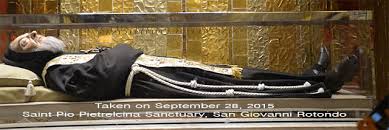

Padre Pio -- body found incorrupt


Tuesday, 18 August 2015

Catholic Mass -- St. Alphonsus Liguori


St. Alphonsus Liguori


Bishop, Doctor of the Church, and the founder of the Redemptorist Congregation. He was born Alphonsus Marie Antony John Cosmos Damien Michael Gaspard de Liguori on September 27,1696, at Marianella, near Naples, Italy. 

Raised in a pious home, Alphonsus went on retreats with his father, Don Joseph, who was a naval officer and a captain of the Royal Galleys. Alphonsus was the oldest of seven children, raised by a devout mother of Spanish descent. Educated at the University of Naples, Alphonsus received his doctorate at the age of sixteen. By age nineteen he was practicing law, but he saw the transitory nature of the secular world, and after a brief time, retreated from the law courts and his fame. 

Visiting the local Hospital for Incurables on August 28, 1723, he had a vision and was told to consecrate his life solely to God. In response, Alphonsus dedicated himself to the religious life, even while suffering persecution from his family. He finally agreed to become a priest but to live at home as a member of a group of secular missionaries. He was ordained on December 21, 1726, and he spent six years giving missions throughout Naples. 

In April 1729, Alphonsus went to live at the "Chiflese College," founded in Naples by FatherMatthew Ripa, the Apostle of China. There he met Bishop Thomas Falcoia, founder of the Congregation of Pious Workers. This lifelong friendship aided Alphonsus, as did his association with a mystic, SisterMary Celeste. 

With their aid, Aiphonsus founded the Congregation of the Most Holy Redeemer on November 9, 1732. The foundation faced immediate problems, and after just one year, Alphonsus found himself with only one lay brother, his other companions having left to form their own religious group. He started again, recruited new members, and in 1743 became the prior of two new congregations, one for men and one for women. 

Pope Benedict XIV gave his approval for the men's congregation in 1749 and for the women's in 1750. Alphonsus was preaching missions in the rural areas and writing. He refused to become the bishop of Palermo but in 1762 had to accept the papal command to accept the see of St. Agatha of the Goths near Naples. Here he discovered more than thirty thousand uninstructed men and women and four hundred indifferent priests. 

For thirteen years Alphonsus fed the poor, instructed families, reorganized the seminary and religious houses, taught theology, and wrote. His austerities were rigorous, and he suffered daily the pain from rheumatism that was beginning to deform his body. 

He spent several years having to drink from tubes because his head was so bent forward. An attack of rheumatic fever, from May 1768 to June 1769, left him paralyzed. He was not allowed to resign his see, however, until 1775.

In 1780, Alphonsus was tricked into signing a submission for royal approval of his congregation. This submission altered the original rule, and as a result Alphonsus was denied any authority among the Redemptorists. Deposed and excluded from his own congregation, Alphonsus suffered great anguish. 

But he overcame his depression, and he experienced visions, performed miracles, and gave prophecies. He died peacefully on August 1,1787, at Nocera di Pagani, near Naples as the Angelus was ringing. 

He wasbeatified in 1816 and canonized in 1839. In 1871, Alphonsus was declared a Doctor of the Church by Pope Pius IX. His writings on moral, theological, and ascetic matters had great impact and have survived through the years, especially his Moral Theology and his Glories of Mary. 

He was buried at the monastery of the Pagani near Naples. Shrines were built there and at St. Agatha of the Goths. 

He is the patron of confessors, moral theologians, and the lay apostolate. In liturgical art he is depicted as bent over with rheumatism or as a young priest.


http://www.catholic.org/saints/saint.php?saint_id=1284

Monday, 8 June 2015

Why Go to Catholic Mass? What is Spiritual Communion?

What is a Catholic Mass?

Mass is the central act of worship in the life of a Catholic. Going to Mass is about spending time with God, but also receiving his graces (inner strength to live the Christian life). The name ‘Mass’ comes the final blessing said by the priest in Latin ‘Ite missa es’ meaning “to send out” as Jesus Christ sent his disciples out to the world to take his teaching to them we are to do the same.
Graces Derived from Assisting at Mass
 
  1. The Mass is Calvary continued.
  2. Every Mass is worth as much as the sacrifice of our Lord's life, sufferings, and death.
  3. Holy Mass is the most powerful atonement for your sins.
  4. At the hour of death the Masses you have heard will be your greatest consolation.
  5. Every Mass will go with you to judgment and plead for pardon.
  6. At Mass you can diminish more or less temporal punishment due to your sins, according to your fervor.
  7. Assisting devoutly at Holy Mass you render to the sacred humanity of Our Lord the greatest homage.
  8. He supplies for many of your negligences and omissions.
  9. He forgives the venial sins which you have not confessed.  The power of Satan over you is diminished.
  10. You afford the souls in Purgatory the greatest possible relief.
  11. One Mass heard during life will be of more benefit to you than many heard fro you after your death.
  12. Your are preserved from dangers and misfortunes which otherwise might have befallen you.  You shorten your purgatory.
  13. Every Mass wins for you a higher degree of glory in Heaven.
  14. You receive the priest's blessing which Our Lord ratifies in Heaven.
  15. You kneel amidst a multitude of holy angels, who are present at the adorable Sacrifice with reverential awe.
  16. You are blessed in your temporal goods and affairs.
In eternity, we shall fully realize that it was certainly worthwhile to have assisted at Holy Mass daily. 

PRAY FOR PRIESTS THAT THEY MAY OFFER
THE MASS WITH HOLY LOVE AND REVERENCE.

Holy Communion - The Holy Eucharist
Each time we receive Holy Communion our venial sins are forgiven.
Christ revealed to St. Gertrude the Great that each time ONE person receives Holy Communion something good happens to every being in heaven, on earth and in purgatory.
The Curate of Ars said that a Communion well received is worth more than 20,000 NFF (New Franc - French currency a great amount in those days) given to the poor.
Each time we receive Communion our place in heaven is raised forever, our stay in purgatory shortened.
After receiving Holy Communion Our Lord said we should pray:

"Most Sacred Heart of Jesus
may the whole world burn with love for You!"


(revelation to Gabrielle Bossis in France)
Prayers after Mass and Communion
Prayers before the Crucifix
Look down on me Good and Gentle Jesus,
while before Thy Face I humbly kneel and with burning soul pray and beseech Thee to fix deep in my heart livelysentiments of faith, hope and charity, true contrition for my sins and a firm
purpose of amendment, while I contemplate with great love and tender pity Thy Five Wounds,
pondering over them within me and calling to mind
the words which David Thy Prophet said of Thee my Jesus,
"They have pierced My Hands and My Feet,
they have numbered all My Bones."  (Ps 21: 17-18)
Our Father, Hail Mary, Glory Be, for the Holy Father's intentions.
Plenary indulgence when said after Communion (S. Paen. Ap., 2 Feb 1934)
Anima Christi
Soul of Christ, sanctify me.
Body of Christ, save me.
Blood of Christ, inebriate me.
Water from the side of Christ, wash me.
Passion of Christ, strengthen me.
O good Jesus, hear me.
Within Thy Wounds hide me.
Suffer me not to be separated from Thee.
From the malignant enemy, defend me.
In the hour of my death, call me.
And bid me come to Thee.
That with Thy saints I may praise Thee.
Forever and ever.
Amen
St. Ignatius Loyola

An indulgence of 300 days.  An indulgence of 7 years , if recited after Holy Communion.

WHY Should I go to Mass Every Day?

"The Mass is the most perfect form of prayer." Pope Paul VI

For each Mass we hear with devotion, Our Lord sends a saint to comfort us at death. (revelation of Christ to St. Gertrude the great)

St. Padre Pio, the stigmatic priest, said, the world could exist more easily without the sun than without the Mass.

The Cure' Ars, St. Jean Vianney said, if we knew the value of the Mass we would die of joy.

A great doctor of the Church, St. Anselm, declares that a single Mass offered for oneself during life may be worth more than a thousand celebrated for the same intention after death.  St. Leonard of Port Maurice supports this statement by saying that one Mass before death may be more profitable than many after it.

"The Holy Mass would be of greater profit if people had it offered in their lifetime, rather than having it celebrated for the relief of their souls after death."  Pope Benedict XV

Once, St. Teresa was overwhelmed with God's Goodness and asked Our Lord, "How can I thank you?"  Our Lord replied, "ATTEND ONE MASS."
Spiritual Communion
The best way to receive Christ is in Holy Communion at Mass. 

Yet for those times you can’t make Mass, or can’t take Communion because of an unconfessed mortal sin (for which you can ask for and receive God’s forgiveness in the Sacrament of Penance), you can still reach out to Him by making a Spiritual Communion in prayer!

St. Thomas Aquinas once defined a Spiritual Communion as “an ardent desire to receive Jesus in the Most Holy Sacrament [in Communion at Mass] and in lovingly embracing Him as if we had actually received Him.”


The value of a spiritual Communion well made is enormous.  We can and should make one frequently.  Simply think of Jesus and how much He love us and how much we love Him, then ask Our Blessed Mother to ask Her Divine Son to come into our hearts.  We can offer these Communions for the interest of the Sorrowful and Immaculate Heart of Mary, noting our special intention!
Act of Spiritual Communion

My Jesus,
I believe that You
are present in the Most Holy Sacrament.
I love You above all things and I desire to receive You into my soul.
Since I cannot at this moment receive You sacramentally,
come at least spiritually into my heart. 
I embrace You as if You were already there          and unite myself wholly to You. 
Never permit me to be separated from You.
Amen.