Ad

Showing posts with label tested by fire. Show all posts

Friday, 12 May 2017

Tribulation & Trials by St. Bernard, abbot


St. Bernard of Clairvaux

I am with him in tribulation

From a sermon St. Bernard, abbot


I am with him in tribulation, says God.  Shall I then seek anything here below apart from tribulation?  For me it is good to cling to God, and also to put my hope in the Lord God, because he has said: I will rescue him and glorify him.

I am with him in tribulation.  My delight, he says, is to be with the sons of men—Emmanuel, God with us.  



He himself descended to be near those 
who are saddened in spirit, to be with us in our tribulation.  
One day we shall be caught up together in the clouds to meet the Lord in the air; and so we shall always be with the Lord—provided, however, that we are concerned here below to have him with us, as our companion on the journey, who will restore us to our true country or, better, as one who is now our way and our true country hereafter. 

It is good for me to be sad, O Lord, as long as you are with me, rather than to be a king apart from you, to feast without you, to boast without you.  It is better for me to embrace you in tribulations, to have you with me in the furnace, than to be without you in heaven.  For what do I have in heaven apart from you?  What have I desired on earth?  Gold is tested in the furnace, and the just by the trial of tribulation.  There, yes there, you are present with them, Lord.  You are there in the midst of those gathered in your name, as you were once with the three young men in the fiery furnace.

Why are we afraid, why do we hesitate, 
why do we flee from this furnace?  

The fire rages, 
but the Lord is with us in tribulation.  

If God is with us who can be against us?  And if he then rescues us, who will steal us from his hand?  Lastly, if he honors us, who can dishonor us?  If he honors us, who can humiliate us?

I will fill him with length of days.  It is as if he said more clearly:  I know what he desires, I know what he thirsts for, and what he likes.  He likes neither silver nor gold, pleasure nor curiosity, nor any of the honors of the world.  All this he considers as loss; all this he despises, counting it as dung.  He has totally emptied himself, and he does not allow himself to be concerned with things he knows can never satisfy him.  He knows in whose image he had been made, of what greatness he is capable; he does not strive to raise himself up only to be cut down from the highest state.


So I will fill him 
with length of days
for only the true light can refresh, 
only the eternal can fill him.  

Indeed this length of days 
has no end, 
this light knows 
no setting, and 
this fullness can never 
turn to disgust.

Taken from the Liturgy of the Hours, According to the Roman Rite, Ordinary Time, Catholic Book Publishing Corp.  New York, 1975


Friday, 21 September 2012

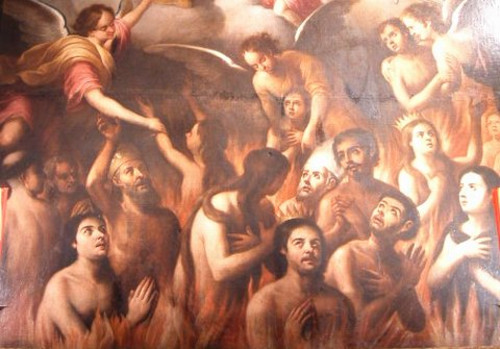
Purgatory – Catholic Beliefs


The Catechism of the Catholic Church defines purgatory as a "purification, so as to achieve the holiness necessary to enter the joy of heaven," which is experienced by those "who die in God’s grace and friendship, but still imperfectly purified" (CCC 1030). It notes that "this final purification of the elect . . . is entirely different from the punishment of the damned" (CCC 1031).

The purification is necessary because, as Scripture teaches, nothing unclean will enter the presence of God in heaven (Rev. 21:27) and, while we may die with our mortal sins forgiven, there can still be many impurities in us, specifically venial sins and the temporal punishment due to sins already forgiven.

Check the Bible
Hebrews 12:14 - without holiness no one will see the Lord. We need final sanctification to attain true holiness before God, and this process occurs during our lives and, if not completed during our lives, in the transitional state of purgatory.

Hebrews 12:23 - the spirits of just men who died in godliness are "made" perfect. They do not necessarily arrive perfect. They are made perfect after their death. But those in heaven are already perfect, and those in hell can no longer be made perfect. These spirits are in purgatory.

1 Peter 3:19; 4:6 - Jesus preached to the spirits in the "prison." These are the righteous souls being purified for the beatific vision.

Revelation 21:27 - nothing unclean shall enter heaven. The word “unclean” comes from the Greek word “koinon” which refers to a spiritual corruption. Even the propensity to sin is spiritually corrupt, or considered unclean, and must be purified before entering heaven. It is amazing how many Protestants do not want to believe in purgatory. 

Purgatory exists because of the mercy of God. 

If there were no purgatory, this would also likely mean no salvation for most people. God is merciful indeed.

Luke 23:43 – many Protestants argue that, because Jesus sent the good thief right to heaven, there can be no purgatory. There are several rebuttals. First, when Jesus uses the word "paradise,” He did not mean heaven. Paradise, from the Hebrew "sheol," meant the realm of the righteous dead. This was the place of the dead who were destined for heaven, but who were captive until the Lord's resurrection. Second, since there was no punctuation in the original manuscript, Jesus’ statement “I say to you today you will be with me in paradise” does not mean there was a comma after the first word “you.” This means Jesus could have said, “I say to you today, you will be with me in paradise” (meaning, Jesus could have emphasized with exclamation his statement was “today” or “now,” and that some time in the future the good thief would go to heaven). Third, even if the thief went straight to heaven, this does not prove there is no purgatory (those who are fully sanctified in this life – perhaps by a bloody and repentant death – could be ready for admission in to heaven).

 1 Cor. 3:10-15 - works are judged after death and tested by fire. Some works are lost, but the person is still saved. Paul is referring to the state of purgation called purgatory. The venial sins (bad works) that were committed are burned up after death, but the person is still brought to salvation. This state after death cannot be heaven (no one with venial sins is present) or hell (there is no forgiveness and salvation).

1 Corinthians 3:15“if any man’s work is burned up, he will suffer loss, though he himself will be saved, but only as through fire.” The phrase for "suffer loss" in the Greek is "zemiothesetai." The root word is "zemioo" which also refers to punishment. The construction “zemiothesetai” is used in Ex. 21:22 and Prov. 19:19 which refers to punishment (from the Hebrew “anash” meaning “punish” or “penalty”). Hence, this verse proves that there is an expiation of temporal punishment after our death, but the person is still saved. This cannot mean heaven (there is no punishment in heaven) and this cannot mean hell (the possibility of expiation no longer exists and the person is not saved).

Saint Augustine said, in The City of God, that  

"temporary punishments are suffered by some in this life only, by others after death, by others both now and then; but all of them before that last and strictest judgment" (21:13). 

It is between the particular and general judgments, then, that the soul is purified of the remaining consequences of sin: 


 "I tell you, you will never get out 
till you have paid the very last copper"  
(Luke 12:59).