Ad

Showing posts with label Mercy of God. Show all posts

Saturday, 22 April 2017

Divine Mercy Sunday Indulgence


Plenary Indulgence for 
Divine Mercy Sunday

In a decree dated August 3, 2002, the Apostolic Penitentiary announced that in order “to ensure that the faithful would observe this day (Divine Mercy Sunday) with intense devotion, the Supreme Pontiff himself established that this Sunday be enriched by a plenary indulgence…so that the faithful might receive in great abundance the gift of the consolation of the Holy Spirit.  In this way, they can foster a growing love for God and for their neighbor, and after they have obtained God’s pardon, they in turn might be persuaded to show a prompt pardon to their brothers and sisters.”

The plenary indulgence is granted (under the usual conditions of a sacramental confession, Eucharistic communion and a prayer for the intentions of the Supreme Pontiff) to the faithful who, on Divine Mercy Sunday, in a spirit that is completely detached from the affection for a sin, even a venial sin, recite the Our Father and the Creed, and also adding a devout prayer (e.g. Merciful Jesus, I trust in you!).

Additional provisions are offered for those who are impeded from fulfilling these requirements, but who wish to acquire a plenary indulgence.  The full text of the decree of the Apostolic Penitentiary may be found at: www.mercysunday.com.  While the readings and prayers for Mass on this day remain unchanged (they reflect perfectly on Our Lord’s Divine Mercy) the Holy See offers this reflection:

The Gospel of the Second Sunday of Easter narrates the wonderful things Christ the Lord accomplished on the day of the Resurrection during His first public appearance: “On the evening of that day, the first day of the week, the doors being shut where the disciples were, for fear of the Jews, Jesus came and stood among them and said to them, ‘Peace be with you.’  When He had said this, He showed them His hands and His side.  Then the disciples were glad to see the Lord.  Jesus said to them again, ‘Peace be with you.  As the Father has sent Me, so even I send you,’ and then He breathed on them, and said, ‘Receive the Holy Spirit.  If you forgive the sins of any, they are forgiven; if you retain the sins of any, they are retained’” (Jn 20, 19-23).

In addition, the decree requires that parish priests “should inform the faithful in the most suitable way of the Church’s salutary provision.  They should promptly and generously be willing to hear their confessions.  On Divine Mercy Sunday, after celebrating Mass they should lead the prayers that have been given above and they should also encourage the faithful to perform acts of mercy as often as they can.”

From the Feb. 2003 edition of the BCL (Bishops Committee on the Liturgy) NewsLetter by the U.S. Conference of Catholic Bishops.

APOSTOLIC PENITENTIARY
General Remarks On Indulgences 
From the Official Vatican website

1. This is how an indulgence is defined in the Code of Canon Law (can. 992) and in the "../../../../archive/catechism/ccc_toc.htm" (n. 1471): "An indulgence is a remission before God of the temporal punishment due to sins whose guilt has already been forgiven, which the faithful Christian who is duly disposed gains under certain prescribed conditions through the action of the Church which, as the minister of redemption, dispenses and applies with authority the treasury of the satisfactions of Christ and the saints".

2. In general, the gaining of indulgences requires certain prescribed conditions (below, nn. 3, 4), and the performance of certain prescribed works (nn. 8, 9, 10 indicate those specific to the Holy Year).

3. To gain indulgences, whether plenary or partial, it is necessary that the faithful be in the state of grace at least at the time the indulgenced work is completed.

4. A plenary indulgence can be gained only once a day. In order to obtain it, the faithful must, in addition to being in the state of grace:
— have the interior disposition of complete detachment from sin, even venial sin;
— have sacramentally confessed their sins;
— receive the Holy Eucharist (it is certainly better to receive it while participating in Holy Mass, but for the indulgence only Holy Communion is required);
— pray for the intentions of the Supreme Pontiff.

5. It is appropriate, but not necessary, that the sacramental Confession and especially Holy Communion and the prayer for the Pope's intentions take place on the same day that the indulgenced work is performed; but it is sufficient that these sacred rites and prayers be carried out within several days (about 20) before or after the indulgenced act

Prayer for the Pope's intentions is left to the choice of the faithful, but an "Our Father" and a "Hail Mary" are suggested. 

One sacramental Confession suffices for several plenary indulgences, but a separate Holy Communion and a separate prayer for the Holy Father's intentions are required for each plenary indulgence.

6. For the sake of those legitimately impeded, confessors can commute both the work prescribed and the conditions required (except, obviously, detachment from even venial sin).

7. Indulgences can always be applied either to oneself or to the souls of the deceased, but they cannot be applied to other persons living on earth.


Cardinal William Wakefield Baum
Major Penitentiary
Bishop Luigi De Magistris
Titular Bishop of Nova
Regent

From the Official Vatican website 


Thursday, 25 October 2012

Pope John Paul II's Homily Divine Mercy Sunday, 2001.


Pope John Paul II's Homily
On the first universal celebration of Divine Mercy Sunday April 22, 2001

Divine Mercy: The Easter Gift

"Fear not, I am the first and the last, 
and the living one; I died, 
and behold I am alive for evermore"  
(Rev 1:17-18).

We heard these comforting words in the Second Reading taken from the Book of Revelation. They invite us to turn our gaze to Christ, to experience His reassuring presence. To each person, whatever his condition, even if it were the most complicated and dramatic, the Risen One repeats: "Fear not!; I died on the Cross but now I am alive for evermore"; "I am the first and the last, and the living one."

"The first," that is, the source of every being and the first-fruits of the new creation; "the last," the definitive end of  history; "the living one," the inexhaustible source of life that triumphed over death forever.

In the Messiah, crucified and risen, we recognize the features of the Lamb sacrificed on Golgotha, who implores forgiveness for His torturers and opens the gates of heaven to repentant sinners; we glimpse the face of the immortal King who now has "the keys of Death and Hades" (Rev 1:18).

Give thanks to the Lord, for He is good; for His mercy endures forever! (Ps 117:1). Let us make our own the Psalmist's exclamation which we sang in the Responsorial Psalm: "The Lord's mercy endures forever!" In order to understand thoroughly the truth of these words, let us be led by the liturgy to the heart of the event of salvation, which unites Christ's Death and Resurrection with our lives and with the world's history. This miracle of mercy has radically changed humanity's destiny. It is a miracle in which is unfolded the fullness of the love of the Father who, for our redemption, does not even draw back before the sacrifice of His Only-begotten Son.

In the humiliated and suffering Christ, believers and non-believers can admire a surprising solidarity, which binds Him to our human condition beyond all imaginable measure. The Cross, even after the Resurrection of the Son of God, "speaks and never ceases to speak of God the Father, who is absolutely faithful to His eternal love for man. ... Believing in this love means believing in mercy" (Rich in Mercy, 7).
Blessed Pope John Paul II and Divine Mercy


Let us thank the Lord for His love, which is stronger than death and sin. It is revealed and put into practice as mercy in our daily lives, and prompts every person in turn to have "mercy" towards the Crucified One. Is not loving God and loving one's neighbor and even one's "enemies," after Jesus' example, the program of life of every baptized person and of the whole Church?


A great joy

With these sentiments, we are celebrating the Second Sunday of Easter, which since last year, the year of the Great jubilee, is also called "Divine Mercy Sunday." It is a great joy for me to be able to join all of you, dear pilgrims and faithful who have come from various nations to commemorate, after one year, the canonization of Sister Faustina Kowalska, witness and messenger of the Lord's merciful love.

The elevation to the honors of the altar of this humble religious, a daughter of my land, is not only a gift for Poland but for all humanity. Indeed the message she brought is the appropriate and incisive answer that God wanted to offer to the questions and expectations of human beings in our time, marked by terrible tragedies. Jesus said to Sister Faustina one day: "Mankind will not have peace until it turns with trust to My mercy" (Diary, 300). Divine Mercy! This is the Easter gift that the Church receives from the risen Christ and offers to humanity at the dawn of the third millennium.

The Gospel, which has just been proclaimed, helps us to grasp the full sense and value of this gift. The Evangelist John makes us share in the emotion felt by the Apostles in their meeting with Christ after His Resurrection. Our attention focuses on the gesture of the Master, who transmits to the fearful, astounded disciples the mission of being ministers of Divine Mercy. He shows them His hands and His side, which bear the marks of the Passion, and tells them: "As the Father has sent Me, even so I send you" (John 20:21.)

Immediately afterwards, "He breathed on them, and said to them, 'Receive the Holy Spirit. If you forgive the sins of any, they are forgiven; if you retain the sins of any, they are retained' " (John 20:22-23). Jesus entrusted to them the gift of "forgiving sins," a gift that flows from the wounds in His hands, His feet, and especially from His pierced side. From there a wave of mercy is poured out over all humanity.

Let us relive this moment with great spiritual intensity. Today the Lord also shows us His glorious wounds and His Heart, an inexhaustible source of light and truth, of love and forgiveness.

Sacred Heart of Jesus
The Heart of Christ!

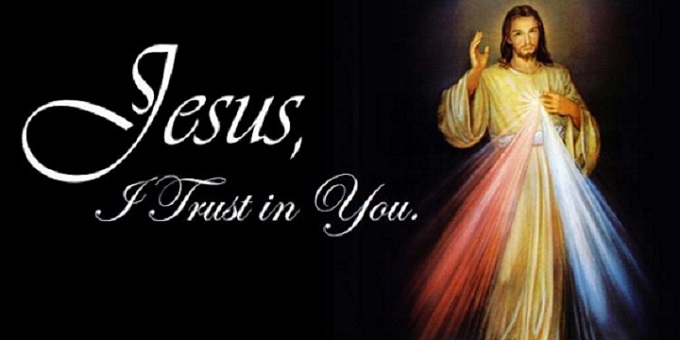
His "Sacred Heart" has given men everything: redemption, salvation, sanctification. Saint Faustina Kowalska saw coming from this Heart that was overflowing with generous love, two rays of light which illuminated the world.

The two rays, [according to what Jesus Himself told her], denote blood and water (Diary, 299). The blood recalls the sacrifice of Golgotha and the mystery of the Eucharist; the water, according to the rich symbolism of the Evangelist John, makes us think of Baptism and the Gift of the Holy Spirit (See John 3:5; 4:14).

Through the mystery of this wounded Heart, the restorative tide of God's merciful love continues to spread over the men and women of our time. Here alone can those who long for true and lasting happiness find its secret.

"Jesus, I trust in You!"

This prayer, dear to so many of the devout, clearly expresses the attitude with which we too would like to abandon ourselves trustfully in Your hands, O Lord, our only Savior.

You are burning with the desire to be loved and those in tune with the sentiments of Your Heart learn how to build the new civilization of love. A simple act of abandonment is enough to overcome the barriers of darkness and sorrow, of doubt and desperation. The rays of Your Divine Mercy restore hope, in a special way, to those-who feel overwhelmed by the burden of sin.

Mary, Mother of Mercy, help us always to have this trust in your Son, our Redeemer. Help us too, St. Faustina, whom we remember today with special affection. Fixing our weak gaze on the Divine Savior's face, we would like to repeat with you: "Jesus, I trust in You!" Now and for ever. Amen.


Friday, 21 September 2012

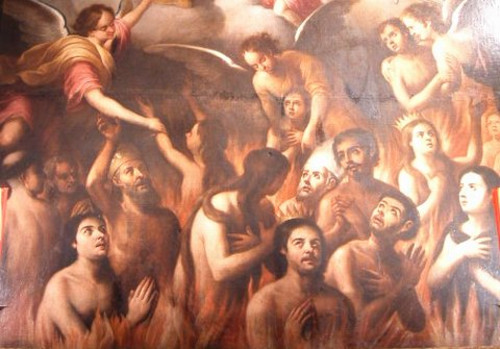
Purgatory – Catholic Beliefs


The Catechism of the Catholic Church defines purgatory as a "purification, so as to achieve the holiness necessary to enter the joy of heaven," which is experienced by those "who die in God’s grace and friendship, but still imperfectly purified" (CCC 1030). It notes that "this final purification of the elect . . . is entirely different from the punishment of the damned" (CCC 1031).

The purification is necessary because, as Scripture teaches, nothing unclean will enter the presence of God in heaven (Rev. 21:27) and, while we may die with our mortal sins forgiven, there can still be many impurities in us, specifically venial sins and the temporal punishment due to sins already forgiven.

Check the Bible
Hebrews 12:14 - without holiness no one will see the Lord. We need final sanctification to attain true holiness before God, and this process occurs during our lives and, if not completed during our lives, in the transitional state of purgatory.

Hebrews 12:23 - the spirits of just men who died in godliness are "made" perfect. They do not necessarily arrive perfect. They are made perfect after their death. But those in heaven are already perfect, and those in hell can no longer be made perfect. These spirits are in purgatory.

1 Peter 3:19; 4:6 - Jesus preached to the spirits in the "prison." These are the righteous souls being purified for the beatific vision.

Revelation 21:27 - nothing unclean shall enter heaven. The word “unclean” comes from the Greek word “koinon” which refers to a spiritual corruption. Even the propensity to sin is spiritually corrupt, or considered unclean, and must be purified before entering heaven. It is amazing how many Protestants do not want to believe in purgatory. 

Purgatory exists because of the mercy of God. 

If there were no purgatory, this would also likely mean no salvation for most people. God is merciful indeed.

Luke 23:43 – many Protestants argue that, because Jesus sent the good thief right to heaven, there can be no purgatory. There are several rebuttals. First, when Jesus uses the word "paradise,” He did not mean heaven. Paradise, from the Hebrew "sheol," meant the realm of the righteous dead. This was the place of the dead who were destined for heaven, but who were captive until the Lord's resurrection. Second, since there was no punctuation in the original manuscript, Jesus’ statement “I say to you today you will be with me in paradise” does not mean there was a comma after the first word “you.” This means Jesus could have said, “I say to you today, you will be with me in paradise” (meaning, Jesus could have emphasized with exclamation his statement was “today” or “now,” and that some time in the future the good thief would go to heaven). Third, even if the thief went straight to heaven, this does not prove there is no purgatory (those who are fully sanctified in this life – perhaps by a bloody and repentant death – could be ready for admission in to heaven).

 1 Cor. 3:10-15 - works are judged after death and tested by fire. Some works are lost, but the person is still saved. Paul is referring to the state of purgation called purgatory. The venial sins (bad works) that were committed are burned up after death, but the person is still brought to salvation. This state after death cannot be heaven (no one with venial sins is present) or hell (there is no forgiveness and salvation).

1 Corinthians 3:15“if any man’s work is burned up, he will suffer loss, though he himself will be saved, but only as through fire.” The phrase for "suffer loss" in the Greek is "zemiothesetai." The root word is "zemioo" which also refers to punishment. The construction “zemiothesetai” is used in Ex. 21:22 and Prov. 19:19 which refers to punishment (from the Hebrew “anash” meaning “punish” or “penalty”). Hence, this verse proves that there is an expiation of temporal punishment after our death, but the person is still saved. This cannot mean heaven (there is no punishment in heaven) and this cannot mean hell (the possibility of expiation no longer exists and the person is not saved).

Saint Augustine said, in The City of God, that  

"temporary punishments are suffered by some in this life only, by others after death, by others both now and then; but all of them before that last and strictest judgment" (21:13). 

It is between the particular and general judgments, then, that the soul is purified of the remaining consequences of sin: 


 "I tell you, you will never get out 
till you have paid the very last copper"  
(Luke 12:59).