THE FEAST OF MERCY (Divine Mercy Sunday)
Among all of the elements of devotion to The Divine Mercy
requested by our Lord through Sr. Faustina, the Feast of Mercy holds first
place. The Lord's will with regard to its establishment was already made known
in His first revelation to the saint. In all, there were 14 revelations
concerning the desired feast.
Once after insisting, "Do all you possibly can for this
work of mercy," Jesus added: "My Heart rejoices on account of this
feast." Sister Faustina concluded: "After these words, I understood
that nothing can dispense me from the obligation which the Lord demands of
me" (Diary, 998).
Our Lord's explicit desire is that this feast be celebrated
on the first Sunday after Easter. He joins the feast to the designated Sunday
in eight revelations: Diary, 49, 88, 280, 299, 341, 570, 699, and 742. He also
implies a connection between the feast and that Sunday on some other occasions
recorded in the saint's Diary (see Diary, 420, 89).
 |
| St. Faustina, St. John Paul II - The Spark from Poland |
The "First Sunday after Easter" ‑
which is designated in "The Liturgy of the Hours and the Celebration of
the Eucharist" as the "Octave Day of Easter" ‑
was officially called the Second Sunday of Easter after the liturgical reform
of Vatican II. Now, by the Decree of the Congregation for Divine Worship and
the Discipline of the Sacraments, the name of this liturgical day has been
changed to:
"Second Sunday of Easter,
or of Divine Mercy."
Pope John Paul II made the surprise announcement of this
change in his homily at the canonization of Sr. Faustina on April 30, 2000.
There, he declared: "It is important then that we accept the whole message
that comes to us from the word of God on this Second Sunday of Easter, which
from now on throughout the Church, will be called 'Divine Mercy Sunday.' "
By the words "the whole message," the Holy Father
was referring to the strict connection between the "Easter Mystery of the
Redemption" ‑ the suffering, death, burial, resurrection, and
ascension of Christ, followed by the sending of the Holy Spirit ‑
and this Feast of Divine Mercy, the Octave Day of Easter.
In this regard, the Holy Father also said, citing the
Responsorial Psalm of the Liturgy, "The Church sings ... , as if receiving
from Christ's lips these words of the Psalm" [that is, Give thanks to the
Lord for He is good; His steadfast love (=mercy) endures forever, Ps 118:1].
And then, the Holy Father developed the connection further: "[This comes]
from the lips of the risen Christ, who bears the great message of Divine Mercy
and entrusts its ministry to the Apostles in the Upper Room: 'Peace be with
you. As the Father has sent Me, even so I send you. ... Receive the Holy
Spirit. If you forgive the sins of any, they are forgiven; if you retain the
sins of any, they are retained' " (Jn 20:21‑23).
By what the Holy Father continued to say, it becomes clear
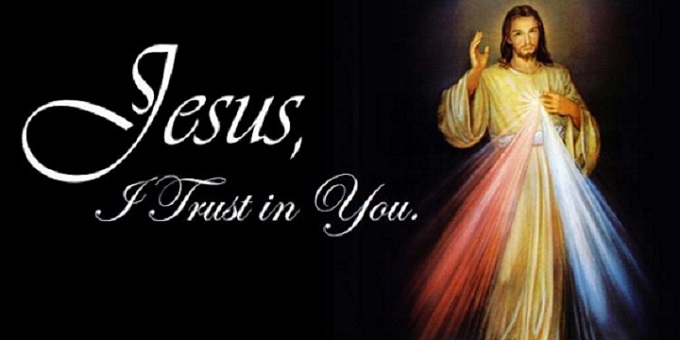
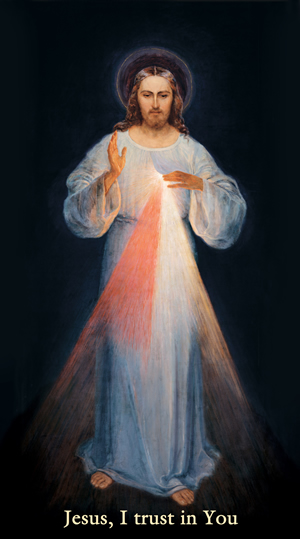
why Jesus insisted that the sacred image of Himself as The Divine Mercy is to
be venerated throughout the world in connection with the observance of this
Sunday (see Diary, 49, 88, 299, 341, 570, 742). The Holy Father said:
"Before speaking these words, Jesus shows His hands and His side. He
points, that is, to the wounds of the Passion, especially the wound in His
Heart, the source from which flows the great wave of mercy poured out on
humanity.
"From that Heart, Sr. Faustina Kowalska, the blessed
whom from now on we will call a saint, will see two rays of light shining from
that Heart and illuminating the world: 'The two rays,' Jesus Himself explained
to her one day, 'represent blood and water' (Diary, 299).
 |
| Jesus Pierced with a Lance -- and Blood and Water gushed out |
"Blood and water! We immediately think of the testimony
given by the Evangelist John, who, when a soldier on Calvary pierced Christ's
side with his spear, sees blood and water flowing from it (cf. Jn 19:34).
Moreover, if the blood recalls the sacrifice of the Cross and the gift of the Eucharist,
the water, in Johannine symbolism, represents not only Baptism but also the
gift of the Holy Spirit (cf. Jn 3:5; 4:14; 7:37‑39).
"Divine Mercy reaches human beings through the Heart of
Christ crucified: 'Tell, My daughter, [all people] that I am Love and Mercy
itself [personified]' Jesus will ask of Sr. Faustina (Diary, 1074).
Christ
pours out this mercy on humanity through the sending of the Spirit who, in the
Trinity, is the Person‑Love.
And is not mercy love's
'second name' (cf. Rich in Mercy, n.7), understood in its deepest and most
tender aspect, in its ability to take upon itself the burden of any need and,
especially, in its most immense capacity for forgiveness?"
From this teaching of the Holy Father on that most solemn
occasion of his "presenting the life and witness of Sr. Faustina Kowalska.
to the whole Church as a gift of God to our time," it can be deduced that
the most opportune time, the most proper one, for the solemn honoring of The
Divine Mercy falls immediately after the Paschal Feast of Easter, recalling the
attaining of our Redemption.
St. Augustine called the eight days of Easter (which the
Church liturgically considers as constituting a single day ‑
the day of the new creation) "days of mercy and pardon." He calls the
Sunday of this Paschal Octave (which our Lord insisted with St. Faustina is the
Feast of Mercy [Diary, 88]) "the summary of the days of mercy"
(Sermon 156, Dom. In Albis). It is no wonder, then, that already during his
pilgrimage to Blessed Faustina's tomb on June 7, 1997, Pope John Paul 11
declared: "I give thanks to Divine Providence that I have been enabled to
contribute personally to the fulfillment of Christ's will through the
institution of the Feast of Divine Mercy."

In fact, Jesus Himself dictated the intentions for each day
of the novena which starts on Good Friday and He desired to be celebrated as a
preparation for the solemn observance of this feast.
 |
| Divine Mercy |
The image of Jesus, The Divine Mercy, is to have a special
place of honor on the Feast of Mercy, a visual reminder of all that Jesus did
for us through His Passion, Death, and Resurrection ... and a reminder, too, of
what He asks of us in return ‑ to trust Him and be merciful to
others:
"I want the image to be solemnly blessed on the first
Sunday after Easter, and I want it to be venerated publicly so that every soul
may know about it" (341).
\
A Special Promise of Mercy
Our Lord's promise to grant complete forgiveness of sins and
punishment on the Feast of Mercy is recorded three times in the Diary of Saint
Faustina, each time in a slightly different way:
"I want to grant a complete pardon to the souls that
will go to Confession and receive Holy Communion on the Feast of My mercy"
(1109).
"Whoever approaches the Fountain of Life on this day
will be granted complete forgiveness of sins and punishment" (300).
"The soul that will go to Confession and receive Holy
Communion will obtain complete forgiveness of sins and punishment" (699).
Extraordinary Graces
 |
| Body and Blood of Christ in the Eucharist |
Our Lord is emphasizing, through this promise, the infinite
value of Confession and Communion as miracles of mercy. He wants us to realize
that since the Eucharist is His own Body, Blood, Soul, and Divinity, it is the
"Fountain of Life" (300). The Eucharist is Jesus, Himself, the Living
God, longing to pour Himself as Mercy into our hearts.
Why would Our Lord feel the need to emphasize this? Because
so many people do not really understand it. They either see no need to receive
Holy Communion, or they receive it simply out of habit. As St. Paul explains in
his letter to the Corinthians, they eat the bread or drink the cup of the Lord unworthily, "without
recognizing the body of the Lord" (I Cor 11:27‑29).
In His revelations to Saint Faustina Our Lord makes it very
clear what He is offering us in Holy Communion and how much it hurts Him when
we treat His presence with indifference:
"My great delight is to unite Myself with souls ...
When I come to a human heart in Holy Communion, My hands are full of all kinds
of graces which I want to give to the soul. But souls do not even pay any
attention to Me; they leave Me to Myself and busy themselves with other things.
Oh, how sad I am that souls do not recognize Love! They treat Me as a dead
object" (1385) ...
"It pains Me very much when religious souls receive the
Sacrament of Love merely out of habit, as if they did not distinguish this
food. I find neither faith nor love in their hearts. I go to such souls with
great reluctance. It would be better if they did not receive Me" (1288)
...
"How painful it is to Me that souls so seldom unite
themselves to Me in Holy Communion. I wait for souls, and they are indifferent
toward Me. I want to lavish My graces on them, and they do not want to accept
them. They treat me as a dead object, whereas My Heart is full of love and
mercy. In order that you may know at least some of My pain imagine the most
tender of mothers who has great love for her children, while those children
spurn her love. Consider her pain. No one is in a position to console her. This
is but a feeble image and likeness of My love" (1447).
So, Our Lord's promise of complete forgiveness
is both a
reminder and a call.
It is a reminder that He is truly present
and truly alive
in the Eucharist,
filled with love for us and waiting for us to turn
to Him
with trust.
And it is a call for us all to be washed clean in His Love through
Confession and Holy Communion ‑ no matter how terrible our sins ‑
and begin our lives again. He is offering us a new start.
Prepare Yourself Properly
 |
| Confession and Divine Mercy |
Going to Confession is not the only way we should prepare
ourselves for Divine Mercy Sunday. As Cardinal Francis Macharski, Archbishop of
Krakow, Poland explains in a 1985 pastoral letter, we are not simply called to
ask for God's mercy with trust. We are also called to be merciful:
"Our own merciful attitude is likewise a preparation.
Without deeds of mercy our devotion would not be real. For Christ does not only
reveal the mercy of God, but at the same time He places before people the
demand that they conduct themselves in life with love and mercy. The Holy
Father states that this requirement constitutes the very heart of the Gospel
ethos (Rich in Mercy, 3) ‑ it is the commandment of love and
the promise: "Blessed are the merciful, for they shall obtain mercy' (Mt
5:7). Let it be a mercy that is forgiving and true, and universal, with good
words, deeds, and prayer for others!"
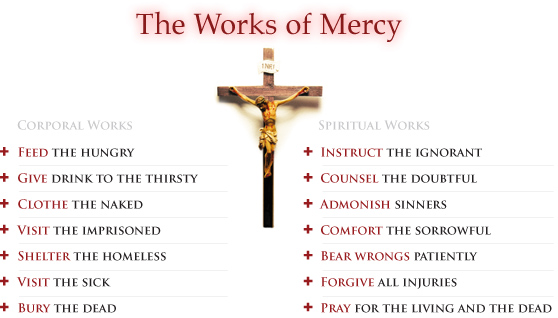
Our Lord's words to Saint Faustina about this requirement to
be merciful are very strong and leave no room for misinterpretation:
 |
| Works or Deeds of Mercy |
"Yes, the first Sunday after Easter is the Feast of
Mercy, but there must also be acts of mercy ... I demand from you deeds of
mercy, which are to arise out of love for Me. You are to show mercy to your
neighbors always and everywhere. You must not shrink from this or try to excuse
or absolve yourself from it" (742).
 |
| Receive Christ Reverently |
Thus, to fittingly observe the Feast of Mercy, we should:
1. Celebrate the
Feast on the Sunday after Easter;
2. Sincerely repent
of all our sins;
3. Place our complete
trust in Jesus;
4. Go to
Confession, preferably before that Sunday;
5. Receive Holy
Communion on the day of the Feast;
6. Venerate* the
Image of The Divine Mercy;
7. Be merciful to
others, through our actions, words, and
prayers on their behalf.
*To venerate a sacred image or statue simply means to
perform some act or make some gesture of deep religious respect toward it
because of the person whom it represents ‑ in this case, our Most Merciful
Savior.
 |
| Divine Mercy - St. John Paul II and St. Faustina |