Showing posts with label Holy Trinity. Show all posts
Showing posts with label Holy Trinity. Show all posts
Tuesday, 1 February 2022


Tuesday, 6 December 2016
The Five Fatima Prayers
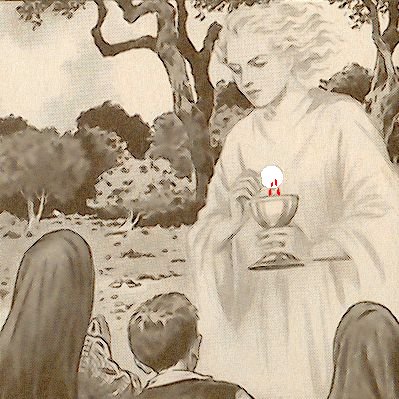 |
| Angel of Fatima |
The two prayers taught by the Angel:
My God, I
believe, I adore, I hope in and I love You. I ask pardon for all those who do
not believe in You, do not hope in You, do not love You.
Most Holy
Trinity, Father, Son and Holy Spirit, I adore You profoundly, and I offer You
the Most Precious Body, Blood, Soul and Divinity of the same Son Jesus Christ,
present in the Tabernacles of the world, in reparation for all the sacrileges,
outrages and indifferences by which He Himself is offended. And by the infinite merits of His Most Sacred
Heart and through the Immaculate Heart of Mary, O beg of You the conversion of
poor sinners.
 |
| Our Lady of Fatima |
The three prayers taught
by Our Lady:
O Most Holy Trinity,
I adore Thee; my God, I love Thee in the Most Blessed Sacrament.
O my Jesus,
forgive our sins, save us from the fires of Hell, lead all souls to Heaven,
especially those most in need.
O my Jesus,
it is for love of Thee, for the conversion of sinners and in reparation for
sins committed against the Immaculate Heart of Mary, I offer this sacrifice to
Thee.
Monday, 23 March 2015
FATIMA PRAYERS NEEDED NOW

FATIMA PRAYERS NEEDED
TO BE PRAYED NOW!!
EUCHARISTIC PRAYER
MOST HOLY TRINITY, I adore Thee! My God, My God,
I love Thee in the
Most Blessed Sacrament.
(3 times)
PARDON PRAYER
MY GOD, I believe, I adore, I trust, and I love Thee!
I ask pardon for for
those who do not believe,
do not adore, do not
trust and do not love Thee.
(3 times)

SACRIFICE PRAYER
Sacrifices -- A great
"secret" of converting sinners is to make sacrifices for them, as
well as to pray for them. Our Lady Of Fatima said: "Many souls go to Hell
because there are none to sacrifice themselves and to pray for them," And
the holy Cure of Ars said that the conversion of sinners "begins with prayer
and ends with penance."
But whereas
"penance" and "sacrifice" sound frightening to some people
and we may not like these words, yet they are the key to obtaining Heaven for
poor sinners. If we are frightened of penance, we can begin by making one
little sacrifice per day-----perhaps eating something we do not like, or
drinking water instead of pop, or making ourselves wait a half hour or so to
take a drink when we are thirsty. These are little forms of
"fasting". Some sacrifices we are obliged to make anyway, but we can
offer them for sinners: examples of these are being patient with a trying
person or turning off an immodest TV, program. These sacrifices will be
presents for Our Lady, the precious coin she can use to buy back souls that are
headed for Hell.
It seems that God loves to "delegate" His work, He has given
it to us to be the "secondary" causes of His work, including the
salvation of our "brother" and our "neighbor." And though
His Blood poured out on Calvary was sufficient to save all souls, He requires
that we, the living branches on Him, the Vine, ask for and even
"activate" its application to those souls by our prayers and our
sacrifices.
At Fatima both the Angel and Our Lady asked for sacrifices for sinners.
They said, "Sacrifice yourself." This is done largely by generously
making individual sacrifices.
The Angel of Fatima, too, told the three children to
"Offer prayers and sacrifices constantly to the Most High . . . Make of
everything you can a sacrifice, and offer it to God as an act of reparation for
the sins by which He is offended, and in supplication for the conversion of
sinners . . . Above all, accept and bear with submission the sufferings which
the Lord will send you."

OUR LADY
OF FATIMA SAID: SACRIFICE YOURSELVES FOR SINNERS AND SAY MANY TIMES, ESPECIALLY
WHEN YOU MAKE SOME SACRIFICE:
O JESUS, it is for love of Thee,
for the conversion of sinners,
and in reparation for the sins
committed against
the Immaculate Heart of Mary.
DECADE PRAYER
(To be said after the Glory Be at the end of each decade of the Rosary)
O MY JESUS, forgive us our sins, save us from the fire of Hell,
lead all souls to Heaven,
especially those who are most in need of Thy mercy.

ANGEL'S PRAYER
(Given to the three children by the Angel who
preceded Our Lady's
first appearance to them.)
MOST Holy Trinity, Father, Son, a
nd Holy Spirit, I adore Thee
profoundly.
I offer Thee the Most Precious
Body, Blood, Soul, and Divinity
of Jesus Christ, present in all
the tabernacles of the world,
in reparation for the outrages,
sacrileges, and indifference
by which He is offended. And through the infinite merit
of His Most Sacred Heart, and
the Immaculate Heart of Mary,
I beg of Thee the conversion of
poor sinners.
(3 times)
 |
| 1000s of people see the Miracle of the Sun at Fatima |
Thursday, 16 January 2014
Baptism the Great Sacrament

We celebrated the Feast of the Baptism of the Lord last
Sunday. Baptism is one of the most
important Sacraments …actually needed to receive the other Sacraments of the
Church.
I wanted to write something
regarding this great Sacrament, what I have learned—what the Church says about
it and why it’s so important.
The first question that comes to mind is WHY DID JESUS HAVE
TO BE BAPTIZED?

The Catechism of the Catholic
Church states “Our Lord voluntarily submitted himself to the baptism of St. John,
intended for sinners, in order to "fulfill all righteousness."19 Jesus' gesture is a manifestation of his
self-emptying.20 The Spirit who had hovered over the waters of the first
creation descended then on the Christ as a prelude of the new creation, and the
Father revealed Jesus as his "beloved Son."21”
Okay, what does that mean--exactly? I had often wondered about this same question
over the years and have discovered through my research an answer that made it
easier to understand so I thought that I would share my findings with you.
"…. Christ is
baptized, not that he may be sanctified in the waters, but that he himself may sanctify the waters, and by
his own purification may purify those streams which he touches.”
"For the
consecration of Christ is the greater consecration of another element. For
when the Savior is washed, then already for our baptism all water is cleansed
and the fount purified, that the grace of the laver may be administered to the
peoples that come after. Christ
therefore takes the lead in baptism, so that Christian peoples may follow after him with confidence." (St. Maximus of Turin, 423) Excerpts
from: http://www.catholic.org/hf/faith/story.php?id=44333AD

“…In submitting
Himself humbly to the baptism of St. John the Baptist, however, Christ provided
the example for the rest of us. If even He should be baptized, though He
had no need of it, how much more should the rest of us be thankful for this
sacrament, which frees us from the darkness of sin and incorporates us into the
Church, the life of Christ on earth! His Baptism, therefore, was
necessary--not for Him, but for us.
Many of the Fathers of
the Church, as well as the medieval Scholastics, saw Christ's Baptism as the institution of the sacrament. His Flesh
blessed the water, and the descent of the Holy Spirit (in the form of a dove)
and the voice of God the Father announcing that this was His Son, in Whom He
was well pleased, marked the beginning of Christ's public ministry.” http://catholicism.about.com/od/holydaysandholidays/p/Baptism_of_Lord.htm
Here are the Readings for this
Feast of the Baptism of the Lord:

Isaiah 42:1-4, 6-7, or
Isaiah 40:1-5, 9-11;
Psalm 29:1-2, 3-4, 3, 9-10, or Psalm 104:1b-2, 3-4, 24-25,
27-28, 29-30;
Acts 10:34-38 or Titus 2:11-14; 3:4-7;
Luke 3:15-16, 21-22
“What a wonderful God
is our God” as Mother Angelica has said… Yes, He IS wonderful!!
Let me now share with
you more about this sacrament—it’s definition and it’s effects on the soul.
1213 Holy Baptism is the
basis of the whole Christian life, the gateway to life in the Spirit (vitae
spiritualis ianua),4 and the door which
gives access to the other sacraments. Through Baptism we are freed from sin and reborn as sons of God; we become
members of Christ, are incorporated into the Church and made sharers in her
mission: "Baptism is the sacrament
of regeneration through water in the word."5 Catechism of the Catholic
Church, http://www.vatican.va/archive/ccc_css/archive/catechism/p2s2c1a1.htm

Pope Francis had this to say about the Sacrament. “This sacrament constitutes a true immersion
in the death of Christ, to rise with him in a new life. It is a bath of regeneration
by water and the Spirit and that illuminates us with the grace of Christ,”
the Pope expressed in his Nov. 13 (2013) address. Read more: http://www.ncregister.com/daily-news/pope-francis-baptism-is-a-bath-of-regeneration#ixzz2qaYokoFq
The Effects of the Sacrament of Baptism:
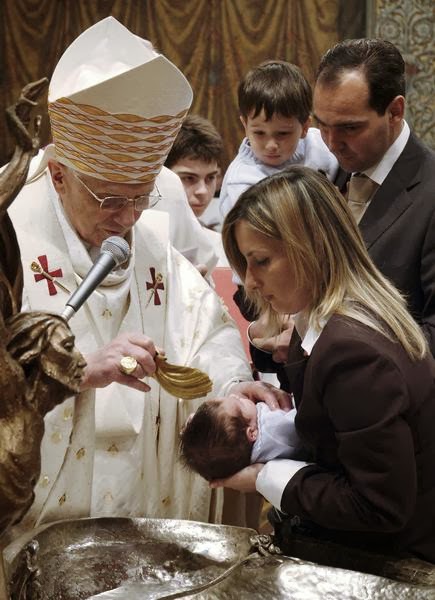
Baptism
has six primary effects, which are all supernatural graces:
1. The removal of the guilt of
both Original Sin (the sin imparted to all mankind by the Fall of Adam and
Eve in the Garden of Eden) and personal sin (the sins that we have
committed ourselves).
2. The remission of all punishment that we owe because of sin, both temporal (in this world and in Purgatory) and eternal (the punishment that we would suffer in hell).
3. The infusion of grace in the form of sanctifying grace (the life of God within us); the seven gifts of the Holy Spirit; and the three theological virtues.(see below)
4. Becoming a part of Christ.
5. Becoming a part of the Church, which is the Mystical Body of Christ on earth.
6. Enabling participation in the sacraments, the priesthood of all believers, and the growth in grace.
 The Catechism of the Catholic Church notes, "They (the 7 Gifts of the Holy Spirit) complete and perfect
the virtues of those who receive them." When we are infused with the
gifts of the Holy Spirit, we respond to the promptings of the Holy
Spirit as if by instinct...
The Catechism of the Catholic Church notes, "They (the 7 Gifts of the Holy Spirit) complete and perfect
the virtues of those who receive them." When we are infused with the
gifts of the Holy Spirit, we respond to the promptings of the Holy
Spirit as if by instinct...1. Wisdom ~ Not from Books...
The Wisdom that we receive through the Sacrament of Baptism is not one to help us with science, chemistry, math.... It's a more profound Wisdom of the Spirit....
Wisdom is the perfection of faith. As Fr. John A. Hardon, S.J., notes in his Modern Catholic Dictionary,
"Where faith is a simple knowledge of the articles of Christian belief,
wisdom goes on to a certain divine penetration of the truths
themselves." ... Thus wisdom, the Catholic Encyclopedia notes, "by
detaching us from the world, makes us relish and love only the things of
heaven." Through wisdom, we judge the things of the world in light of
the highest end of man—the contemplation of God.

Such
detachment, however, is not the same as renunciation of the world—far
from it. Rather, wisdom helps us to love the world properly, as the
creation of God, rather than for its own sake. The material world,
though fallen as a result of the sin of Adam and Eve, is still worthy of
our love; we simply need to see it in the proper light, and wisdom
allows us to do so.
Knowing the proper ordering of the material and spiritual worlds
through wisdom, we can more easily bear the burdens of this life and
respond to our fellow man with charity and patience. http://catholicism.about.com/od/beliefsteachings/p/Wisdom.htm
2. Understanding ~ of the Divine
Understanding is the second gift of the Holy Spirit, behind only wisdom. ...Wisdom is the desire to contemplate the things of God, while understanding allows us,... become certain of the truth of the doctrine of the Trinity. Such certitude moves beyond faith, which "merely assents to what God has revealed."

Understanding rises above natural reason, which is concerned only with the things we can sense in the world around us. Thus, understanding is both speculative—concerned with intellectual knowledge—and practical, because it can help us to order the actions of our lives toward our final end, which is God. Through understanding, we see the world and our life within it in the larger context of the eternal law and the relation of our souls to God.
http://catholicism.about.com/od/beliefsteachings/p/Understanding.htm
3. Counsel ~ Choosing Correctly

Counsel is the perfection of the cardinal virtue of prudence...Counsel allows us to judge rightly what we should do in a particular circumstance. It goes beyond prudence, though, in allowing such judgments to be made promptly, "as by a sort of supernatural intuition," as Fr. John A. Hardon writes in his Modern Catholic Dictionary. ..."With the gift of counsel, the Holy Spirit speaks, as it were, to the heart and in an instant enlightens a person what to do," writes Father Hardon. It is the gift that allows us as Christians to be assured that we will act correctly in times of trouble and trial. Through counsel, we can speak without fear in defense of the Christian Faith. Thus, the Catholic Encyclopedia notes, counsel "enables us to see and choose correctly what will help most to the glory of God and our own salvation."...
2. Understanding ~ of the Divine
Understanding is the second gift of the Holy Spirit, behind only wisdom. ...Wisdom is the desire to contemplate the things of God, while understanding allows us,... become certain of the truth of the doctrine of the Trinity. Such certitude moves beyond faith, which "merely assents to what God has revealed."

Understanding rises above natural reason, which is concerned only with the things we can sense in the world around us. Thus, understanding is both speculative—concerned with intellectual knowledge—and practical, because it can help us to order the actions of our lives toward our final end, which is God. Through understanding, we see the world and our life within it in the larger context of the eternal law and the relation of our souls to God.
http://catholicism.about.com/od/beliefsteachings/p/Understanding.htm
3. Counsel ~ Choosing Correctly

Counsel is the perfection of the cardinal virtue of prudence...Counsel allows us to judge rightly what we should do in a particular circumstance. It goes beyond prudence, though, in allowing such judgments to be made promptly, "as by a sort of supernatural intuition," as Fr. John A. Hardon writes in his Modern Catholic Dictionary. ..."With the gift of counsel, the Holy Spirit speaks, as it were, to the heart and in an instant enlightens a person what to do," writes Father Hardon. It is the gift that allows us as Christians to be assured that we will act correctly in times of trouble and trial. Through counsel, we can speak without fear in defense of the Christian Faith. Thus, the Catholic Encyclopedia notes, counsel "enables us to see and choose correctly what will help most to the glory of God and our own salvation."...
4. Fortitude
Fortitude is commonly called courage, but it is different from what much of what we think of as courage today. Fortitude is always reasoned and reasonable; the person exercising fortitude is willing to put himself in danger if necessary, but he does not seek danger for danger's sake.

Fortitude is the virtue that allows us to overcome fear and to remain
steady in our will in the face of obstacles. Prudence and justice are
the virtues through which we decide what needs to be done; fortitude
gives us the strength to do it.
It also shows itself, as the Catholic Encyclopedia notes, "in moral
courage against the evil spirit of the times, against improper fashions,
against human respect, against the common tendency to seek at least the
comfortable, if not the voluptuous." Fortitude is the virtue of the martyrs, who are willing to give their
lives rather than to renounce their faith. That sacrifice may be
passive—Christian martyrs do not actively seek martyrdom—but it is
nonetheless determined and resolute.
7. Knowledge

Knowledge allows us to see the circumstances of our life as God sees
them, albeit in a more limited way, since we are limited by our human
nature. Through the exercise of knowledge, we can ascertain God's
purpose in our lives and His reason for placing us in our particular
circumstances...
"it enables those who have the gift to discern easily and effectively
between the impulses of temptation and the inspirations of grace."
Judging all things in the light of divine truth, we can more easily
distinguish between the promptings of God and the subtle wiles of the
devil.
6. Piety - A Gift of the Holy Spirit

Fr. John A. Hardon, S.J., notes in his Modern Catholic Dictionary,
is "The moral virtue by which a person is disposed to render to God the
worship and service he deserves." Far from being a drudgery, worship
should be an act of love, and piety is the instinctive affection for
God that makes us desire to render worship to Him, just as we
voluntarily honor our parents... It instills in us a desire always to do that which is pleasing to God..."
http://catholicism.about.com/od/beliefsteachings/p/Piety.htm7. Fear of the Lord

The fear of the Lord is the desire not to offend Him, and the
certainty that He will give us the grace necessary to keep from doing
so. It is that certainty that gives us hope.
The fear of the Lord is like the respect we have for our parents.
We do not wish to offend them, but we also do not live in fear of them,
in the sense of being frightened...it is not a fear of punishment, but a desire not to offend God that parallels our desire not to offend our parents... the fear of the Lord is the beginning of wisdom because it is one of the foundations of our religious life,
http://catholicism.about.com/od/beliefsteachings/p/Fear_of_the_Lord.htm
The Three Theological Virtues
FAITH, HOPE AND CHARITY (LOVE)

"A virtue is an habitual and firm disposition to do
the good. It allows the person not only to perform good acts, but to
give the best of himself. The virtuous person tends toward the good with
all his sensory and spiritual powers; he pursues the good and chooses
it in concrete actions.
- The goal of a virtuous life is to become like God.63 "
- http://www.vatican.va/archive/ccc_css/archive/catechism/p3s1c1a7.htm
Unlike the cardinal virtues,
which can be practiced by anyone, the theological virtues are gifts of
grace from God, and the object of the virtues—what the practice of the
virtue aims at—is God Himself.
"1813
The theological virtues are the foundation of Christian moral activity;
they animate it and give it its special character. They inform and give
life to all the moral virtues. They are infused by God into the souls
of the faithful to make them capable of acting as his children and of
meriting eternal life. They are the pledge of the presence and action of
the Holy Spirit in the faculties of the human being. There are three
theological virtues: faith, hope, and charity.77"
FAITH

1815 The gift of faith remains in one who has not sinned against it.80 But "faith apart from works is dead":81 when it is deprived of hope and love, faith does not fully unite the believer to Christ and does not make him a living member of his Body.
1816 The disciple of Christ must not only keep the faith and live on it, but also profess it, confidently bear witness to it, and spread it: "All however must be prepared to confess Christ before men and to follow him along the way of the Cross, amidst the persecutions which the Church never lacks."82 Service of and witness to the faith are necessary for salvation: "So every one who acknowledges me before men, I also will acknowledge before my Father who is in heaven; but whoever denies me before men, I also will deny before my Father who is in heaven."83
HOPE

"Hope is the theological virtue by which we desire
the kingdom of heaven and eternal life as our happiness, placing our
trust in Christ's promises and relying not on our own strength, but on
the help of the grace of the Holy Spirit. "Let us hold fast the
confession of our hope without wavering, for he who promised is
faithful."84 "The Holy Spirit . . . he poured out upon us
richly through Jesus Christ our Savior, so that we might be justified by
his grace and become heirs in hope of eternal life."85
1818 The virtue of hope responds to the aspiration to happiness which God has placed in the heart of every man; it takes up the hopes that inspire men's activities and purifies them so as to order them to the Kingdom of heaven; it keeps man from discouragement; it sustains him during times of abandonment; it opens up his heart in expectation of eternal beatitude. Buoyed up by hope, he is preserved from selfishness and led to the happiness that flows from charity...
1818 The virtue of hope responds to the aspiration to happiness which God has placed in the heart of every man; it takes up the hopes that inspire men's activities and purifies them so as to order them to the Kingdom of heaven; it keeps man from discouragement; it sustains him during times of abandonment; it opens up his heart in expectation of eternal beatitude. Buoyed up by hope, he is preserved from selfishness and led to the happiness that flows from charity...
"...We can therefore hope in the glory of heaven promised by God to those who love him and do his will.92 In every circumstance, each one of us should hope, with the grace of God, to persevere "to the end"93
and to obtain the joy of heaven, as God's eternal reward for the good
works accomplished with the grace of Christ. In hope, the Church prays
for "all men to be saved."94 She longs to be united with Christ, her Bridegroom, in the glory of heaven..."
CHARITY

Charity is the theological virtue by which we love
God above all things for his own sake, and our neighbor as ourselves
for the love of God.
1823 Jesus makes charity the new commandment.96 By loving his own "to the end,"97 he makes manifest the Father's love which he receives. By loving one another, the disciples imitate the love of Jesus which they themselves receive. Whence Jesus says: "As the Father has loved me, so have I loved you; abide in my love." And again: "This is my commandment, that you love one another as I have loved you."98
1824 Fruit of the Spirit and fullness of the Law, charity keeps the commandments of God and his Christ: "Abide in my love. If you keep my commandments, you will abide in my love."99
1825 Christ died out of love for us, while we were still "enemies."100 The Lord asks us to love as he does, even our enemies, to make ourselves the neighbor of those farthest away, and to love children and the poor as Christ himself.101
1823 Jesus makes charity the new commandment.96 By loving his own "to the end,"97 he makes manifest the Father's love which he receives. By loving one another, the disciples imitate the love of Jesus which they themselves receive. Whence Jesus says: "As the Father has loved me, so have I loved you; abide in my love." And again: "This is my commandment, that you love one another as I have loved you."98
1824 Fruit of the Spirit and fullness of the Law, charity keeps the commandments of God and his Christ: "Abide in my love. If you keep my commandments, you will abide in my love."99
1825 Christ died out of love for us, while we were still "enemies."100 The Lord asks us to love as he does, even our enemies, to make ourselves the neighbor of those farthest away, and to love children and the poor as Christ himself.101
Excerpts from the Catechism of the Catholic Church
http://www.vatican.va/archive/ccc_css/archive/catechism/p3s1c1a7.htm
Monday, 9 December 2013
Novena of the Three Hail Marys

Efficacious Novena
of
The Three
The Three
Hail Marys
In honor of the Power, Wisdom, and Loving Mercy
of the Blessed Virgin Mary
Oh, Immaculate Mary, Virgin most
Powerful, I beseech you, through that immense Power which you have received
from the Eternal Father, obtain for me Purity of heart, - Strength to overcome
all the enemies of my soul; -and the special favor I implore in my present
necessity.
( Name It)
Mother most pure! Forsake me not,
despise not my prayer, graciously hear me for God's glory, your honor, and the
welfare of my soul.
 To obtain this favor I honor your
Power by reciting:
To obtain this favor I honor your
Power by reciting:
Hail Mary, Full of Grace,
The
Lord is with thee.
Blessed art thou among women, and blessed is the fruit
of thy womb, Jesus.
Holy Mary, Mother of God,
pray
for us sinners now, and at the hour of death.
Amen.
Oh Virgin Mary, My Mother,
through that ineffable Wisdom bestowed upon you by the Incarnate Word of God, I
humbly beseech you, obtain for me Meekness and humility of heart; - a perfect
knowledge of the divine Will and strength to accomplish it always.

Oh Mary, Seat of Wisdom; as a
tender Mother lead me in the path of Christian Virtue and perfection; enlighten
and enable me to do what is most pleasing to your beloved Son. and obtain my
petition.
To obtain this grace I honor your
Wisdom by reciting:
Hail Mary, Full of Grace,
The
Lord is with thee.
Blessed art thou among women, and blessed is the fruit
of thy womb, Jesus.
Holy Mary, Mother of God,
pray
for us sinners now, and at the hour of death.
Amen.
Oh, Mother of Mercy, Mother of
penitent sinners, I stand before you sinful and sorrowful, beseeching you
through the immense Love given to you by the Holy Spirit for us poor sinners,
obtain for me true and perfect contrition for my sins, which I hate and detest
with all my heart, because I love God.
Mother most Merciful, help me in my present
necessity.

Turn, then those eyes of Mercy
toward us, Oh Clement, Oh Loving oh Sweet Virgin Mary!
To obtain this precious gift, I
honor Your Loving Mercy by reciting:
Hail Mary, Full of Grace,
The
Lord is with thee.
Blessed art thou among women, and blessed is the fruit
of thy womb, Jesus.
Holy Mary, Mother of God,
pray
for us sinners now, and at the hour of death.
Amen.

Three Hail Mary’s a Day
Keeps Mortal Sin Away
One of the greatest and most powerful Marian devotions is the practice of reciting three Hail Mary’s every day in honor of the three Divine Persons of the Trinity and for the grace avoid all mortal sins, specifically sexual sins.
The Blessed and Immaculate Virgin Mary taught the “Three Hail Mary
Devotion” to St. Mechtilde about the year 1270. It’s rather simple. Pray
the three Hail Mary’s in honor of the Holy Trinity who lavished so many
graces upon Mary and then end with: “O my Mother, preserve me this day
(or night) from mortal sin.”
 |
| St. Anthony of Padua |
The great doctor of the Church, Saint Anthony of Padua practiced the
Three Hail Mary’s devotion and exhorted others to do so, as well. The
other great Franciscan missionary St. Leonard of Port Maurice
(1675-1751) also openly exhorted his listeners to practice this devotion
as a remedy against sexual sins.
The doctor of the Church St. Alphonsus Maria Liguori, in his book The Glories of Mary, says the following about the devotion:
 |
| St. Alphonsus Maria Liguori, |
“Each morning and each night, when arising and when going to bed, say three Hail Mary’s prostrate on the ground, or at least kneeling, and to each Hail Mary add the short aspiration: ‘By thy pure and Immaculate Conception, O Mary, make my body pure and my soul holy.’
Pope Leo XIII later indulgenced the daily Three Hail Mary’s. Why not
add this easy and simply devotion to your spiritual tool belt.
And don’t forget, the daily Holy Rosary is the greatest weapon you have against concupiscence, sin, and the devil.
Article borrowed to share from a writing of Taylor Marshall.
http://taylormarshall.com/2010/10/three-hail-marys-day-keeps-mortal-sin.html
Subscribe to:
Posts (Atom)