The Story of St. Bernard of Clairvaux
Born in 1090, at
Fontaines, near Dijon, France; died at Clairvaux, 21 August, 1153.
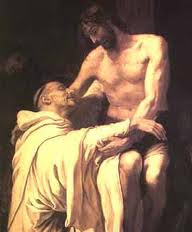 |
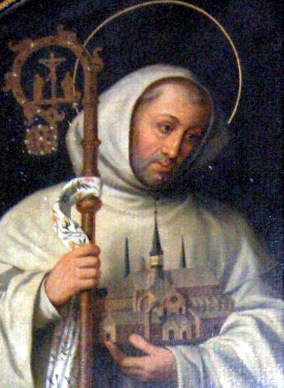
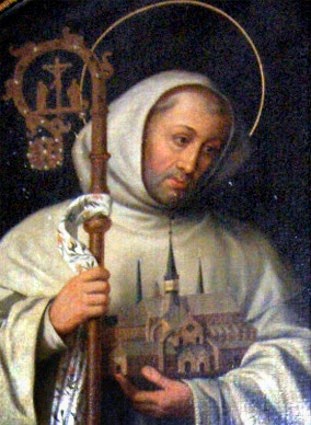
| St. Bernard of Clairvaux with Christ |
His parents were
Tescelin, lord of Fontaines, and Aleth of Montbard, both belonging to the
highest nobility of Burgundy. Bernard,
the third of a family of seven children, six of whom were sons, was educated
with particular care, because, while yet unborn, a devout man had foretold his
great destiny. At the age of nine years, Bernard was sent to a much renowned
school at Chatillon-sur-Seine, kept by the secular canons of Saint-Vorles. He had a great taste for literature and
devoted himself for some time to poetry. His success in his studies won the admiration
of his masters, and his growth in virtue was no less marked. Bernard's great desire was to excel in
literature in order to take up the study of Sacred Scripture, which later on
became, as it were, his own tongue.
"Piety was his all," says Bossuet. He had a special devotion to the Blessed
Virgin, and there is no one who speaks more sublimely of the Queen of
Heaven. Bernard was scarcely nineteen
years of age when his mother died.
During his youth, he did not escape trying temptations, but his virtue
triumphed over them, in many instances in a heroic manner, and from this time
he thought of retiring from the world and living a life of solitude and prayer.
When Bernard
with thirty he sought admission into the Clairvaux order.
Three years later, St. Stephen sent the young Bernard, at the head of a
band of monks, the third to leave Cîteaux, to found a new house at Vallée
d'Absinthe, or Valley of Bitterness, in the Diocese of Langres. This Bernard
named Claire Vallée, of Clairvaux, on the 25th of June, 1115, and the names of
Bernard and Clairvaux thence became inseparable. During the absence of the
Bishop of Langres, Bernard was blessed as abbot by William of Champeaux, Bishop
of Châlons-sur-Marne, who saw in him the predestined man, servum Dei. From that
moment a strong friendship sprang up between the abbot and the bishop, who was
professor of theology at Notre Dame of Paris, and the founder of the cloister
of St. Victor.
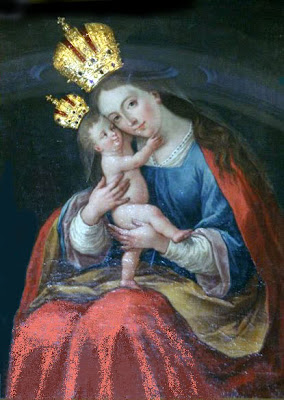 |
| Mary Queen, Jesus King |
The beginnings
of Clairvaux were trying and painful. The regime was so austere that Bernard's
health was impaired by it, and only the influence of his friend William of
Champeaux, and the authority of the General Chapter could make him mitigate his
austerities. The monastery, however,
made rapid progress. Disciples flocked
to it in great numbers, desirous of putting themselves under the direction of
Bernard. His father, the aged Tescelin,
and all his brothers entered Clairvaux as religious, leaving only Humbeline,
his sister, in the world and she, with the consent of her husband, soon took
the veil in the Benedictine Convent of Jully.
Clairvaux becoming too small for the religious who crowded there, it was
necessary to send out bands to found new houses. In 1118, the Monastery of the Three Fountains
was founded in the Diocese of Châlons; in 1119, that of Fontenay in the Diocese
of Auton (now Dijon) and in 1121, that of Foigny, near Vervins, in the Diocese
of Laon (now Soissons), Notwithstanding this prosperity, the Abbot of Clairvaux
had his trials.
In the year
1119, Bernard was present at the first general chapter of the order convoked by
Stephen of Cîteaux. Though not yet thirty years old, Bernard was listened to
with the greatest attention and respect, especially when he developed his
thoughts upon the revival of the primitive spirit of regularity and fervour in
all the monastic orders. It was this general chapter that gave definitive form
to the constitutions of the order and the regulations of the "Charter of
Charity" which Pope Callixtus II confirmed 23 December, 1119. In 1120
Bernard composed his first work "De Gradibus Superbiae et
Humilitatis" and his homilies which he entitles "De Laudibus
Mariae". The monks of Cluny had not seen, with satisfaction, those of
Cîteaux take the first place among the religious orders for regularity and
fervour. For this reason there was a temptation on the part of the "Black
Monks" to make it appear that the rules of the new order were
impracticable. At the solicitation of William of St. Thierry, Bernard defended
himself by publishing his "Apology" which is divided into two parts.
In the first part he proves himself innocent of the invectives against Cluny,
which had been attributed to him, and in the second he gives his reasons for
his attack upon averred abuses. He protests his profound esteem for the
Benedictines of Cluny whom he declares he loves equally as well as the other
religious orders. Peter the Venerable,
Abbot of Cluny, answered the Abbot of Clairvaux without wounding charity in the
least, and assured him of his great admiration and sincere friendship. In the meantime Cluny established a reform,
and Suger himself, the minister of Louis le Gros, and Abbot of St. Denis, was
converted by the apology of Bernard. He hastened to terminate his worldly life
and restore discipline in his monastery. The zeal of Bernard did not stop here;
it extended to the bishops, the clergy, and the faithful, and remarkable
conversions of persons engaged in worldly pursuits were among the fruits of his
labours. Bernard's letter to the Archbishop of Sens is a real treatise "De
Officiis Episcoporum". About the same time he wrote his work on "Grace
and Free Will.
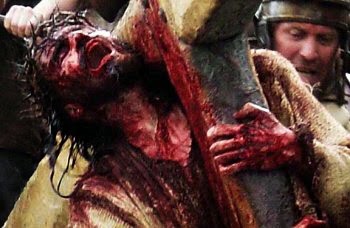
"Saint Bernard, the "most contagious" abbot of the 12th century, had inflamed the hearts of his monks with love for the Suffering Christ. By means of his widely circulated sermons and other writings, Cistercian devotion to the Passion ran across Europe like a fire in stubble."
"My beloved is to me a little bundle of myrrh." From the early days of my conversion, conscious of my grave lack of merits, I made sure to gather for myself this little bundle of myrrh. It was culled from all the anxious hours and bitter experiences of my Lord. . . . there were the insults, the spitting, the blows, the mockery, the scorn, the nails, and similar torments, and all for the salvation of our race. Among the little branches of this perfumed myrrh I feel we must not forget the myrrh which He drank upon the cross and was used for His anointing at burial. In the first of these he took upon Himself the bitterness of my sins, in the second He affirmed the future incorruption of my body. As long as I live I shall proclaim the abounding goodness in these events; for all eternity I shall not forget these mercies, for in them I have found life. (Saint Bernard, On the Song of Songs, 43).
Taken from an
excerpts from
and
Vultus Christi http://vultus.stblogs.org/2009/03/feast-of-the-via-crucis.html