Ad

Showing posts with label Writings of St. Gregory the Great. Show all posts

Thursday, 21 July 2016

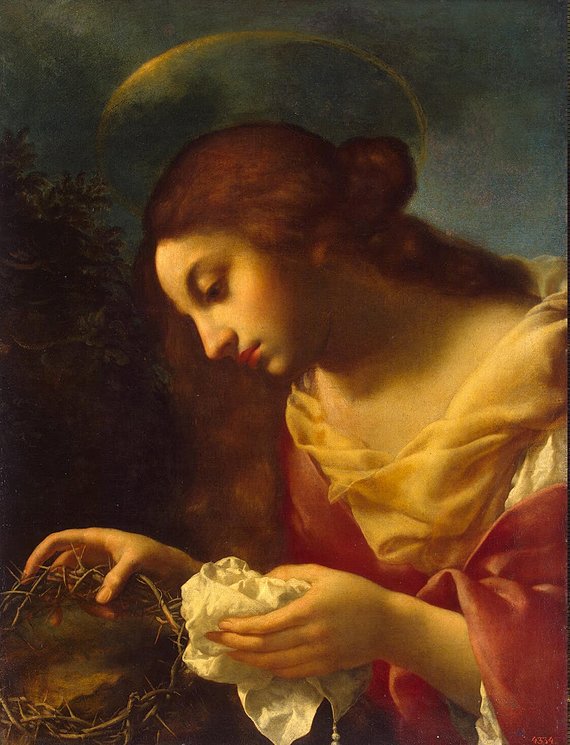
St. Mary Magdalene Sought her Lord

St. Mary Magdalene, Feast Day July 22

St. Mary Magdalene
From the homily on the Gospels by St. Gregory the Great, pope


She longed for Christ, though she thought he had been taken away

When Mary Magdalene came to the tomb and did not find the Lord’s body, she thought it had been taken away and so informed the disciples.  After they came and saw the tomb, they too believed what Mary had told them.  The text then says: The disciples went back home, and it adds: but Mary wept and remained standing outside the tomb.

Weeping at the tomb

We should reflect on Mary’s attitude and the great love she felt for Christ; for though the disciples had left the tomb, she remained.  She was still seeking the one she had not found, and while she sought she wept; burning with the fire of love, she longed for him who she thought had been taken away.  

And so it happened that the woman who stayed behind to seek Christ was the only one to see him.  


For perseverance is essential to any good deed, 
as the voice of truth tells us: 
Whoever perseveres to the end will be saved.

At first she sought but did not find, but when she persevered t happened that she found what she was looking for.  When our desires are not satisfied, they grow stronger, and becoming stronger they take hold of their object.  

Holy desires likewise grow with anticipation, and if they do not grow they are not really desires.  Anyone who succeeds in attaining the truth has burned with such a love.  

As David says: 
My soul has thirsted for the living God; 
when shall I come and appear before the face of God?  

And also in the Song of Songs the Church says:

I was wounded by love; and again: My soul is melted with love.

Weeping at the tomb... Jesus asks Why do you weep?

Woman, why are you weeping? Whom do you seek? 

She is asked why she is sorrowing so that her desire might be strengthened; for when she mentions whom she is seeking, her love is kindled all the more ardently.


Jesus says to her: Mary.  

Jesus is not recognized when he calls her “woman”; so he calls her by name, as though he were saying: Recognize me as I recognize you; for I do not know you as I know others; I know you as yourself. 

And so Mary, once addressed by name, recognizes who is speaking.  

She immediately calls him rabboni,
 that is to say, teacher, 
because the one whom 
she sought outwardly 
was the one who inwardly 
taught her to keep on searching. 

Once addressed by name, Mary recognizes who is speaking and calls him rabboni, teacher

Homily taken from the Liturgy of the Hours

Thursday, 21 June 2012

Writings of Saint Gregory the Great, pope


St. Gregory the Great, Pope and the Holy Spirit
Saint Gregory the Great, pope
From the Moral Reflections on Job
The law of the Lord is manifold
                How must we interpret this law of God?  How, if not by love?  The love that stamps the precepts of right-living on the mind and bids us put them into practice.  Listen to Truth speaking of this law:  This is my commandment, that you love one another. Listen to Paul:  The whole law, he declares, is summed up in love; and again:  Help one another in your troubles, and you will fulfill the law of Christ.  The law of Christ—does anything other than love more fittingly describe it?  Truly we are keeping this law when, out of love, we go to the help of a brother in trouble.
                But we are told that this law is manifold.  Why?  Because love’s lively concern for others is reflected in all the virtues.  It begins with two commands, but it soon embraces many more.  Paul gives a good summary of its various aspects.  Love is patient, he says, and kind; it is never jealous or conceited; its conduct is blameless; it is not ambitious, not selfish, not quick to take offense; it harbors no evil thoughts, does not gloat over other people’s sins, but is gladdened by an upright life. 
                The man ruled by this love shows his patience by bearing wrongs with equanimity; his kindness by generously repaying good for evil.  Jealously is foreign to him.  It is impossible to envy worldly desires.  He is not conceited.  The prizes he covets lie within; outward blessings do not elate him.  His conduct is blameless, for he cannot do wrong in devoting himself entirely to love of God and his neighbor.  He is not ambitious.  The welfare of his own soul is what he cares about.  Apart from that he seeks nothing. He is not selfish.  Unable to keep anything he has in this world, he is as indifferent to it as if it were another’s.  Indeed, in his eyes nothing is his own but what will be so always.  He is not quick to take offense.  Even under provocation, thought of revenge never crosses his mind.  The reward he seeks hereafter will be greater in proportion to his endurance.  He harbors no evil thoughts.  Hatred is utterly rooted out of a heart whose only love is goodness.  Thoughts that defile a man can find no entry.  He does not gloat over other people’s sins.  No; an enemy’s fall affords him no delight, for loving all men, he longs for their salvation.
                On the other hand, he is gladdened by an upright life.  Since he loves others as himself, he takes as much pleasure in whatever good he sees in them as if the progress were his own.  That is why this law of God is manifold.


Taken from the Liturgy of the Hours, According to the Roman Rite, Ordinary Time, Catholic Book Publishing Corp.  New York, 1975