 |
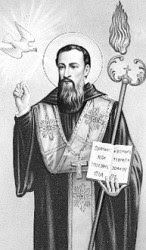
| St. Basil the Great and the Holy Spirit |
St. Basil the Great, His life
Bishop of Caesarea, and one of the most distinguished Doctors of the
Church. Born probably 329; died 1 January, 379. He ranks after Athanasius as a
defender of the Oriental Church against the heresies of the fourth century. With
his friend Gregory of Nazianzus and his brother Gregory of Nyssa, he makes up
the trio known as "The Three Cappadocians", far outclassing the other
two in practical genius and actual achievement.
St.
Basil the Elder, father of St. Basil the Great, was the son of a Christian of
good birth and his wife, Macrina (Acta SS., January, II), both of whom suffered
for the faith during the persecution of Maximinus Galerius (305-314), spending
several years of hardship in the wild mountains of Pontus. St. Basil the Elder was noted for his virtue
(Acta SS, May, VII) and also won considerable reputation as a teacher in
Caesarea. He was not a priest (Cf. Cave, Hist. Lit., I, 239). He married
Emmelia, the daughter of a martyr and became the father of ten children. Three
of these, Macrina, Basil, and Gregory are honoured as saints; and of the sons,
Peter, Gregory, and Basil attained the dignity of the episcopate.
Under the care of his father and his grandmother, the elder Macrina,
who preserved the traditions of their countryman, St. Gregory Thaumaturgus (c.
213-275) Basil was formed in habits of piety and study. He was still young when his father died and
the family moved to the estate of the elder Macrina at Annesi in Pontus, on the
banks of the Iris. As a boy, he was sent
to school at Caesarea, then "a metropolis of letters", and conceived
a fervent admiration for the local bishop, Dianius. Later, he went to
Constantinople, at that time "distinguished for its teachers of philosophy
and rhetoric", and thence to Athens. Here he became the inseparable companion of
Gregory of Nazianzus, who, in his famous panegyric on Basil which gives a most
interesting description of their academic experiences. According to him, Basil
was already distinguished for brilliancy of mind and seriousness of character
and associated only with the most earnest students. He was able, grave, industrious, and well
advanced in rhetoric, grammar, philosophy, astronomy, geometry, and medicine
Basil came again in contact with Dianius, Bishop of Caesarea, the
object of his boyish affection, and Dianius seems to have baptized him, and
ordained him Reader soon after his return to Caesarea. It was at the same time also that he fell
under the influence of that very remarkable woman, his sister Macrina, who had
meanwhile founded a religious community on the family estate at Annesi. Basil
himself tells us how, like a man roused from deep sleep, he turned his eyes to
the marvellous truth of the Gospel, wept many tears over his miserable life,
and prayed for guidance from God: "Then
I read the Gospel, and saw there that a great means of reaching perfection was
the selling of one's goods, the sharing of them with the poor, the giving up of
all care for this life, and the refusal to allow the soul to be turned by any
sympathy towards things of earth".
To learn the ways of perfection,
Basil now visited the monasteries of Egypt, Palestine, Coele-Syria, and
Mesopotamia. He returned, filled with admiration for the austerity and piety of
the monks, and founded a monastery in his native Pontus, on the banks of the
Iris, nearly opposite Annesi. (Cf. Ramsay, Hist. Geog. of Asia Minor, London,
1890, p. 326). Eustathius of Sebaste had already introduced the eremitical life
into Asia Minor; Basil added the cenobitic or community form, and the new
feature was imitated by many companies of men and women. Basil became known as
the father of Oriental monasticism, the forerunner of St. Benedict. How well he
deserved the title, how seriously and in what spirit he undertook the
systematizing of the religious life, may be seen by the study of his Rule. He seems to have read Origen's writings very
systematically about this time, for in union with Gregory of Nazianzus, he
published a selection of them called the "Philocalia".
Basil still retained considerable influence in Caesarea, and it is
regarded as fairly probable that he had a hand in the election of the successor
of Dianius who died in 362, after having been reconciled to Basil. In any case the new bishop, Eusebius, was
practically placed in his office by the elder Gregory of Nazianzus. Eusebius having persuaded the reluctant Basil
to be ordained priest, gave him a prominent place in the administration of the diocese. During this administration of the diocese,
Basil had so clearly defined his ideas of discipline and orthodoxy, that no one
could doubt the direction and the vigour of his policy.
Basil's letters tell the story of his tremendous and varied
activity; how he worked for the exclusion of unfit candidates from the sacred
ministry and the deliverance of the bishops from the temptation of simony; how
he required exact discipline and the faithful observance of the canons from
both laymen and clerics; how he rebuked the sinful, followed up the offending,
and held out hope of pardon to the penitent. If on the one hand he strenuously
defended clerical rights and immunities, on the other he trained his clergy so
strictly that they grew famous as the type of all that a priest should be.
Basil did not confine his activity to diocesan affairs, but threw himself
vigorously into the troublesome theological disputes then rending the unity of
Christendom. He drew up a summary of the orthodox faith; he attacked by word of
mouth the heretics near at hand and wrote tellingly against those afar. His
correspondence shows that he paid visits, sent messages, gave interviews,
instructed, reproved, rebuked, threatened, reproached, undertook the protection
of nations, cities, individuals great and small. There was very little chance
of opposing him successfully, for he was a cool, persistent, fearless fighter
in defence both of doctrine and of principles. His bold stand against Valens parallels the
meeting of Ambrose with Theodosius. The emperor was dumbfounded at the
archbishop's calm indifference to his presence and his wishes. The incident, as
narrated by Gregory of Nazianzus, not only tells much concerning Basil's
character but throws a clear light on the type of Christian bishop with which
the emperors had to deal and goes far to explain why Arianism, with little
court behind it, could make so little impression on the ultimate history of
Catholicism.
While assisting Eusebius in the care of his diocese, Basil had shown
a marked interest in the poor and afflicted; that interest now displayed itself
in the erection of a magnificent institution, the Ptochoptopheion, or
Basileiad, a house for the care of friendless strangers, the medical treatment
of the sick poor, and the industrial training of the unskilled. Built in the
suburbs, it attained such importance as to become practically the centre of a
new city with the name of he kaine polis or "Newtown". It was the
motherhouse of like institutions erected in other dioceses and stood as a
constant reminder to the rich of their privilege of spending wealth in a truly
Christian way. St. Basil was a practical lover of Christian poverty, and even
in his exalted position preserved that simplicity in food and clothing and that
austerity of life for which he had been remarked at his first renunciation of
the world.
By common consent, Basil ranks among the greatest figures in church
history and the rather extravagant panegyric by Gregory of Nazianzus has been
all but equalled by a host of other eulogists. Physically delicate and
occupying his exalted position but a few years, Basil did magnificent and
enduring work in an age of more violent world convulsions than Christianity has
since experienced. By personal virtue he attained distinction in an age of saints;
and his purity, his monastic fervour, his stern simplicity, his friendship for
the poor became traditional in the history of Christian asceticism. In fact,
the impress of his genius was stamped indelibly on the Oriental conception of
religious life. In his hands the great
metropolitan see of Caesarea took shape as the sort of model of the Christian
diocese; there was hardly any detail of episcopal activity in which he failed
to mark out guiding lines and to give splendid example. Not the least of his glories
is the fact that toward the officials of the State he maintained that fearless
dignity and independence which later history has shown to be an indispensable
condition of healthy life in the Catholic episcopate.
Read more about
St. Basil at the website address below.


