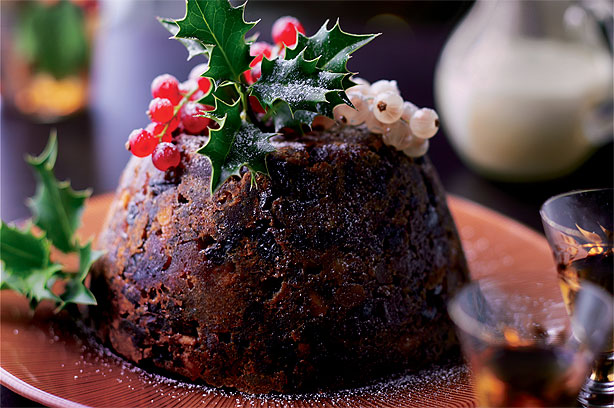
One of my most favorite Christmas traditions is watching the movie The Christmas Carol by Charles Dickens (actor Alastair Sim, he's the best Scrooge!)... When I was a child that was the first time I heard about the Christmas pudding. Since then it has become a favorite dessert to look forward to as well.
If you have watched the Christmas Carol movie or better yet read the book written by Charles Dickens, you will know that the Christmas pudding was part of the Christmas meal... To read The Christmas Carol by Dickens see http://gaslight.mtroyal.ca/carol.htm
An excerpt from the story:
"Hallo! A great deal of steam! The pudding was out of the
copper. A smell like a washing-day! That was the cloth. A smell like an
eating-house and a pastry-cook's next door to each other with a laundress's
next door to that! That was the pudding! In half a minute Mrs. Cratchit
entered, -- flushed but smiling proudly, -- with the pudding, like a speckled
cannon-ball, so hard and firm, blazing in half of half a quartern of ignited
brandy, and bedight with Christmas holly stuck into the top.
 |
| 1840s-1843-Charles-Dickens-Christmas Carol |
O, a wonderful pudding I Bob Cratchit said, and calmly too,
that he regarded it as the greatest success achieved by Mrs. Cratchit since
their marriage. Mrs. Cratchit said that now the weight was off her mind, she
would confess she had had her doubts about the quantity of flour. Everybody had
something to say about it, but nobody said or thought it was at all a small pudding
for a large family. Any Cratchit would have blushed to hint at such a thing."
Christmas pudding is a type of pudding traditionally served
as part of the Christmas dinner in Britain, Ireland and in some other countries
where it has been brought by British emigrants. It has its origins in medieval
England, and is sometimes known as plum pudding or just "pud", though
this can also refer to other kinds of boiled pudding involving dried fruit.
Despite the name "plum pudding," the pudding contains no actual plums
due to the pre-Victorian use of the word "plums" as a term for
raisins. The pudding is composed of many dried fruits held together by egg and
suet, sometimes moistened by treacle or molasses and flavoured with cinnamon,
nutmeg, cloves, ginger, and other spices. The pudding is aged for a month, months,
or even a year; the high alcohol content of the pudding prevents it from
spoiling during this time.
History of the Christmas Pudding
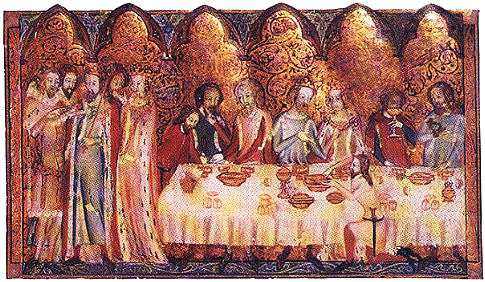 |
| Medieval Christmas |
There is a popular myth that plum pudding's association with
Christmas goes back to a custom in medieval England that the "pudding
should be made on the 25th Sunday after Trinity, that it be prepared with 13
ingredients to represent Christ and the 12 apostles, and that every family
member stir it in turn from east to west to honour the Magi and their journey
in that direction".
However, recipes for plum puddings appear mainly, if
not entirely, in the 17th century and later. Their possible ancestors include
savoury puddings such as those in Harleian MS 279, crustades, malaches whyte,
creme boiled (a kind of stirred custard), and sippets.
Various ingredients and
methods of these older recipes appear in early plum puddings.
One of the earliest plum pudding recipes is given by Mary
Kettilby in her 1714 book A Collection of above Three Hundred Receipts in Cookery,
Physick and Surgery.
There is a popular and wholly unsubstantiated myth that in
1714, King George I (sometimes known as the Pudding King) requested that plum
pudding be served as part of his royal feast in his first Christmas in England.
As techniques for meat preserving improved in the 18th century, the savoury
element of both the mince pie and the plum pottage diminished as the sweet
content increased.
People began adding dried fruit and sugar. The mince pie
kept its name, though the pottage was increasingly referred to as plum pudding.
Although the latter was always a celebratory dish it was originally eaten at
the Harvest festival, not Christmas. It was not until the 1830s that the
cannonball of flour, fruits, suet, sugar and spices, all topped with holly,
made a definite appearance, becoming more and more associated with Christmas.
 |
| Christmas Pudding |
The East Sussex cook Eliza Acton was the first to refer to it as
"Christmas Pudding" in her bestselling 1845 book Modern Cookery for
Private Families.
The pudding "had the great merit" of not needing
to be cooked in an oven, something "most lower class households did not
have".
The custom of eating Christmas pudding was carried to many
parts of the world by British colonists, and beyond the United Kingdom, became
a popular and common a dish in the Republic of Ireland, Australia, New Zealand,
and South Africa.
Excerpts from Wikipedia https://en.wikipedia.org/wiki/Christmas_pudding
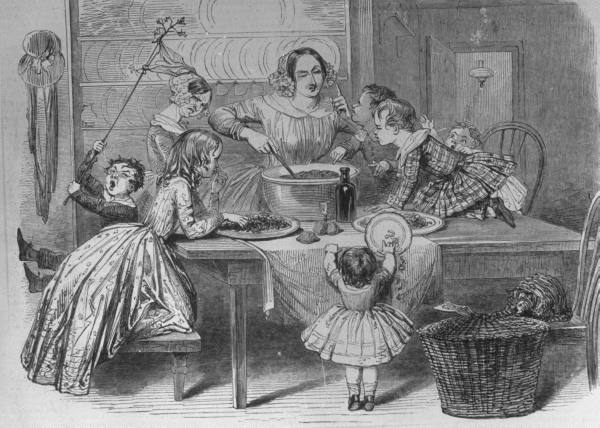 |
| Stirring the Pudding |
"Stir up Thy might, we beg Thee, O Lord; and come so
that we may escape through Thy protection and be saved by Thy help from the dangers
that threaten us because of our sins. Who livest and reignest for ever and
ever."
Afterwards the pudding is steamed and put away until the
feast of Christmas. Then warmed brandy or rum is added and set ablaze; and the
flaming pudding is brought to the dinner table to be served as soon as the
flame burns out. Actually the pudding is prepared on the Saturday before
"Stir-up" Sunday. Filled with the good things of the world, the
pudding is supposed to represent Christ who will bring with Him on His birthday
all the good things of heaven. Children love to work on the pudding, and the
busy mother finds extra hands a great help in dicing, grating and juicing the
fruits.
We use a recipe from "Jubilee," November 1953. The
ingredients cost about three dollars and will make five pounds of pudding. Adolph
Paganuzzi, chef of a well-known Greenwich Village, New York, pastry shop, reduced
his famous recipe to family proportions for "Jubilee." With his kind
permission we give it here:
1/2 lb. beef suet, chopped 1/4 lb. diced candied citron
1/2 lb. all-purpose flour, sifted 1/4 lb. diced candied orange peels
1/4 lb. bread crumbs 1/4 lb. diced candied lemon
peels
3/4 lb. brown sugar 8 eggs, beaten
2 teaspoons ground cinnamon 2 lemons--grated rind and their juice
1 teaspoon ground allspice 2 oranges--grated rind and their
juice
1 teaspoon ground ginger 1/2 pt. Sherry or Port wine
1-1/4 lbs. raisins--any kind
Into a bowl mix and work together all the ingredients one at
a time, in the order in which they are listed above.
When they have been well
mixed, pour the mixture into a well-greased mold or can. Cover, and seal tight.
Steam in large, covered kettle, roaster or similar utensil and let simmer for
at least five hours.
When done, the pudding can be stored away until Christmas.
It may be kept a year and will improve with age. It may be served with any
sauce desired, such as fruit, rum, brandy, raisin, vanilla or any other kind.
Liquid sauces are better than semi-liquid.
Rum Sauce
1 pt. Sherry wine 1 small stick cinnamon
1/2 lb. brown sugar Rind of 1/2 orange
2 bay leaves 1/2 pt. rum
Place all the ingredients in a glass jar and let stand
together for a few days. Bring to a boil, strain and serve over the pudding.
Taken from Mimi Matthews.com AUTHENTIC VICTORIAN CHRISTMAS PUDDING
Excerpt taken from FAMILY ADVENT CUSTOMS by Helen McLoughlin
https://www.ewtn.com/library/FAMILY/ADVCUST.TXT |
| Recipe for Christmas Plum-Pudding from Beeton’s Book of Household Management, 1861. |


