Ad

Showing posts with label Jesus is the light of the world. Show all posts

Wednesday, 11 June 2014

St. Chromatius, Bishop --- Shine with the Light of Truth

From a treatise on the Gospel of
Saint Matthew
by Saint Chromatius, bishop
You are the light of the world
You are the light of the world.  A city set on a hill cannot be hidden. Not do men light a lamp only to put it under a bushel basket; they put it on a stand where it gives light to all in the house.  The Lord called his disciples the sale of the earth because they seasoned with heavenly wisdom the hearts of men rendered insipid by the devil.  Now he calls them the light of the world as well, because they have been enlightened by him, the true and everlasting light, and have themselves become a light in the darkness.
Since he is the Sun of Justice, he fittingly calls his disciples the lights of the world.  The reason for this is that through them, as through shining rays, he has poured out the light of the knowledge of himself upon the entire world.  For by manifesting the light of truth, they have dispelled the darkness of error form the hearts of men.
Morever, we too have been enlightened by them.  We have been made light out of darkness as the Apostle says: For once you were darkness, but now you are light in the Lord; walk as children of light.  He says another time: For you are not sons of the night and of darkness, but you are all sons of light and of the day.
Saint John also rightly asserts in his letter: God is light, and whoever abides in God is in the light just as God himself is in the light. Therefore, because we rejoice in having been freed from the darkness of error, we should always walk in the light as children of light.  This is why the Apostle says: Among them you shine as lights in the world, holding fast to the word of life.
If we fail to live in the lights, we shall, to our condemnation and that of others, be veiling over and obscuring by our infidelity the light men so desperately need.  As we know from Scripture, the man who received the talent should have made it produce a heavenly profit, but instead he preferred to hide it away rather than put it to work and was punished as he deserved.
Consequently, that brilliant lamp which was lit for the sake of our salvation should always shine in us.  For we have the lamp of the heavenly commandment and spiritual grace, to which David referred: Your law is a lamp to my feet and a light to my path.  Solomon also ways this about it: For the command of the law is a lamp.

Therefore, we must not hide this lamp of law and faith.  Rather, we must set it up in the Church, as a lamp-stand, for the salvation of many, so that we may enjoy the light of truth itself and all believers may be enlightened.

Taken from Liturgy of the Hours, June 11


Who was St. Chromatius???


Chromatius was born in Aquileia in about 345 A.D. He was ordained a deacon, then a priest; finally, he was appointed Bishop of that Church (388). After receiving episcopal ordination from Bishop Ambrose he dedicated himself courageously and energetically to an immense task because of the vast territory entrusted to his pastoral care: the ecclesiastical jurisdiction of Aquileia, in fact, stretched from the present-day territories of Switzerland, Bavaria, Austria and Slovenia, as far as Hungary.
St Chromatius of Aquileia exercised his ministry in the ancient Church of Aquileia, a fervent centre of Christian life located in the Roman Empire's Decima regione, the Venetia et Histria. In 388 A.D., when Chromatius assumed the Episcopal throne of the city, the local Christian communities had already developed a glorious history of Gospel fidelity.
Martyrs of the Christian Faith
Between the middle of the third century and the early years of the fourth, the persecution of Decius, Valerian and Diocletian had taken a heavy toll of martyrs. Furthermore, the Church of Aquileia, like so many other Churches of that time, had had to contend with the threat of the Arian heresy. Athanasius himself - a standard-bearer of Nicene orthodoxy whom the Arians had banished to exile - had for some time been in Aquileia, where he had taken refuge. Under the guidance of its Bishops, the Christian community withstood the snares of the heresy and reinforced their own attachment to the Catholic faith.
Trinitarian Mystery
Chromatius was a wise teacher and a zealous pastor. His first and main commitment was to listen to the Word, to be able to subsequently proclaim it: he always bases his teaching on the Word of God and constantly returns to it. Certain subjects are particularly dear to him: first of all, the Trinitarian mystery, which he contemplated in its revelation throughout the history of salvation.
Then, the theme of the Holy Spirit: Chromatius constantly reminds the faithful of the presence and action in the life of the Church of the Third Person of the Most Holy Trinity. But the holy Bishop returns with special insistence to the mystery of Christ. The Incarnate Word is true God and true man: he took on humanity in its totality to endow it with his own divinity. These truths, which he also reaffirmed explicitly in order to counter Arianism, were to end up about 50 years later in the definition of the Council of Chalcedon.
Virgin Mary by Lyubomir Kanelov
The heavy emphasis on Christ's human nature led Chromatius to speak of the Virgin Mary. His Mariological doctrine is clear and precise. To him we owe evocative descriptions of the Virgin Most Holy: Mary is the "evangelical Virgin capable of accepting God"; she is the "immaculate and inviolate ewe lamb" who conceived the "Lamb clad in purple" (cf. Sermo XXIII, 3: Scrittori dell'area santambrosiana 3/1, p. 134). The Bishop of Aquileia often compares the Virgin with the Church: both, in fact, are "virgins" and "mothers".
Chromatius developed his ecclesiology above all in his commentary on Matthew. These are some of the recurring concepts: the Church is one, she is born from the Blood of Christ; she is a precious garment woven by the Holy Spirit; the Church is where the fact that Christ was born of a Virgin is proclaimed, where brotherhood and harmony flourish.
Ship in a Storm
One image of which Chromatius is especially fond is that of the ship in a storm - and his were stormy times, as we have heard: "There is no doubt", the Holy Bishop says, "that this ship represents the Church" (cf. Tractatus XLII, 5: Scrittori dell'area santambrosiana 3/2, p. 260).


Tuesday, 3 December 2013

Incarnation by St. Gregory Nazianzen


Saint Gregory Nazianzen
The Marvel of the Incarnation

St. Gregory Nazianzen the Theologian
The very Son of God, older than the ages, the invisible, the incomprehensible, the incorporeal, the beginning of beginning, the light of light, the fountain of life and immortality, the image of the archetype, the immovable seal, the perfect likeness, the definition and word of the Father: he it is who comes to his own image and takes our nature for the good of our nature, and unites himself to an intelligent soul for the good of my soul, to purify like by like.  He takes to himself all that is human, except for sin.  He was conceived by the Virgin Mary, who had been first prepared in soul and body by the Spirit: his coming to birth had to be treated with honor, virginity had to receive new honor.  He comes forth as God, in the human nature he has taken, one being, made of two contrary elements, flesh and spirit.  Spirit gave divinity, flesh received it.
He who makes rich is made poor; he takes on the poverty of my flesh, that I may gain the riches of his divinity.  He who is full is made empty; he is emptied for a brief space of his glory, that I may share in his fullness.

What is the wealth of goodness?  What is this mystery that surrounds me?  I received the likeness of God, but failed to keep it.  He takes on my flesh, to bring salvation to the image, immortality to the flesh.  He enters into a second union with us, a union far more wonderful than the first.


Holiness had to be brought to man by the humanity assumed by one who was God, so that God might overcome the tyrant by force and so deliver us and lead us back to himself through the mediation of his Son.  The Son arranged this for the honor of the Father, to whom the Son is clearly obedient in all things.

The Good Shepherd, who lays down his life for the sheep, came in search of the straying sheep to the mountains and hills on which you used to offer sacrifice.  When he found it, he took it on the shoulders that bore the wood of the cross, and led it back to the life of heaven.

Christ, the light of all lights, follows John, the lamp that goes before him.  The Word of God follows the voice in the wilderness; the bridegroom follows the bridegroom’s friend, who prepares a worthy people for the Lord by cleansing them by water in preparation for the Spirit.

We need God to take our flesh and die,  that we might live.  We have died with him, that we may be purified.  We have risen again with him, because we have died with him.  We have been glorified with him, because we have risen again with him.

taken from the Liturgy of the Hours, Book 1 Advent Season

Saturday, 17 November 2012

Advent -- Prepare for the Lord


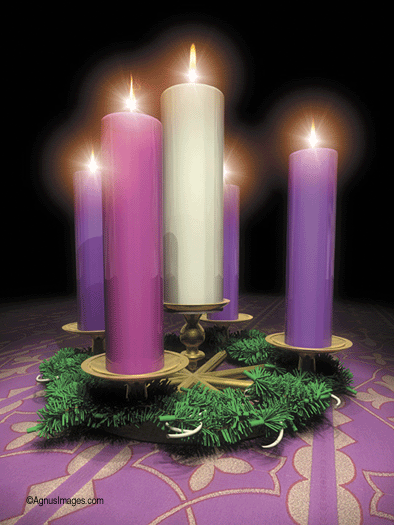
Advent Wreath with 3 purple candles and one rose colored...the White is Christmas Day


Advent Preparing for Christ's Birth 

and His Second Coming

In the Catholic Church, Advent is a period of preparation, extending over four Sundays, before Christmas. (For more details, see "When Does Advent Start?") The word Advent comes from the Latin advenio, "to come to," and refers to the coming of Christ. This refers, first of all, to our celebration of Christ's birth at Christmas; but second, to the coming of Christ in our lives through grace and the Sacrament of Holy Communion; and finally, to His Second Coming at the end of time.

Our preparations, therefore, should have all three comings in mind. We need to prepare our souls to receive Christ worthily.


 When Does Advent Start?

 
For 2012 it begins December 2, 2012 and ends December 23, 2012.

Advent is called a "little Lent," because, like Lent, it is a time of repentance. While fasting during Advent used to be universal, most Western Christians today treat Advent as an early part of the Christmas season. Eastern Rite Catholics (and the Eastern Orthodox), however, continue to celebrate Advent with the Philip's Fast, named after the Apostle Philip. The fast doesn't really have anything to do with the Apostle Philip, other than the fact that it starts on November 15, the day after his feast in the Eastern calendar. It runs through Christmas Eve, December 24.


Celebrate Advent . . . With a Fast!
By Scott P. Richert, About.com Guide November 15, 2012

Like most fasts in the Eastern Church, Philip's Fast is fairly strict and includes abstinence from meat, eggs, and dairy products on all weekdays, and fish, oil, and wine on most days. (Different Eastern Churches observe the fast more or less strictly; because extreme fasting can affect your health, you should never increase the strictness of a fast beyond what the Church prescribes without consulting with your priest.)

While Roman Rite Catholics are no longer bound to fast during Advent, reviving the tradition of repentance during Advent can help us better appreciate our Christmas celebration. Pope John Paul II called on Western Catholics to learn more about the traditions of our Eastern Rite brethren; joining them, even if for only one day a week, in celebrating Philip's Fast is a very good way to do so.


When Does the Christmas Season Start?

Christmas Day is the first day of the Christmas Season. The period of feasting continues until Epiphany, the 12th day after Christmas, and the Christmas season proper continues until the feast of the Presentation of the Lord (Candlemas)--February 2--a full 40 days after Christmas!

What most people think of as "the Christmas season," the period between Thanksgiving and Christmas, roughly corresponds to Advent, the period of preparation for the Christmas feast. Advent begins on the fourth Sunday before Christmas and ends on Christmas Eve. It's meant to be a time of preparation--of prayer, fasting, almsgiving, and repentance. In the early centuries of the Church, it was observed by a 40-day fast, just like Lent, which was followed by the 40 days of feasting in the Christmas season.


The Symbols of Advent

In its symbolism, the Church continues to stress the penitential and preparatory nature of Advent.   As during Lent, priests wear purple vestments, and the Gloria ("Glory to God") is omitted during Mass.   The only exception is on the Third Sunday of Advent, known as Gaudete Sunday, when priests can wear rose-colored vestments. As on Laetare Sunday during Lent, this exception is designed to encourage us to continue our prayer and fasting, because we can see that Advent is more than halfway over.


Why Do Priests Wear 
Purple During Advent?

All of these things are signs of the penitential nature of Advent and a reminder that the Christmas season hasn't started yet. I've mentioned before that Advent was once known as a "little Lent," and so the penitential color of purple makes an appearance, the organ is muted, and the Gloria--one of the most festive hymns of the Mass--isn't sung. Our thoughts, even on Sunday, are supposed to be on preparing ourselves for the coming of Christ, both at Christmas and at the Second Coming.

Just as during Lent, however, the Church allows us some rest as we pass the halfway point of Advent. The third Sunday of Advent is known as Gaudete Sunday, because "Gaudete" ("Rejoice") is the first word of the entrance antiphon at that Mass. On that Sunday, your priest will likely wear rose vestments--a color that still reminds us of the penitential purple, but also has a lightness and joy to it, reminding us that Christmas is drawing near.


What Is Gaudete Sunday?  

The Third Sunday of Advent

The Introit for Gaudete Sunday, in both the Traditional Latin Mass and the Novus Ordo, is taken from Philippians 4:4,5: "Gaudete in Domino semper" ("Rejoice in the Lord always").

Like Lent, Advent is a penitential season, so the priest normally wears purple vestments.  But on Gaudete Sunday, having passed the midpoint of Advent, the Church lightens the mood a little, and the priest may wear rose vestments. 

The change in color provides us with encouragement to continue our spiritual preparation—especially prayer and fasting—for Christmas.
For this same reason, the third candle of the Advent wreath, first lit on Gaudete Sunday, is traditionally rose-colored.


The Advent Wreath

Perhaps the best-known of all Advent symbols is the Advent wreath, a custom which originated among German Lutherans but was soon adopted by Catholics. Consisting of four candles (three purple and one pink) arranged in a circle with evergreen boughs (and often a fifth, white candle in the center), the Advent wreath corresponds to the four Sundays of Advent. The purple candles represent the penitential nature of the season, while the pink candle calls to mind the respite of Gaudete Sunday. (The white candle, when used, represents Christmas.)


The History of the Advent Wreath

A typical German Adventskranz, or Advent wreath.
FR. WILLIAM SAUNDERS


 The Advent wreath is part of our long-standing Catholic tradition. However, the actual origins are uncertain. There is evidence of pre-Christian Germanic peoples using wreathes with lit candles during the cold and dark December days as a sign of hope in the future warm and extended-sunlight days of Spring. In Scandinavia during Winter, lighted candles were placed around a wheel, and prayers were offered to the god of light to turn “the wheel of the earth” back toward the sun to lengthen the days and restore warmth.


By the Middle Ages,  
the Christians adapted this tradition and 
used Advent wreathes as part 
of their spiritual preparation for Christmas.   

After all, 

Christ is
 “the Light that came into the world” 
to dispel the darkness of sin and to radiate the truth and love of God 
(cf. John 3:19-21). 

By 1600, both Catholics and Lutherans had more 
formal practices surrounding the Advent wreath.

The symbolism of the Advent wreath is beautiful. 
   
The wreath is made of various evergreens, 
signifying continuous life. 


Even these evergreens have a traditional meaning 
which can be adapted to our faith: 

The laurel signifies victory over persecution and suffering; 

pine, holly, and yew, immortality; 

and cedar, strength and healing. 


Holly also has a special 
Christian symbolism: 
The prickly leaves remind us 
of the crown of thorns, 
and one English legend tells 
of how the cross was made of holly. 


The circle of the wreath, 
which has no beginning or end, 
symbolizes the eternity of God, 
the immortality of the soul, 
and the everlasting life found in Christ. 


Any pine cones, nuts, or seedpods used 
to decorate the wreath 
also symbolize life and resurrection. 


All together, 
the wreath of evergreens depicts the immortality 
of our soul and the new, everlasting life 

promised to us through Christ, 
the eternal Word of the Father, 

who entered our world 
becoming true man and who 
was victorious over sin and death 
through His own passion, death, and resurrection.

The four candles represent 
the four weeks of Advent.  

A tradition is that each week represents 
one thousand years, 
to sum to the 4,000 years
 from Adam and Eve 
until the Birth of the Savior.  

Three candles are purple and one is rose. The purple candles in particular symbolize the prayer, penance, and preparatory sacrifices and goods works undertaken at this time. The rose candle is lit on the third Sunday, Gaudete Sunday, when the priest also wears rose vestments at Mass; Gaudete Sunday is the Sunday of rejoicing, because the faithful have arrived at the midpoint of Advent, when their preparation is now half over and they are close to Christmas. The progressive lighting of the candles symbolizes the expectation and hope surrounding our Lord’s first coming into the world and the anticipation of His second coming to judge the living and the dead.

The light again signifies Christ, 
the Light of the world. 

Some modern day adaptions include a white candle placed in the middle of the wreath, which represents Christ and is lit on Christmas Eve. Another tradition is to replace the three purple and one rose candles with four white candles, which will be lit throughout Christmas season.

By the Middle Ages, the Christians adapted this tradition and used Advent wreathes as part of their spiritual preparation for Christmas.

In family practice, the Advent wreath is most appropriately lit at dinner time after the blessing of the food. 

A traditional prayer service using the Advent wreath proceeds as follows: 

On the First Sunday of Advent, 
the father of the family blesses the wreath, praying: 
O God, by whose word all things are sanctified, 
pour forth Thy blessing upon this wreath, 
and grant that we who use it may prepare
 our hearts for the coming of Christ and 
        may receive from Thee      
              abundant graces. 
Who livest and reignest forever. 
                                                    Amen.” 


He then continues for each of the days of the first week of Advent, 

O Lord, stir up Thy might, 
we beg thee, 
and come, that by 
Thy protection 
we may deserve 
to be rescued from 
the threatening dangers 
of our sins 
and saved by Thy deliverance. 
Who livest and reignest forever. Amen.”  

The youngest child then lights 
one purple candle.


During the second week of Advent,
the father prays: 

O Lord, stir up our hearts 
that we may prepare for 
Thy only begotten Son, 
that through His coming 
we may be made worthy to serve 
Thee with pure minds. 
Who livest and reignest forever. Amen.” 

The oldest child then lights 
the purple candle 
from the first week plus 
one more purple candle.


During the third week of Advent,
 the father prays: 

O Lord, we beg Thee, 
incline Thy ear to our prayers 
and enlighten the darkness 
of our minds by the grace 
of Thy visitation. 
Who livest and reignest forever. Amen.”

 The mother then lights the two previously lit purple 
candles plus the rose candle.


Finally, the father prays during the fourth week of Advent

The father then lights all of the candles of the wreath.
O Lord, stir up Thy power, we pray Thee, and come; 
and with great might help us, that with the help of Thy grace, 
Thy merciful forgiveness may hasten what our sins impede. 
      Who livest and   
    reignest forever. 
                              Amen.” 


Since Advent is a time to stir-up our faith in the Lord, 
the wreath and its prayers provide us a way 
to augment this special preparation for Christmas.    
Moreover, this good tradition helps us 
to remain vigilant in our homes and 
not lose sight of the true meaning of Christmas.
  http://www.catholiceducation.org/articles/religion/re0132.html


Celebrating Advent

 We can better enjoy Christmas—all 12 days of it, from Christmas Day to Epiphany—if we revive Advent as a period of preparation. Abstaining from meat on Fridays, or not eating at all between meals, is a good way to revive the Advent fast. (Not eating Christmas cookies or listening to Christmas music before Christmas is another.) We can incorporate such customs as the Advent wreath, the Saint Andrew Christmas Novena, and the Jesse Tree into our daily ritual, and we can set some time aside for special scripture readings for Advent, which remind us of the threefold coming of Christ.

Holding off on putting up the Christmas tree and other decorations is another way to remind ourselves that the feast is not here yet. Traditionally, such decorations were put up on Christmas Eve, but they would not be taken down until after Epiphany, in order to celebrate the Christmas season to its fullest.