Ad

Showing posts with label Jesus prayer. Show all posts

Monday, 15 September 2014

Our Father Explained by St. Louis de Montfort

The Our Father
Excerpts taken from the 
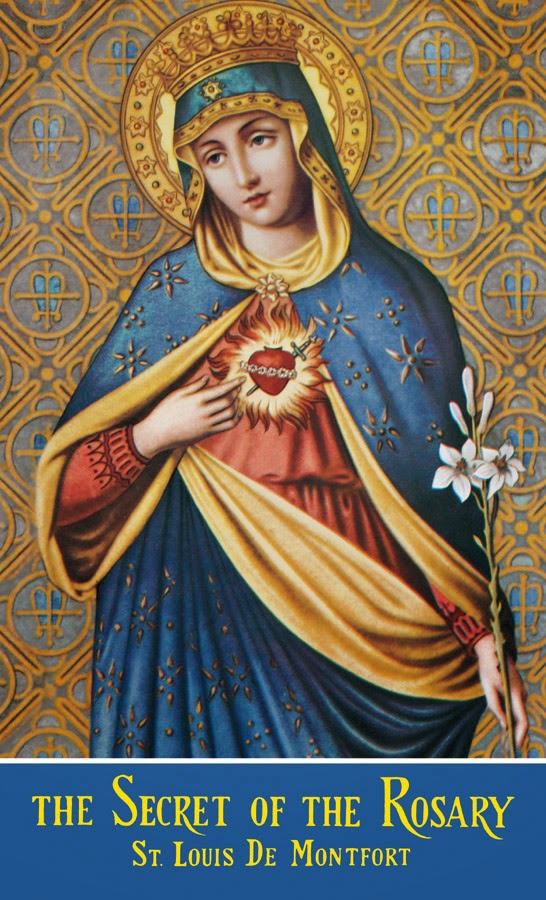
Secrets of the Rosary by St. Louis de Monfort

The Our Father or the Lord’s Prayer derives its great value above all from its author, who is neither a man nor an angel, but the King of angels and of men, our Lord Jesus Christ.  St. Cyprian says it was necessary that he who came to give us the life of grace as our Saviour should teach us the way to pray as our heavenly Master.

St. Louis de Montfort
The beautiful order, the tender forcefulness and the clarity of this divine prayer pay tribute to our divine Master’s wisdom.  It is a short prayer but can teach us so very much, and it is well within the grasp of uneducated people, while scholars find it a continual source of investigation into the mysteries of God.  The Our Father contains all the duties we owe to God, the acts of all the virtues and the petitions for all our spiritual and corporal needs. 

Tertullian says that the Our Father is a summary of the New Testament.  Thomas a Kempis says that it surpasses all the desires of all the saints; that it is a condensation of all the beautiful sayings of all the psalms and canticles; that in it we ask God for everything that we need, that by it we praise him in the very best way; that by it we lift up our souls from earth to heaven and unite them closely to God.
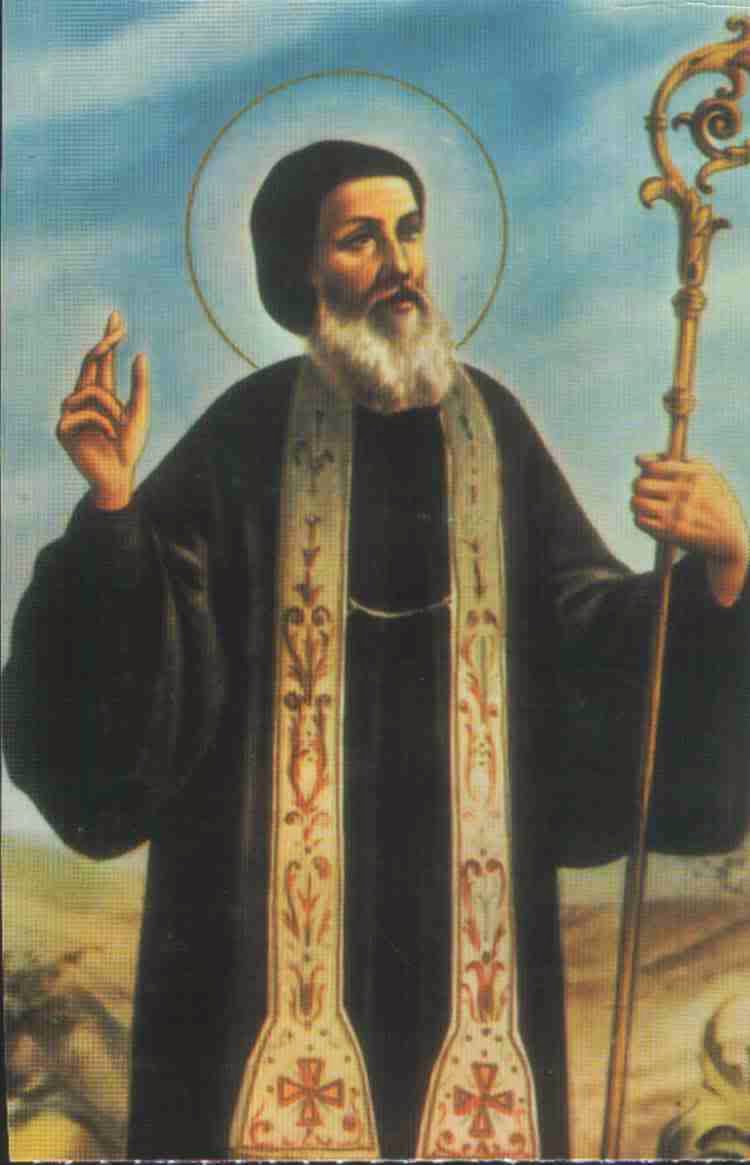
St. John Chrysostom
St. John Chrysostom says that we cannot be our Master’s disciples unless we pray as he did and in the way that he showed us.  Moreover, God the Father listens more willingly to the prayer that we have learned from his Son rather than those of our own making, which have all our human limitations.  

We should say the Our Father with the certitude that the eternal Father will hear us because it is the prayer of his Son, who he always hears, and because we are his members.  God will surely grant our petitions made through the Lord’s Prayer because it is impossible to imagine that such a good Father could refuse a request couched in the language of so worth a Son, reinforced by his merits, and made at his behest.

St. Augustine assures us that whenever we say the Our Father devoutly our venial sins are forgiven.  The just man falls seven times, and the Lord’s Prayer he will find seven petitions which will both help him to avoid lapses and protect him from his spiritual enemies.  Our Lord, knowing how weak and helpless we are, and how many difficulties we endure, made his prayer short and easy to say, so that is we say it devoutly and often, we can be sure that God will quickly come to our aid. . .
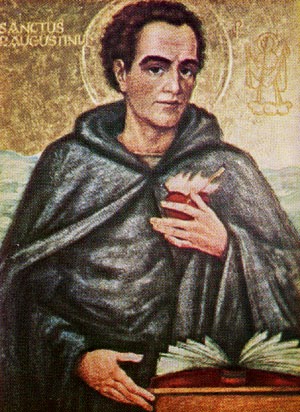
St. Augustine


. . . People who say the Lord’s Prayer carefully, weighing every word and meditating on them, may indeed call themselves blessed, for they find therein everything that they need or can wish for.  When we say this wonderful prayer, we touch God’s heart at the very outset by calling him by that sweet name of Father. . .

We have God for our Father, so we are all brothers, and heaven is our homeland and our heritage.

. . . So we ought to love our heavenly Father and say to him over and over again:
God the Father

“Our Father who art in heaven” – Thou who dost fill heaven and earth with the immensity of thy being.  Thou who art present everywhere: Thou who art in the saints by thy glory, in the damned by they justice, in the good by thy grace, in sinners by the patience with which thou dost tolerate them, grant that we may always remember that we come from thee; grant that we may live as thy true children; that we may direct our course towards thee alone with all the ardour or our soul. 

“Hallowed be thy name”  The name of the Lord is holy and to be feared, said the prophet-king David, and heaven, according to Isaiah, echoes with the praises of the seraphim who unceasingly praise the holiness of the Lord, God of hosts.  We ask her that all the world may learn to know and adore the attributes of our God, who is so great and so holy.  We ask that he may be known, loved and adored by pagans, Turks, Jews, barbarians and all infidels; that all men may serve and glorify him by a living faith, a staunch hope, a burning charity, and by the renouncing of all erroneous beliefs.  In short, we pray that all men may be holy because our God himself is holy.

“Thy kingdom come”  That is to say; May your reign in our souls by your grace, during life, so that after death we may be found worthy to reign with thee in thy kingdom, in perfect and unending bliss; that we firmly believe in this happiness to come; we hope for it and we expect it, because God the Father has promised it in his great goodness, and because it was purchased for us by the merits of God the Son; and it has been made known to us by the light of the Holy Ghost. 
Thy Will be Done
“Thy will be done on earth as it is in heaven”  As Tertullian says, this sentence does not mean in the least we are afraid of people thwarting God’s designs, because nothing whatsoever can happen without divine Providence having foreseen it and having made it fit into his plans beforehand.  No obstruction in the whole world can possibly prevent the will of God from being carried out.  Rather, when we say these words, we ask God to make us humbly resigned to all that he has seen fit to send us in this life.  We also ask him to help us to do, in all things and at all times, his holy will, made known to us by the commandments, promptly, lovingly, and faithfully, as the angels and the blessed do in heaven.

“Give us this day our daily bread”  Our Lord teaches us to ask God for everything that we need, whether in the spiritual or the temporal order.  By asking for our daily bread, we humbly admit our own poverty and insufficiency, and pay tribute to our God, knowing that all temporal goods come from his Providence.  When we say bread we ask for that which is necessary to live; and, of course that does not include luxuries.  We ask for this bread today, which means that we are concerned only for the present, leaving the morrow in the hands of Providence.  And when we ask for our daily bread, we recognize that need God’s help every day and that we are entirely dependent upon him for his help and protection.
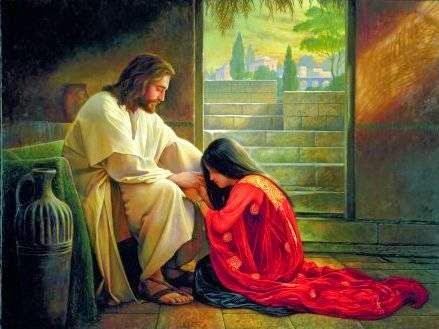
 
“Forgive us our trespasses as we forgive those who trespass against us”  Every sin, says St. Augustine and Tertullian, is a debt which we contract with God, and he in his justice requires payment down to the last farthing.  Unfortunately we all have these sad debts.  No matter how many they may be, we should go to God with all confidence and with true sorrow for our sins, saying, “Our Father who art in heaven, forgive us our sins of thought and those of speech, forgive us our sins of commission and of omission which make us infinitely guilty in the eyes of thy justice.  “We dare to ask this because thou art our loving and merciful Father, and because we have forgiven those who have offended us out of obedience to you and out of charity.  “Do not permit us, in spite of our infidelity to thy graces, to give in to the temptations of the world, the devil, and the flesh.

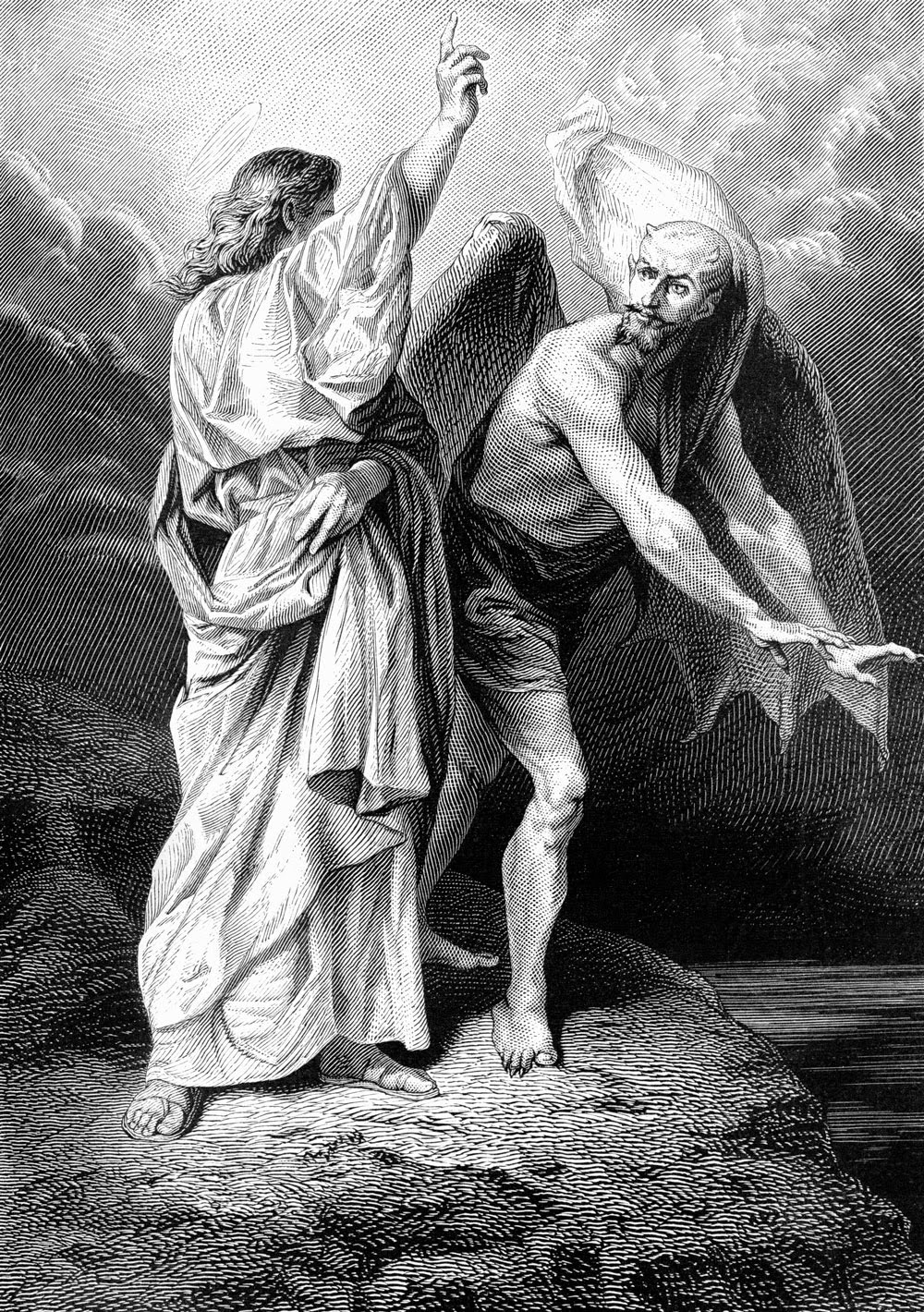
Temptation of Christ
“But deliver us from evil” The evil of sin, from the evil of temporal punishment and of everlasting punishment, which we have rightly deserved. 

“Amen”  This word at the end of the Our Father is very consoling, and St. Jerome says that it is a sort of seal of approbation that God puts at the end of our petitions to assure us that he will grant our requests, as though he himself were answering: “Amen, May it be as you have asked, for truly you have obtained what you asked for.”  That is what is meant by this word: Amen.
. . . Each word of the Lord’s Prayer is a tribute we pay to the perfections of God.  We honour his fecundity by the name of Father.  Father, thou who throughout eternity dost beget a Son who is God like thee, eternal, consubstantial with thee, who is of the very same essence as thee; and is of like power and goodness and wisdom as thou art… Father and Son, who, from our mutual love, produce the Holy Ghost, who is God like unto you; three persons but one God.  Our Father.  
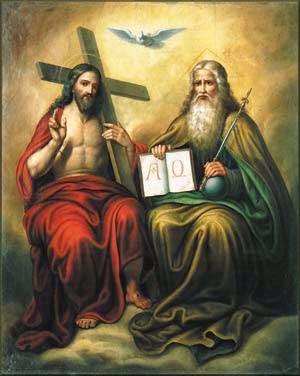
The Holy Trinity
This means that he is the Father of mankind, because he has created us and continues to sustain us, and because he has redeemed us.  He is also the merciful Father of sinners, the Father who is the friend of the just, and the glorious Father of the blessed in heave.  When we say Who art, we honour by these words the infinity and immensity and fullness of God’s essence.  

God is rightly called “He who is;” that is to say, he exists of necessity, essentially, and eternally, because he is the Being of beings and the cause of all beings, and he is in all of them by his essence, by his presence and by his power, but without being bounded by their limitations.  

We honour his sublimity and his glory and his majesty by the words Who art in heaven, that is to say, seated as on thy throne, holding sway over all men by thy justice. . .

. . . It is our duty, therefore, to say it often, with attention, and the same spirit as he composed it.

Louis de Montfort has must more to say in his book, “The Secret of the Rosary”, you should get a copy.


Tuesday, 4 September 2012

Our Father/Lord's Prayer--Catechism of the Catholic Church


Jesus Teaching the Lord's Prayer by Tissot
Our Father, 
Who Art in Heaven
Hallowed by Thy Name
Thy Kingdom come 
Thy Will be done
On earth, as it is in Heaven
Give us this day Our daily bread
And forgive us our trespasses
As we forgive those
Who trespass against us
And lead us not into temptation
But deliver us from evil.
Amen.


(traditional Matthean version)
Source: Catechism of The Roman Catholic Church, 
Part Four Christian Prayer, Section Two:The Lord's Prayer
Note: These words are identical to the version found in the Litany section of the U.S. Book of Common Prayer, 1928 edition.

 http://www.lords-prayer-words.com/lord_roman_catholic_version.html


PART FOUR
CHRISTIAN PRAYER

SECTION TWO

THE LORD'S PRAYER
"OUR FATHER!"

 
ARTICLE 1
"THE SUMMARY OF THE WHOLE GOSPEL"

2761 The Lord's Prayer "is truly the summary of the whole gospel."7 "Since the Lord . . . after handing over the practice of prayer, said elsewhere, 'Ask and you will receive,' and since everyone has petitions which are peculiar to his circumstances, the regular and appropriate prayer [the Lord's Prayer] is said first, as the foundation of further desires."8

I. AT THE CENTER OF THE SCRIPTURES
2762 After showing how the psalms are the principal food of Christian prayer and flow together in the petitions of the Our Father, St. Augustine concludes:
Run through all the words of the holy prayers [in Scripture], and I do not think that you will find anything in them that is not contained and included in the Lord's Prayer.9
2763 All the Scriptures - the Law, the Prophets, and the Psalms - are fulfilled in Christ.10 The Gospel is this "Good News." Its first proclamation is summarized by St. Matthew in the Sermon on the Mount;11 the prayer to our Father is at the center of this proclamation. It is in this context that each petition bequeathed to us by the Lord is illuminated:
The Lord's Prayer is the most perfect of prayers. . . . In it we ask, not only for all the things we can rightly desire, but also in the sequence that they should be desired. This prayer not only teaches us to ask for things, but also in what order we should desire them.12
2764 The Sermon on the Mount is teaching for life, the Our Father is a prayer; but in both the one and the other the Spirit of the Lord gives new form to our desires, those inner movements that animate our lives. Jesus teaches us this new life by his words; he teaches us to ask for it by our prayer. The rightness of our life in him will depend on the rightness of our prayer.

II. THE LORD'S PRAYER
2765 The traditional expression "the Lord's Prayer" - oratio Dominica - means that the prayer to our Father is taught and given to us by the Lord Jesus. The prayer that comes to us from Jesus is truly unique: it is "of the Lord." On the one hand, in the words of this prayer the only Son gives us the words the Father gave him:13 he is the master of our prayer. On the other, as Word incarnate, he knows in his human heart the needs of his human brothers and sisters and reveals them to us: he is the model of our prayer.
2766 But Jesus does not give us a formula to repeat mechanically.14 As in every vocal prayer, it is through the Word of God that the Holy Spirit teaches the children of God to pray to their Father. Jesus not only gives us the words of our filial prayer; at the same time he gives us the Spirit by whom these words become in us "spirit and life."15 Even more, the proof and possibility of our filial prayer is that the Father "sent the Spirit of his Son into our hearts, crying, 'Abba! Father!'"16 Since our prayer sets forth our desires before God, it is again the Father, "he who searches the hearts of men," who "knows what is the mind of the Spirit, because the Spirit intercedes for the saints according to the will of God."17 The prayer to Our Father is inserted into the mysterious mission of the Son and of the Spirit.

III. THE PRAYER OF THE CHURCH
2767 This indivisible gift of the Lord's words and of the Holy Spirit who gives life to them in the hearts of believers has been received and lived by the Church from the beginning. The first communities prayed the Lord's Prayer three times a day,18 in place of the "Eighteen Benedictions" customary in Jewish piety.

2768 According to the apostolic tradition, the Lord's Prayer is essentially rooted in liturgical prayer:
[The Lord] teaches us to make prayer in common for all our brethren. For he did not say "my Father" who art in heaven, but "our" Father, offering petitions for the common body.19
In all the liturgical traditions, the Lord's Prayer is an integral part of the major hours of the Divine Office. In the three sacraments of Christian initiation its ecclesial character is especially in evidence:

2769 In Baptism and Confirmation, the handing on (traditio) of the Lord's Prayer signifies new birth into the divine life. Since Christian prayer is our speaking to God with the very word of God, those who are "born anew". . . through the living and abiding word of God"20 learn to invoke their Father by the one Word he always hears. They can henceforth do so, for the seal of the Holy Spirit's anointing is indelibly placed on their hearts, ears, lips, indeed their whole filial being. This is why most of the patristic commentaries on the Our Father are addressed to catechumens and neophytes. When the Church prays the Lord's Prayer, it is always the people made up of the "new-born" who pray and obtain mercy.21
 
2770 In the Eucharistic liturgy the Lord's Prayer appears as the prayer of the whole Church and there reveals its full meaning and efficacy. Placed between the anaphora (the Eucharistic prayer) and the communion, the Lord's Prayer sums up on the one hand all the petitions and intercessions expressed in the movement of the epiclesis and, on the other, knocks at the door of the Banquet of the kingdom which sacramental communion anticipates.

2771 In the Eucharist, the Lord's Prayer also reveals the eschatological character of its petitions. It is the proper prayer of "the end-time," the time of salvation that began with the outpouring of the Holy Spirit and will be fulfilled with the Lord's return. The petitions addressed to our Father, as distinct from the prayers of the old covenant, rely on the mystery of salvation already accomplished, once for all, in Christ crucified and risen.

2772 From this unshakeable faith springs forth the hope that sustains each of the seven petitions, which express the groanings of the present age, this time of patience and expectation during which "it does not yet appear what we shall be."22 The Eucharist and the Lord's Prayer look eagerly for the Lord's return, "until he comes."23

IN BRIEF
2773 In response to his disciples' request "Lord, teach us to pray" (Lk 11:1), Jesus entrusts them with the fundamental Christian prayer, the Our Father.
2774 "The Lord's Prayer is truly the summary of the whole gospel,"24 the "most perfect of prayers."25 It is at the center of the Scriptures.
2775 It is called "the Lord's Prayer" because it comes to us from the Lord Jesus, the master and model of our prayer.
2776 The Lord's Prayer is the quintessential prayer of the Church. It is an integral part of the major hours of the Divine Office and of the sacraments of Christian initiation: Baptism, Confirmation, and Eucharist. Integrated into the Eucharist it reveals the eschatological character of its petitions, hoping for the Lord, "until he comes" (1 Cor 11:26).

 http://www.vatican.va/archive/ccc_css/archive/catechism/p4s2a1.htm

Monday, 23 July 2012

The Lord's Prayer - and the Meaning of


 "Our Father who art in heaven
Hallowed be thy Name
Thy Kingdom come
Thy Will be done on earth
As it is in heaven
Give us this day our daily bread
And forgive us our trespasses
As we forgive those who trespasses against us
And lead us not into temptation
But deliver us from evil."
                                           Amen.

To understand the significance of this prayer that Christ gave us, you must understand each statement that Jesus uses, below is an explanation that will help you grasp the true meaning of this prayer.


The meaning of the Lord’s Prayer

Our…
The word “our” is important. It is in the plural. Christ has highly recommended prayer in common in which we as God’s children who love one another unite to ask our loving Father for what we need. The official prayer of the whole Church as a body is called the Liturgy. This public prayer of the Church is of far more value than private prayer, even though this too is necessary and highly important.

Father who art in heaven …
We address God as “Father who art in heaven” because we belong to Him, our loving Father, who created us and watches over us, who adopts us through sanctifying Grace as His children, and who destines us to live forever with Him in Heaven, our true home and last end.

Hallowed be Thy Name…
...comes from the word “Holy,” be held and kept holy, be glorified by us, and that not only by our words, but principally by the lives we lead. The honor and glory of God should be the principal subject of our prayers, and the ultimate end of our every action; every other thing must be subordinate to this. When we say this we are simply praying that God may be known and honored by all men.
The “Name” of course, represents the person. God’s name represents God Himself. The first desire of love is that God should be known, loved, and honored by all. In Exodus 3:13-15 we find the four Hebrew letters spelling out “Yahweh,” meaning I AM who Am.

Thy Kingdom Come…
...When we say this, we pray that the Kingdom of God’s grace may be spread throughout the world, that all men may come to know and enter the true Church and to live as worthy members of it, and that, finally, we all may be admitted to the Kingdom of God’s Glory.
Those who desire to arrive at the Kingdom of Heaven, must endeavor so to order their life and conversation, as if they were already conversing in Heaven. This humble petition is also to be understood for the accomplishment of the Divine Will in every part of the world, for the extirpation of error, and explosion of vice, that truth and virtue may everywhere obtain, and Heaven and earth differ no more in honoring the Supreme majesty of God. -- St. John Chrysostom.
True love desires that God’s Kingdom, the Church, should spread on earth until the day when Christ will come again to take us all, body and soul, to Heaven.

Thy Will be done on earth…
...We are praying that all men may obey God on earth as willingly as the Saints and Angels do in Heaven. We are asking God for our love to grow to perfection. Love seeks to do God’s will and to please Him perfectly. We ask that our love will grow till we love Him as much as He is loved in heaven where all love is perfect. We, therefor, are asking Him to make us Saints.
“As we are only to pray for our daily bread, we are not to be over solicitous for the morrow, now for the things of this earth, but being satisfied with what is necessary, turn all our thoughts to the joys of Heaven.” -- St. John Chrysostom.

Give us this day our daily bread…
We can conclude then when we say “give us this day our daily bread,” we are praying that God will give us each day all that is necessary to support the material life of our bodies and the spiritual life of our souls.

And forgive us our trespasses…  
Of all the petitions this one is repeated twice. God puts our judgment in our own hands, that none might complain, being the author of His own sentence. He could have forgiven us our sins without this condition, but He consulted our good, in affording us opportunities of practicing daily the virtues of piety and mildness.
“These trespasses or debts signify not only mortal but venial sins, as St. Augustine often teaches. Therefore every man, be he ever so just, yet because he cannot live without venial sin, ought to say this prayer.” -- St. John Chrysostom. 

As we forgive those who trespass against us…
Here again Jesus recommends the forgiving of others, as the means of obtaining forgiveness.  In this sentence, Jesus reminds us that if we want God’s merciful love to forgive us the horrible offenses of sin, we must love others enough to forgive them their offenses against us.  The Crucified Christ gave us a perfect example of this in Luke 23:34:“Father forgive them, for they know not what they do.”

Lead us Not into Temptation...
God is not the tempter of evil, nor is He the author of sin (James 1:13). He tempts no man; we pray that He would not suffer the devil to tempt us above our strength; that he would remove the temptations, or enable us to overcome them, and deliver us from evil, particularly the evil of sin.
It is not a sin to be tempted. Our Blessed Lord Himself was tempted. We also must be tempted if we are to acquire any virtue. But we pray that when temptation comes, as it so often does, that we may not be overcome by it.

But deliver us from evil…
We are praying that God will always protect us from harm and especially from harm to our souls. We are also asking that the bodily evils, sickness, suffering, poverty, etc., will never become so severe that we cannot bear them with the grace of God.

Amen.
“Amen” is a Hebrew word that stems from the word aman, which means “to be faithful, support, or confirm.” The word “amen” actually means, “so be it,” or “truly.”
Therefore, when we end our prayers with "amen," we are re-affirming our dedication to God through Jesus Christ. We also use it to confirm a statement (i.e., when the pastor says something powerful out of the Word of God, and members of the congregation say "Amen").
Amen explanation taken from:  http://www.raptureready.com/faq/faq363.html


The Seven Petitions in the Our Father:
1) God’s Glory
2) Union with God
3) Perfect Love
4) Needs of Soul and Body
5) Forgiveness of Sin
6) Protection in Temptation
7) Freedom from all Harm

Excerpts from      http://www.philvaz.com/apologetics/s8.htm  Written by Tim Rash