Ad

Saturday, 29 September 2018

Archangels Michael, Gabriel, and Raphael Feast Day September 29

Archangels Michael, Gabriel and Raphael

Feasts of Saints Michael, Gabriel, and Raphael, Archangels


September 29

“Amen, Amen, I say to you, you will see heaven opened and the angels of God ascending and descending on the Son of Man.”  John 1:51

Yes, angels are real.  And they are mighty glorious, beautiful and magnificent in every way.  Today we honor three of the multitude of angels in Heaven:  Michael, Gabriel and Raphael.

These angels are “archangels”.  An archangel is the second order of angels just above the guardian angels.  In all, there are nine orders of celestial beings that we commonly refer to as angels and all nine of these orders are traditionally organized into three spheres.  The entire hierarchy is traditionally organized this way:
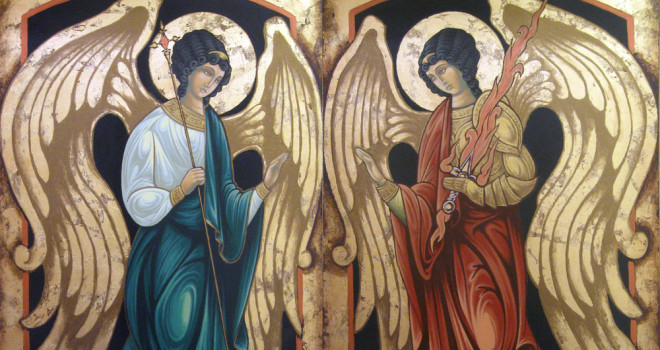

Highest Sphere:  Seraphim, Cherubim and Thrones.

Middle Sphere:  Dominions, Virtues and Powers.

Lower Sphere:  Principalities, Archangels and Angels (Guardian Angels).

The hierarchy of these celestial beings is ordered in accord with their function and purpose.  The highest of the beings, the Seraphim, were created solely for the purpose of surrounding the Throne of God in perpetual worship and adoration.  The lowest of the beings, the Guardian Angels, were created for the purpose of caring for humans and communicating God’s messages.  The Archangels, whom we honor today, were created for the purpose of bringing messages of great importance to us and to accomplish tasks of the highest importance in our lives.

Michael is well known as the archangel who was empowered by God to cast Lucifer our of Heaven.  Lucifer is traditionally thought to be of the highest sphere of celestial beings and, thus, being cast out by a lowly archangel was quite a humiliation.


Gabriel is well known for being the archangel who brought the message of the Incarnation to the Blessed Virgin Mary.


And Raphael, whose name means “God heals” is referred to in the Old Testament Book of Tobit as is said to have been sent to bring healing to Tobit’s eyes.


Though not much is known of these archangels, its important to believe in them, honor them and to pray to them.  We pray to them because we believe God has entrusted them with a mission to help us bring healing, fight evil and proclaim the Word of God.  Their power comes from God, but God has chosen to use the archangels, and all celestial beings, to accomplish His plan and purpose.

Reflect, today, upon your knowledge of the angels.  Do you believe in them?  Do you honor them?  Do you rely upon their powerful intercession and mediation in your life?  God wants to use them, so you should truly seek their help in your life.

Lord, thank You for the gift of the Archangels whom we honor today.  Thank you for their powerful working in our lives. Help us to rely upon them and to love them for their service.  Archangels, pray for us, heal us, teach us and protect us.  Jesus, I Trust in You.

Above taken from the book “Daily Reflections for Ordinary Time: Weeks 18-34”  Feast of the Archangels, September 29 by John Paul Thomas

Sts. Michael, Gabriel and Raphael Archangels


The Word ‘Angel’ denotes a Function rather than a Nature

From a homily on the Gospels by Saint Gregory the great, pope

You should be aware that the word ‘angel’ denotes a function rather than a nature.  Those holy spirits of Heaven have indeed always been spirits.  They can only be called angels when they deliver some message.  Moreover, those who deliver messages of lesser importance are called angels; and those who proclaim messages of supreme importance are called Archangels.

And so it was that not merely an angels but the Archangel Gabriel was sent to the Virgin Mary.  It was only fitting that the highest angel should come to announce the greatest of all messages.

Some angels are give proper names to denote the service they are empowered to perform.  In that holy city, where perfect knowledge flows from the vision of Almighty God, those who have no names may easily be known.  But personal names are assigned to some, not because they could not be known without them, but rather to denote their ministry when they come among us.  

Thus, Michael means 
“Who is like God?”; 

Gabriel is 
“strength of God”; 

and Raphael is 
“God’s Remedy”.
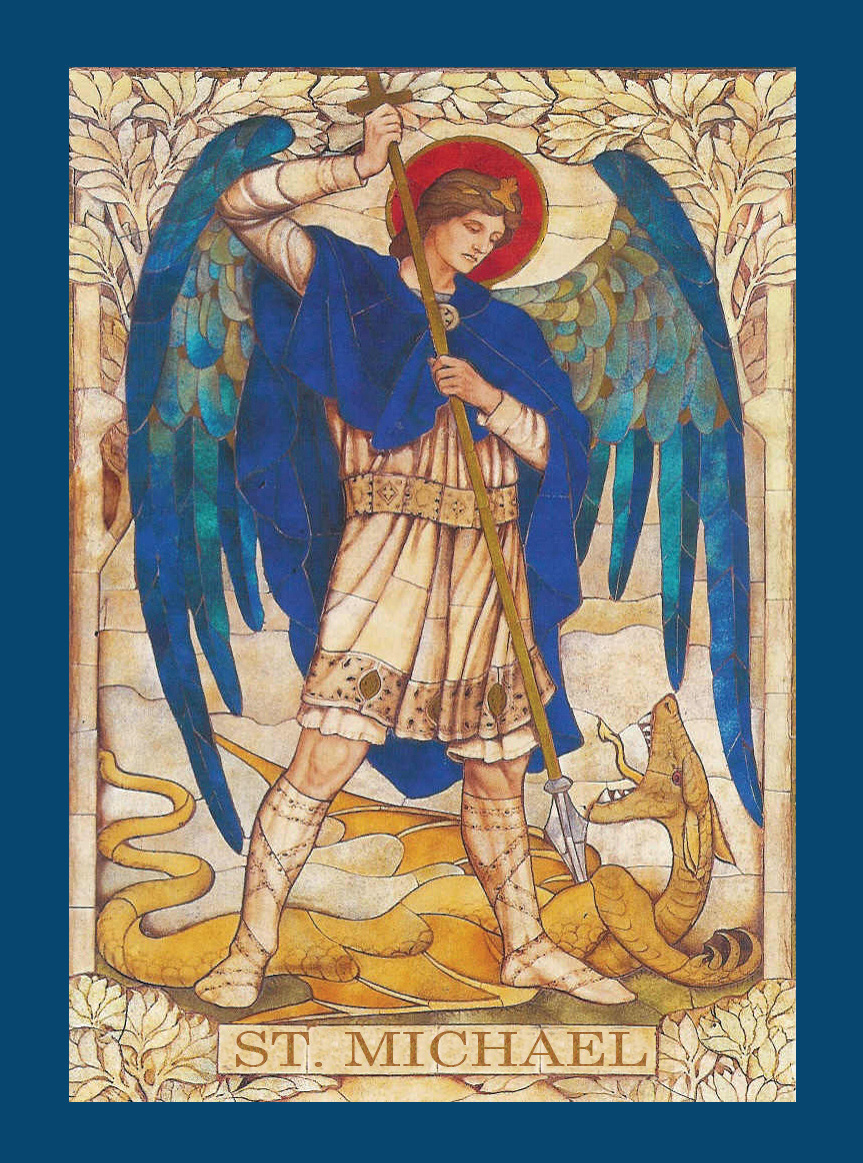

Who is like unto God!  St. Michael the Archangel
Whenever some act of wondrous power must be performed, Michael is sent, so that his action and his name may make it clear that no one can do what God does by His superior power. So also our ancient foe desired in his pride to be like God, saying: “I will ascend into Heaven; I will exalt my throne above the stars of Heaven; I will be like the Most High.”   He will be allowed to remain in power until the end of the world when he will be destroyed in the final punishment.  Then, he will fight the Archangel Michael, as we are told by John: A battle was fought with Michael the archangel.


Blessed Virgin Mary and Archangel Gabriel
So too, Gabriel, who is called God’s strength, was sent to Mary.  He came to announce  the One Who appeared as a humble man to quell the cosmic powers.  Thus God’s strength announced the coming of the Lord of the Heavenly powers, mighty in battle.


Raphael means, as I have said, God’s Remedy, for when he touched Tobit’s eyes in order to cure him, he banished the darkness of his blindness.  Thus, since he is to heal, he is rightly called God’s Remedy.

Above taken from the Liturgy of the Hours Ordinary Time Weeks 18-34, September 29 Michael, Gabriel and Raphael, Archangels

Friday, 21 September 2018

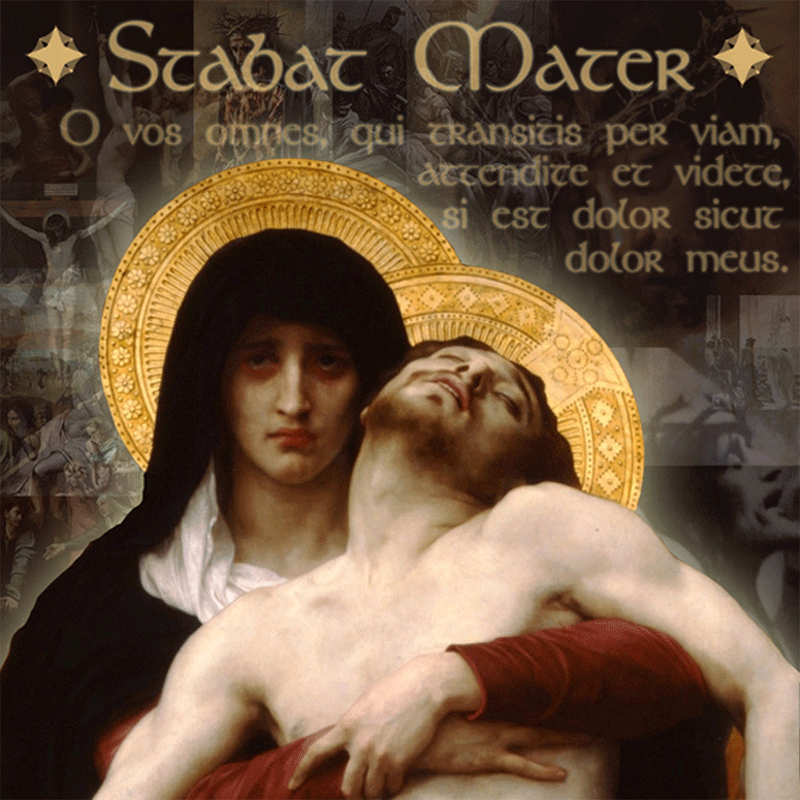
Our Lady of Sorrows

Lady of Sorrows

Our Lady of Sorrows


September 15


His Mother stood by the Cross

From a sermon by Saint Bernard, abbot

Prophesy of Simeon
The martyrdom of the Virgin is set forth both in the prophecy of Simeon and in the actual story of our Lord’s passion.  The holy old man said of the infant Jesus: He has been established as a sign which will be contradicted.   He went on to say: And your own heart will be pierced by a sword.

Truly, O blessed Mother, a sword has pierced your heart.  For only by passing through your heart could the sword enter the flesh of your Son.  Indeed, after your Jesus—who belongs to everyone, but is especially yours—gave up His life, the cruel spear, which was not withheld from His lifeless body, tore open His side.  Clearly it did not touch His soul and could not harm Him, but it did pierce your heart.  For surely His soul was no longer there, but yours could not be torn away.  Thus the violence of sorrow has cut through your heart, and we rightly call you more than martyr, since the effect of compassion in you has gone beyond the endurance of physical suffering.

Christ gives His Mother to John
Or were those words: Woman, behold your Son, not more than a sword to you, truly piercing your heart, cutting through the division between soul and spirit?  What an exchange!  John is given to you in place of Jesus the servant in place of the Lord, the disciple in place of the Master; the son of Zebedee replaces the Son of God, a mere man replaces God Himself.  How could these words not pierce your most loving heart, when the mere remembrance of them breaks ours, hearts of stone and iron though they are!

Do not be surprised, brothers , that Mary is said to be martyr in spirit.  Let him be surprised who does not remember the words of Paul, that one of the greatest crimes of the Gentiles was that they were without love.  That was far from the heart of Mary; let it be far from her servants.

Perhaps someone will say: “Had she not known before that He would not die?”  Undoubtedly.  “Did she not experience Him to rise again at once?”  Surely.  “And still she grieved over her crucified Son?” Intensely.  Who are you and what source of your wisdom that you are more surprised at the compassion of Mary than the passion of Mary’s Son?  For if He could die in body, could she not died with Him in spirit?  He died in body through a love greater than anyone had known.  She died in spirit through love unlike any other since His.


Father,
As your Son was raised on the cross,
His mother Mary stood by Him, sharing His sufferings.
May Your Church be united with Christ
In His suffering and death
And so come to share in his rising to new life,
Where He lives and reigns with You and the Holy Spirit,
One God, for ever and ever.


Taken from Liturgy of the Hours,  Our Lady of Sorrows

St. Matthew, Apostle September 21

St. Matthew, 

Apostle 

and Evangelist

Feast Day September 21

Jesus saw him through the eyes of mercy 
and chose him

From a homily by Saint Bede the Venerable, priest

Jesus calls Matthew [Mathew 9:9]
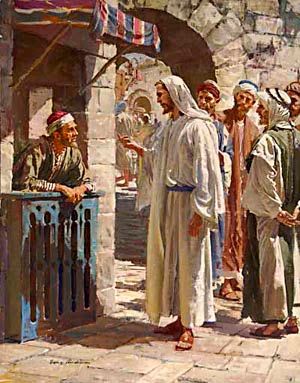
Jesus saw a man called Matthew sitting at the tax office and he said to him: Follow Me.  Jesus saw Matthew not merely in the usual sense, but more significantly with His merciful understanding of men.

He saw the tax collector and, because He saw him through the eyes of mercy and chose him, He said to him: “Follow Me.”  This following meant imitating the pattern of His life—not just walking after Him.  Saint John tells us: Whoever says he abides in Christ ought to walk in the same way in which He walked.

And he rose and followed Him.  There is not reason for surprise that the tax collector abandoned earthly wealth as soon as the Lord commanded him.  Nor should one be amazed that neglecting his wealth, he joined a band of men whose leader had, on Matthew’s assessment, no riches at all.  Our Lord summoned Matthew by speaking to him in words. By an invisible, interior impulse flooding his mind with the light of grace, He instructed him to walk in His footsteps.  In this way Matthew could understand that Christ, who was summoning him away from earthly possessions, had incorruptible treasures of heaven in His gift.

Supper at Matthew's house with tax collectors and sinners
As He sat at table in the house, behold many tax collectors and sinners came and sat down with Jesus and His disciples.  This conversion of one tax collector gave many men, those from his own profession and other sinners, an example of repentance and pardon.  Notice also the happy and true anticipation of his future status as apostle and teacher of the nations.  No sooner was he converted than Matthew drew after him a whole crowd of sinners along the same road to salvation.  He took up his appointed duties while still taking his first steps in the faith and from that hour he fulfilled his obligation ad thus grew in merit.

To see a deeper understand of the great celebration Matthew held at his house, we must realize that he not only gave a banquet for the Lord at his earthly residence, but far more pleasing was he banquet set in his own heart which he provided through faith and love.  Our Saviour attests to this: Behold I stand at the door and knock; if anyone hears My voice and opens the door, I will come in to him and eat with him, and he with Me.

Behold I stand at the door and knock  Revelation 3:20
On hearing Christ’s voice, we open the door to receive Him, as it were, when we freely assent to His promptings and when we give ourselves over  to doing what must be done.  Christ, since He dwells I the hearts of His chosen ones through the grace of His love, enters so that He might eat with us and we with Him.  He ever refreshes us by the light of His presence insofar as we progress in our devotion to and longing for the things of heaven.  He Himself is delighted by such a pleasing banquet.


God of Mercy,
You chose a tax collector, Saint Matthew,
To share the dignity of the apostles.
By his example and prayers
Help us to follow Christ
And remain faithful in Your service.
We ask this through our Lord Jesus Christ, Your Son,
Who lives and reigns with You and the Holy Spirit,
One God, forever and ever.
Amen

Taken from the Liturgy of the Hours Feast of St. Matthew, Apostle and Evangelist

See YOUTUBE  Jesus of Nazareth Supper at Matthew's story of Prodigal Son https://youtu.be/14epxvU8XIA

Saturday, 8 September 2018

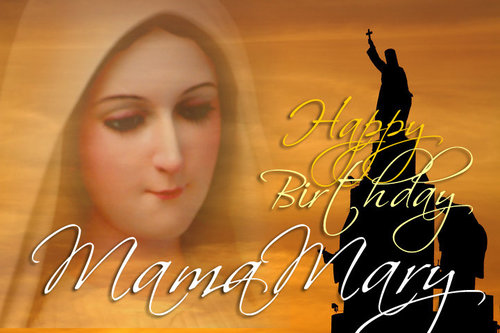
HAPPY BIRTHDAY BLESSED MOTHER! (SEPT 8)


Feast of the Nativity
 of the 

Blessed Virgin Mary, 
September 8

“Behold, the virgin shall be with child and bear a son, and they shall name him Emmanuel.”
                                                                              Matthew 1:23

We all love to celebrate birthdays.  Today is the birthday celebration of our dear Mother.  In December we honor her Immaculate Conception.  In January we celebrate her as the Mother of God.  In August we celebrate her Assumption into Heaven and there are many other days throughout the year where we honor a unique aspect of her life.  But today is simply her birthday celebration!

Celebrating her birthday is a way of celebrating her simply for being herself.  We do not necessarily focus in on any of the unique, beautiful and profound aspects of her life today.  We do not necessarily look at all she accomplished, her perfect yes to God, her coronation in Heaven, her assumption or any other specifics.  All parts of her are glorious, beautiful, awe-inspiring and worth of their own unique feasts and celebration.

Today, however, we simply celebrate our Blessed Mother because she was created and brought into this world by God and that alone is worth celebrating.  We honor her simply because we love her and we celebrate her birthday as we would celebrate the birthday of anyone we love and care for.

Reflect, today, upon the fact that Mother Mary is your mother.  She truly is your mother and its’s worth celebrating her birthday in the same way you would celebrate anyone’s birthday who was a member of your family.  Your honoring of Mary, today, is a way of solidifying your bond with her and assuring her that you desire her to be an important part of your life.

Happy Birthday, Blessed Mother! We love you dearly!

Hail Mary, full of grace, the Lord is with Thee.  Blessed are thou among women and blessed is the fruit of thy womb JESUS.  Holy Mary, Mother of God, pray for us sinners now and at the hour of our death.  Amen.

Precious Jesus, through the heart of the Immaculate Virgin Mary, our Mother, we trust in YOU!


--Taken from the book “Daily Reflections for Ordinary Time: Weeks 18-34” by John Paul Thomas

I highly recommend this book which give you a reflection of the reading every day.

Wednesday, 22 August 2018

Suffering, Tribulation From the writings of St. Rose of Lima


St. Rose of Lima, Virgin

From the writings of St. Rose of Lima

Let us know the love of Christ which surpasses all knowledge

Our Lord and Saviour lifted up his voice and said with incomparable majesty: “Let all men know what grace comes after tribulation.  Let them know that without the burden of afflictions it is impossible to reach the height of grace.  Let them know that the gifts of grace increase as the struggles increase.  Let men take care not to stray and be deceived.  This is the only true stairway to paradise, without the cross they can find no road to climb to heaven.

When I heard these words, a strong force came upon me and seemed to place me in the middle of a street, so that I might say in a loud voice to people of every age, sex and status: “Hear, O people; hear, O nations.  I am warning you about the commandment of Christ by using words that came from his own lips: 

We cannot obtain grace unless we suffer afflictions.  
We must heap trouble upon trouble to attain 
a deep participation in the divine nature, 
the glory of the sons of God and perfect happiness of soul.”

That same force urged me to proclaim the beauty of divine grace.  It pressed me so that my breath came slow and forced me to sweat and pant.  I felt as if my soul could no longer be kept in the prison of the body, but that it had burst its chains and was free and alone and was going very swiftly through the whole world saying: 

“If only mortals would learn how great 
it is to possess divine grace, 
how beautiful, how noble, how precious.  
How many riches it hides within itself, 
how many joys and delights!  

Without doubt they would devote all their care and concern to winning for themselves pains and afflictions.  All men throughout the world would seek trouble, infirmities and torments, instead of good fortune, in order to attain the unfathomable treasure of grace.  This is the reward and the final gain of patience.  No one would complain about his cross or about troubles that may happen to him, if he would come to know the scales on which they are weighed when they are distributed to men.”


Beheading of John the Baptist, Martyr August 29

St. John the Baptist


Precursor of Christ 
in Birth and Death
From a homily by Saint Bede the Venerable, priest

As forerunner of our Lord's birth, preaching and death, the blessed John showed in his struggle a goodness worthy of the sight of heaven.  In the words of scripture: Though in the sight of men he suffered torments, his hope is full of immortality.  We justly commemorate the day of his birth with a joyful celebration, a day which he himself made festive for us through his suffering and which he adorned with the crimson splendor of his own blood.  We do rightly revere his memory with joyful hearts, for he stamped with the seal of martyrdom the testimony which he delivered on behalf of our Lord.

There is no doubt that blessed John suffered imprisonment and chains as a witness to our Redeemer, whose forerunner he was, and gave his life for Him.  His persecutor had demanded not that he should deny Christ, but only that he should be kept silent about the truth.  Nevertheless, he died for Christ.  Does Christ not say: I am the truth?  Therefore, because John shed his blood for the truth, he surely died for Christ.

Through his birth, preaching and baptizing, he bore witness to the coming birth, preaching and baptism of Christ, and his own suffering he showed that Christ also would suffer.

St. John he Baptist Imprisonment
Such was the quality and strength of the man who accepted the end of this present life by shedding his blood after the long imprisonment.  He preached the freedom of heavenly peace, yet was thrown into irons by ungodly men; he was locked away in the darkness of prison, though he came bearing witness to the Light itself, which is Christ.  John was baptized in his own blood, though he had been privileged to baptize the Redeemer of the world, to hear the voice of the Father above him, and to see the grace of the Holy Spirit descending upon Him.  But to endure temporal agonies for the sake of the truth was not a heavy burden for such men as John; rather it was easily borne and even desirable, for he knew eternal joy would be his reward.

Beheading of St. John the Baptist
Since death was ever near at hand through the inescapable necessity of nature, such men considered it a blessing to embrace it and thus gain the reward of eternal life by acknowledging Christ’s name.  Hence the apostle Paul rightly says: You have been granted the privilege not only to believe in Christ but also to suffer for his sake.  He tells us why it is Christ’s gift that his chosen ones should suffer for him: The sufferings of this present time are not worthy to be compared with the glory that is to be revealed in us.

Stairway to Heaven


Queenship of Mary


Queen of the World and of Peace

From a homily by Saint Amadeus of Lausanne, bishop

Observe how fitting it was that even before her assumption the name of Mary shone forth wondrously throughout the world. Her fame spread everywhere even before she was raised above the heavens in her magnificence. Because of the honor due her Son, it was indeed fitting for the Virgin Mother to have first ruled upon earth and then be raised up to heaven in glory. It was fitting that her fame be spread in this world below, so that she might enter the heights of heaven in overwhelming blessedness. Just as she was borne from virtue to virtue by the Spirit of the Lord, she was transported from earthly renown to heavenly brightness.

So it was that she began to taste the fruits of her future reign while still in the flesh. At one moment she withdrew to God in ecstasy; at the next she would bend down to her neighbors with indescribable love. In heaven angels served her, while here on earth she was venerated by the service of men. Gabriel and the angels waited upon her in heaven. The virgin John, rejoicing that the Virgin Mother was entrusted to him at the cross, cared for her with the other apostles here below. The angels rejoiced to see their queen; the apostles rejoiced to see their lady, and both obeyed her with loving devotion.

Dwelling in the loftiest citadel of virtue, like a sea of divine grace or an unfathomable source of love that has everywhere overflowed its banks, she poured forth her bountiful waters on trusting and thirsting souls. Able to preserve both flesh and spirit from death she bestowed health-giving salve on bodies and souls. Has anyone ever come away from her troubled or saddened or ignorant of the heavenly mysteries? Who has not returned to everyday life gladdened and joyful because his request had been granted by the Mother of God?

She is a bride, so gentle and affectionate, and the mother of the only true bridegroom. In her abundant goodness she has channeled the spring of reason’s garden, the well of living and life-giving waters that pour forth in a rushing stream from divine Lebanon and flow down from Mount Zion until they surround the shores of every far-flung nation. With divine assistance she has redirected these waters and made them into streams of peace and pools of grace. Therefore, when the Virgin of virgins was led forth by God and her Son, the King of kings, amid the company of exulting angels and rejoicing archangels, with the heavens ringing with praise, the prophecy of the psalmist was fulfilled, in which he said to the Lord: At your right hand stands the queen, clothed in gold of Ophir.


A great sign appeared 
in the heavens: 
a woman clothed 
with the sun, 
with the moon under her feet,
and upon her head a crown of twelve stars.


From the Liturgy of the Hours, August 22nd Memorial for the Queenship of Mary


I love you Holy Mother, pray for us.


Saint Amadeus (1110-1159) was born of the royal family of Franconia, in France in 1110. He was the son of Blessed Amadeus of Clermont, France and was educated at the monasteries at Bonnevaux and Cluny. Amadeus entered the monastery at Clairvaux in 1124, becoming a Cistercian under the spiritual direction of St. Bernard. Fifteen years later he was appointed abbot of Ilautecombe abbey in Savoy in 1139. Five years later he was made bishop of Lausanne in 1144. There he worked for renewal and reform in a troubled region racked with violence and disturbances. In one of his letters he tells how his vestments once ran red with the blood of a man murdered while the bishop tried unsuccessfully to protect him. Amid these difficulties and administrative duties, Amadeus wrote and preached eight homilies in praise of the Blessed Virgin Mary, the Mother of God, reflecting the devotion learned in the Cistercian monastery under St. Bernard. These homilies evidence a distinctive piety expressed with all the eloquence of a trained orator. The above is one of those homilies.