Ad

Showing posts with label homily by St. Gregory the Great. Show all posts

Saturday, 29 September 2018

Archangels Michael, Gabriel, and Raphael Feast Day September 29

Archangels Michael, Gabriel and Raphael

Feasts of Saints Michael, Gabriel, and Raphael, Archangels


September 29

“Amen, Amen, I say to you, you will see heaven opened and the angels of God ascending and descending on the Son of Man.”  John 1:51

Yes, angels are real.  And they are mighty glorious, beautiful and magnificent in every way.  Today we honor three of the multitude of angels in Heaven:  Michael, Gabriel and Raphael.

These angels are “archangels”.  An archangel is the second order of angels just above the guardian angels.  In all, there are nine orders of celestial beings that we commonly refer to as angels and all nine of these orders are traditionally organized into three spheres.  The entire hierarchy is traditionally organized this way:
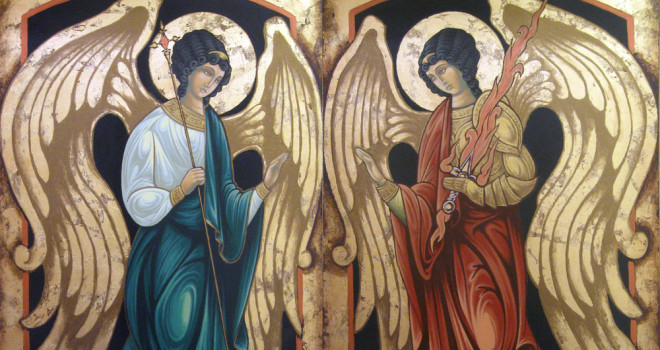

Highest Sphere:  Seraphim, Cherubim and Thrones.

Middle Sphere:  Dominions, Virtues and Powers.

Lower Sphere:  Principalities, Archangels and Angels (Guardian Angels).

The hierarchy of these celestial beings is ordered in accord with their function and purpose.  The highest of the beings, the Seraphim, were created solely for the purpose of surrounding the Throne of God in perpetual worship and adoration.  The lowest of the beings, the Guardian Angels, were created for the purpose of caring for humans and communicating God’s messages.  The Archangels, whom we honor today, were created for the purpose of bringing messages of great importance to us and to accomplish tasks of the highest importance in our lives.

Michael is well known as the archangel who was empowered by God to cast Lucifer our of Heaven.  Lucifer is traditionally thought to be of the highest sphere of celestial beings and, thus, being cast out by a lowly archangel was quite a humiliation.


Gabriel is well known for being the archangel who brought the message of the Incarnation to the Blessed Virgin Mary.


And Raphael, whose name means “God heals” is referred to in the Old Testament Book of Tobit as is said to have been sent to bring healing to Tobit’s eyes.


Though not much is known of these archangels, its important to believe in them, honor them and to pray to them.  We pray to them because we believe God has entrusted them with a mission to help us bring healing, fight evil and proclaim the Word of God.  Their power comes from God, but God has chosen to use the archangels, and all celestial beings, to accomplish His plan and purpose.

Reflect, today, upon your knowledge of the angels.  Do you believe in them?  Do you honor them?  Do you rely upon their powerful intercession and mediation in your life?  God wants to use them, so you should truly seek their help in your life.

Lord, thank You for the gift of the Archangels whom we honor today.  Thank you for their powerful working in our lives. Help us to rely upon them and to love them for their service.  Archangels, pray for us, heal us, teach us and protect us.  Jesus, I Trust in You.

Above taken from the book “Daily Reflections for Ordinary Time: Weeks 18-34”  Feast of the Archangels, September 29 by John Paul Thomas

Sts. Michael, Gabriel and Raphael Archangels


The Word ‘Angel’ denotes a Function rather than a Nature

From a homily on the Gospels by Saint Gregory the great, pope

You should be aware that the word ‘angel’ denotes a function rather than a nature.  Those holy spirits of Heaven have indeed always been spirits.  They can only be called angels when they deliver some message.  Moreover, those who deliver messages of lesser importance are called angels; and those who proclaim messages of supreme importance are called Archangels.

And so it was that not merely an angels but the Archangel Gabriel was sent to the Virgin Mary.  It was only fitting that the highest angel should come to announce the greatest of all messages.

Some angels are give proper names to denote the service they are empowered to perform.  In that holy city, where perfect knowledge flows from the vision of Almighty God, those who have no names may easily be known.  But personal names are assigned to some, not because they could not be known without them, but rather to denote their ministry when they come among us.  

Thus, Michael means 
“Who is like God?”; 

Gabriel is 
“strength of God”; 

and Raphael is 
“God’s Remedy”.
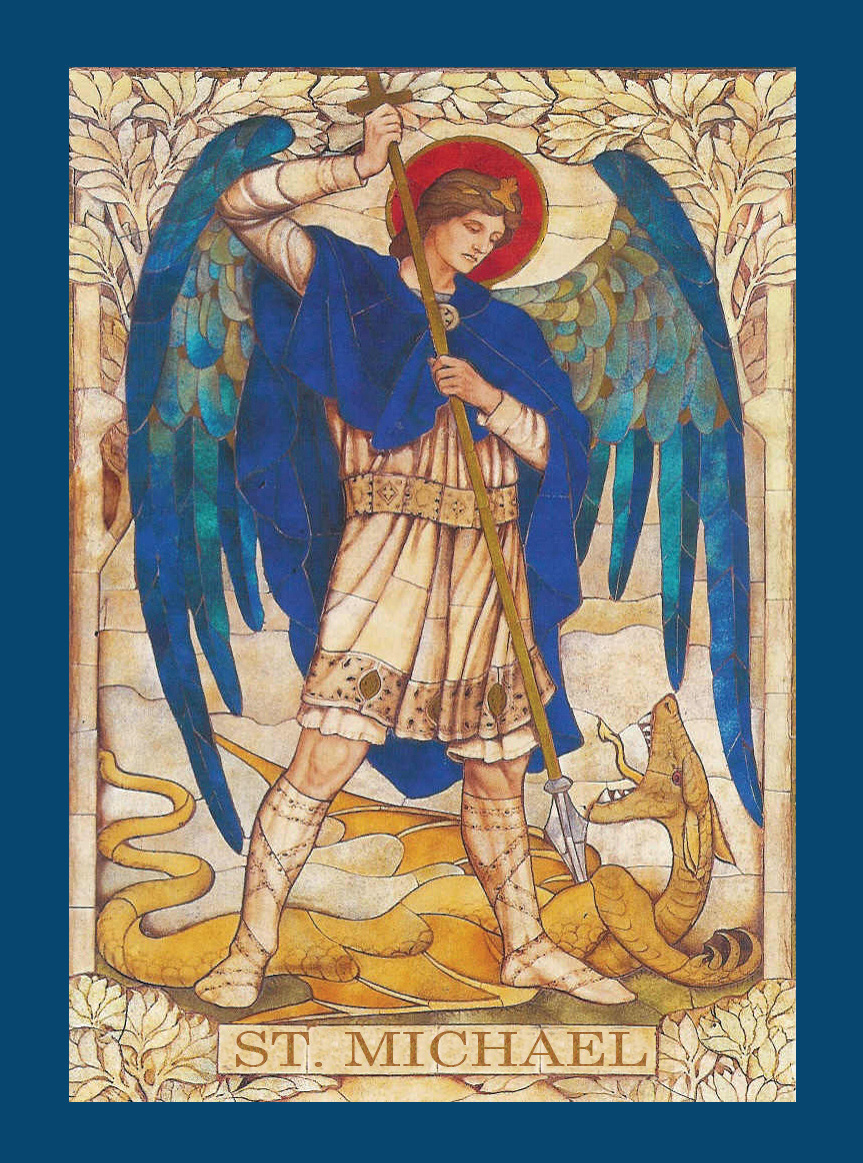

Who is like unto God!  St. Michael the Archangel
Whenever some act of wondrous power must be performed, Michael is sent, so that his action and his name may make it clear that no one can do what God does by His superior power. So also our ancient foe desired in his pride to be like God, saying: “I will ascend into Heaven; I will exalt my throne above the stars of Heaven; I will be like the Most High.”   He will be allowed to remain in power until the end of the world when he will be destroyed in the final punishment.  Then, he will fight the Archangel Michael, as we are told by John: A battle was fought with Michael the archangel.


Blessed Virgin Mary and Archangel Gabriel
So too, Gabriel, who is called God’s strength, was sent to Mary.  He came to announce  the One Who appeared as a humble man to quell the cosmic powers.  Thus God’s strength announced the coming of the Lord of the Heavenly powers, mighty in battle.


Raphael means, as I have said, God’s Remedy, for when he touched Tobit’s eyes in order to cure him, he banished the darkness of his blindness.  Thus, since he is to heal, he is rightly called God’s Remedy.

Above taken from the Liturgy of the Hours Ordinary Time Weeks 18-34, September 29 Michael, Gabriel and Raphael, Archangels

Tuesday, 4 July 2017

St. Thomas the Apostle by St. Gregory the Great

St. Thomas the Apostle - John 20:24-29

St. Thomas, Apostle Feast Day July 3rd

From the homily on the Gospels by Saint Gregory the Great, pope

My Lord 
and my God

Thomas, one of the twelve, called the Twin, was not with them when Jesus came.

He was the only disciple absent; on his return he heard what had happened but refused to believe it.  The Lord came a second time; he offered his side for the disbelieving disciple to touch, held out his hands, and showing the scars of his wounds, healed the wound of his disbelief.

Dearly beloved, what do you see in these events?  Do you really believe that it was by chance that this chosen disciple was absent, then came and heard, heard and doubted, doubted and touched, touched and believed?  It was not by chance but in God’s providence.  

In a marvelous way God’s mercy 
arranged that the disbelieving disciple, 
in touching the wounds of 
his master’s body, 
should heal our wounds of disbelief.  

The disbelief of Thomas has done more for our faith than the faith of the other disciples.  As he touches Christ and is won over to belief, every doubt is cast aside and our faith is strengthened.  So the disciple who doubted, then felt Christ’s wounds, becomes a witness to the reality of the resurrection.

Because you have seen Me, you believed.
Touching Christ, he cried out: My Lord and my God!  Jesus said to him: Because you have seen me, Thomas, you believed.  Paul said: Faith the guarantee of things hoped for, the evidence of things unseen.  

It is clear, then, that faith is the proof of what cannot be seen.  What it seen gives knowledge, not faith. 

When Thomas saw and touched, why was he told: You have believed because you have seen me? Because what he saw and what he believed were different things.  

God cannot be seen by mortal men.  

Thomas saw a human being, whom he acknowledged to be God, and said: 
My Lord and my God. 

Seeing, he believed; 
looking at one who was true man, 
he cried out that this was God, 
the God he could not see.


What follows is reason for great joy: Blessed are those who have not seen and have believed.  

There is here a particular reference to ourselves; we hold in our hearts one we have not seen in the flesh.  We are included in these words, but only if we follow up our faith with good works.  The true believer practices what he believes.  But of those who pay only lip service to faith, Paul has this to say: They profess to know God, but they deny him in their works.  Therefore James says: Faith without works is dead.

Thursday, 21 July 2016

St. Mary Magdalene Sought her Lord

St. Mary Magdalene, Feast Day July 22

St. Mary Magdalene
From the homily on the Gospels by St. Gregory the Great, pope


She longed for Christ, though she thought he had been taken away

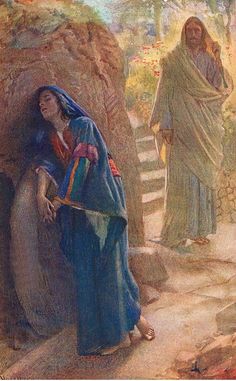
When Mary Magdalene came to the tomb and did not find the Lord’s body, she thought it had been taken away and so informed the disciples.  After they came and saw the tomb, they too believed what Mary had told them.  The text then says: The disciples went back home, and it adds: but Mary wept and remained standing outside the tomb.

Weeping at the tomb

We should reflect on Mary’s attitude and the great love she felt for Christ; for though the disciples had left the tomb, she remained.  She was still seeking the one she had not found, and while she sought she wept; burning with the fire of love, she longed for him who she thought had been taken away.  

And so it happened that the woman who stayed behind to seek Christ was the only one to see him.  


For perseverance is essential to any good deed, 
as the voice of truth tells us: 
Whoever perseveres to the end will be saved.

At first she sought but did not find, but when she persevered t happened that she found what she was looking for.  When our desires are not satisfied, they grow stronger, and becoming stronger they take hold of their object.  

Holy desires likewise grow with anticipation, and if they do not grow they are not really desires.  Anyone who succeeds in attaining the truth has burned with such a love.  

As David says: 
My soul has thirsted for the living God; 
when shall I come and appear before the face of God?  

And also in the Song of Songs the Church says:

I was wounded by love; and again: My soul is melted with love.

Weeping at the tomb... Jesus asks Why do you weep?

Woman, why are you weeping? Whom do you seek? 

She is asked why she is sorrowing so that her desire might be strengthened; for when she mentions whom she is seeking, her love is kindled all the more ardently.


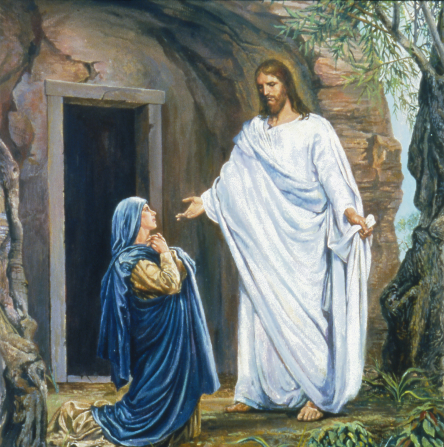
Jesus says to her: Mary.  

Jesus is not recognized when he calls her “woman”; so he calls her by name, as though he were saying: Recognize me as I recognize you; for I do not know you as I know others; I know you as yourself. 

And so Mary, once addressed by name, recognizes who is speaking.  

She immediately calls him rabboni,
 that is to say, teacher, 
because the one whom 
she sought outwardly 
was the one who inwardly 
taught her to keep on searching. 

Once addressed by name, Mary recognizes who is speaking and calls him rabboni, teacher

Homily taken from the Liturgy of the Hours