Showing posts with label Christ's Resurrection. Show all posts
Showing posts with label Christ's Resurrection. Show all posts
Sunday, 4 April 2021


Tuesday, 30 March 2021
Tuesday, 4 July 2017
St. Thomas the Apostle by St. Gregory the Great
 |
| St. Thomas the Apostle - John 20:24-29 |
St. Thomas, Apostle Feast Day July 3rd
From the homily on the Gospels by Saint Gregory the Great, pope
From the homily on the Gospels by Saint Gregory the Great, pope
My Lord
and my God
Thomas, one of the
twelve, called the Twin, was not with them when Jesus came.
He was the only disciple absent; on his return he heard what
had happened but refused to believe it.
The Lord came a second time; he offered his side for the disbelieving
disciple to touch, held out his hands, and showing the scars of his wounds,
healed the wound of his disbelief.
Dearly beloved, what do you see in these events? Do you really believe that it was by chance
that this chosen disciple was absent, then came and heard, heard and doubted,
doubted and touched, touched and believed? It was not by chance but in God’s providence.
In a marvelous way God’s mercy
arranged that
the disbelieving disciple,
in touching the wounds of
his master’s body,
should
heal our wounds of disbelief.
The disbelief
of Thomas has done more for our faith than the faith of the other
disciples. As he touches Christ and is
won over to belief, every doubt is cast aside and our faith is
strengthened. So the disciple who
doubted, then felt Christ’s wounds, becomes a witness to the reality of the
resurrection.
 |
| Because you have seen Me, you believed. |
Touching Christ, he cried out: My Lord and my God! Jesus
said to him: Because you have seen me,
Thomas, you believed. Paul said: Faith the guarantee of things hoped for, the
evidence of things unseen.
It is
clear, then, that faith is the proof of what cannot be seen. What it seen gives knowledge, not faith.
When Thomas saw and touched, why was he told: You have believed because you have seen me? Because
what he saw and what he believed were different things.
God cannot be seen by mortal men.
Thomas saw a human being, whom he
acknowledged to be God, and said:
My Lord
and my God.
Seeing, he believed;
looking at one who was true man,
he cried out that this was God,
the God he
could not see.
What follows is reason for great joy: Blessed are those who have not seen and have believed.

There is here a particular reference to
ourselves; we hold in our hearts one we have not seen in the flesh. We are included in these words, but only if
we follow up our faith with good works.
The true believer practices what he believes. But of those who pay only lip service to
faith, Paul has this to say: They profess
to know God, but they deny him in their works.
Therefore James says: Faith
without works is dead.
Wednesday, 12 April 2017
Death and Resurrection - St. Basil, bishop
 |
| Christ Crucified |
By One Death and Resurrection the World was Saved
From the book On the Holy Spirit by Saint Basil, bishop
When mankind was estranged from him by disobedience, God our
Savior made a plan for raising us from our fall and restoring us to friendship
with himself. According to this plan
Christ came in the flesh, he showed us the gospel way of life, he suffered,
died on the cross, was buried and rose from the dead. He did this so that we could be saved by imitation
of him, and recover our original status as sons of God by adoption.

To attain holiness, then, we must not only pattern our lives
on Christ’s by being gentle, humble and patient, we must also imitate him in
his death.
Taking Christ for his model,
Paul said that he wanted to become like him in his death in the hope that he
too would be raised from death to life.
We imitate Christ’s death by being buried with him in baptism.
If we ask what this kind of burial means and
what benefit we may hope to derive from it, it means first of all making a
complete break with our former way of life, and our Lord himself said that this
cannot be done unless a man is born again.
In other words, we have to begin a new life,
and we cannot do so until
our previous life
has been brought to an end.
When runners reach the turning point on a racecourse, they have to pause
briefly before they can go back in the opposite direction. So also when we wish to reverse the direction
of our lives there must be a pause, or a death, to make the end of one life and
the beginning of another.
Our descent into hell takes place
when we imitate the burial
of Christ by our baptism.
The bodies of
the baptized are in a sense buried in the water as a symbol of their
renunciation of the sins of their unregenerate nature. As the Apostle says: The circumcision you have undergone is not an operation performed by
human hands, but the complete stripping away of your unregenerate nature. This is the circumcision that Christ gave us,
and it is accomplished by our burial with him in baptism. Baptism cleanses the soul from the pollution
of worldly thoughts and inclinations: You
will wash me, says the psalmist, and
I shall be whiter than snow.
We
receive this saving baptism only once
because there was only one death and one
resurrection
for the salvation of the world, and baptism is its symbol.
 |
| Mary Magdalene meets the Risen Christ |
Thursday, 4 June 2015
Friday, 21 March 2014
Death and Christ's Promise -- Saint Anastasius sermon
Death is not the End
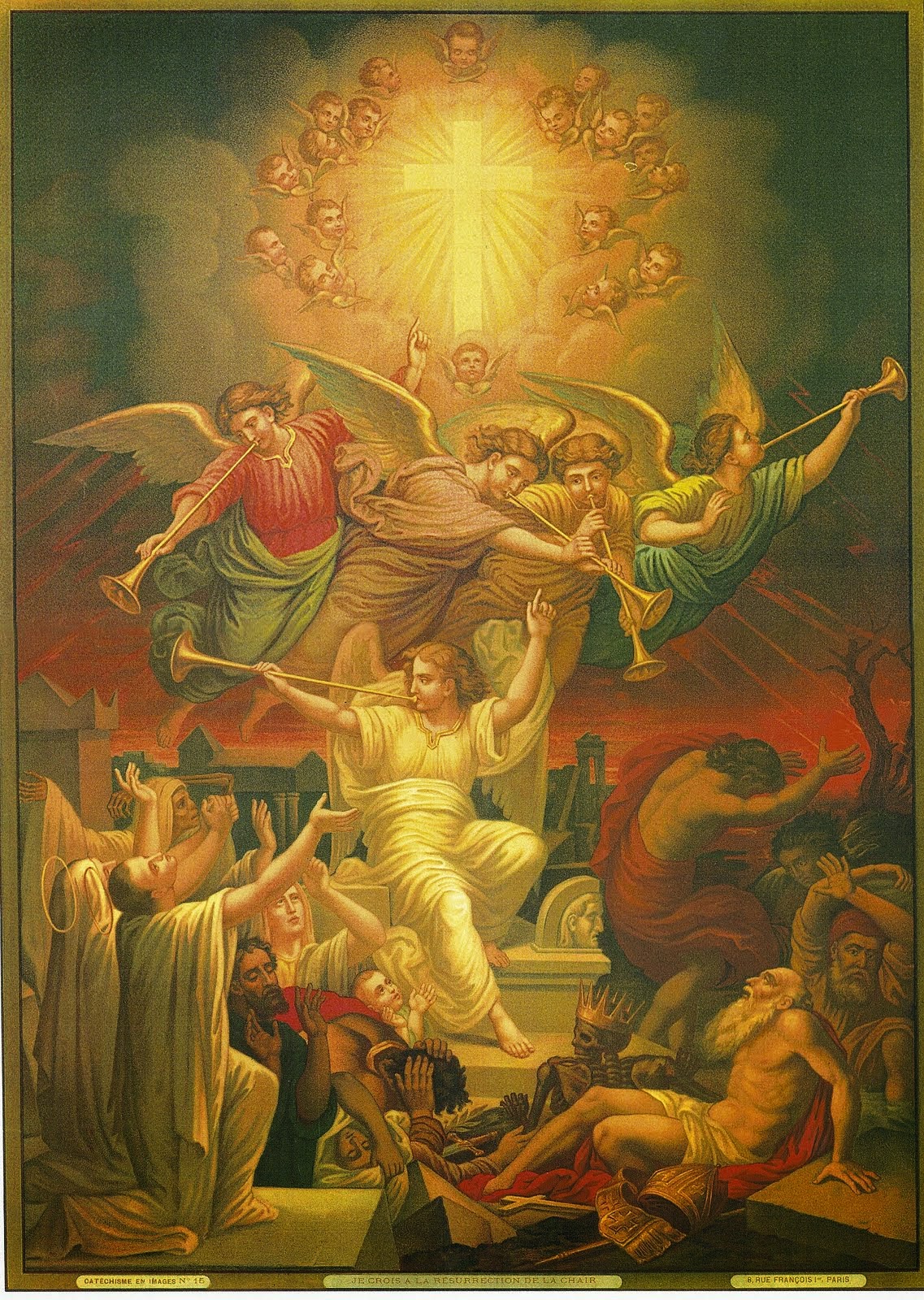
I work in a funeral home - death is a daily occurrence. Being Catholic I have the faith in Christ's promise. And I pray for those who pass through here... and all the dead for the Mercy of God to be upon them.
Many family (and deceased) come through the doors with no faith at all - saying that death is final and there is nothing else. What a horrible way to live thinking that there is nothing.
Today is full of unbelievers... it seems to be an epidemic. We must do all in our power to tell the Truth... to all who will listen so that we can save souls.
I wanted to share with you a sermon on the subject of the Resurrection of the Dead by a great saint. I hope it inspires you as it has me.
From a sermon by
Saint Anastasius of Antioch, bishop
Christ will change our lowly body
To this end Christ died and rose to life that he might be Lord both of the dead and of the living. But God is not God of the dead, but of the living. That is why the dead, now under the dominion of one who has risen to life, are no longer dead but alive. Therefore life has dominion over them and, just as Christ, having been raised from the dead, will never die again, so too they will live and never fear death again. When they have been thus raised from the dead and freed from decay, they shall never again see death, for they will share in Christ’s resurrection just as he himself shared in their death.
This is why Christ descended into the underworld, with its
imperishable prison bars: to shatter the doors of bronze and break the bars of
iron and, from decay, to raise our life to himself by giving us freedom in
place of servitude.
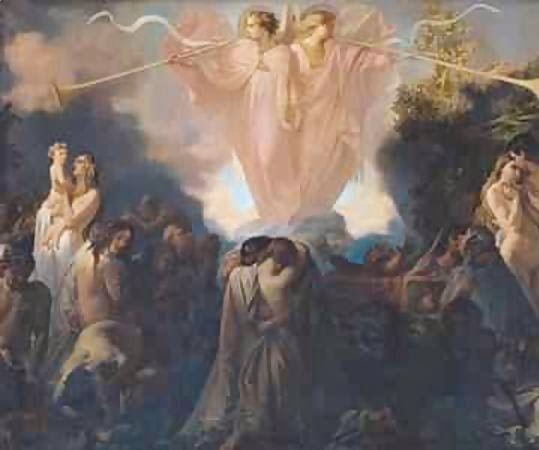
But if this plan does not yet appear to be perfectly
realized — for men still die and bodies still decay in death — this should not
occasion any loss of faith. For, in receiving the firstfruits, we have already
received the pledge of all the blessings we have mentioned; with them we have
reached the heights of heaven, and we have taken our place beside him who has
raised us up with himself, as Paul says: In Christ God has raised us up with
him, and has made us sit with him in the heavenly places.
And the fulfillment will be ours on the day predetermined by
the Father, when we shall put off our childish ways and come to perfect
manhood. For this is the decree of the Father of the ages: the gift, once
given, is to be secure and no more to be rejected by a return to childish
attitudes.
 There is no need to recall that the Lord rose from the dead
with a spiritual body, since Paul in speaking of our bodies bears witness that
they are sown as animal bodies and raised as spiritual bodies: that is, they
are transformed in accordance with the glorious transfiguration of Christ who
goes before us as our leader.
There is no need to recall that the Lord rose from the dead
with a spiritual body, since Paul in speaking of our bodies bears witness that
they are sown as animal bodies and raised as spiritual bodies: that is, they
are transformed in accordance with the glorious transfiguration of Christ who
goes before us as our leader.
The Apostle, affirming something he clearly knew, also said
that this would happen to all mankind through Christ, who will change our lowly
body to make it like his glorious body.
If this transformation is a change into a spiritual body and
one, furthermore, like the glorious body of Christ, then Christ rose with a
spiritual body, a body that was sown in dishonor, but the very body that was
transformed in glory.
Having brought this body to the Father as the first-fruits
of our nature, he will also bring the whole body to fulfillment. For he
promised this when he said: I, when I am lifted up, will draw all men to
myself.
taken from the Liturgy of the Hours
If you don't have the books go on the web
Subscribe to:
Posts (Atom)