Ad

Showing posts with label St. Gregory the Great. Show all posts

Tuesday, 4 July 2017

St. Thomas the Apostle by St. Gregory the Great

St. Thomas the Apostle - John 20:24-29

St. Thomas, Apostle Feast Day July 3rd

From the homily on the Gospels by Saint Gregory the Great, pope

My Lord 
and my God

Thomas, one of the twelve, called the Twin, was not with them when Jesus came.

He was the only disciple absent; on his return he heard what had happened but refused to believe it.  The Lord came a second time; he offered his side for the disbelieving disciple to touch, held out his hands, and showing the scars of his wounds, healed the wound of his disbelief.

Dearly beloved, what do you see in these events?  Do you really believe that it was by chance that this chosen disciple was absent, then came and heard, heard and doubted, doubted and touched, touched and believed?  It was not by chance but in God’s providence.  

In a marvelous way God’s mercy 
arranged that the disbelieving disciple, 
in touching the wounds of 
his master’s body, 
should heal our wounds of disbelief.  

The disbelief of Thomas has done more for our faith than the faith of the other disciples.  As he touches Christ and is won over to belief, every doubt is cast aside and our faith is strengthened.  So the disciple who doubted, then felt Christ’s wounds, becomes a witness to the reality of the resurrection.

Because you have seen Me, you believed.
Touching Christ, he cried out: My Lord and my God!  Jesus said to him: Because you have seen me, Thomas, you believed.  Paul said: Faith the guarantee of things hoped for, the evidence of things unseen.  

It is clear, then, that faith is the proof of what cannot be seen.  What it seen gives knowledge, not faith. 

When Thomas saw and touched, why was he told: You have believed because you have seen me? Because what he saw and what he believed were different things.  

God cannot be seen by mortal men.  

Thomas saw a human being, whom he acknowledged to be God, and said: 
My Lord and my God. 

Seeing, he believed; 
looking at one who was true man, 
he cried out that this was God, 
the God he could not see.


What follows is reason for great joy: Blessed are those who have not seen and have believed.  

There is here a particular reference to ourselves; we hold in our hearts one we have not seen in the flesh.  We are included in these words, but only if we follow up our faith with good works.  The true believer practices what he believes.  But of those who pay only lip service to faith, Paul has this to say: They profess to know God, but they deny him in their works.  Therefore James says: Faith without works is dead.

Thursday, 6 April 2017

Tell the World the GOOD NEWS

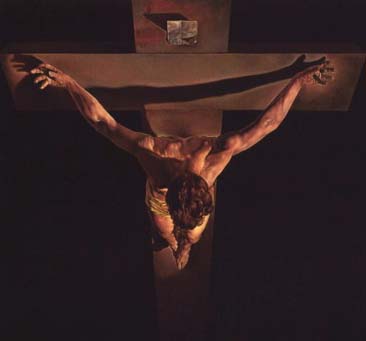
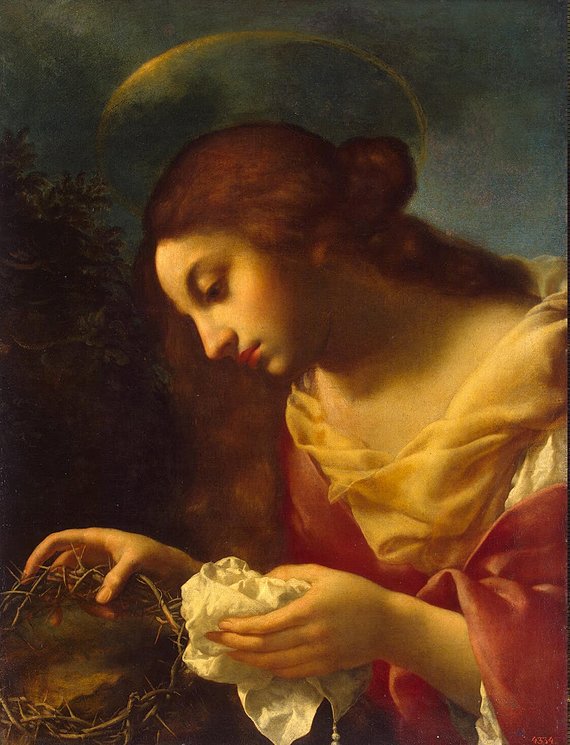
The Crucifixion of Christ


From the Moral Reflections on Job 
by Saint Gregory the Great, pope

The mystery of our new life in Christ

Holy Job is a type of the Church.  At one time he speaks for the body, at another for the head.  As he speaks of its members he is suddenly caught up to speak in the name of their head.  So it is here, where he says: I have suffered this without sin on my hands, for my prayer to God was pure.

Christ suffered without sin on His hands, for He committed no sin and deceit was not found on His lips.  Yet He suffered the pain of the cross for our redemption.  His prayer to God was pure, His alone out of all mankind, for in the midst of His suffering He prayed for His persecutors: Father, forgive them, for they do not know what they are doing.

Is it possible to offer, or even to imagine, a purer kind of prayer than that which shows mercy to one’s torturers by making intercession for them?  It was thanks to this kind of prayer that the frenzied persecutors who shed the blood of the Redeemer drank it afterward in faith and proclaimed Him to be the Son of God.

The text goes on fittingly to speak of Christ’s blood: Earth, do not cover over my blood, do not let my cry find a hiding place in you.  When man sinned, God had said: Earth you are, and to earth you will return.  Earth does not cover over the blood of the Redeemer, for every sinner, as he drinks the Blood that is the price of his redemption, offers praise and thanksgiving, and to the best of his power makes that Blood known to all around him.
Earth has not hidden away His blood, for holy Church has preached in every corner of the world the mystery of its redemption.

Blood of Christ
Notice what follows: Do not let my cry find a hiding place in you.  The Blood that is drunk, the Blood of redemption, is itself the cry of our Redeemer.  Paul speaks of the sprinkled blood that calls out more eloquently than Abel’s.  Of Abel’s blood Scripture had written: The voice of your brother’s blood cries out to me from the earth.  

The Blood of Jesus 
calls out more eloquently than Abel’s, 
for the blood of Abel asked 
for the death of Cain the fratricide, 

while the Blood of the Lord 
has asked for, and obtained, 
life for His persecutors.


If the sacrament of the Lord’s Passion is to work its effect in us, we must imitate what we receive and proclaim to mankind what we revere.  The cry of the Lord finds a hiding place in us if our lips fail to speak of this, though our hearts believe in it.  So that His cry may not lie concealed in us it remains for us all, each in his own measure, to make known to those around us the mystery of our new life in Christ.

Thursday, 21 July 2016

St. Mary Magdalene Sought her Lord

St. Mary Magdalene, Feast Day July 22

St. Mary Magdalene
From the homily on the Gospels by St. Gregory the Great, pope


She longed for Christ, though she thought he had been taken away

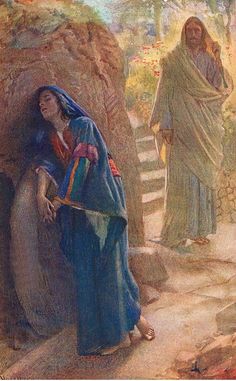
When Mary Magdalene came to the tomb and did not find the Lord’s body, she thought it had been taken away and so informed the disciples.  After they came and saw the tomb, they too believed what Mary had told them.  The text then says: The disciples went back home, and it adds: but Mary wept and remained standing outside the tomb.

Weeping at the tomb

We should reflect on Mary’s attitude and the great love she felt for Christ; for though the disciples had left the tomb, she remained.  She was still seeking the one she had not found, and while she sought she wept; burning with the fire of love, she longed for him who she thought had been taken away.  

And so it happened that the woman who stayed behind to seek Christ was the only one to see him.  


For perseverance is essential to any good deed, 
as the voice of truth tells us: 
Whoever perseveres to the end will be saved.

At first she sought but did not find, but when she persevered t happened that she found what she was looking for.  When our desires are not satisfied, they grow stronger, and becoming stronger they take hold of their object.  

Holy desires likewise grow with anticipation, and if they do not grow they are not really desires.  Anyone who succeeds in attaining the truth has burned with such a love.  

As David says: 
My soul has thirsted for the living God; 
when shall I come and appear before the face of God?  

And also in the Song of Songs the Church says:

I was wounded by love; and again: My soul is melted with love.

Weeping at the tomb... Jesus asks Why do you weep?

Woman, why are you weeping? Whom do you seek? 

She is asked why she is sorrowing so that her desire might be strengthened; for when she mentions whom she is seeking, her love is kindled all the more ardently.


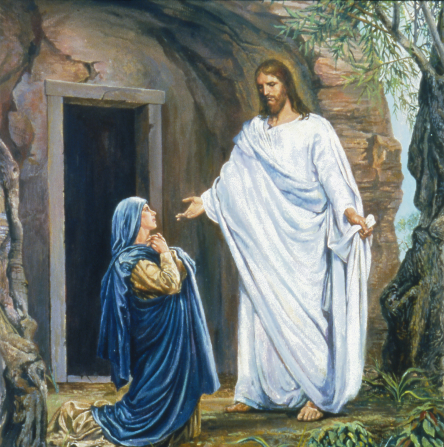
Jesus says to her: Mary.  

Jesus is not recognized when he calls her “woman”; so he calls her by name, as though he were saying: Recognize me as I recognize you; for I do not know you as I know others; I know you as yourself. 

And so Mary, once addressed by name, recognizes who is speaking.  

She immediately calls him rabboni,
 that is to say, teacher, 
because the one whom 
she sought outwardly 
was the one who inwardly 
taught her to keep on searching. 

Once addressed by name, Mary recognizes who is speaking and calls him rabboni, teacher

Homily taken from the Liturgy of the Hours

Wednesday, 13 July 2016

Seek First the Kingdom of God


In the world, yet not of it

From a homily on the Gospels by Saint Gregory the Great, pope

I would like to urge you to forsake everything, but that I do not presume to do.  Yet, if you cannot give up everything of this world, at least keep what belongs to the world in such a way that you yourself are not kept prisoner by the world.  

Whatever you possess must not possess you; whatever you own must be under the power of your soul; for if your soul is overpowered by the love of this world’s goods, it will be totally at the mercy of its possessions.


In other words, 

we make use of temporal things, 
but our hearts are set on what is eternal.  

Temporal goods help us on our way, but our desire must be for those eternal realities which are our goal.  


We should give no more than a side glance 
at all that happens in the world, 
but the eyes of our soul 
are to be focused right ahead; 
for our whole attention must 
be fixed on those realities 
which constitute our goal.

Whatever is vicious must be utterly eradicated, wrenched away not merely from being put into act but even from being so much as thought of.  


No carnal pleasure, no worldly curiosity, 
no surge of ambition must keep us 
from the Lord’s Supper.  

But further, our minds should merely skirt even the good deeds we perform in this life; in this way, the physical things which give us pleasure will serve our bodily needs without hindering the soul’s progress.  

You see, my brothers, I dare not say to you, give up everything.  Yet, if you will, you can give everything up even while keeping it, provided you handle the temporal things in such a way that your whole mind is directed toward what is eternal.  

A man can use the world 
as if he were not using it, 
if he makes all 
external needs 
minister to the support of his life 
without allowing them to dominate his soul. 


They remain external to him and under his control, serving him without halting the soul’s drive to higher things.  For such men, everything in this world is there for their use, not to be desired.


Nothing should interfere 
with your soul’s longing; 
no created pleasure in the world 
should ensnare you.


If the object of love is what is good, then the soul should take its delight in the higher good, the things of heaven.  If the object of fear is what is evil, then we should keep before ourselves the things that are eternally evil.  

In this way, if the soul sees that we should have a greater love and a greater fear about what concerns the next life, it will never cling to this life.


To help us achieve all this we have the help of the mediator between God and man.  Through Him we shall obtain all this the more quickly, the more we burn with a great love for Him, who lives and reigns with the Father and the Holy Spirit, for ever and ever. Amen. 


Wednesday, 19 August 2015

Angels Those Who See the Face of God

Angels


From a homily on the Gospels 
by Saint Gregory the Great, pope

The word “angel” denotes a function rather than a nature
You should be aware that the word “angel” denotes a function rather than a nature.  Those holy spirits of heaven have indeed always been spirits.  They can only be called angels when they deliver some message.  Moreover, those who deliver message of lesser importance are called angels; and those who proclaim messages of supreme importance are called archangels.

St. Gabriel and Our Lady at the Annunciation
And so it was that not merely an angel but he archangel Gabriel was sent to the Virgin Mary.  It was only fitting that the highest angel should come to announce the greatest of all messages.


Some angels are given proper names to denote the service they are empowered to perform.  In that holy city, where perfect knowledge flows from the vision of almighty God, those who have no names may easily be known.  But personal names are assigned to some, not because they could not be knowing without them,
St. Michael the Archangel
but rather to denote their ministry when they came among us.  Thus, Michael means “Who is like God”’ Gabriel is “The Strength of God”, and Raphael is “God’s Remedy.”


Whenever some act of wondrous power must be performed, Michael is sent, so that his action and his name may make it clear that no one can do what God does by his superior power.  So also our ancient foe desired in his pride to be like God, saying: I will ascend into heaven; I will exalt my throne avoe the stars of heaven; I will be like the Most High.  He will be allowed to remain in power until the end of the world when he will be destroyed in the final punishment.  Then, he will fight with the archangel Michael, as we

St. Raphael the Archangel
are told by John: A battle was fought with Michael the archangel.  So too Gabriel, who is called God’s strength, was sent to Mary.  He came to announce the One who appeared as a humble man to quell the cosmic powers.  Thus God’s strength announced the coming of the Lord of heavenly powers, mighty in battle.
Raphael means, as I have said, God’s remedy (healer), for when he touched Tobit’s eyes in order to cure him, he banished the darkness of his blindness.  Thus, since he is to heal, he is rightly called God’s remedy.


Thursday, 21 June 2012

The Life of St. Gregory the Great, pope


St. Gregory the Great, pope
Born: c.540
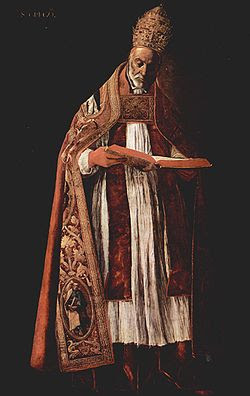
St. Gregory the Great, pope
Died: March 12, 604
Canonized: 604
Feast Day: September 3
Patron Saint of: musicians, students, teachers
Pope Gregory I (Latin: Gregorius I) (c. 540 – 12 March 604), better known in English as Gregory the Great, was pope from 3 September 590 until his death.  Gregory is well known for his writings, which were more prolific than those of any of his predecessors as pope.
He “… is certainly one of the most notable figures in Ecclesiastical History.  He has exercised in many respects a momentous influence on the doctrine, the organization, and the discipline of the Catholic Church. To him we must look for an explanation of the religious situation of the Middle Ages; indeed, if no account were taken of his work, the evolution of the form of medieval Christianity would be almost inexplicable.  And further, in so far as the modern Catholic system is a legitimate development of medieval Catholicism, of this too Gregory may not unreasonably be termed the Father. Almost all the leading principles of the later Catholicism are found, at any rate in germ, in Gregory the Great. (F.H. Dudden, "Gregory the Great", 1, p. v).”
“Gregory's father was Gordianus, a wealthy patrician, probably of the famous gens Amicia, who owned large estates in Sicily and a mansion on the Caelian Hill in Rome, the ruins of which, apparently in a wonderful state of preservation, still await excavation beneath the Church of St. Andrew and St. Gregory.  His mother Silvia appears also to have been of good family, but very little is known of her life. She is honoured as a saint, her feast being kept on 3 November. Portraits of Gordianus and Silvia were painted by Gregory's order, in the atrium of St. Andrew's monastery, and a pleasing description of these may be found in John the Deacon (Vita, IV, lxxxiii).
                “Besides his mother, two of Gregory's aunts have been canonised, Gordianus's two sisters, Tarsilla and Æmiliana, so that John the Deacon speaks of his education as being that of a saint among saints. 
 “Of his early years we know nothing beyond what the history of the period tells us.   Between the years 546 and 552 Rome was first captured by the Goths under Totila, and then abandoned by them; next it was garrisoned by Belisarius, and besieged in vain by the Goths, who took it again, however, after the recall of Belisarius, only to lose it once more to Narses.   
“Of his education, we have no details. Gregory of Tours tells us that in grammar, rhetoric and dialectic he was so skilful as to be thought second to none in all Rome, and it seems certain also that he must have gone through a course of legal studies. Not least among the educating influences was the religious atmosphere of his home. He loved to meditate on the Scriptures and to listen attentively to the conversations of his elders, so that he was "devoted to God from his youth up".
 “Gregory had a deep respect for the monastic life. He viewed being a monk as the 'ardent quest for the vision of our Creator.  'His three paternal aunts were nuns renowned for their sanctity.  However, after the two eldest passed away after seeing a vision of their ancestor Pope Felix, the youngest soon abandoned the religious life and married the steward of her estate. Gregory's response to this family scandal was “many are called but few are chosen."  Gregory's mother Silvia herself is a saint.  On his father's death, he converted his family villa suburbana, located on the Caelian Hill just opposite the Circus Maximus, into a monastery dedicated to the apostle Saint Andrew.   After his death it was rededicated as San Gregorio Magno al Celio.  
In his life of contemplation, Gregory concluded that “in that silence of the heart, while we keep watch within through contemplation, we are as if asleep to all things that are without."   Gregory was not always forgiving, or pleasant for that matter, even in his monastic years.  For example, a monk lying on his death bed confessed to stealing three gold pieces.  Gregory forced the monk to die friendless and alone, then threw his body and coins on a manure heap to rot with a curse, “Take your money with you to perdition”.   Gregory believed that punishment of sins can begin, even on one's deathbed.  Eventually, Pope Pelagius II ordained him a deacon and solicited his help in trying to heal the schism of the Three Chapters in northern Italy.   However, Italy was not healed until well after Gregory was gone.
He became Pope in 590.  During his pontificate, Gregory is credited with re-energizing the Church's missionary work among the non-Christian peoples of northern Europe.   He is most famous for sending a mission, often called the Gregorian mission, under Augustine of Canterbury, prior of Saint Andrew's, where he had perhaps succeeded Gregory, to evangelize the pagan Anglo-Saxons of England. The mission was successful, and it was from England that missionaries later set out for the Netherlands and Germany.   The preaching of the Catholic faith and the elimination of all deviations from it was a key element in Gregory's worldview, and it constituted one of the major continuing policies of his pontificate. 
 In his official documents, Gregory was the first to make extensive use of the term "Servant of the Servants of God" (servus servorum Dei) as a papal title, thus initiating a practice that was to be followed by most subsequent popes.[41]
 Throughout the Middle Ages he was known as “the Father of Christian Worship” because of his exceptional efforts in revising the Roman worship of his day.
                He is also known as St. Gregory the Dialogist in Eastern Orthodoxy because of his Dialogues.   For this reason, English translations of Orthodox texts will sometimes list him as "Gregory Dialogus".  He was the first of the popes to come from a monastic background.  Gregory is a Doctor of the Church and one of the Latin Fathers.  He is considered a saint in the Roman Catholic Church, Eastern Orthodox Church, Anglican Communion, and some Lutheran churches. Immediately after his death, Gregory was canonized in 604, by popular acclaim.  The Protestant reformer, John Calvin, admired Gregory and declared in his Institutes that Gregory was the last good pope.  He is the patron saint of musicians, singers, students, and teachers.
Gregory is certainly one of the most notable figures in Ecclesiastical History.  He has exercised in many respects a momentous influence on the doctrine, the organization, and the discipline of the Catholic Church. To him we must look for an explanation of the religious situation of the Middle Ages; indeed, if no account were taken of his work, the evolution of the form of medieval Christianity would be almost inexplicable.   And further, in so far as the modern Catholic system is a legitimate development of medieval Catholicism, of this too Gregory may not unreasonably be termed the Father.   Almost all the leading principles of the later Catholicism are found, at any rate in germ, in Gregory the Great. (F.H. Dudden, "Gregory the Great", 1, p. v).
“Pope Saint Gregory the Great not only saved the Church, in times so frightful that the men who lived in them were sure that the end of the world was come, but he founded the great civilization which has lasted down to our day and of which we are part, Western Civilization. All alone, in the midst of famine and pestilence, floods and earthquakes, endangered by Greeks and barbarians alike, and abandoned by the Emperor, Pope Gregory, frail and ailing in body but strong and undaunted in spirit, succored and saved his people, his city, his country, and the whole of Christendom.” 
Sacramentaries directly influenced by Gregorian reforms are referred to as Sacrementaria Gregoriana. With the appearance of these sacramentaries, the Western liturgy begins to show a characteristic that distinguishes it from Eastern liturgical traditions.  In contrast to the mostly invariable Eastern liturgical texts, Roman and other Western liturgies since this era have a number of prayers that change to reflect the feast or liturgical season; these variations are visible in the collects and prefaces as well as in the Roman Canon itself.
“Gregory's mind and memory were both exceptionally receptive, and it is to the effect produced on him by these disasters that we must attribute the tinge of sadness which pervades his writings and especially his clear expectation of a speedy end to the world.”
Gregory is commonly accredited with founding the medieval papacy and so many attribute the beginning of medieval spirituality to him.[44] Gregory is the only Pope between the fifth and the eleventh centuries whose correspondence and writings have survived enough to form a comprehensive corpus. Some of his writings are:
·         Sermons (forty on the Gospels are recognized as authentic, twenty-two on Ezekiel, two on the Song of Songs)
·         Dialogues, a collection of miracles, signs, wonders, and healings including the popular life of Saint Benedict[45]
·         Commentary on Job, frequently known even in English-language histories by its Latin title, Magna Moralia
·         The Rule for Pastors, in which he contrasted the role of bishops as pastors of their flock with their position as nobles of the church: the definitive statement of the nature of the episcopal office
·         Copies of some 854 letters have survived, out of an unknown original number recorded in Gregory's time in a register. It is known to have existed in Rome, its last known location, in the 9th century. It consisted of 14 papyrus rolls, now missing. Copies of letters had begun to be made, the largest batch of 686 by order of Adrian I. The majority of the copies, dating from the 10th to the 15th century, are stored in the Vatican Library.
                                        http://catholicism.org/gregory-great.htm
                                        http://www.newadvent.org/cathen/06780a.htm

Writings of Saint Gregory the Great, pope


St. Gregory the Great, Pope and the Holy Spirit
Saint Gregory the Great, pope
From the Moral Reflections on Job
The law of the Lord is manifold
                How must we interpret this law of God?  How, if not by love?  The love that stamps the precepts of right-living on the mind and bids us put them into practice.  Listen to Truth speaking of this law:  This is my commandment, that you love one another. Listen to Paul:  The whole law, he declares, is summed up in love; and again:  Help one another in your troubles, and you will fulfill the law of Christ.  The law of Christ—does anything other than love more fittingly describe it?  Truly we are keeping this law when, out of love, we go to the help of a brother in trouble.
                But we are told that this law is manifold.  Why?  Because love’s lively concern for others is reflected in all the virtues.  It begins with two commands, but it soon embraces many more.  Paul gives a good summary of its various aspects.  Love is patient, he says, and kind; it is never jealous or conceited; its conduct is blameless; it is not ambitious, not selfish, not quick to take offense; it harbors no evil thoughts, does not gloat over other people’s sins, but is gladdened by an upright life. 
                The man ruled by this love shows his patience by bearing wrongs with equanimity; his kindness by generously repaying good for evil.  Jealously is foreign to him.  It is impossible to envy worldly desires.  He is not conceited.  The prizes he covets lie within; outward blessings do not elate him.  His conduct is blameless, for he cannot do wrong in devoting himself entirely to love of God and his neighbor.  He is not ambitious.  The welfare of his own soul is what he cares about.  Apart from that he seeks nothing. He is not selfish.  Unable to keep anything he has in this world, he is as indifferent to it as if it were another’s.  Indeed, in his eyes nothing is his own but what will be so always.  He is not quick to take offense.  Even under provocation, thought of revenge never crosses his mind.  The reward he seeks hereafter will be greater in proportion to his endurance.  He harbors no evil thoughts.  Hatred is utterly rooted out of a heart whose only love is goodness.  Thoughts that defile a man can find no entry.  He does not gloat over other people’s sins.  No; an enemy’s fall affords him no delight, for loving all men, he longs for their salvation.
                On the other hand, he is gladdened by an upright life.  Since he loves others as himself, he takes as much pleasure in whatever good he sees in them as if the progress were his own.  That is why this law of God is manifold.


Taken from the Liturgy of the Hours, According to the Roman Rite, Ordinary Time, Catholic Book Publishing Corp.  New York, 1975