Ad

Showing posts with label Catholic Sacrament. Show all posts

Thursday, 6 April 2017

Tell the World the GOOD NEWS

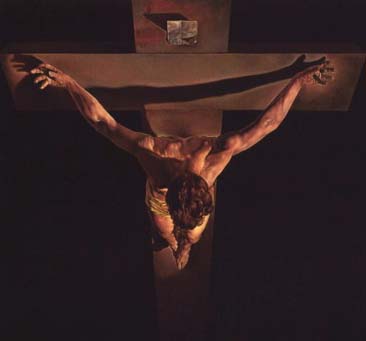
The Crucifixion of Christ


From the Moral Reflections on Job 
by Saint Gregory the Great, pope

The mystery of our new life in Christ

Holy Job is a type of the Church.  At one time he speaks for the body, at another for the head.  As he speaks of its members he is suddenly caught up to speak in the name of their head.  So it is here, where he says: I have suffered this without sin on my hands, for my prayer to God was pure.

Christ suffered without sin on His hands, for He committed no sin and deceit was not found on His lips.  Yet He suffered the pain of the cross for our redemption.  His prayer to God was pure, His alone out of all mankind, for in the midst of His suffering He prayed for His persecutors: Father, forgive them, for they do not know what they are doing.

Is it possible to offer, or even to imagine, a purer kind of prayer than that which shows mercy to one’s torturers by making intercession for them?  It was thanks to this kind of prayer that the frenzied persecutors who shed the blood of the Redeemer drank it afterward in faith and proclaimed Him to be the Son of God.

The text goes on fittingly to speak of Christ’s blood: Earth, do not cover over my blood, do not let my cry find a hiding place in you.  When man sinned, God had said: Earth you are, and to earth you will return.  Earth does not cover over the blood of the Redeemer, for every sinner, as he drinks the Blood that is the price of his redemption, offers praise and thanksgiving, and to the best of his power makes that Blood known to all around him.
Earth has not hidden away His blood, for holy Church has preached in every corner of the world the mystery of its redemption.

Blood of Christ
Notice what follows: Do not let my cry find a hiding place in you.  The Blood that is drunk, the Blood of redemption, is itself the cry of our Redeemer.  Paul speaks of the sprinkled blood that calls out more eloquently than Abel’s.  Of Abel’s blood Scripture had written: The voice of your brother’s blood cries out to me from the earth.  

The Blood of Jesus 
calls out more eloquently than Abel’s, 
for the blood of Abel asked 
for the death of Cain the fratricide, 

while the Blood of the Lord 
has asked for, and obtained, 
life for His persecutors.


If the sacrament of the Lord’s Passion is to work its effect in us, we must imitate what we receive and proclaim to mankind what we revere.  The cry of the Lord finds a hiding place in us if our lips fail to speak of this, though our hearts believe in it.  So that His cry may not lie concealed in us it remains for us all, each in his own measure, to make known to those around us the mystery of our new life in Christ.

Friday, 9 May 2014

EUCHARIST -- Unless You Eat My Flesh and Drink My Blood


From a sermon by Saint Gaudentius of Brescia, bishop
The inheritance of the new covenant


The heavenly sacrifice, instituted by Christ, is the most gracious legacy of his new covenant. On the night he was delivered up to be crucified he left us this gift as a pledge of his abiding presence.
 
This sacrifice is our sustenance on life’s journey; by it we are nourished and supported along the road of life until we depart from this world and make our way to the Lord. For this reason he addressed these words to us:
 
Unless you eat my flesh and drink my blood,
you will not have life in you.

It was the Lord’s will that his gifts should remain with us, and that we who have been redeemed by his precious blood should constantly be sanctified according to the pattern of his own passion.
 
Christ's Sacrifice at Holy Mass
And so he commanded those faithful disciples of his whom he made the first priests of his Church to enact these mysteries of eternal life continuously. All priests throughout the churches of the world must celebrate these mysteries until Christ comes again from heaven. Therefore let us all, priests and people alike, be faithful to this everlasting memorial of our redemption.
 
Daily it is before our eyes as a representation of the passion of Christ. We hold it in our hands, we receive it in our mouths, and we accept it in our hearts.
 
It is appropriate that we should receive the body of Christ in the form of bread, because, as there are many grains of wheat in the flour from which bread is made by mixing it with water and baking it with fire, so also we know that many members make up the one body of Christ which is brought to maturity by the fire of the Holy Spirit.
 
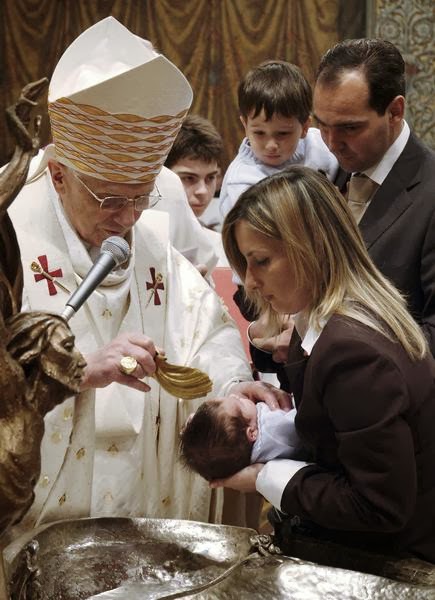
Jesus' Baptism
Christ was born of the Holy Spirit, and since it was fitting that he should fulfill all justice, he entered into the waters of baptism to sanctify them. When he left the Jordan he was filled with the Holy Spirit who had descended upon him in the form of a dove.
 
As the evangelist tells us: Jesus, full of the Holy Spirit, returned from the Jordan.
 
Similarly, the wine of Christ’s blood, drawn from the many grapes of the vineyard that he had planted, is extracted in the winepress of the cross. When men receive it with believing hearts, like capacious wineskins, it ferments within them by its own power.

And so, now that you have escaped from the power of Egypt and of Pharaoh, who is the devil, join with us, all of you, in receiving this sacrifice of the saving passover with the eagerness of dedicated hearts. Then in our inmost being we shall be wholly sanctified by the very Lord Jesus Christ whom we believe to be present in his sacraments, and whose boundless power abides for ever.


Thursday, 16 January 2014

Baptism the Great Sacrament


We celebrated the Feast of the Baptism of the Lord last Sunday.  Baptism is one of the most important Sacraments …actually needed to receive the other Sacraments of the Church.   

I wanted to write something regarding this great Sacrament, what I have learned—what the Church says about it and why it’s so important.

The first question that comes to mind is WHY DID JESUS HAVE TO BE BAPTIZED?   


The Catechism of the Catholic Church states “Our Lord voluntarily submitted himself to the baptism of St. John, intended for sinners, in order to "fulfill all righteousness."19 Jesus' gesture is a manifestation of his self-emptying.20 The Spirit who had hovered over the waters of the first creation descended then on the Christ as a prelude of the new creation, and the Father revealed Jesus as his "beloved Son."21”


Okay, what does that mean--exactly?  I had often wondered about this same question over the years and have discovered through my research an answer that made it easier to understand so I thought that I would share my findings with you. 

"…. Christ is baptized, not that he may be sanctified in the waters, but that he himself may sanctify the waters, and by his own purification may purify those streams which he touches.”
"For the consecration of Christ is the greater consecration of another element.  For when the Savior is washed, then already for our baptism all water is cleansed and the fount purified, that the grace of the laver may be administered to the peoples that come after.  Christ therefore takes the lead in baptism, so that Christian peoples may follow after him with confidence."  (St. Maximus of Turin, 423) Excerpts from:  http://www.catholic.org/hf/faith/story.php?id=44333AD

“…In submitting Himself humbly to the baptism of St. John the Baptist, however, Christ provided the example for the rest of us.  If even He should be baptized, though He had no need of it, how much more should the rest of us be thankful for this sacrament, which frees us from the darkness of sin and incorporates us into the Church, the life of Christ on earth! His Baptism, therefore, was necessary--not for Him, but for us.

Many of the Fathers of the Church, as well as the medieval Scholastics, saw Christ's Baptism as the institution of the sacrament. His Flesh blessed the water, and the descent of the Holy Spirit (in the form of a dove) and the voice of God the Father announcing that this was His Son, in Whom He was well pleased, marked the beginning of Christ's public ministry.” http://catholicism.about.com/od/holydaysandholidays/p/Baptism_of_Lord.htm

Here are the Readings for this Feast of the Baptism of the Lord:


Isaiah 42:1-4, 6-7, or Isaiah 40:1-5, 9-11; 
Psalm 29:1-2, 3-4, 3, 9-10, or Psalm 104:1b-2, 3-4, 24-25, 27-28, 29-30; 
Acts 10:34-38 or Titus 2:11-14; 3:4-7; 
Luke 3:15-16, 21-22


“What a wonderful God is our God” as Mother Angelica has said… Yes, He IS wonderful!!  


Let me now share with you more about this sacrament—it’s definition and it’s effects on the soul.


1213 Holy Baptism is the basis of the whole Christian life, the gateway to life in the Spirit (vitae spiritualis ianua),4 and the door which gives access to the other sacraments. Through Baptism we are freed from sin and reborn as sons of God; we become members of Christ, are incorporated into the Church and made sharers in her mission: "Baptism is the sacrament of regeneration through water in the word."5 Catechism of the Catholic Church,  http://www.vatican.va/archive/ccc_css/archive/catechism/p2s2c1a1.htm


Pope Francis had this to say about the Sacrament.  “This sacrament constitutes a true immersion in the death of Christ, to rise with him in a new life. It is a bath of regeneration by water and the Spirit and that illuminates us with the grace of Christ,” the Pope expressed in his Nov. 13 (2013) address.  Read more: http://www.ncregister.com/daily-news/pope-francis-baptism-is-a-bath-of-regeneration#ixzz2qaYokoFq


The Effects of the Sacrament of Baptism:

Baptism has six primary effects, which are all supernatural graces:

1. The removal of the guilt of both Original Sin (the sin imparted to all mankind by the Fall of Adam and Eve in the Garden of Eden) and personal sin (the sins that we have committed ourselves).

2. The remission of all punishment that we owe because of sin, both temporal (in this world and in Purgatory) and eternal (the punishment that we would suffer in hell).

3.  The infusion of grace in the form of sanctifying grace (the life of God within us); the seven gifts of the Holy Spirit; and the three theological virtues.(see below)

4.  Becoming a part of Christ.

5.  Becoming a part of the Church, which is the Mystical Body of Christ on earth.

6.  Enabling participation in the sacraments, the priesthood of all believers, and the growth in grace.

The Catechism of the Catholic Church notes, "They (the 7 Gifts of the Holy Spirit) complete and perfect the virtues of those who receive them." When we are infused with the gifts of the Holy Spirit, we respond to the promptings of the Holy Spirit as if by instinct...

1. Wisdom ~ Not from Books...


 The Wisdom that we receive through the Sacrament of Baptism is not one to help us with science, chemistry, math.... It's a more profound Wisdom of  the Spirit....

Wisdom is the perfection of faith. As Fr. John A. Hardon, S.J., notes in his Modern Catholic Dictionary, "Where faith is a simple knowledge of the articles of Christian belief, wisdom goes on to a certain divine penetration of the truths themselves." ... Thus wisdom, the Catholic Encyclopedia notes, "by detaching us from the world, makes us relish and love only the things of heaven." Through wisdom, we judge the things of the world in light of the highest end of man—the contemplation of God.

Such detachment, however, is not the same as renunciation of the world—far from it. Rather, wisdom helps us to love the world properly, as the creation of God, rather than for its own sake. The material world, though fallen as a result of the sin of Adam and Eve, is still worthy of our love; we simply need to see it in the proper light, and wisdom allows us to do so.
 Knowing the proper ordering of the material and spiritual worlds through wisdom, we can more easily bear the burdens of this life and respond to our fellow man with charity and patience. http://catholicism.about.com/od/beliefsteachings/p/Wisdom.htm


2. Understanding ~ of the Divine

Understanding is the second gift of the Holy Spirit, behind only wisdom. ...Wisdom is the desire to contemplate the things of God, while understanding allows us,... become certain of the truth of the doctrine of the Trinity. Such certitude moves beyond faith, which "merely assents to what God has revealed."


Understanding rises above natural reason, which is concerned only with the things we can sense in the world around us. Thus, understanding is both speculative—concerned with intellectual knowledge—and practical, because it can help us to order the actions of our lives toward our final end, which is God. Through understanding, we see the world and our life within it in the larger context of the eternal law and the relation of our souls to God. 
http://catholicism.about.com/od/beliefsteachings/p/Understanding.htm


3. Counsel ~ Choosing Correctly


Counsel is the perfection of the cardinal virtue of prudence...Counsel allows us to judge rightly what we should do in a particular circumstance. It goes beyond prudence, though, in allowing such judgments to be made promptly, "as by a sort of supernatural intuition," as Fr. John A. Hardon writes in his Modern Catholic Dictionary. ..."With the gift of counsel, the Holy Spirit speaks, as it were, to the heart and in an instant enlightens a person what to do," writes Father Hardon. It is the gift that allows us as Christians to be assured that we will act correctly in times of trouble and trial. Through counsel, we can speak without fear in defense of the Christian Faith. Thus, the Catholic Encyclopedia notes, counsel "enables us to see and choose correctly what will help most to the glory of God and our own salvation."...
4. Fortitude 

Fortitude is commonly called courage, but it is different from what much of what we think of as courage today. Fortitude is always reasoned and reasonable; the person exercising fortitude is willing to put himself in danger if necessary, but he does not seek danger for danger's sake.
Fortitude is the virtue that allows us to overcome fear and to remain steady in our will in the face of obstacles. Prudence and justice are the virtues through which we decide what needs to be done; fortitude gives us the strength to do it.
It also shows itself, as the Catholic Encyclopedia notes, "in moral courage against the evil spirit of the times, against improper fashions, against human respect, against the common tendency to seek at least the comfortable, if not the voluptuous." Fortitude is the virtue of the martyrs, who are willing to give their lives rather than to renounce their faith. That sacrifice may be passive—Christian martyrs do not actively seek martyrdom—but it is nonetheless determined and resolute.
7. Knowledge

Knowledge allows us to see the circumstances of our life as God sees them, albeit in a more limited way, since we are limited by our human nature. Through the exercise of knowledge, we can ascertain God's purpose in our lives and His reason for placing us in our particular circumstances...
"it enables those who have the gift to discern easily and effectively between the impulses of temptation and the inspirations of grace." Judging all things in the light of divine truth, we can more easily distinguish between the promptings of God and the subtle wiles of the devil.
6. Piety - A Gift of the Holy Spirit

Fr. John A. Hardon, S.J., notes in his Modern Catholic Dictionary, is "The moral virtue by which a person is disposed to render to God the worship and service he deserves." Far from being a drudgery, worship should be an act of love, and piety is the instinctive affection for God that makes us desire to render worship to Him, just as we voluntarily honor our parents... It instills in us a desire always to do that which is pleasing to God..."
http://catholicism.about.com/od/beliefsteachings/p/Piety.htm


7. Fear of the Lord


The fear of the Lord is the desire not to offend Him, and the certainty that He will give us the grace necessary to keep from doing so. It is that certainty that gives us hope.
The fear of the Lord is like the respect we have for our parents. We do not wish to offend them, but we also do not live in fear of them, in the sense of being frightened...it is not a fear of punishment, but a desire not to offend God that parallels our desire not to offend our parents... the fear of the Lord is the beginning of wisdom because it is one of the foundations of our religious life,
http://catholicism.about.com/od/beliefsteachings/p/Fear_of_the_Lord.htm


The Three Theological Virtues

FAITH, HOPE AND CHARITY (LOVE) 


"A virtue is an habitual and firm disposition to do the good. It allows the person not only to perform good acts, but to give the best of himself. The virtuous person tends toward the good with all his sensory and spiritual powers; he pursues the good and chooses it in concrete actions.

The goal of a virtuous life is to become like God.63 "
 http://www.vatican.va/archive/ccc_css/archive/catechism/p3s1c1a7.htm
 
Unlike the cardinal virtues, which can be practiced by anyone, the theological virtues are gifts of grace from God, and the object of the virtues—what the practice of the virtue aims at—is God Himself.
 "1813 The theological virtues are the foundation of Christian moral activity; they animate it and give it its special character. They inform and give life to all the moral virtues. They are infused by God into the souls of the faithful to make them capable of acting as his children and of meriting eternal life. They are the pledge of the presence and action of the Holy Spirit in the faculties of the human being. There are three theological virtues: faith, hope, and charity.77" 
FAITH

Faith is the theological virtue by which we believe in God and believe all that he has said and revealed to us, and that Holy Church proposes for our belief, because he is truth itself. By faith "man freely commits his entire self to God."78 For this reason the believer seeks to know and do God's will. "The righteous shall live by faith." Living faith "work[s] through charity."79
1815 The gift of faith remains in one who has not sinned against it.80 But "faith apart from works is dead":81 when it is deprived of hope and love, faith does not fully unite the believer to Christ and does not make him a living member of his Body.
1816 The disciple of Christ must not only keep the faith and live on it, but also profess it, confidently bear witness to it, and spread it: "All however must be prepared to confess Christ before men and to follow him along the way of the Cross, amidst the persecutions which the Church never lacks."82 Service of and witness to the faith are necessary for salvation: "So every one who acknowledges me before men, I also will acknowledge before my Father who is in heaven; but whoever denies me before men, I also will deny before my Father who is in heaven."83

 
HOPE 
"Hope is the theological virtue by which we desire the kingdom of heaven and eternal life as our happiness, placing our trust in Christ's promises and relying not on our own strength, but on the help of the grace of the Holy Spirit. "Let us hold fast the confession of our hope without wavering, for he who promised is faithful."84 "The Holy Spirit . . . he poured out upon us richly through Jesus Christ our Savior, so that we might be justified by his grace and become heirs in hope of eternal life."85
1818 The virtue of hope responds to the aspiration to happiness which God has placed in the heart of every man; it takes up the hopes that inspire men's activities and purifies them so as to order them to the Kingdom of heaven; it keeps man from discouragement; it sustains him during times of abandonment; it opens up his heart in expectation of eternal beatitude. Buoyed up by hope, he is preserved from selfishness and led to the happiness that flows from charity...
"...We can therefore hope in the glory of heaven promised by God to those who love him and do his will.92 In every circumstance, each one of us should hope, with the grace of God, to persevere "to the end"93 and to obtain the joy of heaven, as God's eternal reward for the good works accomplished with the grace of Christ. In hope, the Church prays for "all men to be saved."94 She longs to be united with Christ, her Bridegroom, in the glory of heaven..."
CHARITY

Charity is the theological virtue by which we love God above all things for his own sake, and our neighbor as ourselves for the love of God.
1823 Jesus makes charity the new commandment.96 By loving his own "to the end,"97 he makes manifest the Father's love which he receives. By loving one another, the disciples imitate the love of Jesus which they themselves receive. Whence Jesus says: "As the Father has loved me, so have I loved you; abide in my love." And again: "This is my commandment, that you love one another as I have loved you."98
1824 Fruit of the Spirit and fullness of the Law, charity keeps the commandments of God and his Christ: "Abide in my love. If you keep my commandments, you will abide in my love."99
1825 Christ died out of love for us, while we were still "enemies."100 The Lord asks us to love as he does, even our enemies, to make ourselves the neighbor of those farthest away, and to love children and the poor as Christ himself.101

Excerpts from the Catechism of the Catholic Church
http://www.vatican.va/archive/ccc_css/archive/catechism/p3s1c1a7.htm


Wednesday, 31 October 2012

Prayer for the Eucharist by St. Faustina


O Blessed Host, in golden chalice 
enclosed for me,
That through the vast 
wilderness of exile
I may pass 
pure, immaculate, undefiled;
Oh, grant that through the power 
of Your love
this might come to be.

O Blessed Host, take up 
Your dwelling within my soul,
O Thou my heart's purest love!

With Your brilliance the darkness dispel.
Refuse not Your grace to a humble heart.

O Blessed Host, enchantment of all heaven.
Though Your beauty be veiled
And captured in a crumb of bread,
Strong faith tears away that veil.
 Prayer of St. Faustina


All Saint's Day--All Soul's Day


All Saints' Day
November 1

All Saints Day, the day on which Catholics celebrate all the saints, known and unknown, is a surprisingly old feast. It arose out of the Christian tradition of celebrating the martyrdom of saints on the anniversary of their martyrdom. When martyrdoms increased during the persecutions of the late Roman Empire, local dioceses instituted a common feast day in order to ensure that all martyrs, known and unknown, were properly honored.

 The current date of November 1 was instituted by Pope Gregory III (731-741), when he consecrated a chapel to all the martyrs in St. Peter's Basilica in Rome and ordered an annual celebration. This celebration was originally confined to the diocese of Rome, but Pope Gregory IV (827-844) extended the feast to the entire Church and ordered it to be celebrated on November 1.

The vigil or eve of the feast, October 31, is commonly known as All Hallows Eve, or Halloween. Despite concerns among some Christians (including some Catholics) in recent years about the "pagan origins" of Halloween (see Halloween, Jack Chick, and Anti-Catholicism), the vigil was celebrated from the beginning—long before Irish practices, stripped of their pagan origins (just as the Christmas tree was stripped of similar connotations), were incorporated into popular celebrations of the feast.
Excerpts taken from: 
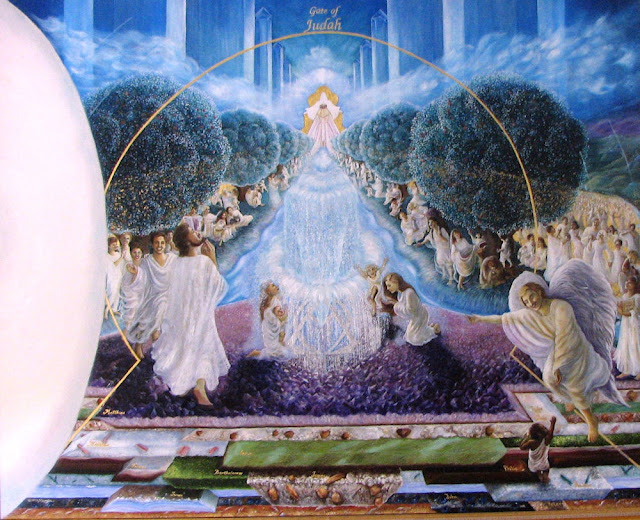

Vision of heaven, the New Jerusalem
All Saints' Day (in the Roman Catholic Church officially the Solemnity of All Saints and also called All Hallows or Hallowmas), often shortened to All Saints, is a solemnity celebrated on the First of November by parts of Western Christianity, and on the first Sunday after Pentecost in Eastern Christianity, in honour of all the saints, known and unknown. In the Western calendar it is the day after Halloween and the day before All Souls' Day.
 

In Western Christian theology, the day commemorates all those who have attained the beatific vision in Heaven. It is a national holiday in many historically Catholic countries. In the Catholic Church and many Anglican churches, the next day specifically commemorates the departed faithful who have not yet been purified and reached heaven. 


All Saints' Day at a cemetery in 
Sanok, Poland - flowers and lighted candles  honor the memory of deceased relatives. 


Christians who celebrate All Saints' Day and All Souls' Day do so in the fundamental belief that there is a prayerful spiritual bond between those in purgatory (the 'Church Suffering'), those in heaven (the 'Church triumphant'), and the living (the 'Church militant'). Other Christian traditions define, remember and respond to the saints in different ways; for example, in the Methodist Church, the word "saints" refers to all Christians and therefore, on All Saints' Day, the Church Universal, as well as the deceased members of a local congregation, are honoured and remembered.


Homily for the Solemnity of All Saints
By Fr Munachi Ezeogu, cssp

Why is it necessary to celebrate the feast of all saints? All year round we are celebrating feasts of saints: Thomas Aquinas, January 28; Augustine of Hippo, August 28; Theresa of Lisieux, October 1, etc. Why then is it necessary to set apart a day to celebrate the feast of all saints? I can think of two important reasons.

1. Beside the handful of saints whose feast days we celebrate on specific days in the year, there are countless other saints and martyrs, men, women and children united with God in the heavenly glory whom we do not celebrate. Many of these would be our own parents and grand-parents who were heroic women and men of faith. Today we keep their honourable memory. In many ways, therefore, today's feast can be called the feast of the Unknown Saint, in line with the tradition of the Unknown Soldier. We celebrate what the first reading calls "a great multitude that no one could count, from every nation, from all tribes and peoples and languages, standing before the throne and before the Lamb, robed in white, with palm branches in their hands" (Rev 7:9).
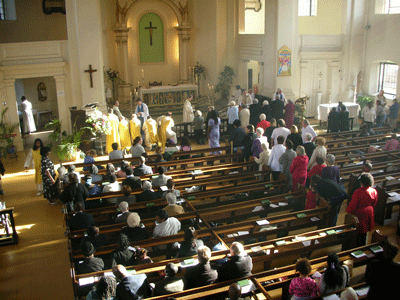
All Saints Day Mass
2. This celebration gives us a peek into our eternal destiny. The saints we celebrate were men and women like us. Where we are now they used to be, and where they are now we hope to be someday. As Christians we know that a person's life story is not limited to what happens to them between the day they are born and the day they die. Our story starts before we are born, at our conception, and goes beyond the day we die, to all eternity. That is why we do not simply forget people after they die. Didn't St Theresa of Lisieux say that she would spend eternity doing good on earth? In our mortal eyes she is dead and gone. But in the eyes of faith we know that she is alive now more than ever, because she is now fully alive in God. She is now more alive than we are because the life she now enjoys can no longer be diminished by suffering, disease and sin, or death.

Unfortunately, our reaching the fullness of life with the saints does not happen automatically. "Not everyone who says to me, 'Lord, Lord,' will enter the kingdom of heaven, but only the one who does the will of my Father in heaven" (Matthew 7:21). How do we live a life of doing the will of our heavenly Father? The answer is given us in today's gospel, the Beatitudes, where Jesus gives his followers a road map to a happy eternity. All the saints we celebrate today walked the hard and narrow path of the Beatitudes to arrive at heavenly bliss. On the feast of All Saints the church invites us and challenges us to walk the walk, not just to talk the talk, of the saints.

The Beatitudes propose to us a way of life, inviting us to identify with the poor, those who mourn, the meek, and those who hunger and thirst after justice. They challenge us to be compassionate people, to be men and women who are pure in heart, and to become the peacemakers in our dealings with one another, in our families and in the society at large, even when this approach to things exposes us to ridicule and persecution. None of the saints we celebrate today had it as their aim in life to amass wealth, to acquire power or to gain popularity. Rather they looked forward to the eternal reward which God gives to his faithful ones at the end of this short earthly life of illusion.
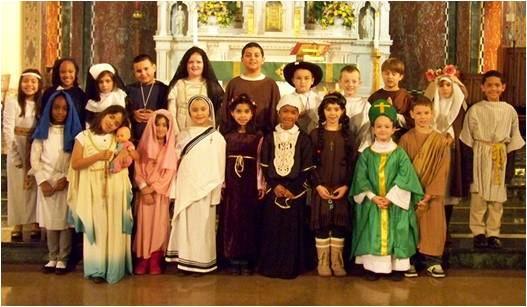
Children dressed as their favorite Saint
Today we are invited to walk the path of the saints, the way of the Beatitudes. The way is narrow and hard. We need faith and courage to walk it. The example of the saints and their prayers encourage us and help us on. St Augustine found it hard to live the Beatitudes, but when he read the lives of the saints he said, "What these ordinary women and men have done, why not me?" Why not? Faith assures us all who heed the call of Jesus and live the life of the Beatitudes that at the end of life we shall, together with all the saints, hear the consoling words of the Lord, "Well done, good and faithful servant, enter into the joys of your master" (Matthew 25:21).

Thankyou, Fr Munachi Ezeogu   http://www.munachi.com/z/allsaints.htm


All Souls' Day November 2

In Western Christianity, this day is observed principally in the Catholic Church, although some churches of Anglican Communion and the Old Catholic Churches also celebrate it. The Eastern Orthodox Church observes several All Souls' Days during the year. 

The Roman Catholic celebration is associated with the doctrine that the souls of the faithful who at death have not been cleansed from the temporal punishment due to venial sins and from attachment to mortal sins cannot immediately attain the beatific vision in heaven, and that they may be helped to do so by prayer and by the sacrifice of the Mass. 


In other words, when they died, they had not yet attained full sanctification and moral perfection, a requirement for entrance into Heaven. This sanctification is carried out posthumously in Purgatory.
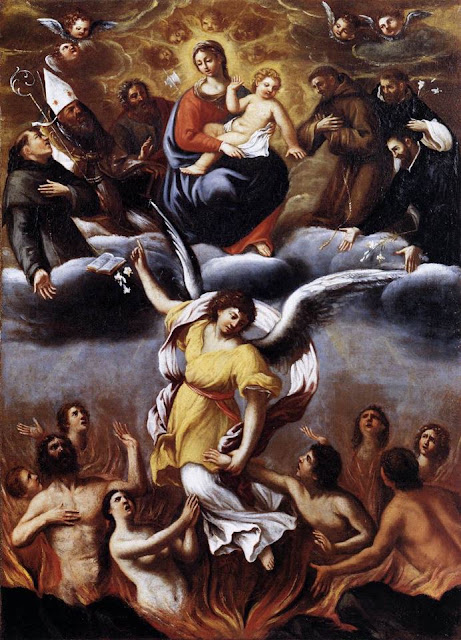

Souls in Purgatory Angels assisting them through the Graces of Mary Mother of God
Among continental Protestants its tradition has been more tenaciously maintained. Even Luther's influence was not sufficient to abolish its celebration in Saxony during his lifetime; and, though its ecclesiastical sanction soon lapsed even in the Lutheran Church, its memory survives strongly in popular custom. Just as it is the custom of French people, of all ranks and creeds, to decorate the graves of their dead on the jour des morts, so German , Polish and Hungarian people stream to the graveyards once a year with offerings of flowers and special grave lights. Among Czech people the custom of visiting and tidying graves of relatives on the day is quite common even among atheists. In North America, however, most Protestant acknowledgment of the holiday is generally secular, celebrated in the form of Halloween festivities.


All Soul's Night Irish Folklore
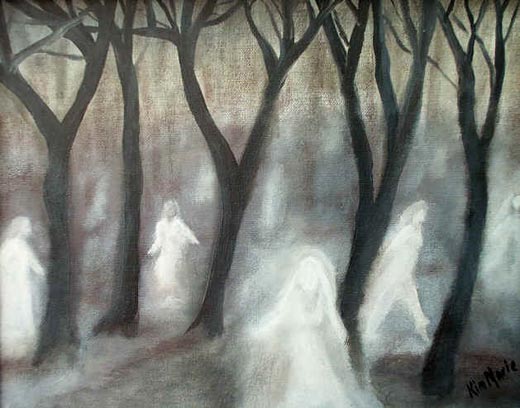
Souls of the Dead wandering on All Soul's Night

All Soul's Night is when the walls between the worlds grow thin and spirits of the underworld walk the Earth.

On All Soul's Night a Rosary of fifteen decades was said, and food and drink were left on the kitchen table during the night for the departed souls of the family, who, it was believed, returned on this night. Mashed potatoes and spirits, such as poteen, were the normal offerings on such occasions. The people generally believed that the spirits of the dead remained in the household until twelve noon on the following day.

It was the custom on this night to sweep the kitchen floor carefully and put on a good fire to welcome the souls of dead relatives who were still in Purgatory. On the following morning the discerning eye could see the mark of feet in the ashes. If the footprints indicated a person facing the fire all was well but if they pointed towards the door a death would take place in the family during the coming year.
http://www.movilleinishowen.com/history/folklore/all_souls_night.htm


          There is a Mexican saying that we die three deaths: 

the first when our bodies die, 
the second when our bodies are 
lowered into the earth out of sight, and 
the third when our loved ones forget us. 

Catholics forestall that last death by seeing the faithful dead as members of the Church, alive in Christ, and by praying for them -- and asking their prayers for us -- always. 


Cardinal Wiseman wrote in his Lecture XI:
"Sweet is the consolation of the dying man, who, conscious of imperfection, believes that there are others to make intercession for him, when his own time for merit has expired; soothing to the afflicted survivors the thought that they possess powerful means of relieving their friend.

In the first moments of grief, this sentiment will often overpower religious prejudice, cast down the unbeliever on his knees beside the remains of his friend and snatch from him an unconscious prayer for rest; it is an impulse of nature which for the moment, aided by the analogies of revealed truth, seizes at once upon this consoling belief. But it is only a flitting and melancholy light, while the Catholic feeling, cheering though with solemn dimness, resembles the unfailing lamp, which the piety of the ancients is said to have hung before the sepulchres of their dead."
Though we should daily pray for the dead in Purgatory, above all for our ancestors, today is especially set aside for hanging that "unfailing lamp before the sepulchres of our dead" as we are told to do by Sacred Scripture:

"And making a gathering, [Judas] sent twelve thousand drachms of silver to Jerusalem for sacrifice to be offered for the sins of the dead, thinking well and religiously concerning the resurrection,

(For if he had not hoped that they that were slain should rise again, it would have seemed superfluous and vain to pray for the dead,)

And because he considered that they who had fallen asleep with godliness, had great grace laid up for them. It is therefore a holy and wholesome thought to pray for the dead, that they may be loosed from sins."
II Maccabees 12: 43-46 
Book of Maccabees 12: 43-46

At the three Masses offered today, the glorious Sequence "Dies Irae" (also used in Requiem Masses, i.e., Masses for the Dead) will be recited after the Epistle, Gradual, and Tract ("Dies Irae" means "Day of Wrath").

Between Noon of November 1 and Midnight tonight, a person who has been to confession and Communion can gain a plenary indulgence, under the usual conditions, for the poor souls each time he visits a church or public oratory and recites the Our Father, the Hail Mary and the Glory be to the Father six times. This is a special exception to the ordinary law of the Church according to which a plenary indulgence for the same work can be gained only once a day. Because of this, some of the customs described below may be begun on All Saints Day.

Also, the faithful who, during the period of eight days from All Saints Day, visit a cemetery and pray for the dead may gain a plenary indulgence, under the usual conditions, on each day of the Octave, applicable only to the dead. 
 

Catholics also pray this prayer for the dead anytime throughout the year, and whenever they pass a cemetery. 


Many families pray a Rosary nightly for the dead throughout the Octave of All Saints, replacing the Fatima prayer with the Eternal Rest prayer...

 Here is a simple invocation for the dead, called the "Eternal Rest" prayer:
Eternal rest grant unto him/her (them), O Lord; and let perpetual light shine upon him/her (them). May he/she (they) rest in peace. Amen.

Latin version:
Réquiem ætérnam dona ei (eis) Dómine; et lux perpétua lúceat ei (eis). Requiéscat (Requiéscant) in pace. Amen.

Customs

It is practically universal folk belief that the souls in Purgatory are allowed to return to earth on All Souls Day. In Austria, they are said to wander the forests, praying for release. In Poland, they are said to visit their parish churches at midnight, where a light can be seen because of their presence. Afterward, they visit their families, and to make them welcome, a door or window is left open. In many places, a place is set for the dead at supper, or food is otherwise left out for them. In any case, throughout the Octave of All Saints, our beloved dead Flores para los muertosshould be remembered, commemorated, and prayed for.

 During our visits to their graves, we spruce up their resting sites, sprinkling them with holy water, leaving votive candles, and adorning them flowers (especially chrysanthemums and marigolds) to symbolize the Eden-like paradise that man was created to enjoy, and may, if saved, enjoy after death and any needed purgation.

Today is a good day to not only remember the dead spiritually, but to tell your children about their ancestors. Bring out those old photo albums and family trees! Write down your family's stories for your children and grandchildren! Impress upon them the importance of their ancestors! Bring to their minds these words from Ecclesiasticus:


 Let us now praise men of renown, 
and our fathers in their generation. 
The Lord hath wrought great glory 
through his magnificence from the beginning. 
Such as have borne rule in their dominions, 
men of great power, and endued with their wisdom, 
shewing forth in the prophets the dignity of prophets, 
And ruling over the present people, 
and by the strength of wisdom instructing 
the people in most holy words. 
Such as by their skill sought out musical tunes, 
and published canticles of the scriptures. 
Rich men in virtue, studying beautifulness: 
living at peace in their houses. 
All these have gained glory in their generations, 
and were praised in their days. 
They that were born of them have 
left a name behind them,
that their praises might be related:


 And there are some, of whom there is no memorial: 
who are perished, as if they had never been: 
and are become as if they had never been born, 
and their children with them. 

But these were men of mercy, 
whose godly deeds have not failed: 
Good things continue with their seed, 
Their posterity are a holy inheritance, 
and their seed hath stood in the covenants.
 And their children for their sakes remain for ever: 
their seed and their glory shall not be forsaken. 
Their bodies are buried in peace, 
and their name liveth unto generation and generation. 
Let the people shew forth their wisdom, 
and the Church declare their praise.
Ecclesiasticus 44:1-15

Excerpts taken from  

 Stories of the dead --

"As Saint Augustine saith: Sometimes souls be punished in the places where they have sinned, as appeareth by an ensample that Saint Gregory reciteth in the fourth book of his Dialogues, and saith that there was a priest which used gladly a bath, and when he came in to the bath he found a man whom he knew always ready for to serve him.

And it happened on a day, that for his diligent service and his reward, the priest gave to him a holy loaf.   And he weeping, answered: Father, wherefore givest thou me this thing? I may not eat it for it is holy. I was sometime lord of this place, but after my death, I was deputed for to serve here for my sins, but I pray thee that thou wilt offer this bread unto Almighty God for my sins, and know thou for certain that thy prayer shall be heard, and when then thou shalt come to wash thee, thou shalt not find me. And then this priest offered a week entire sacrifice to God for him, and when he came again he found him not."