Showing posts with label St. Michael the Archangel. Show all posts
Showing posts with label St. Michael the Archangel. Show all posts
Thursday, 24 February 2022


Tuesday, 1 February 2022
Monday, 31 January 2022
Saturday, 29 January 2022
Saturday, 15 January 2022
Thursday, 13 January 2022
Tuesday, 11 January 2022
Tuesday, 26 April 2016
Prayers against Evil - Spiritual Warfare
This is War!!
 |
| This is a War against Demons!! |
I hope that you have noticed what is happening around the world... Satan is working harder now then ever before.. they are making gateways to Baal, having Satanic Black Masses in public, celebrities strutting around on stage glorifying Satan...
You need to start praying for protection for yourself and your family... your country, and the world!!
Always remember to pray
to your Guardian Angel
and to St. Michael --
after all he kicked Satan
out of heaven at the beginning
and is fighting him again and
now at the end,
he will send him down to hell forever!!!
Here are some protection prayers that I have found, protect yourself it is going to get bad before Christ comes...
Prayer to St. Michael the Archangel
 |
| No one Messes with St. Michael!! |
Holy Michael, the Archangel, defend us in battle.
Be our
safeguard against the wickedness and snares of the devil. May God rebuke him,
we humbly pray;
and do you, O Prince of the heavenly host,
by the power of God
cast into hell Satan
and all the evil spirits who wander through the world
seeking the ruin of souls.
Amen.
"I will put enmities
between thee and the woman,
and thy seed and her seed:
she shall crush thy
head,
and thou shalt lie in wait for her heel."
 |
| Mary, the Woman from Genesis crushing the head of Satan |
The Woman who will crush the head of Satan
O Glorious
Queen of Heaven and Earth, Virgin Most Powerful, thou who hast the power to
crush the head of the ancient serpent with thy heel, come and exercise this power
flowing from the grace of thine Immaculate Conception.
Shield us under the mantle
of thy purity and love, draw us into the sweet abode of thy heart and annihilate
and render impotent the forces bent on destroying us.
Come Most Sovereign
Mistress of the Holy Angels and Mistress of the Most Holy Rosary, thou who from
the very beginning hast received from God the power and the mission to crush
the head of Satan.
Send forth thy holy legions, we humbly beseech thee, that under
thy command and by thy power they may pursue the evil spirits, counter them on
every side, resist their bold attacks and drive them far from us, harming no
one on the way, binding them to the foot of the Cross to be judged and
sentenced by Jesus Christ
Thy Son and to be disposed of by Him as He wills.
St. Joseph,
Patron of the Universal Church, come to our aid in this grave
battle
against the forces of darkness, repel the attacks of the devil.
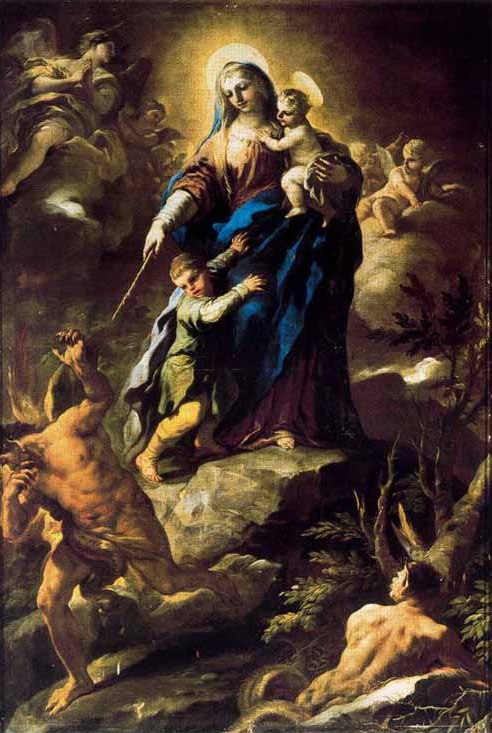 |
| Casting Down Satan & all Evil Spirits to Hell |
Prayer against Evil
Spirit of our God, Father, Son and Holy Spirit, Most Holy
Trinity, descend upon me. Please purify me, mold me, fill me with yourself, and
use me. Banish all the forces of evil from me; destroy them, vanquish them so
that I can be healthy and do good deeds.
Banish from me all spells, witchcraft, black magic, demonic
assignments, malefice, maledictions and the evil eye; diabolic infestations,
oppressions, possessions; all that is evil and sinful; jealousy, treachery,
envy; all physical, psychological, moral, spiritual and diabolical ailments; as
well as all enticing spirits, deaf, dumb, blind, mute and sleeping spirits,
new-age spirits, occult spirits, religious spirits, antichrist spirits, and any
other spirits of death and darkness.
I command and bid all the powers who molest me—by the power
of God Almighty, in the name of Jesus Christ our Savior—to leave me forever,
and to be consigned into the everlasting lake of fire, that they may never
again touch me or any other creature in the entire world.
Amen.
 |
| Be Gone Satan!! |
Standard Deliverance
In the name of the Lord Jesus Christ of Nazareth, by the
power of his cross, his blood and his resurrection, I bind you Satan, the
spirits, powers and forces of darkness, the nether world, and the evil forces
of nature.
I take authority over all curses, hexes, demonic activity
and spells directed against me, my relationships, ministry endeavors, finances,
and the work of my hands; and I break them by the power and authority of the
risen Lord Jesus Christ. I stand with the power of the Lord God Almighty to
bind all demonic interaction, interplay and communications between spirits sent
against me, and send them directly to Jesus Christ for him to deal with as he
wills.
I ask forgiveness for and renounce all negative inner vows
that I have made with the enemy, and ask that Jesus Christ release me from
these vows and from any bondage they may have held in me. I claim the shed
blood of Jesus Christ, the Son of the living God, over every aspect of my life
for my protection.
Amen.
 |
| Spiritual Battle -- This is War |
Binding Evil Spirits
In the name of the Lord Jesus Christ of Nazareth, I stand
with the power of the Lord God Almighty to bind Satan and all his evil spirits,
demonic forces, satanic powers, principalities, along with all kings and
princes of terrors, from the air, water, fire, ground, netherworld, and the
evil forces of nature.
I take authority over all demonic assignments and functions
of destruction sent against me, and I expose all demonic forces as weakened,
defeated enemies of Jesus Christ. I stand with the power of the Lord God
Almighty to bind all enemies of Christ present together, all demonic entities
under their one and highest authority, and I command these spirits into the
abyss to never again return.
I arise today with the power of the Lord God Almighty to
call forth the heavenly host, the holy angels of God, to surround and protect,
and cleanse with God’s holy light all areas vacated by the forces of evil. I
ask the Holy Spirit to permeate my mind, heart, body, soul and spirit, creating
a hunger and thirst for God’s holy Word, and to fill me with the life and love
of my Lord, Jesus Christ.
Amen.
http://www.catholicwarriors.com/pages/warfare_prayers.htm
KEEP GOING THERE IS MORE....

Taken from
http://www.orthodoxchurchquotes.com/tag/demons/
KEEP GOING THERE IS MORE....

From Unseen Warfare:
You must never be afraid . . .
that the enemy is too strong against you,
that his attacks are never ending . . .
You must never be afraid,
if you are troubled by a flood of thoughts,
that the enemy is too strong against you,
that his attacks are never ending,
that the war will last for your lifetime,
and that you cannot avoid incessant
downfalls of all kinds.
Know that our enemies,
with all their wiles,
are in the hands of our divine Commander,
our Lord Jesus Christ,
or Whose honour and glory
you are waging war.
Since He himself leads you into battle,
He will certainly not suffer your enemies
to use violence against you and overcome you,
if you do not yourself cross over
to their side with your will.
He will Himself fight for you and
will deliver your enemies into your hands,
when He wills and as He wills,
as it is written:
‘The Lord thy God walketh in the midst of thy camp,
to deliver thee, and to give up thine enemies before thee’
(Deut. xxii, 14).
+ From Unseen Warfare, St. Theophan the Recluse and St. Nicodemus of the Holy
Taken from
http://www.orthodoxchurchquotes.com/tag/demons/
 |
| Christ Crushing the head of Satan |
Wednesday, 19 August 2015
Angels Those Who See the Face of God
Angels

From a homily on the Gospels
by Saint Gregory the Great, pope
The word “angel” denotes a function rather than a nature
You should be aware that the word “angel” denotes a function
rather than a nature. Those holy spirits
of heaven have indeed always been spirits.
They can only be called angels when they deliver some message. Moreover, those who deliver message of lesser
importance are called angels; and those who proclaim messages of supreme
importance are called archangels.
 |
| St. Gabriel and Our Lady at the Annunciation |
And so it was that not merely an angel but he archangel
Gabriel was sent to the Virgin Mary. It
was only fitting that the highest angel should come to announce the greatest of
all messages.
 |
| St. Michael the Archangel |
Whenever some act of wondrous power must be performed,
Michael is sent, so that his action and his name may make it clear that no one
can do what God does by his superior power.
So also our ancient foe desired in his pride to be like God, saying: I will ascend into heaven; I will exalt my
throne avoe the stars of heaven; I will be like the Most High. He will be allowed to remain in power until
the end of the world when he will be destroyed in the final punishment. Then, he will fight with the archangel
Michael, as we
are told by John: A battle
was fought with Michael the archangel. So
too Gabriel, who is called God’s strength, was sent to Mary. He came to announce the One who appeared as a
humble man to quell the cosmic powers.
Thus God’s strength announced the coming of the Lord of heavenly powers,
mighty in battle.
 |
| St. Raphael the Archangel |
Raphael means, as I have said, God’s remedy (healer), for when he
touched Tobit’s eyes in order to cure him, he banished the darkness of his
blindness. Thus, since he is to heal, he
is rightly called God’s remedy.
Wednesday, 18 March 2015
PRAYERS TO COMBAT EVIL BY REKNOWN EXORCIST
 |
| Father Amorth, exorcist for the Diocese of Rome via Trailer - Amorth L'esorcista, https://www.youtube.com/watch?v=rfGuu2S6DS4. |
5 Prayers Recommended
by an Exorcist
to Combat Evil
by HAMBROSE
Exorcist Tells His Story (Listers,) Father Gabriele Amorth
claims to have performed over 70,000 exorcisms from 1986 to 2010. The good
priest serves as an exorcist for the Diocese of Rome and is the founder and
honorary president of the International Association of Exorcists. He has
written two books: An Exorcist Tells His Story & An Exorcist: More Stories.
And yes, his favorite movie is The Exorcist.1
In his book An Exorcist Tells His Story, Fr. Amorth lists
the following prayers to help combat evil; however, Fr. Amorth and many other
priests have stressed that the number one protection from evil is the Sacrament
of Confession and the Sacrament of the Holy Eucharist. Often times people want
esoteric rituals to deliver them from evil, when in reality what they need is
to become right with God. Along with regular Confession and reception of the
Holy Eucharist, these prayers should be coupled with Our Lord’s Prayer and the
Prayer to St. Michael the Archangel.
Prayers of Deliverance
1. Prayer Against the Malefic from the Greek Ritual

Kyrie eleison. God, our Lord, King of ages, All-powerful and
All-mighty, You Who made everything and Who transform everything simply by Your
will. You Who in Babylon changed into dew the flames of the ‘seven-times
hotter’ furnace and protected and saved the three holy children. You are the
doctor and the physician of our soul. You are the salvation of those who turn
to You. We beseech You to make powerless, banish, and drive out every diabolic
power, presence, and machination; every evil influence, malefice, or evil eye
and all evil actions aimed against Your servant [name of person/s]. Where there
is envy and malice, give us an abundance of goodness, endurance, victory, and
charity. O Lord, You Who love man, we beg You to reach out Your powerful hands
and Your most high and mighty arms and send the angel of peace over us, to
protect us, body and soul. May he keep at bay and vanquish every evil power,
every poison or malice invoked against us by corrupt and envious people. Then,
under the protection of Your authority may we sing, in gratitude, ‘The Lord is
my salvation; whom should I fear? I will not fear evil because You are with me,
my God, my strength, my powerful Lord, Lord of peace, Father of all ages.”
Yes, Lord our God, be merciful to us, Your image, and save
your servant [name of person/s] from every threat or harm from the evil one,
and protect him/her by raising him/her above all evil. We ask You this through
the intercession of our Most Blessed, glorious Lady, Mary ever Virgin, Mother
of God, of the most splendid archangels and all Your saints. Amen!
2. Anima Christi

Soul of Christ, sanctify me; Body of Christ, save me; Blood
of Christ, inebriate me; Water from the side of Christ, wash me; Passion of
Christ, strengthen me; O good Jesus, hear me; within Thy wounds, hide me; let
me never be separated from Thee; from the evil one, deliver me; at the hour of
my death, call me and bid me come to Thee, that with Thy saints, I may praise
Thee forever and ever. Amen.
3. Prayer Against Every Evil

Spirit of our God, Father, Son, and Holy Spirit, Most Holy
Trinity, Immaculate Virgin Mary, angels, archangels, and saints of heaven,
descend upon me. Please purify me, Lord, mold me, fill me with yourself, use
me.
Banish all the forces of evil from me, destroy them, vanish
them, so that I can be healthy and do good deeds.
Banish from me all spells, witchcraft, black magic,
malefice, ties, maledictions, and the evil eye; diabolic infestations,
oppressions, possessions; all that is evil and sinful, jealously, perfidy,
envy; physical, psychological, moral, spiritual, diabolical aliments.
Burn all these evils in hell, that they may never again
touch me or any other creature in the entire world.
I command and bid all the power who molest me – by the power
of God all powerful, in the name of Jesus Christ our Savior, through the
intercession of the Immaculate Virgin Mary – to leave me forever, and to be
consigned into the everlasting hell, where they will be bound by Saint Michael
the archangel, Saint Gabriel, Saint Raphael, our guardian angels, and where
they will be crushed under the heel of the Immaculate Virgin Mary. Amen.
4. Prayer for Inner Healing

Lord Jesus, You came to heal our wounded and troubled
hearts. I beg You to heal the torments that cause anxiety in my heart; I beg
You, in a particular way, to heal all who are the cause of sin. I beg You to
come into my life and heal me of the psychological harms that struck me in my
early years and from the injuries that they caused through my life.
Lord Jesus, You know my burdens. I lay them all on Your Good
Shepherd’s Heart. I beseech You – by the merits of the great, open wound in
Your heart-to heal the small wounds that are in mine. Heal the pain of my
memories, so that nothing that has happened to me will cause me to remain in
pain and anguish, filled with anxiety.
Heal, O Lord, all those wounds that have been the cause of
all the evil that is rooted in my life. I want to forgive all those who have
offended me. Look to those inner sores that make me unable to forgive. You Who
came to forgive the afflicted of heart, please, heal my own heart.
Heal, my Lord Jesus, those intimate wounds that cause me
physical illness. I offer You my heart. Accept it, Lord, purify it and give me
the sentiments of Your Divine Heart. Help me to be meek and humble.
Heal me, O Lord, from the pain caused by the death of my
loved ones, which is oppressing me. Grant me to regain peace and joy in the
knowledge that You are the Resurrection and the Life. Make me an authentic
witness to Your Resurrection, Your victory over sin and death, Your living
presence among us. Amen.
 5. Prayer for Deliverance
My Lord, you are all powerful, you are God, you are Father.
We beg you through the intercession and help of the archangels Michael, Raphael
and Gabriel, for the deliverance of our brothers and sisters who are enslaved
by the evil one. All saints of Heaven, come to our aid.
From anxiety, sadness and obsessions, we beg You. Free us, O
Lord.
From hatred, fornication, envy, we beg You, Free us, O Lord.
From thoughts of jealousy, rage, and death, we beg You, Free
us, O Lord.
From every thought of suicide and abortion, we beg You, Free
us, O Lord.
From every form of sinful sexuality, we beg You, Free us, O
Lord.
From every division in our family, and every harmful
friendship, we beg You, Free us, O Lord.
From every sort of spell, malefic, witchcraft, and every
form of the occult, we beg You,
Free us, O Lord.
Lord, You Who said, “I leave you peace, My peace I give
you,” grant that, through the intercession of the Virgin Mary, we may be
liberated from every evil spell and enjoy your peace always. In the name of
Christ, our Lord. Amen.
Please remember the best defense against evil
is a
well-ordered and holy soul.
Regular confession and
reception of the Holy
Eucharist
is a person’s greatest refuge.
Also remember these prayers
for deliverance should be coupled
with Our
Lord’s Prayer and
the Prayer to St. Michael the Archangel.

Wednesday, 26 September 2012
Catholic Rosary Prayers

Catholic Rosary Prayers

Hail Holy
Queen Prayer
Hail, Holy
Queen, Mother of Mercy,
our life, our sweetness and our hope, to thee do we
cry,
poor banished children of Eve;
to thee do we send up our sighs,
mourning
and weeping in this vale of tears;
turn, then most gracious Advocate,
thine
eyes of mercy towards us, and after this,
our exile, show unto us the blessed
fruit of thy womb Jesus. O clement, O loving, O sweet Virgin Mary!
Pray for us,
O holy Mother of God,
that we may be made worthy of the promises of Christ.
Amen.

Fatima
prayer
O my Jesus,
forgive us our sins. Save us from the fires of hell, lead all souls to heaven
especially those in most need of thy mercy.
(Story of Fatima separate post)

Saint
Michael Prayer
Saint
Michael the Archangel, defend us in the day of battle. Be our safeguard
against
the wickedness
and the snares of the devil. May God rebuke him
we humbly pray
and do thou O Prince of the Heavenly Host cast into hell Satan and all the evil
spirits who prowl throughout the world seeking the ruin of souls.
Amen.
Prayer From
the Catholic Breviary
(said when praying the rosary after the prayers above)

Let us
pray, O God, whose only begotten Son,
by His life death and Resurrection,
has
purchased for us the reward of eternal salvation.
Grant we beseech Thee that
while meditating upon
these mysteries of the most holy rosary
of the Blessed
Virgin Mary,
we may imitate what they contain and obtain
what they promise
through the same Christ our Lord.
Amen.
 The Roman Breviary, which with rare exceptions (certain religious orders, the Ambrosian and Mozarabic RiteRites, etc.) is used at this day throughout the Latin Church, is divided into four parts according to the seasons of the year: Winter, Spring, Summer, and Autumn. It is constructed of the following elements: (a) the Psalter; (b) the Proper of the Season; (c) Proper of the Saints; (d) the Common; (e) certain special Offices.
More on the Breviary (The Liturgy of the Hours) and Psalter forms of prayer coming in a future post...
Thursday, 30 August 2012
St. Michael the Archangel In World Religions
Who is like God?
St.
Michael known in Christianity as one of the Archangels, is also recognized in
many traditions and references throughout history in many of the world’s
religions. I found this most
enlightening, I hope you will too.
Christianity -St. Michael mentioned in Scripture
 |
| Early 20th Century Russian Icon of St. Michael |
Both in the Old and New Testament
·
Daniel
10:13 Gabriel (another great Archangel) says to Daniel, when
he asks God to permit the Jews to return to Jerusalem: "The Angel of the kingdom of the Persians resisted me . .
. and, behold Michael, one of the chief princes, came to help me . . . and none is my
helper in all these things, but Michael your prince."
·
Daniel
12, the Angel speaking of the end of the world and the
Antichrist says: "At that time shall Michael rise up, the great prince, who
standeth for the children of thy people."
·
In
the Catholic Epistle of St. Jude: "When Michael the Archangel, disputing
with the devil, contended about the body of Moses", etc. St. Jude
alludes to an ancient Jewish tradition of a dispute between Michael and Satan
over the body of Moses, an account of which is also found in the apocryphal
book on the assumption of Moses (Origen, De Principiis III.2.2). St.
Michael concealed the tomb of Moses; Satan, however, by disclosing it, tried to
seduce the Jewish people to the sin of hero-worship. St. Michael also guards
the body of Eve, according to the "Revelation of Moses" ("Apocryphal
Gospels", etc., ed. A. Walker, Edinburgh, p. 647).
·
Revelation
12:7, "And
there was a great battle in heaven, Michael and his angels fought with the
dragon." St. John speaks of the great conflict at the end of time,
which reflects also the battle in heaven at the beginning of time. According to
the Fathers there is often question of St. Michael in Scripture where his name
is not mentioned. They say he was the cherub who stood at the gate of paradise, "to
keep the way of the tree of life" (Genesis 3:24), the angel through whom
God published the Decalogue to his chosen people, the angel who stood in the
way against Balaam (Numbers 22:22 sqq.), the angel who routed the army of
Sennacherib (2 Kings 19:35).
THE FOUR OFFICES OF ST. MICHAEL
 |
| St. Michael defeating Satan |
- To fight against Satan.
- To rescue the souls of the faithful from the power of the enemy, especially at the hour of death.
- To be the champion of God's people, the Jews in the Old Law, the Christians in the New Testament; therefore he was the patron of the Church, and of the orders of knights during the Middle Ages.
- To call away from earth and bring men's souls to judgment ("signifer S. Michael repraesentet eas in lucam sanctam", Offert. Miss Defunct. "Constituit eum principem super animas suscipiendas", Antiph. off. Cf. The Shepherd of Hermas, Book III, Similitude 8, Chapter 3).
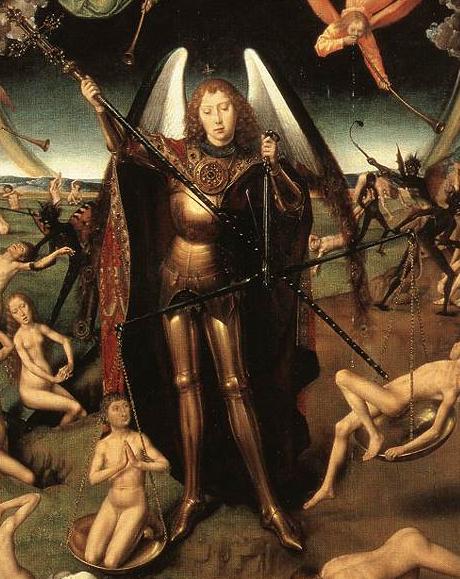 |
| St. Michael the weighing of souls |
Veneration in Roman Catholic Tradition
It would have been natural to St. Michael, the
champion of the Jewish people, to be the champion also of Christians, giving
victory in war to his clients.
The early Christians, however, regarded some of the
martyrs as their military patrons: St. George, St. Theodore, St. Demetrius, St.
Sergius, St. Procopius, St. Mercurius, etc.; but to St. Michael they gave the care of
their sick.
 At the place where he was first venerated, in Phrygia,
his prestige as angelic healer obscured his interposition in military affairs.
It was from early times the centre of the true cult of the holy angels,
particularly of St. Michael.
At the place where he was first venerated, in Phrygia,
his prestige as angelic healer obscured his interposition in military affairs.
It was from early times the centre of the true cult of the holy angels,
particularly of St. Michael.
Tradition relates that St. Michael in the earliest ages
caused a medicinal spring to spout at Chairotopa near Colossae, where
all the sick who bathed there, invoking the Blessed Trinity and St. Michael,
were cured.
Still more famous are the springs which St. Michael is
said to have drawn from the rock at Colossae (Chonae, the present
Khonas, on the Lycus). The pagans directed a stream against the sanctuary of
St. Michael to destroy it, but the archangel split the rock by lightning to
give a new bed to the stream, and sanctified forever the waters which came from
the gorge. The Greeks claim that this apparition took place about the middle of
the first century and celebrate a feast in commemoration of it on 6 September
(Analecta Bolland., VIII, 285-328). Also at Pythia in Bithynia and elsewhere in
Asia the hot springs were dedicated to St. Michael.
At
Constantinople likewise, St. Michael was the great heavenly physician.
His principal sanctuary, the Michaelion, was at Sosthenion, some fifty miles
south of Constantinople; there the archangel is said to have appeared to the
Emperor Constantine. The sick slept in this church at night to wait for a
manifestation of St. Michael; his feast was kept there 9 June. Another famous
church was within the walls of the city, at the thermal baths of the Emperor
Arcadius; there the synaxis of the archangel was celebrated 8 November. This
feast spread over the entire Greek Church, and the Syrian, Armenian, and Coptic
Churches adopted it also; it is now the principal feast of St. Michael in the
Orient. It may have originated in
Phrygia, but its station at Constantinople was the Thermae of Arcadius
(Martinow, "Annus Graeco-slavicus", 8 Nov.). Other feasts of St.
Michael at Constantinople were: 27 October, in the "Promotu" church;
18 June, in the Church of St. Julian at the Forum; and 10 December, at Athaea.
The Christians of Egypt placed their life-giving river,
the Nile, under the protection of St. Michael; they adopted the Greek feast and kept it 12
November; on the twelfth of every month they celebrate a special commemoration
of the archangel, but 12 June, when the river commences to rise, they keep as a
holiday of obligation the feast of St. Michael "for the rising of the
Nile", euche eis ten symmetron anabasin ton potamion hydaton.
At Rome the Leonine Sacramentary (sixth century) has
the "Natale Basilicae Angeli via Salaria", 30 September; of the five
Masses for the feast three mention St. Michael. The Gelasian Sacramentary
(seventh century) gives the feast "S. Michaelis Archangeli", and the
Gregorian Sacramentary (eighth century), "Dedicatio Basilionis S. Angeli
Michaelis", 29 Sept. A manuscript also here adds "via Salaria"
(Ebner, "Miss. Rom. Iter Italicum", 127). This church of the Via
Salaria was six miles to the north of the city; in the ninth century it was
called Basilica Archangeli in Septimo (Armellini, "Chiese di Roma",
p. 85). It disappeared a thousand years ago. At Rome also the part of heavenly
physician was given to St. Michael. According to an (apocryphal?)
legend of the tenth century he appeared over the Moles Hadriani (Castel di S.
Angelo), in 950, during the procession which St. Gregory held against the
pestilence, putting an end to the plague. Boniface IV (608-15) built on the
Moles Hadriani in honour of him, a church, which was styled St. Michaelis inter
nubes (in summitate circi).
 |
| Apparition of St. Michael at Mount Gargano |
In Normandy St. Michael is the patron of mariners
in his famous sanctuary at Mont-Saint-Michel in the Diocese of Coutances. He is
said to have appeared there, in 708, to St. Aubert, Bishop of Avranches. In
Normandy his feast "S. Michaelis in periculo maris" or "in Monte
Tumba" was universally celebrated on 18 Oct., the anniversary of the
dedication of the first church, 16 Oct., 710; the feast is now confined to the
Diocese of Coutances. In Germany, after its evangelization, St. Michael
replaced for the Christians the pagan god Wotan, to whom many mountains were
sacred, hence the numerous mountain chapels of St. Michael all over Germany.
The hymns of
the Roman Office are said to have been composed by St. Rabanus Maurus of Fulda
(d. 856). In art St. Michael is represented as an angelic warrior, fully armed with
helmet, sword, and shield (often the shield bears the Latin inscription: Quis
ut Deus), standing over the dragon, whom he sometimes pierces with a
lance. He also holds a pair of scales in which he weighs the souls of the
departed (cf. Rock, "The Church of Our Fathers", III, 160),
or the
book of life, to show that he takes part in the judgment. His feast (29
September) in the Middle Ages was celebrated as a holy day of obligation, but
along with several other feasts it was gradually abolished since the eighteenth
century (see FEASTS). Michaelmas Day, in
England and other countries, is one of the regular quarter-days for settling
rents and accounts; but it is no longer remarkable for the hospitality with
which it was formerly celebrated. Stubble-geese being esteemed in
perfection about this time, most families had one dressed on Michaelmas Day. In
some parishes (Isle of Skye) they had a procession on this day and baked a
cake, called St. Michael's bannock.
Information and excerpts taken from the following
sites:
Eastern and Oriental Orthodoxy
The Eastern Orthodox accord Michael the title
"Archistrategos", or "Supreme Commander of the Heavenly Hosts."
The Eastern Orthodox pray to their guardian angels and above all to Michael and
Gabriel.
The Eastern Orthodox have always had strong devotions
to angels, and the trend continues to date with the term "Bodiless
Powers" applied to them.[43] A number of feasts dedicated to Archangel
Michael are celebrated by the Eastern Orthodox throughout the year.
Archangel
Michael is mentioned in a number of Eastern Orthodox hymns and prayer, and his
icons are widely used within Eastern Orthodox churches.[44] In many Eastern
Orthodox icons, Christ is accompanied by a number of angels, Michael being a predominant
figure among them.
 |
| Byzantine icon of St. Michael 13th century |
The place of
Michael in the Coptic Orthodox Church of Alexandria is a saintly intercessor,
where he is seen as the one who presents to God the prayers of the just, who
accompanies the souls of the dead to heaven, who defeats the devil. He is
celebrated liturgically on the 12th of each month.[47] In Alexandria, a church
was dedicated to him in the early fourth century on the 12th of the month of
Ba'unah. On the 12th of the month of Hathor is the celebration of Michael's
appointment in heaven, where Michael became the chief of the angels.
St. Michael in Judaism
 |
| St. Michael's name in Hebrew |
The idea that Michael was the advocate of the Jews
became so prevalent that in spite of the rabbinical prohibition against
appealing to angels as intermediaries between God and his people, Michael came
to occupy a certain place in the Jewish liturgy. There were two prayers written
beseeching him as the prince of mercy to intercede in favor of Israel: one
composed by Eliezer ha-Kalir, and the other by Judah ben Samuel he-Hasid. But
appeal to Michael seems to have been more common in ancient times. Thus Jeremiah
is said to have addressed a prayer to him.[19] "When a man is in need he
must pray directly to God, and neither to Michael nor to Gabriel."
The rabbis
declare that Michael entered upon his role of defender at the time of the
biblical patriarchs. Thus, according to Rabbi Eliezer ben Jacob, it was Michael
who rescued Abraham from the furnace into which he had been thrown by Nimrod
(Midrash Genesis Rabbah xliv. It was Michael, the "one that had
escaped" (Genesis 14:13), who told Abraham that Lot had been taken captive
(Midrash Pirke R. El.), and who protected Sarah from being defiled by
Abimelech. He announced to Sarah that she would bear a son and he rescued Lot
at the destruction of Sodom.
St. Michael in Midrash
The
Hebrew term Midrash (Hebrew: מדרש; plural midrashim, "story" from "to investigate" or
"study") also "Interpretation" or "Exposition"[1]
is a homiletic method of biblical exegesis. The term also refers to the whole
compilation of homiletic teachings on the Bible.
Midrash
is a way of interpreting biblical stories that goes beyond simple distillation
of religious, legal or moral teachings. It fills in many gaps left in the
biblical narrative regarding events and personalities that are only hinted at.
It is said that
Michael
prevented Isaac from being sacrificed by his father by substituting a
ram in his place, and saved Jacob, while yet in his mother's womb,
from being killed by Samael. Later Michael prevented Laban
from harming Jacob.(Pirke De-Rabbi Eliezer, xxxvi). It was Michael who wrestled
with Jacob and who afterward blessed him.
The midrash Exodus Rabbah holds that Michael
exercised his function of advocate of Israel at the time of the Exodus also,
when Satan (as an adversary) accused the Israelites of idolatry and declared that
they were consequently deserving of death by drowning in the Red Sea.
Michael is also said to have destroyed the army of Sennacherib.
Protestant views of St. Michael
St. Michaelis Luthern Church on the €2 coin 2008
Most Protestant Christians (excluding Anglicans)
generally reject the intercession of saints as a whole. However, the
Anglican prayer of preparation before Mass includes a confession to
"Michael the Archangel" as well as other saints such as John the Baptist.
Protestant
denominations generally recognize only two archangels, Michael and Gabriel,
usually emphasizing Michael, unlike Judaism, Roman Catholicism, and Eastern
Orthodoxy which may at times recognize seven (and in rare cases eight) archangels,
with Michael, Gabriel, and Raphael generally regarded with an elevated status,
e.g. being the only archangels honored by name in Catholicism.
 |
| St. Michael in Victory by Murillo |
Some early Protestant scholars identified Michael with
the pre-incarnate Christ, basing their view, partly on the juxtaposition of the
"child" and the archangel in Revelation 12, and partly on the
attributes ascribed to him in Daniel. Similarly in 1751 Anglican bishop
Robert Clayton held that Michael was the Logos and Gabriel the Holy Spirit, an
extreme position which resulted in his prosecution, just before he died.
Michael continues to be recognized among Protestants
by key churches dedicated to him, e.g. St. Michaelis Church, Hamburg, a famous
Lutheran Church which appears on the coins of the European Union.[54]
St. Michael mentioned in the Qur'an
Michael
(Arabic: ميخائيل, Mikhail ميكائيل, Mikael ), is one
of the two archangels mentioned in the Qur'an, alongside Jibreel (Gabriel). In
the Qur'an, Michael is mentioned once only, in Sura 2:98: "Whoever is an
enemy to God, and His angels and His messengers, and Jibreel and Mikhail! Then, lo! God (Himself) is an enemy to the
disbelievers." Some Muslims believe that the reference in Sura 11:69
is Michael, one of the three angels who visited Abraham.
Jehovah's Witnesses
beliefs of St. Michael
beliefs of St. Michael
Jehovah's Witnesses believe Michael to be another name
for Jesus Christ in heaven, in his pre-human and post-resurrection existence.
They assert that, because a definite article is used at Jude 9 when referring
to "Michael the Archangel", and because the term
"archangel" is used only in the singular in the Bible, never clearly
in the plural, that therefore Michael is the only archangel, and therefore
synonymous with Jesus, who is described at 1 Thessalonians 4:16 as descending
"with a cry of command, with the voice of an archangel, and with the sound
of the trumpet".
They believe the prominent roles assigned to Michael
at Daniel 12:1 and Revelation 12:7; 19:14, 16 are identical to Jesus' roles, as
the one chosen to lead God's people, and as the one who "stands up",
identifying them as the same spirit being. Because they identify Michael with
Jesus, he is therefore considered the first and greatest of all God's heavenly
sons, God's chief messenger who takes the lead in vindicating God's
sovereignty, sanctifying his name, fighting the wicked forces of Satan, and
protecting God's covenant people on earth.[56] Jehovah's Witnesses also
identify Michael with the "Angel of the Lord" who led the Israelites
in the wilderness.[57]
Seventh-day Adventists
beliefs of St.
Michael
 |
| St. Michael defeats Satan by Giordano, Luca |
Seventh-day Adventists believe that Michael is another
name for the Heavenly Christ, and another name for the Word-of-God (as in John
1) before He became incarnate as Jesus. Archangel (meaning "Chief of the
Angels") was the leadership position held by the Word-of-God as Michael
while among the angels. So according to Adventist theology, Michael was considered
the "eternal Word", and not a created being or created angel, and the
one by whom all things were created. The Word was then born incarnate as Jesus.
Seventh-day
Adventists believe the name "Michael" is significant in showing who
it is, just as "Immanuel" (which means "God with us") is
about who Jesus is. They believe that name "Michael" signifies
"one who is God" and that as the "Archangel" or "chief
or head of the angels" He led the angels and thus the statement in
Revelation 12:7-9 identifies Jesus as Michael.[59]
Seventh-day
Adventists believe that the term 'Michael' is but one of the many titles
applied to the Son of God, the second person of the Godhead. But, according to
Adventists, such a view does not in any way conflict with the belief in His full
deity and eternal pre-existence, nor does it in the least disparage His person
and work.[60]
In the
Seventh-day Adventist view, the statement in 1 Thessalonians 4:13-18: "For
the Lord himself shall descend from heaven, with a shout, with the voice of the
archangel, and with the trump of God" identifies Jesus as Archangel, which
is Michael.[61] And the Seventh-day Adventists believe that John 5:25-29 also
confirms that Jesus and Michael are the same.[61]
Seventh-day Adventists believe there is and can only
be one archangel and that one Archangel is named Michael and yet in Scripture
is shown as doing what also applies to Christ even from the beginning, so is
Christ pre-incarnate. There was a perception that Adventists were relegating
Jesus to something less than divine or less than God but that is not valid
since Seventh-day Adventism theology teaches and is expressly
Trinitarian.[62][63]
Beliefs of The Church of Jesus Christ of
Latter-day Saints
Latter-day Saints (also known informally as Mormons)
believe that Michael is Adam, the Ancient of Days (Dan. 7), a prince, and the
patriarch of the human family and that Michael assisted Jehovah (the heavenly
form of Jesus Christ) in the creation of the world under the direction of God
the Father.
St. Michael as Patron Saint and Names of
Religious Orders
What IS a patron saint?
“Patron saints are chosen as special protectors or guardians over areas of life. These areas can include occupations, illnesses, churches, countries, causes -- anything that is important to us. The earliest records show that people and churches were named after apostles and martyrs as early as the fourth century.
“Patron saints are chosen as special protectors or guardians over areas of life. These areas can include occupations, illnesses, churches, countries, causes -- anything that is important to us. The earliest records show that people and churches were named after apostles and martyrs as early as the fourth century.
Recently, the popes have named
patron saints but patrons can be chosen by other individuals or groups as well.
Patron saints are often chosen today because an interest, talent, or event in
their lives overlaps with the special area. Angels can also be named as patron
saints. A patron saint can help us when we follow the example of that saint's
life and when we ask for that saint's intercessory prayers to God.” Definition
taken from http://www.catholic.org/saints/patron.php More on Patron Saints under separate
post.
 |
| Bulgarian women at the Feast of St. Michael |
In the Roman Catholic calendar of saints, Anglican
Calendar of Saints, and the Lutheran Calendar of Saints, the archangel's feast
is celebrated on Michaelmas Day. The day is also considered the feast of Saints
Gabriel, and Raphael or the Feast of Saint Michael and All Angels. On
the Western Christian calendar the feast is celebrated on 29 September.
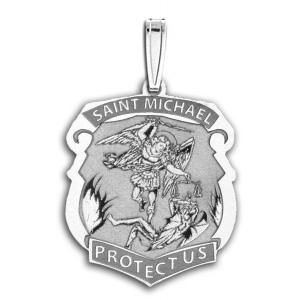
He is known worldwide as the Patron saint of Law Enforcement and soldiers.
He is known worldwide as the Patron saint of Law Enforcement and soldiers.
In the Eastern Orthodox Church, Saint Michael's
principal feast day is November 8 (November 21 by most Orthodox churches since
they use the Julian calendar), where he is honored along with the rest of the "Bodiless Powers
of Heaven" (i.e. angels) as their Supreme Commander, and the Miracle at
Chonae is commemorated on September 6.
In late medieval Christianity, Michael, together with
Saint George, became the patron saint of chivalry and is now also
considered the patron saint of police officers and the military.
In mid to late 15th century, France was one of only
four courts in Western Christendom without an order of knighthood.
 Later in
the 15th century, Jean Molinet glorified the primordial feat of arms of the
archangel as "the first deed of knighthood and chivalrous prowess that was
ever achieved."Thus Michael was the natural patron of the first
chivalric order of France, the Order of Saint Michael of 1469.
Later in
the 15th century, Jean Molinet glorified the primordial feat of arms of the
archangel as "the first deed of knighthood and chivalrous prowess that was
ever achieved."Thus Michael was the natural patron of the first
chivalric order of France, the Order of Saint Michael of 1469.
In the British honours system, a chivalric order founded in 1818 is also named for these two saints, the Order of St Michael and St George.
The Order of Michael the Brave is Romania's highest military decoration.
Later in
the 15th century, Jean Molinet glorified the primordial feat of arms of the
archangel as "the first deed of knighthood and chivalrous prowess that was
ever achieved."Thus Michael was the natural patron of the first
chivalric order of France, the Order of Saint Michael of 1469.In the British honours system, a chivalric order founded in 1818 is also named for these two saints, the Order of St Michael and St George.
The Order of Michael the Brave is Romania's highest military decoration.
Apart from his being a patron of warriors, the sick
and the suffering also consider Archangel Michael their patron saint.
Based on the legend of his 8th century apparition at Mont-Saint-Michel, France, the Archangel is the patron of mariners in this famous sanctuary.
After the evangelisation of Germany, where mountains were often dedicated to pagan gods, Christians placed many mountains under the patronage of the Archangel, and numerous mountain chapels of St. Michael appeared all over Germany.
He has been the patron saint of Brussels since the Middle Ages.
The city of Arkhangelsk in Russia is named for the Archangel. Ukraine and its capital Kiev also consider Michael their patron saint and protector.
Based on the legend of his 8th century apparition at Mont-Saint-Michel, France, the Archangel is the patron of mariners in this famous sanctuary.
After the evangelisation of Germany, where mountains were often dedicated to pagan gods, Christians placed many mountains under the patronage of the Archangel, and numerous mountain chapels of St. Michael appeared all over Germany.
He has been the patron saint of Brussels since the Middle Ages.
The city of Arkhangelsk in Russia is named for the Archangel. Ukraine and its capital Kiev also consider Michael their patron saint and protector.
 |
| Michaelite Fathers http://www.michaelites.ca/congregationintro.htm |
The Congregation of Saint Michael the Archangel (CSMA), also known as the Michaelite Fathers, is a religious order of the Roman Catholic Church founded in 1897.
Major shrines to St. Michael
•St. Michael and St. Gudula Cathedral, in Brussels,
Belgium
•Mont Saint-Michel, Normandy, France - a World
Heritage Site
•St. Michael's Cathedral (Toronto), Canada
·
St.
Michael's Golden-Domed Monastery in Kiev (Ukraine).
•St. Michael's Cathedral (Izhevsk), Russia
•St. Michael's
Cathedral, Qingdao, China
•Chudov
Monastery in the Moscow Kremlin
•Archangel
Cathedral in the Moscow Kremlin - a World Heritage Site
•Monte
Sant'Angelo sul Gargano, Gargano, Italy
•St Michael's
Mount, Cornwall, UK
•St. Michael's
Basilica, Miramichi, Canada
•Skellig
Michael, off the Irish west coast - a World Heritage Site
•St Michael's
Cathedral, Coventry, UK
 |
| St. Micheal's Golden-Domed Monastery, Kiev, Ukraine |
•St. Michael's
Golden-Domed Monastery, Kiev, Ukraine
•St Michael's
Church in Vienna, Austria
•Basilica of St
Michael the Archangel, Tayabas, Quezon, Philippines
•Saint
Michael's church, Berlin
•St. Michael's
Cathedral in Belgrade, Serbia
Legends
Judaism
·
There is a legend which seems to be of Jewish origin, and which was adopted by the Copts, to the effect
that Michael
was first sent by God to bring Nebuchadnezzar (c. 600 BC) against Jerusalem,
and that Michael was afterward very active in freeing his nation from
Babylonian captivity. According to midrash Genesis Rabbah, Michael saved Hananiah
and his companions from the Fiery furnace. Michael was active in the time of
Esther: "The more Haman accused Israel on earth, the more Michael
defended Israel in heaven".[80] It was Michael who reminded Ahasuerus that
he was Mordecai's debtor; and there is a legend that Michael
appeared to the high priest Hyrcanus, promising him assistance.
Christendom
· A 12th-century icon of the Miracle at Chonae, from Saint Catherine's
Monastery, Mount Sinai.
 |
| St. Michael icon at Sinai (Egypt) by K. Weitzmann |
The Orthodox Church celebrates the Miracle at Chonae
on September 6. The legend states that the pagans directed a stream against the
sanctuary of St Michael to destroy it, but Archippus (the custodian) prayed to
Michael, the archangel appeared and split the rock to open up a new bed for the
stream, directing the flow away from the church and sanctifying forever the
waters which came from the new gorge. The spring which came forth after this
event is said to have special healing powers. The legend existed in earlier
times, but the 5th-7th century texts that refer to the miracle at Chonae formed
the basis of specific paradigms for "properly approaching" angelic
intermediaries for more effective prayers within the Christian culture.
There is a late 5th century legend in Cornwall, UK
that the
Archangel appeared to fishermen on St Michael's Mount. According to author Richard Freeman Johnson
this legend is likely a nationalistic twist to a myth. Cornish legends also
hold that the mount itself was constructed by giants and that King Arthur
battled a giant there.
·
The legend of the apparition of the Archangel at
around 490 AD at a secluded hilltop cave on Monte Gargano in Italy gained a
following among the Lombards in the immediate period thereafter, and by the 8th
century pilgrims arrived from as far away as England. The Roman Breviary then
recorded it on May 8, the date on which the Lombards attributed their 663
victory over the Greek Neopolitan to the intercession of the Archangel.
 |
| Micheal's statue at Castel Sant'Angelo in Rome |
Castel Sant'Angelo in Rome, with Michael's statue atop
According to Roman legends, while a devastating plague
persisted in Rome, Archangel Michael appeared with a sword over the mausoleum
of Hadrian, in apparent answer to the prayers of Pope St Gregory I the Great (c. 590-604) that the plague should cease. After the
plague ended, in honor of the occasion, the pope called the mausoleum
"Castel Sant'Angelo" (Castle of the Holy Angel), the name by which it
is still known.
·
The Mont-Saint-Michel in Normandy, France
 |
| Mont Saint Michel in Normandy, France |
 A Portuguese Carmelite nun, Antónia d'Astónaco, had reported an apparition and private revelation of
the Archangel Michael who had told to this devoted Servant of God, in 1751,
that she would like to be honored, and God glorified, by the praying of nine
special invocations. These nine invocations correspond to invocations to the nine
choirs of angels and origins the famous Chaplet of Saint Michael. This
private revelation and prayers were approved by Pope Pius IX in 1851. (*The prayer Chaplet of Satin Michael and Nine Choirs of Angels will be under their own
posts)
A Portuguese Carmelite nun, Antónia d'Astónaco, had reported an apparition and private revelation of
the Archangel Michael who had told to this devoted Servant of God, in 1751,
that she would like to be honored, and God glorified, by the praying of nine
special invocations. These nine invocations correspond to invocations to the nine
choirs of angels and origins the famous Chaplet of Saint Michael. This
private revelation and prayers were approved by Pope Pius IX in 1851. (*The prayer Chaplet of Satin Michael and Nine Choirs of Angels will be under their own
posts)
·
From
1961 to 1965, four young schoolgirls had reported several
apparitions of Archangel Michael in the small village of Garabandal, Spain.
At Garabandal, the apparitions of the
Archangel Michael were mainly reported as announcing the arrivals of the Virgin
Mary. The Catholic Church has neither approved, nor condemned the Garabandal
apparitions.
 |
| Garabandal, Spain |
Art and literature
In literature
In the English epic poem Paradise Lost by John Milton, Michael commands the army of angels
loyal to God against the rebel forces of Satan. Armed with a sword from God's
armory, he bests Satan in personal combat, wounding his side.
Artistic depictions of St. Michael
Archangel Michael
in Christian art
·
Early
20th century Russian icon of the 7 Holy Angels, with Michael in the front.
·
Archangel
Michael may be depicted alone or with other angels such as Gabriel. Some depictions with Gabriel date back to the
8th century, e.g. the stone casket at Notre Dame de Mortain church in France.
·
The
widely reproduced image of Our Mother of Perpetual Help, an icon of the Cretan
school, depicts Michael on the left carrying the lance and sponge of the
crucifixion of Jesus, with Gabriel on the right side of Mary and Jesus.
 | |
| St. Michael reaching to save souls in purgatory |
Constantine
felt that Licinius was an agent of Satan, and associated him with the serpent
described in the Book of Revelation (12:9). After the victory, Constantine
commissioned a depiction of himself and his sons slaying Licinius represented
as a serpent - a symbolism borrowed from the Christian teachings on the
Archangel to whom he attributed the victory. A similar painting, this time with
the Archangel Michael himself slaying a serpent then became a major art piece
at the Michaelion and eventually lead to the standard iconography of Archangel
Michael as a warrior saint.
 ·
In
other depictions Michael may be holding a pair of scales in which he weighs the
souls of the departed and may hold the book of life (as in the Book of
Revelation), to show that he takes part in the judgment. However this form of depiction is less common
than the slaying of the dragon. Michelangelo depicted this scene on the
altar wall of the Sistine Chapel.
·
In
other depictions Michael may be holding a pair of scales in which he weighs the
souls of the departed and may hold the book of life (as in the Book of
Revelation), to show that he takes part in the judgment. However this form of depiction is less common
than the slaying of the dragon. Michelangelo depicted this scene on the
altar wall of the Sistine Chapel.
·
In
Byzantine art Michael was often shown as a princely court dignitary, rather
than a warrior who battled Satan or with scales for weighing souls on the Day
of Judgement.
Judaism
Most Jewish
teachings interpret the Second Commandment as against the use of "graven
images" as visual art.
Islam Islamic art's focus on calligraphy, rather than
painting and sculpture, similarly derives from the association of idolatry with
the depiction of human or angelic forms.
Subscribe to:
Posts (Atom)