Ad

Showing posts with label St. Ignatius of Antioch. Show all posts

Tuesday, 2 May 2017

St. Ignatius of Antioch Letter to the Ephesians

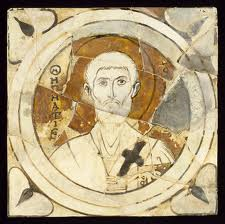
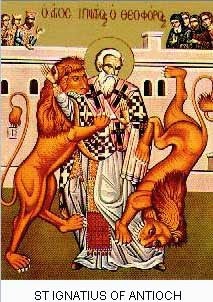
St. Ignatius of Antioch
EPISTLE TO THE EPHESIANS

Ignatius of Antioch 
[Also called Theophorus (ho Theophoros); born in Syria, around the year 50; died at Rome between 98 and 117]


Ignatius, who is also called Theophorus, to the Church which is at Ephesus, in Asia, deservedly most happy, being blessed in the greatness and fullness of God the Father, and predestinated before the beginning[1] of time, that it should be always for an enduring and unchangeable glory, being united[2] and elected through the true passion by the will of the Father, and Jesus Christ, our God: Abundant happiness through Jesus Christ, and His undefiled grace.

CHAP. I.--PRAISE OF THE EPHESIANS.

I have become acquainted with your name, much-beloved in God, which ye have acquired by the habit of righteousness, according to the faith and love in Jesus Christ our Saviour. 

Being the followers[4] of God, and stirring up[5] yourselves by the blood of God, ye have perfectly accomplished the work which was beseeming to you. 

For, on hearing that I came bound from Syria for the common name and hope, trusting through your prayers to be permitted to fight with beasts at Rome, that so by martyrdom I may indeed become the disciple of Him "who gave Himself for us, an offering and sacrifice to God,"[6][ye hastened to see me[7]]. I received, therefore,[8] your whole multitude in the name of God, through Onesimus, a man of inexpressible love,[9] and your bishop in the flesh, whom I pray you by Jesus Christ to love, and that you would all seek to be like him. And blessed be He who has granted unto you, being worthy, to obtain such an excellent bishop.

CHAP. II.--CONGRATULATIONS AND ENTREATIES.

As to my fellow-servant Burrhus, your deacon in regard to God and blessed in all things,[1] I beg that he may continue longer, both for your honour and that of your bishop. And Crocus also, worthy both of God and you, whom I have received as the manifestation[2] of your love, hath in all things refreshed[3] me, as the Father of our Lord Jesus Christ shall also refresh[3] him; together with Onesimus, and Burrhus, and Euplus, and Fronto, by means of whom, I have, as to love, beheld all of you. May I always have joy of you, if indeed I be worthy of it. It is therefore befitting that you should in every way glorify Jesus Christ, who hath glorified you, that by a unanimous obedience "ye may be perfectly joined together in the same mind, and in the same judgment, and may all speak the same thing concerning the same thing,"[5] and that, being subject to the bishop and the presbytery, ye may in all respects be sanctified.

CHAP. III.--EXHORTATIONS TO UNITY.

I do not issue orders to you, as if I were some great person. For though I am bound for the name [of Christ], I am not yet perfect in Jesus Christ. For now I begin to be a disciple, and I speak to you as fellow- disciples with me. For it was needful for me to have been stirred up by you in faith, exhortation, patience, and long-suffering. But inasmuch as love suffers me not to be silent in regard to you, I have therefore taken[6] upon me first to exhort you that ye would all run together in accordance with the will of God. For even Jesus Christ, our inseparable life, is the [manifested] will of the Father; as also bishops, settled everywhere to the utmost bounds [of the earth], are so by the will of Jesus Christ.

CHAP. IV.--THE SAME CONTINUED.

Wherefore it is fitting that ye should run together in accordance with the will of your bishop, which thing also ye do. For your justly renowned presbytery, worthy of God, is fitted as exactly to the bishop as the strings are to the harp. Therefore in your concord and harmonious love, Jesus Christ is sung. And do ye, man by man, become a choir, that being harmonious in love, and taking up the song of God in unison, ye may with one voice sing to the Father through Jesus Christ, so that He may both hear you, and perceive by your works that ye are indeed the members of His son. It is profitable, therefore, that you should live in an unblameable unity, that thus ye may always enjoy communion with God.

CHAP. V.--THE PRAISE OF UNITY.

For if I in this brief space of time, have enjoyed such fellowship with your bishop--I mean not of a mere human, but of a spiritual nature--how much more do I reckon you happy who are so joined to him as the Church is to Jesus Christ, and as Jesus Christ is to the Father, that so all things may agree in unity! 
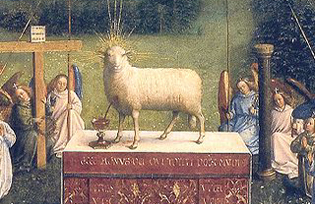
Adoration of the Lamb (closeup) by Van Eyck


Adoration of the Lamb by Van Eyck


Let no man deceive himself:
if any one be not within the altar, 
he is deprived of the bread of God. 


For if the prayer of one or two possesses[4] such power, how much more that of the bishop and the whole Church !He, therefore, that does not assemble with the Church, has even[5] by this manifested his pride, and condemned himself. For it is written, "God resisteth the proud."[9] Let us be careful, then, not to set ourselves in opposition to the bishop, in order that we may be subject to God.

CHAP. VI.--HAVE RESPECT TO THE BISHOP AS TO CHRIST HIMSELF.

Now the more any one sees the bishop keeping silence,[10] the more ought he to revere him. For we ought to receive every one whom the Master of the house sends to be over His household,[11] as we would do Him that sent him. It is manifest, therefore, that we should look upon the bishop even as we would upon the Lord Himself. And indeed Onesimus himself greatly commends your good order in God, that ye all live according to the truth, and that no sect has any dwelling-place among you. Nor, indeed, do ye hearken to any one rather than to Jesus Christ speaking in truth.

CHAP. VII.--BEWARE OF FALSE TEACHERS.

For some are in the habit of carrying about the name [of Jesus Christ] in wicked guile, while yet they practise things unworthy of God, whom ye must flee as ye would wild beasts. For they are ravening dogs, who bite secretly, against whom ye must be on your guard, inasmuch as they are men who can scarcely be cured. There is one Physician who is possessed both of flesh and spirit; both made and not made; God existing in flesh; true life in death; both of Mary and of God; first possible and then impossible,[7] even Jesus Christ our Lord.

CHAP. VIII.--RENEWED PRAISE OF THE EPHESIANS.

Let not then any one deceive you, as indeed ye are not deceived, inasmuch as ye are wholly devoted to God. For since there is no strife raging among you which might distress you, ye are certainly living in accordance with God's will. I am far inferior to you, and require to be sanctified by your Church of Ephesus, so renowned throughout the world. They that are carnal cannot do those things which are spiritual, nor they that are spiritual the things which are carnal; even as faith cannot do the works of unbelief, nor the unbelief the works of faith. But even those things which ye do according to the flesh are spiritual; for ye do all things in Jesus Christ.

CHAP. IX.--YE HAVE GIVEN NO HEED TO FALSE TEACHERS.

Nevertheless, I have heard of some who have passed on from this to you, having false doctrine, whom ye did not suffer to sow among you, but stopped your ears, that ye might not receive those things which were sown by them, as being stones[1] of the temple of the Father, prepared for the building of God the Father, and drawn up on high by the instrument of Jesus Christ, which is the cross,[2] making use of the Holy Spirit as a rope, while your faith was the means by which you ascended, and your love the way which led up to God. Ye, therefore, as well as all your fellow-travellers, are God- bearers, temple-bearers, Christ-bearers, bearers of holiness, adorned in all respects with the commandments of Jesus Christ, in whom also I exult that I have been thought worthy, by means of this Epistle, to converse and rejoice with you, because with respect to your Christian life[7] ye love nothing but God only.

CHAP. X.--EXHORTATIONS TO PRAYER, HUMILITY, ETC.

And pray ye without ceasing in behalf of other men. For there is in them hope of repentance that they may attain to God. See,[2] then, that they be instructed by your works, if in no other way. 

Be ye meek in response to their wrath, 
humble in opposition to their boasting: 
to their blasphemies return[4] your prayers;
in contrast to their error, 
be ye stedfast[5] in the faith; 
and for their cruelty, manifest your gentleness. 

While we take care not to imitate their conduct, let us be found their brethren in all true kindness; and let us seek to be followers of the Lord (who ever more unjustly treated, more destitute, more condemned?), that so no plant of the devil may be found in you, but ye may remain in all holiness and sobriety in Jesus Christ, both with respect to the flesh and spirit.

CHAP. XI.--AN EXHORTATION TO FEAR GOD, ETC.

The last times are come upon us. Let us therefore be of a reverent spirit, and fear the long-suffering of God, that it tend not to our condemnation. For let us either stand in awe of the wrath to come, or show regard for the grace which is at present displayed--one of two things. Only [in one way or another] let us be found in Christ Jesus unto the true life. Apart from Him, let nothing attract[16] you, for whom I bear about these bonds, these spiritual jewels, by which may I arise through your prayers, of which I entreat I may always be a partaker, that I may be found in the lot of the Christians of Ephesus, who have always been of the same mind with the apostles through the power of Jesus Christ.

CHAP. XII.--PRAISE OF THE EPHESIANS.

I know both who I am, and to whom I write. I am a condemned man, ye have been the objects of mercy; I am subject to danger, ye are established in safety. Ye are the persons through(1) whom those pass that are cut off for the sake of God. Ye are initiated into the mysteries of the Gospel with Paul, the holy, the martyred, the deservedly most happy, at whose feet(4) may I be found, when I shall attain to God; who in all his Epistles makes mention of you in Christ Jesus.

CHAP. XIII.--EXHORTATION TO MEET TOGETHER FREQUENTLY FOR THE WORSHIP OF GOD.

Take heed, then, often to come together 
to give thanks to God, and show forth His praise. 
For when ye assemble frequently in the same place, 
the powers of Satan are destroyed, and the destruction 
at which he aims(7) is prevented by the unity of your faith. 

Nothing is more precious than peace, by which all war, both in heaven and earth,(8) is brought to an end.

CHAP. XIV.--EXHORTATIONS TO FAITH AND LOVE.

None of these things is hid from you, if ye perfectly possess that faith and love towards Christ Jesus(10) which are the beginning and the end of life. For the beginning is faith, and the end is love.(11) Now these two. being inseparably connected together,(12) are of God, while all other things which are requisite for a holy life follow after them. No man [truly] making a profession of faith sinneth;(13) nor does he that possesses love hate any one. The tree is made manifest by its fruit;(15) so those that profess themselves to be Christians shall be recognised by their conduct. For there is not now a demand for mere profession,(16) but that a man be found continuing in the power of faith to the end.

CHAP. XV.--EXHORTATION TO CONFESS CHRIST BY SILENCE AS WELL AS SPEECH.

It is better for a man to be silent and be [a Christian], than to talk and not to be one. It is good to teach, if he who speaks also acts. There is then one Teacher, who spake and it was done; while even those things which He did in silence are worthy of the Father. He who possesses the word of Jesus, is truly able to hear even His very silence, that he may be perfect, and may both act as he speaks, and be recognised by his silence. There is nothing which is hid from God, but our very secrets are near to Him. Let us therefore do all things as those who have Him dwelling in us, that we may be His temples,(20) and He may be in us as our God, which indeed He is, and will manifest Himself before our faces. Wherefore we justly love Him.

CHAP. XVI.--THE FATE OF FALSE TEACHERS.

Do not err, my brethren.(3) Those that corrupt families shall not inherit the kingdom of God.(4) If, then, those who do this as respects the flesh have suffered death, how much more shall this be the case with any one who corrupts by wicked doctrine the faith of God, for which Jesus Christ was crucified! Such an one becoming defiled [in this way], shall go away into everlasting fire, and so shall every one that hearkens unto him.

CHAP. XVII.--BEWARE OF FALSE DOCTRINES.

For this end did the Lord suffer the ointment to be poured upon His head,(7) that He might breathe immortality into His Church. Be not ye anointed with the bad odour of the doctrine of the prince of this world; let him not lead you away captive from the life which is set before you. And why are we not all prudent, since we have received the knowledge of God, which is Jesus Christ? Why do we foolishly perish, not recognising the gift which the Lord has of a truth sent to us?

CHAP. XVIII.--THE GLORY OF THE CROSS.

Let my spirit be counted as nothing(10) for the sake of the cross, which is a stumbling-block" to those that do not believe, but to us salvation and life eternal. "Where is the wise man? where the disputer?"(1) Where is the boasting of those who are styled prudent? For our God, Jesus Christ, was, according to the appointment(3) of God, conceived in the womb by Mary, of the seed of David, but by the Holy Ghost. He was born and baptized, that by His passion He might purify the water.

CHAP. XIX.--THREE CELEBRATED MYSTERIES.

Now the virginity of Mary was hidden from the prince of this world, as was also her offspring, and the death of the Lord; three mysteries of renown,(5) which were wrought in silence by(6) God. How, then, was He manifested to the world?(7) A star shone forth in heaven above all the other stars, the light of Which was inexpressible, while its novelty struck men with astonishment. And all the rest of the stars, with the sun and moon, formed a chorus to this star, and its light was exceedingly great above them all. And there was agitation felt as to whence this new spectacle came, so unlike to everything else [in the heavens]. Hence every kind of magic was destroyed, and every bond of wickedness disappeared; ignorance was removed, and the old kingdom abolished, God Himself being manifested in human form for the renewal of eternal life. And now that took a beginning which had been prepared by God. Henceforth all things were in a state of tumult, because He meditated the abolition of death.

CHAP. XX.--PROMISE OF ANOTHER LETTER.

If Jesus Christ shall graciously permit me through your prayers, and if it be His will, I shall, in a second little work which I will write to you, make further manifest to you [the nature of] the dispensation of which I have begun [to treat], with respect to the new man, Jesus Christ, in His faith and in His love, in His suffering and in His resurrection. Especially [will I do this 14] if the Lord make known to me that ye come together man by man in common through grace, individually,(1) in one faith, and in Jesus Christ, who was of the seed of David according to the flesh, being both the Son of man and the Son of God, so that ye obey the bishop and the presbytery with an undivided mind, 

breaking one and the same bread, which is the medicine of immortality, and the antidote to prevent us from dying, but [which causes] that we should live for ever in Jesus Christ.

CHAP. XXI.--CONCLUSION.

My soul be for yours and theirs(2) whom, for the honour of God, ye have sent to Smyrna; whence also I write to you, giving thanks unto the Lord, and loving Polycarp even as I do you. Remember me, as Jesus Christ also remembered you. Pray ye for the Church which is in Syria, whence I am led bound to Rome, being the last of the faithful who are there, even as I have been thought worthy to be chosen(4) to show forth the honour of God. Farewell in God the Father, and in Jesus Christ, our common hope.

Taken from The Early Church Fathers and Other Works originally published by Wm. B. Eerdmans Pub. Co. in English in Edinburgh, Scotland, beginning in 1867 (Anti-Nicene Fathers I, volume 5, Roberts and Donaldson.) The electronic text obtained from The Electronic Bible Society was not completely corrected. EWTN has corrected all discovered errors.)

Provided Courtesy of:

Eternal Word Television Network

Wednesday, 27 August 2014

TRUE PRESENCE OF CHRIST IN THE EUCHARIST


Risen Christ and the Eucharist
CHRIST IN THE EUCHARIST

Protestant attacks on the Catholic Church often focus on the Eucharist. This demonstrates that opponents of the Church—mainly Evangelicals and Fundamentalists—recognize one of Catholicism’s core doctrines. What’s more, the attacks show that Fundamentalists are not always literalists. This is seen in their interpretation of the key biblical passage, chapter six of John’s Gospel, in which Christ speaks about the sacrament that will be instituted at the Last Supper. This tract examines the last half of that chapter.

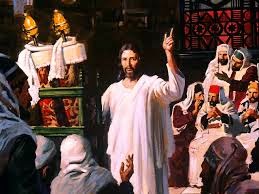
John 6:30 begins a colloquy that took place in the synagogue at Capernaum. The Jews asked Jesus what sign he could perform so that they might believe in him. As a challenge, they noted that "our ancestors ate manna in the desert." Could Jesus top that? He told them the real bread from heaven comes from the Father. "Give us this bread always," they said. Jesus replied, "I am the bread of life; whoever comes to me will never hunger, and whoever believes in me will never thirst." At this point the Jews understood him to be speaking metaphorically.


Christ speaking to the people with authority
Again and Again

Jesus first repeated what he said, then summarized: "‘I am the living bread which came down from heaven; if any one eats of this bread, he will live for ever; and the bread which I shall give for the life of the world is my flesh.’ The Jews then disputed among themselves, saying, ‘How can this man give us his flesh to eat?’" (John 6:51–52).

His listeners were stupefied because now they understood Jesus literally—and correctly. He again repeated his words, but with even greater emphasis, and introduced the statement about drinking his blood: "Truly, truly, I say to you, unless you eat the flesh of the Son of man and drink his blood, you have no life in you; he who eats my flesh and drinks my blood has eternal life, and I will raise him up at the last day. For my flesh is food indeed, and my blood is drink indeed. He who eats my flesh and drinks my blood abides in me, and I in him" (John 6:53–56).


No Corrections
people listening to Jesus

Notice that Jesus made no attempt to soften what he said, no attempt to correct "misunderstandings," for there were none. Our Lord’s listeners understood him perfectly well. They no longer thought he was speaking metaphorically. If they had, if they mistook what he said, why no correction?

On other occasions when there was confusion, Christ explained just what he meant (cf. Matt. 16:5–12). Here, where any misunderstanding would be fatal, there was no effort by Jesus to correct. Instead, he repeated himself for greater emphasis.

In John 6:60 we read: "Many of his disciples, when they heard it, said, ‘This is a hard saying; who can listen to it?’" These were his disciples, people used to his remarkable ways. He warned them not to think carnally, but spiritually: "It is the Spirit that gives life, the flesh is of no avail; the words that I have spoken to you are spirit and life" (John 6:63; cf. 1 Cor. 2:12–14).
John 6:68

But he knew some did not believe. (It is here, in the rejection of the Eucharist, that Judas fell away; look at John 6:64.) "After this, many of his disciples drew back and no longer went about with him" (John 6:66).

This is the only record we have of any of Christ’s followers forsaking him for purely doctrinal reasons. If it had all been a misunderstanding, if they erred in taking a metaphor in a literal sense, why didn’t he call them back and straighten things out? Both the Jews, who were suspicious of him, and his disciples, who had accepted everything up to this point, would have remained with him had he said he was speaking only symbolically.

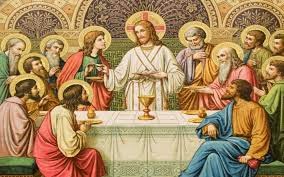
But he did not correct these protesters. Twelve times he said he was the bread that came down from heaven; four times he said they would have "to eat my flesh and drink my blood." John 6 was an extended promise of what would be instituted at the Last Supper—and it was a promise that could not be more explicit. Or so it would seem to a Catholic. But what do Fundamentalists say?


Merely Figurative?

True Body & Blood of Christ
They say that in John 6 Jesus was not talking about physical food and drink, but about spiritual food and drink. They quote John 6:35: "Jesus said to them, ‘I am the bread of life; he who comes to me shall not hunger, and he who believes in me shall never thirst.’" They claim that coming to him is bread, having faith in him is drink. Thus, eating his flesh and blood merely means believing in Christ.

True Body & Blood of Christ
But there is a problem with that interpretation. As Fr. John A. O’Brien explains, "The phrase ‘to eat the flesh and drink the blood,’ when used figuratively among the Jews, as among the Arabs of today, meant to inflict upon a person some serious injury, especially by calumny or by false accusation. To interpret the phrase figuratively then would be to make our Lord promise life everlasting to the culprit for slandering and hating him, which would reduce the whole passage to utter nonsense" (O’Brien, The Faith of Millions, 215). For an example of this use, see Micah 3:3.

Fundamentalist writers who comment on John 6 also assert that one can show Christ was speaking only metaphorically by comparing verses like John 10:9 ("I am the door") and John 15:1 ("I am the true vine"). The problem is that there is not a connection to John 6:35, "I am the bread of life." "I am the door" and "I am the vine" make sense as metaphors because Christ is like a door—we go to heaven through him—and he is also like a vine—we get our spiritual sap through him. But Christ takes John 6:35 far beyond symbolism by saying, "For my flesh is food indeed, and my blood is drink indeed" (John 6:55).

He continues: "As the living Father sent me, and I live because of the Father, so he who eats me will live because of me" (John 6:57). The Greek word used for "eats" (trogon) is very blunt and has the sense of "chewing" or "gnawing." This is not the language of metaphor.


Their Main Argument
Reading scripture

For Fundamentalist writers, the scriptural argument is capped by an appeal to John 6:63: "It is the spirit that gives life, the flesh is of no avail; the words that I have spoken to you are spirit and life." They say this means that eating real flesh is a waste. But does this make sense?

Are we to understand that Christ had just commanded his disciples to eat his flesh, then said their doing so would be pointless? Is that what "the flesh is of no avail" means? "Eat my flesh, but you’ll find it’s a waste of time"—is that what he was saying? Hardly.

The fact is that Christ’s flesh avails much! If it were of no avail, then the Son of God incarnated for no reason, he died for no reason, and he rose from the dead for no reason. Christ’s flesh profits us more than anyone else’s in the world. If it profits us nothing, so that the incarnation, death, and resurrection of Christ are of no avail, then "your faith is futile and you are still in your sins. Then those also who have fallen asleep in Christ have perished" (1 Cor. 15:17b–18).

In John 6:63 "flesh profits nothing" refers to mankind’s inclination to think using only what their natural human reason would tell them rather than what God would tell them. Thus in John 8:15–16 Jesus tells his opponents: "You judge according to the flesh, I judge no one. Yet even if I do judge, my judgment is true, for it is not I alone that judge, but I and he who sent me." So natural human judgment, unaided by God’s grace, is unreliable; but God’s judgment is always true.

The Words I have spoken to you are Spirit & Life
And were the disciples to understand the line "The words I have spoken to you are spirit and life" as nothing but a circumlocution (and a very clumsy one at that) for "symbolic"? No one can come up with such interpretations unless he first holds to the Fundamentalist position and thinks it necessary to find a rationale, no matter how forced, for evading the Catholic interpretation. In John 6:63 "flesh" does not refer to Christ’s own flesh—the context makes this clear—but to mankind’s inclination to think on a natural, human level. "The words I have spoken to you are spirit" does not mean "What I have just said is symbolic." The word "spirit" is never used that way in the Bible. The line means that what Christ has said will be understood only through faith; only by the power of the Spirit and the drawing of the Father (cf. John 6:37, 44–45, 65).


Paul Confirms This

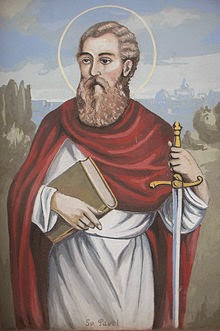
St. Paul
Paul wrote to the Corinthians: "The cup of blessing which we bless, is it not a participation in the blood of Christ? The bread which we break, is it not a participation in the body of Christ?" (1 Cor. 10:16). So when we receive Communion, we actually participate in the body and blood of Christ, not just eat symbols of them. Paul also said, "Therefore whoever eats the bread and drinks the cup of the Lord unworthily will have to answer for the body and blood of the Lord. . . . For any one who eats and drinks without discerning the body, eats and drinks judgment on himself" (1 Cor. 11:27, 29). "To answer for the body and blood" of someone meant to be guilty of a crime as serious as homicide. How could eating mere bread and wine "unworthily" be so serious? Paul’s comment makes sense only if the bread and wine became the real body and blood of Christ.


What Did the First Christians Say?

Anti-Catholics also claim the early Church took this chapter symbolically. Is that so? Let’s see what some early Christians thought, keeping in mind that we can learn much about how Scripture should be interpreted by examining the writings of early Christians.

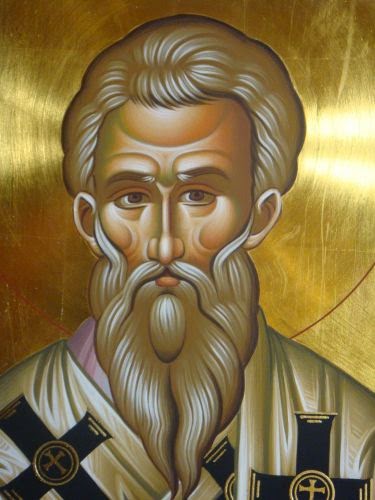
St. Ignatius of Antioch
Ignatius of Antioch, who had been a disciple of the apostle John and who wrote a letter to the Smyrnaeans about A.D. 110, said, referring to "those who hold heterodox opinions," that "they abstain from the Eucharist and from prayer, because they do not confess that the Eucharist is the flesh of our Savior Jesus Christ, flesh which suffered for our sins and which the Father, in his goodness, raised up again" (6:2, 7:1).

St. Justin Martyr
Forty years later, Justin Martyr, wrote, "Not as common bread or common drink do we receive these; but since Jesus Christ our Savior was made incarnate by the word of God and had both flesh and blood for our salvation, so too, as we have been taught, the food which has been made into the Eucharist by the Eucharistic prayer set down by him, and by the change of which our blood and flesh is nourished, . . . is both the flesh and the blood of that incarnated Jesus" (First Apology 66:1–20).

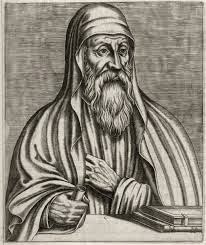
Origen
Origen, in a homily written about A.D. 244, attested to belief in the Real Presence. "I wish to admonish you with examples from your religion. You are accustomed to take part in the divine mysteries, so you know how, when you have received the Body of the Lord, you reverently exercise every care lest a particle of it fall and lest anything of the consecrated gift perish. You account yourselves guilty, and rightly do you so believe, if any of it be lost through negligence" (Homilies on Exodus 13:3).

Cyril of Jerusalem, in a catechetical lecture presented in the mid-300s, said, "Do not, therefore, regard the bread and wine as simply that, for they are, according to the Master’s declaration, the body and blood of Christ. Even though the senses suggest to you the other, let faith make you firm. Do not judge in this matter by taste, but be fully assured by faith, not doubting that you have been deemed worthy
of the body and blood of Christ" (Catechetical Discourses: Mystagogic 4:22:9).

Theodore of Mopsuestia
In a fifth-century homily, Theodore of Mopsuestia seemed to be speaking to today’s Evangelicals and Fundamentalists: "When [Christ] gave the bread he did not say, ‘This is the symbol of my body,’ but, ‘This is my body.’ In the same way, when he gave the cup of his blood he did not say, ‘This is the symbol of my blood,’ but, ‘This is my blood,’ for he wanted us to look upon the [Eucharistic elements], after their reception of grace and the coming of the Holy Spirit, not according to their nature, but to receive them as they are, the body and blood of our Lord" (Catechetical Homilies 5:1).


Unanimous Testimony

Early Christian worship
Whatever else might be said, the early Church took John 6 literally. In fact, there is no record from the early centuries that implies Christians doubted the constant Catholic interpretation. There exists no document in which the literal interpretation is opposed and only the metaphorical accepted.

Why do Fundamentalists and Evangelicals reject the plain, literal interpretation of John 6? For them, Catholic sacraments are out because they imply a spiritual reality—grace—being conveyed by means of matter. This seems to them to be a violation of the divine plan. For many Protestants, matter is not to be used, but overcome or avoided.

One suspects, had they been asked by the Creator their opinion of how to bring about mankind’s salvation, Fundamentalists would have advised him to adopt a different approach. How much cleaner things would be if spirit never dirtied itself with matter! But God approves of matter—he approves of it because he created it—and he approves of it so much that he comes to us under the appearances of bread and wine, just as he does in the physical form of the Incarnate Christ.


NIHIL OBSTAT: I have concluded that the materials
presented in this work are free of doctrinal or moral errors.
Bernadeane Carr, STL, Censor Librorum, August 10, 2004
IMPRIMATUR: In accord with 1983 CIC 827
permission to publish this work is hereby granted.
+Robert H. Brom, Bishop of San Diego, August 10, 2004
Share on twitterShare on emailShare on printShare on gmailShare on stumbleuponMore Sharing Services

Wednesday, 11 June 2014

Living for Christ and not the world

St. Ignatius of Antioch
From a letter to the Romans

by Saint Ignatius of Antioch,
bishop and martyr
My earthly
desires
have been crucified
 
The delights of this world and all its kingdoms will not profit me.  I would prefer to die in Jesus Christ than to rule over all the earth.  I seek him who died for us, I desire him who rose for us.  I am in the throes of being born again.  Bear with me, my brothers; do not keep me from living, do not wish me to die.  I desire to belong to God; do not give me over to the world, and do not seduce me with perishable things.  Let me see the pure light, when I am there, I shall be truly a man at last.  Let me imitate the sufferings of my God.  If anyone has God in him, let him understand what I want and have sympathy for me, knowing what drives me on.
The price of this world would snatch me away and destroy my desire to be with God.  So let none of you who will be there give him help; side rather with me, that is, with God.  Do not have Jesus Christ on your lips and the world in our hearts.  Give envy no place among you.  And if, when I get there, I should beg for your intervention, pay no attention to me; no, believe instead what I am writing to you now.  For I write to you while I yet live, but I long for death.  My early desires have been crucified, and there no long burns in me the love of perishable things, but a living water speaks within me, say: “Come to the Father.”
I take no delight in corruptible food or in the pleasures of this life.  I want the bread of God, which is the flesh of Jesus Christ, who was David’s seed, and for drink I want his blood, the sign of his imperishable love.
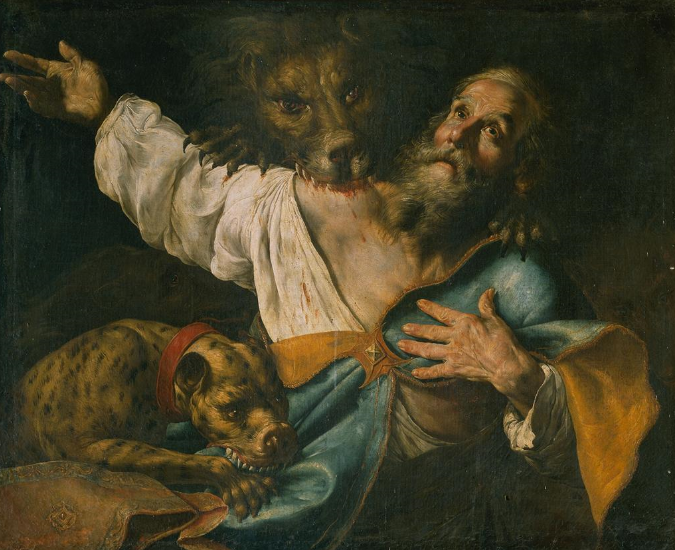
Martyrdom of St. Ignatius of Antioch by Cesar Fracanzano
I no longer wish to live, as men count life.  And I shall have my way, if you wish it so.  Wish it, then, so that you too may have God’s favor.  With these few words I beg you to believe me.  Jesus Christ will make plain to you the truth of what I say; he is the true voice that speaks the Father’s truth.  Pray for me that I may reach my goal.  I have written to you not prompted by merely human feelings and values, but by God’s purpose for me.  If I am to suffer, it will be because you loved me well; if I am rejected, it will be because you hated me.  Remember in your prayers the church of Syria: it now has God for its shepherd instead of me.  Jesus Christ alone will be its bishop, along with your love.  For myself, I am ashamed to be counted among its members, for I do not deserve it, being the least of all, born out of due time.  Yet, if I attain to God, by his mercy I shall be something.  I greet you from the heart, and so do the churches that have welcomed me in love not as a mere passerby but as the representative of Jesus Christ.  Yes, even the churches that were not on my route humanly speaking, though spiritually on the same journey, were there to meet me in city after city.
 
taken from the Liturgy of the Hours (Divine Office) June 10
 
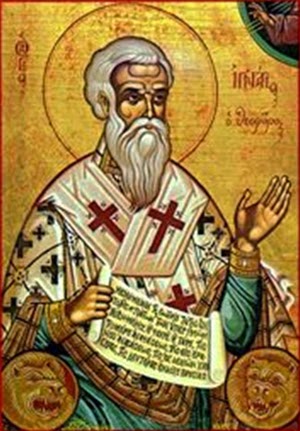
St. Ignatius of Antioch 
St. Ignatius of Antioch
 
Feast Day October 17
St. Ignatius of Antioch was the second bishop of Antioch, Syria.  He was the beloved disciple of John and was consecrated a Bishop around the year 69 by the Apostle Peter, the first Pope.  He was deeply loved by the faithful because of his holiness.  He defended “orthodoxy” (the right teaching) and “orthoproxy” (the right practice) among the early Christians.
He journeyed through Asia Minor and Greece and and wrote sevn letters of encouragement, instruction and inspiration to the Christians in those communities.  The letter written above is a prime example of his great faith and teachings.
St. Ignatius of Antioch was the first to use the term “Catholic” to describe the whole Church.  His letters serve as a unbroken and clear teaching of the Apostles which was given to them directly by Jesus Christ.
In the year 107, under the reign of Emperor Trajan, was sentenced to death because of his refusal to renounce the Christian faith.  He was taken under guard to Rom where he was brutally devoured by wild beasts in a public spectacle.  His holy martyrdom, the shedding of his blood, was a culmination of a life lived conformed to Jesus Christ.
“Permit me to imitate my suffering God… I am God’s wheat and I shall be ground by the teeth of beasts, that I may become the pure bread of Christ.”
Information gathered from Catholic Online