Ad

Showing posts with label Early Fathers of the Church. Show all posts

Wednesday, 11 June 2014

Living for Christ and not the world

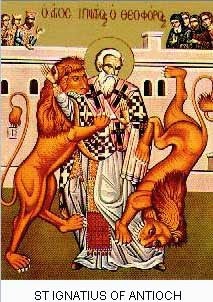
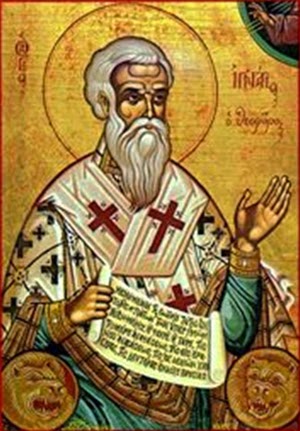
St. Ignatius of Antioch
From a letter to the Romans

by Saint Ignatius of Antioch,
bishop and martyr
My earthly
desires
have been crucified
 
The delights of this world and all its kingdoms will not profit me.  I would prefer to die in Jesus Christ than to rule over all the earth.  I seek him who died for us, I desire him who rose for us.  I am in the throes of being born again.  Bear with me, my brothers; do not keep me from living, do not wish me to die.  I desire to belong to God; do not give me over to the world, and do not seduce me with perishable things.  Let me see the pure light, when I am there, I shall be truly a man at last.  Let me imitate the sufferings of my God.  If anyone has God in him, let him understand what I want and have sympathy for me, knowing what drives me on.
The price of this world would snatch me away and destroy my desire to be with God.  So let none of you who will be there give him help; side rather with me, that is, with God.  Do not have Jesus Christ on your lips and the world in our hearts.  Give envy no place among you.  And if, when I get there, I should beg for your intervention, pay no attention to me; no, believe instead what I am writing to you now.  For I write to you while I yet live, but I long for death.  My early desires have been crucified, and there no long burns in me the love of perishable things, but a living water speaks within me, say: “Come to the Father.”
I take no delight in corruptible food or in the pleasures of this life.  I want the bread of God, which is the flesh of Jesus Christ, who was David’s seed, and for drink I want his blood, the sign of his imperishable love.
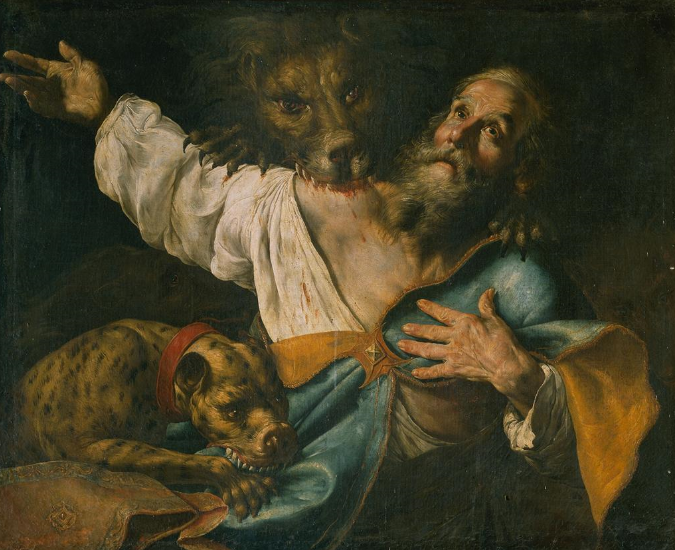
Martyrdom of St. Ignatius of Antioch by Cesar Fracanzano
I no longer wish to live, as men count life.  And I shall have my way, if you wish it so.  Wish it, then, so that you too may have God’s favor.  With these few words I beg you to believe me.  Jesus Christ will make plain to you the truth of what I say; he is the true voice that speaks the Father’s truth.  Pray for me that I may reach my goal.  I have written to you not prompted by merely human feelings and values, but by God’s purpose for me.  If I am to suffer, it will be because you loved me well; if I am rejected, it will be because you hated me.  Remember in your prayers the church of Syria: it now has God for its shepherd instead of me.  Jesus Christ alone will be its bishop, along with your love.  For myself, I am ashamed to be counted among its members, for I do not deserve it, being the least of all, born out of due time.  Yet, if I attain to God, by his mercy I shall be something.  I greet you from the heart, and so do the churches that have welcomed me in love not as a mere passerby but as the representative of Jesus Christ.  Yes, even the churches that were not on my route humanly speaking, though spiritually on the same journey, were there to meet me in city after city.
 
taken from the Liturgy of the Hours (Divine Office) June 10
 
St. Ignatius of Antioch 
St. Ignatius of Antioch
 
Feast Day October 17
St. Ignatius of Antioch was the second bishop of Antioch, Syria.  He was the beloved disciple of John and was consecrated a Bishop around the year 69 by the Apostle Peter, the first Pope.  He was deeply loved by the faithful because of his holiness.  He defended “orthodoxy” (the right teaching) and “orthoproxy” (the right practice) among the early Christians.
He journeyed through Asia Minor and Greece and and wrote sevn letters of encouragement, instruction and inspiration to the Christians in those communities.  The letter written above is a prime example of his great faith and teachings.
St. Ignatius of Antioch was the first to use the term “Catholic” to describe the whole Church.  His letters serve as a unbroken and clear teaching of the Apostles which was given to them directly by Jesus Christ.
In the year 107, under the reign of Emperor Trajan, was sentenced to death because of his refusal to renounce the Christian faith.  He was taken under guard to Rom where he was brutally devoured by wild beasts in a public spectacle.  His holy martyrdom, the shedding of his blood, was a culmination of a life lived conformed to Jesus Christ.
“Permit me to imitate my suffering God… I am God’s wheat and I shall be ground by the teeth of beasts, that I may become the pure bread of Christ.”
Information gathered from Catholic Online

Thursday, 5 June 2014

St. Bonfice - Standing up and Defending the Church


From a letter by Saint Boniface, bishop and martyr
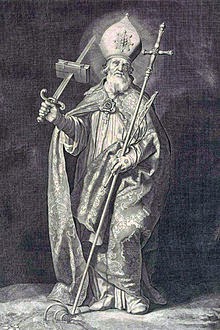
St. Boniface
 
The Careful Shepherd watches over Christ’s flock
 
In her voyage across the ocean of this world, the Church is like a great ship being pounded by the waves of life’s different stresses.  Our duty is not to abandon ship but to keep her on her course.
The ancient fathers showed us how we should carry out this duty.  Clement, Cornelius and many others in the city of Rome, Cyprian at Carthage, Athanasius at Alexandria.  They all lived under Emperors who were pages; they all steered the Christ’s ship—or rather his most dear spouse, the Church.  This they did by teaching and defending her, by their labors and sufferings, even to the shedding of blood.
I am terrified when I think of all this. Fear and trembling came upon me and the darkness of my sins almost covered me. I would gladly give up the task of guiding the Church which I  have accepted if I could find sucha an action warranted by the example of the fathers or by holy Scripture.
St. Boniface Icon
Since this is the case, and since the truth can be assaulted by never defeated or falsified, with our tired mind let us turn to the words of Solomon: Trust in the Lord with all your heart and dod not rely on your own prudence.  Thon on him in all your ways, and he will guide your steps.   In another place her says: The name of the Lord is an impregnable tower. The just man seeks refuge in it and he will be saved.
Let us stand fast in what is right and prepare our souls for trial.  Let us wait upon God’s strengthening aid and say to him: O Lord, you have been our refuge in all generations.
Let us trust in him who has placed this burden upon us.  What we ourselves cannot bear let us bear with the help of Christ.  For he is all-powerful and he tells us: My yoke is easy and my burden is light.
Let us continue the fight on the day of the Lord.  The days of anguish and tribulation have overtaken us; if God so wills, let us die for the holy laws of our fathers, so that we may deserve to obtain an eternal inheritance with them.
Let us be neither dogs that do not bark nor silent onlookers nor paid servants who run away before the wolf.  Instead let us be careful shepherds watching over Christ’s flock.  Let us preach the whole of God’s plan to the powerful and to the humble, to rich and to poor, to men of every rank and age, as far as God gives us the strength, in season and out of season, as Saint Gregory writes in his book of Pastoral Instruction.
 
Who is Saint Boniface?
 
(Latin: Bonifatius) (c. 675? – 5 June 754), born Winfrid, Wynfrith, or Wynfryth in the kingdom of Wessex, probably at Crediton, was an Anglo-Saxon missionary who propagated Christianity in the Frankish Empire during the 8th century. He is the patron saint of Germany, the first archbishop of Mainz and the "Apostle of the Germans". He was killed in Frisia in 754, along with 52 others. His remains were returned to Fulda, where they rest in a sarcophagus which became a site of pilgrimage. Facts about Boniface's life and death as well as his work became widely known, since there is a wealth of material available—a number of vitae, especially the near-contemporary Vita Bonifatii auctore Willibaldi, and legal documents, possibly some sermons, and above all his correspondence.
 ...Through his efforts to reorganize and regulate the church of the Franks, he helped shape Western Christianity, and many of the dioceses he proposed survive today. After his martyrdom, he was quickly hailed as a saint in Fulda and other areas in Germany and in England. His cult is still notably strong today. Boniface is celebrated as a missionary; he is regarded as a unifier of Europe, and he is seen as a German national figure.
 
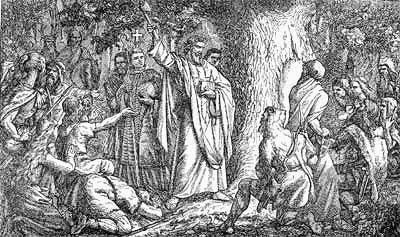
St. Boniface felling the oak tree that was venerated as a God
The Incident at Thor's Oak 
To show the heathens how utterly powerless were the gods in whom they placed their confidence, Boniface felled the oak sacred to the thunder-god Thor, at Geismar, near Fritzlar. He had a chapel built out of the wood and dedicated it to the prince of the Apostles. The heathens were astonished that no thunderbolt from the hand of Thor destroyed the offender, and many were converted. The fall of this oak marked the fall of heathenism. Tradition tells us that Boniface now passed on to the River Werra and there erected a Church of St. Vitus, around which sprang up a town which to the present day bears the name of Wannfried. At Eschwege he is said to have destroyed the statue of the idol Stuffo. Thence he went into Thuringia.
Check out this website for more detailed information regarding this great saint. 

Wednesday, 4 December 2013

WHAT is the IMMACUALATE CONCEPTION???


 IMMACULATE CONCEPTION ...
WHAT IS IT???

WOW, there is a lot of misunderstanding about what Immaculate Conception is... so I thought I should address this topic since the Feast of the Immaculate Conception is celebrated DECEMBER 8th.

NO, this is not about Jesus being Conceived in Mary's womb...We celebrate that on March 25th called the Annunciation of the Lord.

The Immaculate Conception is the realization that God the Father made Mary perfect without stain of sin... she was "Immaculately Conceived."  How can anyone think that God would allow his true goodness and purity -- His Only Begotten Son -- to enter a sinful body????    In my simple little faith -- I can see this as truth, can't you??

I read somewhere (if I find the text I'll add it), that God the Father, knowing that He would send His Son had Mary Immaculately Conceived through the future merits that Her Son would achieve in His Passion and Death on the Cross.  
 
Church Fathers
Throughout the centuries Church Fathers have professed this as fact, but it wasn't until  Pope Pius IX, on December 8, 1854, would declare it a dogma.

"...We turn to the early Fathers of the Church. First, many, not all of them, make sweeping statements about her holiness. That could imply an Immaculate Conception. Secondly, very many of them speak of her as the New Eve. They could have reasoned: the first Eve had an immaculate start in life--no sin was yet committed. So the New Eve, who was to share in undoing the harm of original sin, should have also an immaculate start. However, none of the Fathers actually followed this line of reasoning. (A few Fathers even tried to find sins she had committed, e.g. St. John Chrysostom, Homilies on John 21. PG 59. 130ff)." 
 

Pope Pius IX

In the Apostolic Constitution Ineffabilis Deus, Pope Pius IX wrote that 

"We declare, pronounce, and define that the doctrine which holds that the most Blessed Virgin Mary, in the first instance of her conception, by a singular grace and privilege granted by Almighty God, in view of the merits of Jesus Christ, the Savior of the human race, was preserved free from all stain of original sin, is a doctrine revealed by God and therefore to be believed firmly and constantly by all the faithful." 
http://catholicism.about.com/od/beliefsteachings/f/Imm_Concept_FAQ.htm

There are many writings about the Immaculate Conception just 'Google' it...you will find them all there.  and also check out the Catechism of the Catholic Church for further explanations and doctrine.