Showing posts with label sin. Show all posts
Showing posts with label sin. Show all posts
Friday, 26 March 2021


Monday, 8 March 2021
Wednesday, 12 April 2017
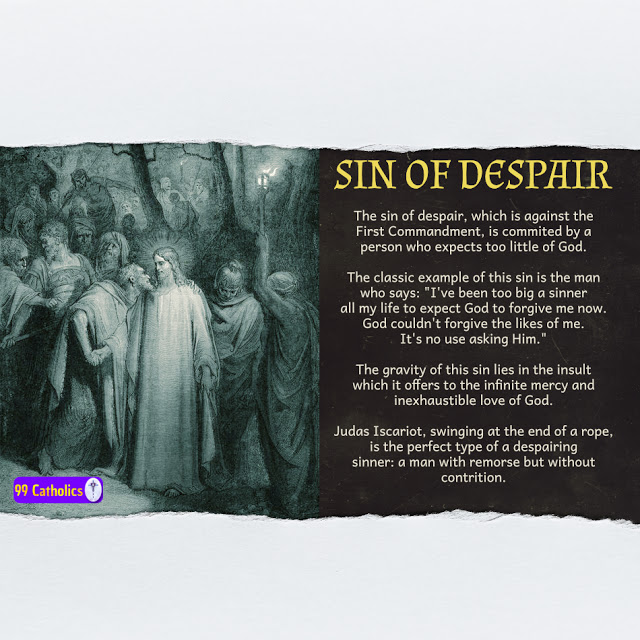
Denial of sins and Judas Iscariot
 |
| Judas Iscariot betrayal of Jesus |
Stuck in Denial
Excerpt from the Book
Lent and Easter Reflections -
Catholic Daily Reflections Series
by John Paul Thomas
(Wednesday of Holy Week)
“The Son of Man indeed
goes, as it is written of him, but woe to that man by whom the Son of Man is
betrayed. It would be better for that
man if he had never been born.” Then Judas, His betrayer, said in reply, “Surely
it is not I, Rabbi?” He answered, “You
have said so.” Matthew 26:25
Was Judas in denial? Did he truly think that he was not the
one who was to betray Jesus? We do not
know for certain what was going on in Judas’ mind, but one thing is clear. . .
he did betray Jesus. And it appears from
his words that he didn’t see his act as a betrayal and, therefore, he was in
deep denial.
Denial, if written out as an acronym, has been said to mean
that I “don’t know I am lying.” Perhaps Judas was so steeped in his own sin
that he couldn’t even admit to himself, let alone to others, that he was lying
and preparing to betray Jesus for money.
This is a scary thought.
It’s scary because it reveals one of the effects of
persistent sin.
Persistent sin makes sin easier.
And eventually, when one persists in the same
sin,
that sin is easily rationalized,
justified and denied as sin altogether.
When one gets stuck in this downward spiral
of persistent sin it’s hard to get out.
And often the only way to survive the psychological tension is to remain
in denial.
 |
| Judas the Betrayer |
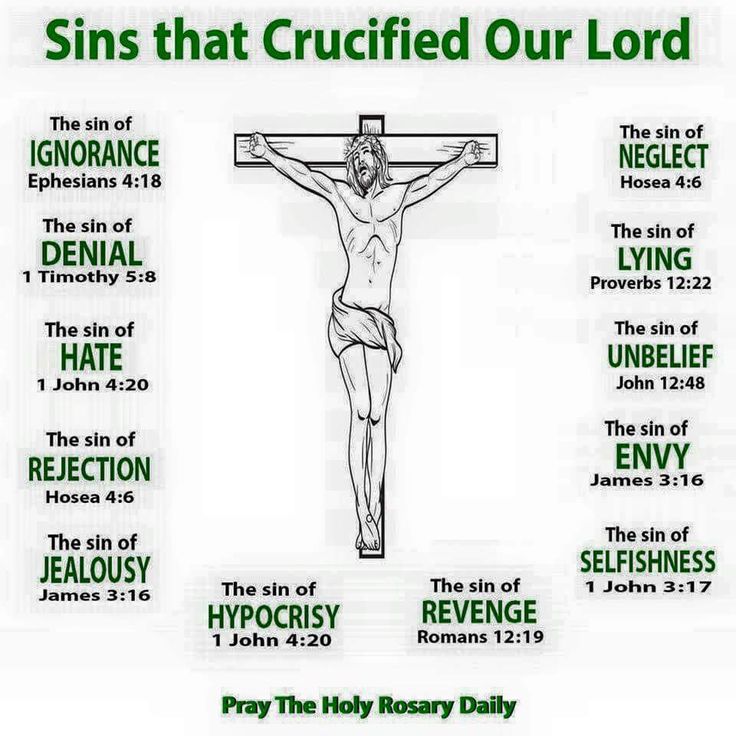
This is an important lesson for us this Holy Week. Sin is never fun to look at and takes great
courage to do so. But imagine if Judas
would have actually confessed to what he was about to do. Imagine if he would have broken down in front
of Jesus and the other Apostles and told them the whole truth. Perhaps that act of honesty would have saved
his life and eternal soul. It would have
been painful and humiliating for him to do so, but it would have been the right
thing to do.
The same is true with you.
Perhaps you are not to a point where your sin is leading you to outright
betrayal of Jesus, but everyone can find some pattern of sin in their lives
this Holy Week. You must seek to discover, with God’s help, some pattern or
habit you have formed. What a great
discovery this would be if you could then face this sin with honesty and
courage. This would enable you to shed
any bit of denial regarding your sin and enable you to conquer that sin so as
to discover the freedom God wants you to experience!
Reflect today, upon Judas saying to Jesus, “Surely it is not
I, Rabbi?” This sad statement from Judas
must have deeply wounded our Lord’s Heart as He witnessed the denial of
Judas. Reflect, also, upon the many
times that you deny your sin, failing to sincerely repent. Make this Holy Week a time for honesty and
integrity. The Lord mercy is so deep and
pure that, if you would understand it, you would have no need to remain in any
form of denial of your sins.
Lord, help me this Holy
Week to have the courage I need to face my sin and weakness. I am a sinner, dear Lord, but it can be very
hard for me to admit it. May I entrust
my sin to You so that I may be set free and receive, in its place, Your
abundant mercy. Jesus I trust in You.
Excerpt from the Book
Lent and Easter Reflections -
Catholic Daily Reflections Series
by John Paul Thomas
I highly recommend this book you can order it on Amazon..books and Kindle edition.
I highly recommend this book you can order it on Amazon..books and Kindle edition.
Monday, 27 March 2017
Sins are Numbered - Tremble and Sin No More
 |
| St. Alphonsus Liguori |
From the Book,
"Preparation for Death: Considerations on Eternal Truths"
by St. Alphonsus Liguori
Consideration XVIII: The Number of Sins
“Because sentence is not speedily pronounced against evil,
the children of men commit evil without fear.” – Eccles. 8:11
FIRST POINT
The Measure is Determined for Each One
IF God instantly chastises the man who insults him, we
certainly should not see him so much outrages as we do at present. But because the Lord does not instantly
punish sinners, but waits for them, they are encouraged to offend him the
more. It is necessary to understand
that, though God waits and bears, he does not wait and bear forever.
It is the opinion of many holy Fathers – of St.
Basil, St. Jerome, St. Ambrose, St. Cyril of Alexandria, St. John Chrysostom,
St. Augustine, and others – that as God, according to the words of Scripture,
Wis. 11:21,
Thou hast ordered all things in measure,
and number and weight has
fixed for each
the number of his days, the degrees of health and talent
which
he will give to him,
so he has also determined the number of sins
that he will
pardon;
and when this number is completed,
he will pardon no more.
Eusebius of Caesarea says the same thing: “God
waits up to a certain number, and afterwards abandons;” and so speak also the
above-mentioned Fathers.
And these Fathers have not spoken at random, but according to
the sacred Scriptures. In one place the
Lord says that he restrained his vengeance against the Amorrithes, because the
number of their sins was not as yet filled up:
For as yet the iniquities of the Amorrithes (Amorites*) are not at the full (Gen
15:16). In another place he says: I will
not add any more to have mercy on the house of Israel (Os. I,6). Again he says: All the men who have tempted
Me ten times shall not see the land (Num. 15:22). Thou hast, says Job, sealed up my offences as
it were in a bag (Job 14:16).
Sinners keep no account of their sins; but God keeps an account of them, that when the harvest is ripe, that is, when the number of sins is completed, he may take vengeance on them. Put ye in the sickles; for the harvest is ripe (Joel 3:13).
In another place he says: Be not without fear about sin forgiven, and
add not sin to sin (Sirach 5:5**). As if
he said: O sinner! You must tremble even on account of the sins which I have
forgiven you; for it you add another, if may happen that this new sin, along
with those which have been pardoned, may complete the number, then there will
be no more mercy for you. The Lord
waiteth patiently, that when the day of judgment shall come, he may punish them
in the fullness of their sins (2 Mac. 6:14).
God waits till the measure of iniquities is filled up, and then he
chastises the sinner.
Sinners keep no account of their sins; but God keeps an account of them, that when the harvest is ripe, that is, when the number of sins is completed, he may take vengeance on them. Put ye in the sickles; for the harvest is ripe (Joel 3:13).
 |
| handwriting on the wall—Mene, Thecel, Phares |
Of such chastisements there are many examples in the Scriptures. Saul disobeyed God a second time, and was
abandoned. When he entreated Samuel to
intercede for him, saying: Bear, I beseech thee, my sin, and return with me that
I may adore the Lord, Samuel answered: I
will not return with thee, because thou hast rejected the word of the Lord, and
the Lord hath rejected thee (1 Kings15:25).
We have also the example of Balthasar, who, after having profaned the vessels of the temple at table, saw a handwriting on the wall—Mene, Thecel, Phares. Daniel came, and in explaining the words, among other things, said: Thou art weighed in the balance, and art found wanting (Dan. 5:27). By these words he gave the king to understand that in the balance of divine justice the weight of his sins had made the scale descend. The same night Balthasar, the Chaldean king, was killed.
There are some who spend their time in investigating the number of the stars, the number of the angels, or the number of years which each one will live.
My brother, it may be that God will pardon you no more after the first criminal pleasure which you indulge, after the first thought to which you consent, or after the first sin which you commit.
We have also the example of Balthasar, who, after having profaned the vessels of the temple at table, saw a handwriting on the wall—Mene, Thecel, Phares. Daniel came, and in explaining the words, among other things, said: Thou art weighed in the balance, and art found wanting (Dan. 5:27). By these words he gave the king to understand that in the balance of divine justice the weight of his sins had made the scale descend. The same night Balthasar, the Chaldean king, was killed.
Oh ! how many
miserable sinners meet with a similar fate!
They live many years, multiplying sins;
but when the number is filled
up,
they are struck dead, and cast into hell!
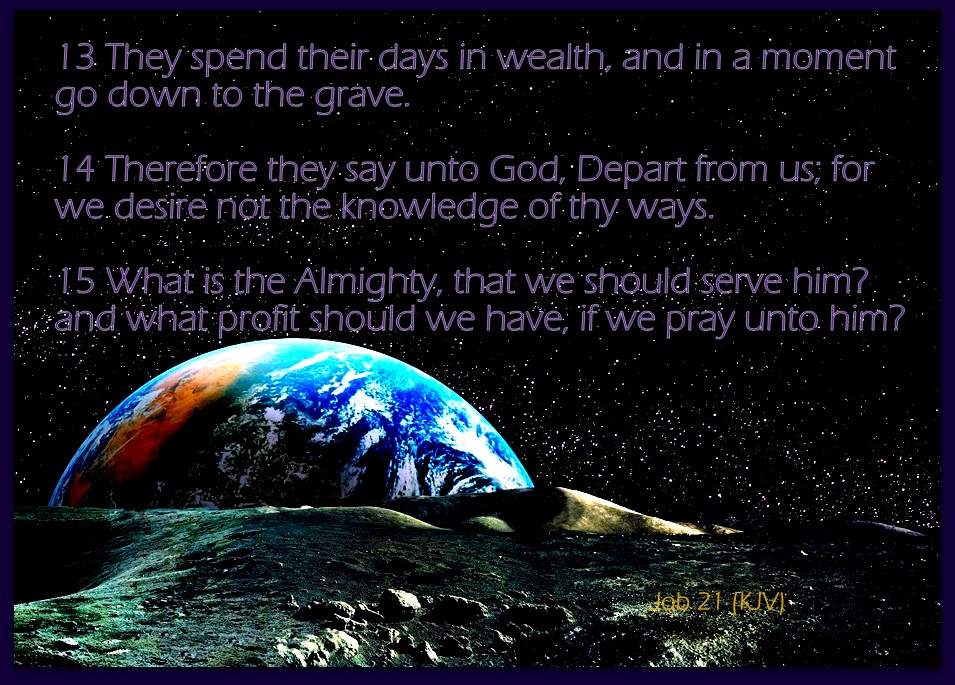
They spend their days in wealth, and in a moment they go down to hell
(Job 21:13).
There are some who spend their time in investigating the number of the stars, the number of the angels, or the number of years which each one will live.
But who can discover the number of sins
which
God will pardon each individual?
We
should, therefore, tremble.
My brother, it may be that God will pardon you no more after the first criminal pleasure which you indulge, after the first thought to which you consent, or after the first sin which you commit.
 |
| Contrite Heart |
Affections
and
Prayers
Behold me, O my God! at
Thy feet. I am that disgusting dog that
has so often eaten the forbidden apples, which I before detested. I do not deserve mercy: but, O My Redeemer! The Blood which Thou shed for me encourages
me and obliges me to hope for it.
How
often have I offended Thee and Thou hast pardoned me! I promised never more to offend Thee, and I
have afterward returned to the vomit: (Prov 26:11) and Thou has again pardoned
me! What do I wait for? Is it that Thou
mayest send me to hell, or that Thou mayest abandon me into the hand of my
sins, which would be a greater punishment than hell?
No, my God!
I wish to amend: and in order to be faithful to Thee, I will put all my confidence
in Thee, I will, whenever tempted, always and instantly have recourse to
Thee.
Hitherto I have trusted in my
promises and resolutions, and have neglected to recommend myself to Thee in my
temptations: this has been the cause of my ruin. Henceforth Thou shalt be my hope and my strength,
and thus I shall be able to do all things.
I can do all things in Him that strengthened me. (Phil
4:13). Give me grace then, O my Jesus,
through Thy merits, to recommend myself to Thee, and to ask Thy aid in my
wants. I love Thee, O Sovereign Good,
amiable above every good. I wish to love
Thee alone; but it is from Thee I must receive aid to love Thee.
O Mary, my Mother! Do thou also assist me by
thy intercession; keep me under thy protection, and make me always invoke thee
when I am tempted. Thy name shall be my
defence.
*Amorites (Amorrithes)
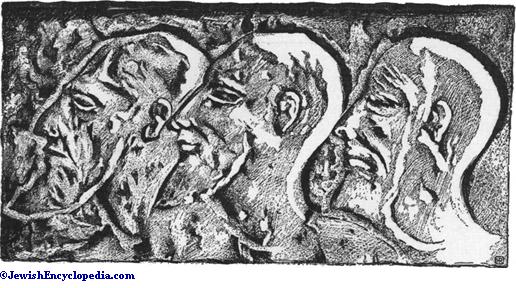 |
| The Amorites |
. . . the isolated
remnants of the Amorites, who in pre-Philistine and pre-Israelitish times had
occupied a large part of the country west of the Jordan.
Amorites.(From the pylon
of the Ramesseum.)
In Tosef., Shab. (vii.
[viii.] 23), and generally in post-Biblical literature, the Canaanites are
usually spoken of as the Amorites (compare Assumptio Mosis, xi. 16; B. M. 25b);
and they were characterized by R. Jose, the chronicler, as the most intractable
of all nations. To the apocryphal writers of the first and second pre-Christian
century they are the main representatives of heathen superstition, loathed as
idolaters, in whose ordinances Israelites may not walk (Lev. xviii. 3).
A special section of the
Talmud (Tosef., Shab. vi.-vii. [vii.-viii.]; Bab. Shab. 67a et seq.) is devoted
to the various superstitions called "The Ways of the Amorites."
According to the Book of Jubilees (xxix. [9] 11), "the former terrible
giants, the Rephaim, gave way to the Amorites, an evil and sinful people whose
wickedness surpasses that of any other, and whose life will be cut short on
earth." In the Syriac Apocalypse of Baruch (lx.) they are symbolized by
"black water" on account of "their black art, their witchcraft
and impure mysteries, by which they contaminated Israel in the time of the
Judges."
**Sirach 5:5-7 Sirach 5:5-7Douay-Rheims 1899 American Edition (DRA)
5 Be not without fear about sin forgiven, and add not sin upon sin:
6 And say not: The mercy of the Lord is great, he will have mercy on
the multitude of my sins.
7 For mercy and wrath quickly come from him, and his wrath looketh upon
sinners.
Tuesday, 19 July 2016
Prayer of Contrition
 |
| Christ Teaching - Sermon on the Mount |
Jesus,
Forgive me!
O Eternal Word!
You
have spent three-and-thirty years in labors and fatigues;
You have given Your
life and Your blood for man’s salvation;
in short, You have spared nothing to
make men love you;
and how is it possible that there should be those who know
this, and yet do not love You?
O God, amongst these ungrateful ones I also may be
numbered!

I see the wrong I have done
You;
O my Jesus, have pity upon me!
I
offer You this ungrateful heart ungrateful it is true, but penitent.
Yes, I repent of every evil,
O my dear Redeemer, for having
despised You!
I repent, and I am sorry
with my whole heart.
O my soul, love a
God Who is bound like a criminal for you;
a God scourged like a slave for you;
a God made a mocking for you;
a God, in
short, dead upon a cross, as the vilest outcast for you!
Yes, My Saviour, let me remember, I beseech You, all that
You have suffered for me that I may never more forget to love You!

O cords that bound my Jesus,
bind me to Jesus;
thorns that
crowned my Jesus,
pierce me with the love of Jesus;
nails that transfixed my
Jesus,
nail me to the Cross of Jesus
O
blood of Jesus,
inebriate me with His Holy Love!
O death of Jesus,
make me die to every
earthly affection!
Pierced feet of my
Lord,
I embrace you;
deliver me from hell, which I have deserved;
my Jesus, in
hell I could no more love You,
and yet I desire to love You always.
Save me, my dearest Saviour;
bind me to
Yourself, that I may never again lose You.

O Mary, refuge of Sinners, and Mother of my Saviour!
Help a sinner who wishes to love God, and who
recommends himself to you; help me for the love you bear for Jesus Christ.
Friday, 8 July 2016
Wisdom of Augustine: A Sacrifice to God is a Contrite Spirit

From a sermon by Saint Augustine, Bishop
I acknowledge my
transgressions, says David.
If I
admit my fault, then you will pardon it.
Let us never assume
that if we live good lives
we will be without sin;
our lives should be praised only
when we continue to beg for pardon.
But men are hopeless creatures, and the less
they concentrate on their own sins the more interested they become in the sins
of others. They seek to criticize, not
to correct. Unable to excuse themselves,
they are ready to accuse others.
This was
not the way that David showed us how to pray and make amends to God, when he
said: I acknowledge my transgression, and
my sin is ever before me.
He did not concentrate
on others’ sins;
he turned
his thoughts upon himself.
He did not
merely stroke the surface, but he plunged inside and went deep down within
himself, and therefore was not impudent in asking to be spared.
Do you want God to be appeased?
Learn what you are to do that
God may be
pleased with you.
Consider the psalm
again: If you wanted sacrifice, I would
indeed have given it; in burnt offerings you will take no delight. Are you to offer nothing? Will you please God without offering?
 |
| King David |
Consider what you read in the same psalm: If you wanted sacrifice, I would indeed have
given it, in burnt offerings you will take no delight. But continue to listen, and say with
David: A sacrifice to God is a contrite
spirit; God does not despise a contrite and humble spirit.
Cast aside your former offerings, for now you
have found out what you are to offer. In
the days of your fathers you would have made offerings of cattle—these were the
sacrifices. If you wanted sacrifice, I would indeed have given it. These then, Lord, you do not want, and yet
you do want sacrifice.
You will take no
delight in burnt offerings, David says.
If you will not take delight in burnt offerings, will you remain without
sacrifice? Not at all.
A
sacrifice to God is a contrite spirit;
God does not despise a contrite
and
humble heart.
 You now have the offering you are to make. No need to examine the herd, no need to
outfit ships and travel to the most remote provinces in search of incense.
You now have the offering you are to make. No need to examine the herd, no need to
outfit ships and travel to the most remote provinces in search of incense.
Search within your heart
for what is pleasing
to God.
Your heart must be crushed.
Are you afraid that it might perish so? You have to reply: Create a clean heart in me, O God.

the unclean
one must be crushed.
We should be displeased with ourselves when we commit sin,
for sin is displeasing to God.
Sinful
though we are,
let us at least be like God in this,
that we are displeased at
what displeases Him.
In some measure
than you will be in harmony with God’s
Will, because you find displeasing in yourself what is abhorrent to your
Creator.
 |
| Beg His Mercy and He will come and lift you up. |
Sunday, 28 February 2016
REPENTANCE ALL OF US NEED IT -- Prayer by St. Alphonsus Liguori

St. Alphonsus of Liguori Spoke of Repentance
"God has said that when a sinner repents their sins are
so good as forgotten. Says Ezekiel: None
of the crimes he committed shall be remembered against him.
Whenever you fall into a fault immediately raise your eyes
to God, make an act of love and confessing your fault you may rest assured
pardon.”

A Prayer for Repentance by St. Alphonsus
Say to God –
“Master, the one you love is ill,
the heart which you love
is sick, covered with sores.
Lord, have Mercy on me –
Forgive me, I’ve sinned against you.
You, God, go out in search for sinners,
here is one at your
feet, who has come in search of you.
The evil has been done – what should I do now?
You do not want me to lose confidence in You.
Even now, after my sin, you wish me only good
and
I love you as well – as my God.
I love you with all my heart and I regret the displeasure
I
have given you. I resolve never to do so
again.
Forgive me – You, Who are God –
Kind and forgiving,
most
loving to those who call on You.
Let me hear those words
you said to Mary Magdalene,
“Your
sins are forgiven.”
Give me the strength to be faithful to You in the future.
Amen.

Monday, 7 September 2015
Not a Popularity Contest YOU MUST SPEAK THE TRUTH
 |
| Are you on the way to Hell?? |
This world has turned from God so much
that the souls in it are racing down
the road to hell and eternal damnation!!!
ARE WE AMONG THEM?
Our duty as Catholics is to stand up even against all odds -- even unto our own death to tell souls the TRUTH of Christ's Teachings.
HOMOSEXUALITY IS WRONG!!
ABORTION IS WRONG!!
CONTRACEPTION IS WRONG!!
GAY MARRIAGE IS WRONG!!
He speaks clearly about our duties as Catholics.
To remain SILENT is a sin.
Christ said we would be hated
as He was hated.
To be His True Follower
we must accept this Martyrdom even to death!!!!
HELP SPREAD THE TRUTH
FOR WE ARE ACCOUNTABLE TO GOD
AS TO WHAT WE DID TO SAVE OTHERS...
WHAT WILL GOD SAY TO YOU?

Tuesday, 26 May 2015
Wednesday, 18 March 2015
God's Mercy for Sinners

Remember to pray the Divine Mercy Chaplet at least on Good Friday through to 2nd Sunday of Easter (Divine Mercy Sunday)
as Christ requested.
Divine Mercy article separate. But here is the link to the Chaplet that I spoke of
http://thedivinemercy.org/message/devotions/praythechaplet.php
The Mercy of God to the Penitent
From a letter by Saint Maximus the Confessor, abbot
 |
| Christ forgives sinner |
So is was that Christ proclaimed that he had come to call
sinners to repentance, not the righteous, and that it was not the healthy who
required a doctor, but he sick. He
declared that he had come to loof for the sheep that was lost, and that is was
to the lost sheep of the house of Israel that he had been sent. Speaking more obscurely in the parable of the
silver coin, he tells us that the purpose of his coming was to reclaim the
royal image, which had been coated with the filth of sin. You can
be sure there is joy in heaven, he said, over one sinner who repents.

Again, he told of how the Father, who is goodness itself,
was moved with pity for his profligate son who returned and made amends by
repentance; how he embraced him, dressed him once more in the fine garments that
befitted his own dignity, and did not reproach him for any of his sins.

So also he cried out: Come
to me, all you that toil and are heavy of heat.
Accept my yoke, he said, by which he meant his commands, or rather,
the whole way of life that he taught us in the Gospel. He then speaks of a burden, but that is only
because repentance seems difficult. In
fact, however, my yoke is easy, he
assures us, and my burden is light.
Then again he instructs us in divine justice and goodness,
telling us to be like our heavenly Father, hold, perfect and merciful.

taken from the Liturgy of the Hours Wednesday, 3rd Week of Lent
Forgive,
he says, and you will be
forgiven.
Behave toward other people
as
you would wish them
to behave toward you.
taken from the Liturgy of the Hours Wednesday, 3rd Week of Lent
Letter from Hell

I read this letter on the
America Needs Fatima
webpage. (link below)
It's a letter written from the depths of hell to a
friend
who had tried without success to help the soul
who refused
the
Mercies of God in life.
I pray that you will read it, not skim through
it.
Truly read it,
and remember what it says.
Pray for those you love,
your family and friends,
and ALL sinners.
That they will be converted
and not receive this
same fate.
 |
| Divine Mercy |
Eternal Father,
I offer you
the Body and Blood,
Soul and Divinity
of Our Lord Jesus Christ,
in atonement for our sins
and those of the whole world!
For the sake of His Sorrowful Passion,
have Mercy on us
and on the whole world!
Introduction to the Letter from Beyond:
 |
| Souls in Damnation |
This letter recounts the tragic story of the eternal damnation of a young woman named Ani. Both the narrative and the letter transcribed below were found among the papers of a deceased nun, who in the world was known as Claire and worked with the condemned woman. This letter was revealed to Claire in a dream shortly after Ani was killed in a car accident.
The narrative received an Imprimatur from the diocese of Treves, Germany in 1953, authorizing its publication as highly instructive. While an Imprimatur is not an affirmation of authenticity, it guarantees that the text is free from doctrinal error. The letter first appeared in a book of revelations and prophecies. Fr. Bernhardin Krempel, Doctor of Theology, published it separately and lent it more authority with his footnotes showing the letter’s absolute concordance with Catholic Doctrine.
I had a friend. That is, we shared a mutual closeness as
friends and neighbors while we worked in the same office.
Later, when Ani got married, I never saw her again. From the
moment we met, we had between us more amiability than real friendship. So when
she moved to the elegant neighborhood of villas far from my home after her
marriage, I didn’t miss her very much.
In mid-September of 1937, while I was vacationing at Lake
Garda, my mother wrote to me: “Imagine, Ani N. died. She lost her life in an
automobile accident. She was buried yesterday in the cemetery of Woodstock.”
The news shocked me. I knew that Ani had never been truly
religious. Was she prepared when God suddenly called her? The next morning I
attended Holy Mass, which was said for her, in the chapel of the nun’s boarding
house where I stayed. I prayed fervently for her eternal repose and also
offered my Holy Communion for that intention.
I felt increasingly ill at ease throughout the day, and that
night I slept restlessly. I awoke suddenly, hearing something like the door of
my room being shaken. As I turned the light on, the clock on my nightstand
showed ten minutes after midnight. I could see nothing. The house was silent.
The waves of Lake Garda could be heard breaking monotonously on the wall of the
boarding house garden. I did not hear the wind at all.
 |
| awake |
I considered for a
moment whether or not I should get up. Ah! It was nothing but a figment of my
imagination brought on by the news of her death, I assured myself. Rolling
over, I prayed a few Our Fathers for the souls in Purgatory, and again fell
asleep.
I then dreamed that I rose at six o’clock to go to the
chapel. On opening the door to my room, I stepped on a parcel containing the
pages of a letter.
Picking it up and recognizing Ani’s handwriting, I screamed.
Trembling as I held the pages in my hands, I was, I must
confess, so shaken that I could not even utter an Our Father. I was almost
suffocating. There was nothing better to do than flee that spot and go into the
open air. I hastily arranged my hair, put the letter in my purse, and rushed
from the house.
 |
| Claire's letter |
Outside, I followed a winding path up through the hills,
passing olive and laurel trees and the neighboring farms, and going beyond the
renowned “Gardesana” highway.
The morning broke radiantly. On other days, I would stop
every hundred paces, enchanted by the magnificent view of the lake and Garda
Island. The soft blue of the water refreshed me and, like a child admiringly
gazing at her grandfather, I would gaze upon ashen-colored Mount Baldo rising
7200 feet above the opposite shore of the lake. That day, however, I did not
have eyes for any of that. After walking a quarter of an hour, I mechanically
let myself sink to the bank and leaned against two cypress trees where the day
before I had taken such pleasure in reading “The Damsel Teresa.” For the first
time I regarded the cypress trees as symbols of death, something I had taken no
notice of in the south, where these trees are common.
I took up the letter. It lacked a signature, but it was,
beyond a doubt, in Ani’s handwriting. There was no mistaking the large S nor
the French T that used to irritate Mr. G. at the office.
The style was not hers, at least not her usual style of
speaking. She conversed and laughed so amiably, with her blue eyes and her
graceful nose. Only when we discussed religious topics did she become sarcastic
and fall into a rude tone like that in the letter, whose agitated cadence I now
entered.
Here, word for word, is the “Letter from Beyond” of Ani V.
as I read it in the dream.
Reading the Letter --
Do not pray for me. I am damned.
 |
| Soul in Hell |
As I tell you this and
relate to you certain circumstances and details about my condemnation, do not
think that I do so out of friendship. Here we no longer love anyone. I do it as
“a part of that power that always desires evil but always produces good.”
In truth, I would
like to see you here where I will remain forever.1
Do not be
surprised at my intent. Here we all think the same way. Our will is petrified
in evil—in what you call “evil.” Even when we do something “good,” as I do now
in opening your eyes about Hell, we don’t do it with good intentions.2
Remember that we
knew each other for four years in M. You were 23 and had already worked in the
office for six months when I arrived. You kept me out of trouble many times,
and frequently gave me good advice while I worked as your trainee. But, what is
that which is referred to as “good”? At the time I praised your “charity.”
Ridiculous! Your help arose from pure vainglory, as I had already suspected.
Here we don’t
acknowledge good in anyone!
You knew me in my
youth, but I will fill in certain details.
According to my
parents’ plans, I should never have existed. In their carelessness, I was
conceived in disgrace. When I came into the light, my two sisters were already
14 and 15 years of age.
I wish that I had
never been born! I wish I could annihilate myself at this moment and escape
these torments! There could be no pleasure comparable to being able to end my
existence, like a piece of clothing reduced to ashes.3 But I must exist; I must
be as I have made myself, with the entire blame of my end upon my own shoulders.
When my parents,
still unmarried, moved from the countryside to the city, they drifted away from
the Church, and they kept company with people who had fallen away from
religion. Having met each other at a dance, they were “obliged” to get married
six months later. During the wedding ceremony a few drops of holy water fell
upon them, just sufficient to draw my mother to Sunday Mass a few times a year.
She never taught me to pray correctly. She wore herself out in daily concerns,
even when our situation was not difficult.
 |
| Catholic Church |
It is only with
deep repugnance and unspeakable disgust that I write words such as pray, Mass,
holy water, and church. I profoundly detest those who go to church, as well as
everyone and everything in general.
For us,
everything is a torment. Everything we come to understand at death, every
recollection of life and of what we know, becomes a burning flame.4
And all of these
memories serve to show us the horrible aspect of the graces we rejected. How
this torments us! We do not eat, we do not sleep, nor do we walk with our legs.
Being spiritually enchained, we reprobates gaze in terror at our misspent
lives, howling and gnashing our teeth, tormented and filled with hatred.
Are you
listening?
Here we drink hatred as if it were water.
We all hate one another.5
More than
anything else, we hate God.
I will try to make you understand how this is.
 |
| Stairway to Heaven |
The blessed in
Heaven must necessarily love God, for they constantly behold Him in His
awe-inspiring beauty. That makes them ineffably happy. We know this, and the
knowledge infuriates us.6
On earth, men
know God through Creation and Revelation and are able to love Him, but they are
not forced to do so.
The believer—I
say this seething—who contemplates and meditates upon Christ stretched upon the
Cross will love Him.
But the soul whom
God approaches and surrounds, and rejects as Avenger and Judge, that soul hates
God as we hate Him.7 This soul hates Him with all the strength of its perverse
will. It hates Him eternally, in virtue of the deliberate resolution to reject
God in which it ended its earthly life. This perverse act of the will can never
be rescinded, nor would we ever want to do so.
Do you now
understand why
Hell must be eternal?

It is because our obstinacy
never
diminishes and never ends.
Being compelled
to do so, I add that God is still merciful towards you. I say “compelled”
because even though I write this letter, I cannot lie as I would like to do. I
put on the paper much that goes against my will. I also have to choke down the
torrent of insults I would like to spew forth.
God showed mercy
towards us in that He did not allow us to do all the evil we wanted to do while
on earth. Had He permitted us to do so, we would have greatly added to our
guilt and chastisement. He allowed us to die prematurely—as is my case—or
permitted attenuating circumstances.
Even now He is
merciful towards us, for He does not oblige us to draw near to Him. He allows
us to remain in this distant place of Hell, thus diminishing our torment.8
Every step closer to God would torment me more than every step you might take
toward a fire.
You were astonished one day when I told you in
passing what my father had told me some days prior to my First Communion: “Take
care, little Ani, that you get a beautiful dress; the rest is nothing but a
sham.” I was almost ashamed for having shocked you so, but now I laugh about
it. The best part of this sham was that Communion was only allowed at twelve
years of age. By then, I had already amply sampled the world’s pleasures and
had easily left everything religious aside, so I didn’t take Communion seriously.

The new custom of
allowing children to receive Holy Communion at seven years of age infuriates
us. We strive in every possible way to frustrate this, making people believe
that in order to receive Communion there must be comprehension, that it is
necessary for children to have committed mortal sins before receiving. The
“white God” [that is, the Sacred Host] will then be less prejudicial than if He
were received with faith, hope, and love, the fruits of Baptism—I spit upon all
this!—which are still alive in a child’s heart. Do you recall that I already
had this same point of view on earth?
I return now to
my father. He fought a lot with my mother. I rarely told you this because I was
ashamed of it. Ah! What is shame? Something ridiculous! We are indifferent to
everything. My parents no longer slept in the same room. I slept in my mother’s
room, and my father slept in the adjoining room, to which he would retire at
any hour of the night. He drank heavily and exhausted all our wealth. My sisters
were employed and needed the money they made, so Mother began to work. In the
last year of her bitter life, Father often beat her when she refused to give
him money.
He was always
very kind to me. I told you about this one day and you were scandalized with my
capriciousness—but what was there about me that didn’t scandalize you?—such as
when I twice returned new pairs of shoes one day because the style of the heel
wasn’t modern enough for me.
On the night in
which a mortal stroke took my father, something happened that I never told you,
because I feared a disagreeable interpretation on your part. Today, however,
you ought to know it. The fact is memorable, for it is the first time that my
true spirit, like that of a cruel executioner, revealed itself.
In bed I was
asleep in my mother’s bedroom. She was sleeping deeply, as her regular
breathing indicated. Suddenly, I heard someone utter my name. An unfamiliar
voice murmured, “What would happen if your father were to die?”
I no longer loved
my father, since he had begun to mistreat my mother. Properly speaking, I no
longer loved anyone; I only clung to certain people who were still kind to me.
Love without a natural motive scarcely exists except in souls that live in the
state of grace, which I did not.
I responded to
that mysterious questioner, “Surely he is not dying.”
After a brief
interval, I heard the same well-understood question, without troubling myself
as to where it came from.
“Whatever! He’s
not dying,” was the sullen reply that escaped me.
For the third
time I was questioned: “What would happen were your father to die?”
In a flash it
passed through my mind how Father often came home somewhat drunk, scolding and
fighting with Mother, and how often he embarrassed us in front of our neighbors
and acquaintances!
I then cried out
stubbornly: “All right, then, it’s what he deserves. Let him die!”
Afterwards,
everything became still.
 |
| lord-byron-on-his-deathbed-c-1826 |
The following
morning, when mother went upstairs to tidy up Father’s room, she found the door
locked. Around noon they forced it open. Father was lying half-dressed on his
bed—dead, a corpse. He probably caught a cold while looking for a beer in the
cellar. He had been sick for a long time.
[Could it be that God had depended upon the will of a child,
to whom this man had shown some goodness, to grant him more time and an
opportunity to convert?]
You and Marta
made me enroll in the association of young ladies. I never told you that I
found the instructions of the two directors to be quite conniving. I found the
games amusing enough. As you know, I quickly came to hold a preponderant role
in them, which flattered me. I also found the outings pleasant, sometimes even
allowing myself to be taken to Confession and receive Holy Communion. I really
had nothing to confess, for I never took account of my thoughts and sentiments.
I was still not ready for worse things.
One day you
admonished me: “Ani, you will be lost if you don’t pray more.” In truth I
prayed very little, and always reluctantly and with annoyance.

You were
undoubtedly right. All those who burn in Hell either did not pray, or did not
pray enough. Prayer is the first step toward God.
It is always decisive,
especially prayer to her who is the Mother of God, whose name we are not
permitted to say. Devotion to her draws innumerable souls away from the devil,
souls whose sins would otherwise have cast them into his hands.
I continue,
furious at being obliged to do so…
Praying is the
easiest thing on earth, and justly so, for God linked salvation to this
simplest of actions.
To those who pray
assiduously, God grants, bit by bit, so much light and strength that even a
drowning sinner is able to raise himself up definitively through prayer, even
though he be immersed in mud up to his chest.

In fact, in my
last years of life I no longer prayed, and thus deprived myself of the graces
without which no one can be saved.
Here we no longer receive any grace at all.
Even if we did receive a grace, we would reject it with disdain. All the
vacillations of earthly life end in the beyond.
In earthly life,
man can pass from a state of sin to a state of grace. From grace he can fall
into sin. I often fell out of weakness, rarely out of malice. With death, this
inconstant “yes” and “no,” this rising and falling, comes to an end. Through
death, every individual enters into his final state, fixed and unalterable.
As one advances
in age, these rises and falls become smaller. True, until one dies one can
either convert or turn one’s back upon God. In death, however, one decides
mechanically, with the last tremors of his will, in the same way he did
throughout his life.

A good or bad
habit becomes second nature, and this is what moves a person one way or another
in his final moments. So it was with me. For years I had lived apart from God.
Consequently, when I received that final call of grace, I decided against Him.
It was fatal not because I had sinned so many times, but rather because I had
so often refused to repent and amend my life.
You repeatedly
admonished me to hear sermons and to read pious books, but I regularly excused
myself, citing a lack of time. Could I have done anything more to increase my
inner uncertainty?
By the time I
reached this critical point, shortly before I left the association of young
ladies, it would have been difficult for me to follow any other path. I felt
unhappy and insecure. I had erected a huge wall against my conversion, which
you must not have perceived. You must have thought my conversion easy when once
you said to me: “Ani, make a good confession and everything will be all right.”
 I suspected that
what you said was true, but the world, the flesh, and the devil already had me
securely in their clutches, such as I was then. I never believed in the action
of the devil, but now I attest that the devil powerfully influences people such
as I was then.9 Only many prayers on the
part of others and my own prayers, together with sacrifices and sufferings,
would have managed to wrench me away from him. And this only slowly.
I suspected that
what you said was true, but the world, the flesh, and the devil already had me
securely in their clutches, such as I was then. I never believed in the action
of the devil, but now I attest that the devil powerfully influences people such
as I was then.9 Only many prayers on the
part of others and my own prayers, together with sacrifices and sufferings,
would have managed to wrench me away from him. And this only slowly.
There are very
few people who are physically possessed, but many who are possessed interiorly.
The devil cannot suppress the free will of those who give themselves over to
his influence, yet, as a chastisement for the person’s almost total apostasy,
God permits the person to be dominated by “evil.”
Although I hate
the devil, I like him because he and his helpers, the angels that fell with him
at the beginning of time, strive to cause the loss of the people on earth.
There are myriad demons. Uncountable numbers of them wander through the world,
like a swarm of flies, without their presence even being suspected.

It does not fall
to us who have been condemned to tempt you; this is left to the fallen
spirits.10 Our torments increase every time they bring another soul to Hell,
but hatred is capable of anything!11
Even though I
trod tortuous byways, God sought me out. I prepared the way for grace by means
of works of natural charity I often did by the natural inclination of my
character. At times, too, God beckoned me to a church. When, despite work at
the office during the day, I took care of my sick mother, no small sacrifice
for me, I strongly felt these attractions of God.
Once, in the
hospital chapel where you used to take me during our free time at mid-day, I
was so moved that I found myself but one step away from conversion. And I
cried.

The pleasures of the world, however, flowed
over this grace like a torrent.
The thorns choked out the wheat.
Rationalizing
that religion is sentimentalism, according to the manner it was discussed in
the office, I cast this grace to the ground, like so many others.
Once you
reprimanded me because in church, rather than genuflecting, I made only a hasty
nod of my head. You thought it was laziness, not suspecting that I already no
longer believed in the presence of Christ in the Blessed Sacrament. I now
believe it, though only naturally, in the manner that one believes in a storm,
the signs and effects of which one perceives.
In the interim, I
had arranged a religion for myself. The general opinion in the office, that
after death souls would return to this world in other beings and would pass
through yet other beings in an endless succession, pleased me. With this, I
banished the distressing problem of the hereafter to the point that it no
longer troubled me.
Why did you not
remind me of the parable of the rich man and poor Lazarus, in which the
narrator, Christ, immediately after their deaths, sent one to Hell and the
other to Paradise? But, what would this reminder have accomplished? Nothing
more than your pious advice.
Bit by bit I
found a god, one privileged enough to be called a god, and distant enough that
I didn’t have to deal with him. I was even confused enough to make of myself,
at will and without changing my religion, a pantheistic god or even a proud
deity.
This “god” had
neither a heaven to console me nor a hell to frighten me. I left him in peace.
This is what my adoration of him consisted of.
One easily
believes in what one loves. With the passing of years, I became sufficiently
convinced of my religion. I lived well with it, without its causing me any
inconvenience.

Only one thing
would have been able to bring me to my senses: a profound and prolonged
suffering. But this suffering never came. Do you now understand that “Whom God
loves, God chastises”?
The association of young ladies organized an
outing one July day. Yes, I liked those outings, but not the sweetly pious
women who went on them.
Recently, an image far different from that one of Our Lady
of Graces had been placed upon the altar of my heart. Beside that of Our Lady
there stood the gentlemanly figure of Max N., who worked in the warehouse. A
short time prior to this we had conversed several times. On this occasion, he
asked me out on the very Sunday of the ladies’ outing. Another woman whom he
had been dating was in the hospital.
He noticed, of
course, that I had my eyes on him, but I had never thought of marrying him. He
was well-to-do, but too friendly toward any and every young lady. Up to that
time I had wanted a man who belonged to me alone, and I alone to him. Thus, I
had always kept a certain distance.
[This is true. There was something noble about Ani,
notwithstanding all her religious indifference. It astonishes me that “honest”
people are also capable of falling into Hell if they are dishonest enough to
flee from encountering God.]
Max heaped every
kindness upon me on the day of that outing. Our conversation, of course, was
certainly not that of your pious women.
On the following
day in the office, you reprimanded me for not having gone with you. I then told
you of my Su Your first question was: “Did you go to Mass?” Crazy! How could I
have gone to Mass when we had agreed to leave at six in the morning? Do you
still remember that I added excitedly, “The good God is not so mean as your
little priests!” Now it falls to me to confess to you that, His infinite
goodness notwithstanding, God takes everything much more seriously than any
priest.
After this first
outing with Max, I attended just one more meeting of the young ladies’
association. Certain things attracted me at Christmastime, but I had already
dissociated myself from you interiorly.
Movies, dances,
and outings followed. At times Max and I argued, but I knew how to keep him
interested in me.
My rival, upon
being released from the hospital, was furious, and I found her very
disagreeable. Her anger worked in my favor, though, for my discreet calm made a
great impression upon Max and, ultimately, led him to choose me over her.
I knew just how
to denigrate her. I would speak calmly, seeming to be entirely objective, but
spewing venom from within. Sentiments and insinuations such as these rapidly
lead one to Hell. They are diabolical, in the true sense of the word.
Why am I telling
you this? To show you how I came to separate myself entirely from God.
To be so distant
from God, it was not necessary to be entirely familiar with Max. I knew that if
I lowered myself to that before the time, he would look down on me, so I
restrained myself and refused. In truth, I was ready to do anything I thought
useful. Determined to win Max, I would stop at nothing.
Little by little
we fell in love, for both of us possessed estimable qualities that we could
mutually appreciate. I was talented and made of myself an able
conversationalist, and so I eventually had Max in my hands, assured that I
alone possessed him, at least in those last months before our wedding.

This is what
constituted my apostasy from God: I made a mere creature into my god. In no
other way is this more fully realized than in the relationship between two
creatures of the opposite sex; love is stifled in matter. This becomes the
allure, the sting, and the venom of the object that is loved. The "adoration" I rendered Max
became an ardent religion.
At
this stage of my life I would hypocritically run off to church during the
office lunch hour, to the good-for-nothing priests, the mumbling of the Rosary,
and other foolishness.
You strove to
encourage this, with some intelligence but apparently without suspecting that,
in final analysis, I no longer had anything to do with these things. I sought
only to set my conscience at ease—I still needed that—in order to justify my
apostasy.
In the depth of
my soul I lived in revolt against God. You did not perceive that. You always thought
I was still Catholic. I wanted to be seen as such, even going so far as giving
a donation to the church, thinking that a little bit of “insurance” couldn’t
hurt.
As certain as you
were about your answers, they always went in one ear and out the other. I was
sure that you could not be right. Taking into consideration our strained
relationship, when my marriage put some distance between us, the pain of our
separation was slight.
I went to
Confession and Holy Communion one more time before my wedding, but it was a
mere formality. My husband felt the same way. But why not? We fulfilled those
formalities just like any others.
You would call
that “unworthy.” But after that unworthy Communion I had greater peace of mind.
It was the last of my life.
Our married life
was generally harmonious. We had the same opinion on just about everything.
That included our shared opinion regarding children: We didn’t want the burden.
Deep down, my husband wanted one, naturally, but no more. Ultimately, I was
able to banish the idea. I preferred fine clothing and furniture, tea with the
ladies, rides in our car, and like amusements.
There passed a
year of earthly pleasure from our wedding day until my sudden death.
Every Sunday we
went for a drive or visited my husband’s relatives—I was ashamed of mine. My
husband’s relatives, like us, swam well on the surface of life.
Inside, however,
I never felt truly happy. Something always gnawed at my soul. I hoped that
death, certainly far in the future, would end everything.
When still a
child, I once heard in a sermon that God rewards the good one does. If He
cannot do this in the next life, He will do it on earth. Thus, without my
expecting it, I received an inheritance from my Aunt, and my husband had the
good fortune of seeing his salary raised considerably. With this, we were able
to decorate our new house very well.
My religion was
in its last agony, like daylight’s last glimmer in the distant sky. The clubs
and cafes of the city and the restaurants where we ate when traveling did not
draw us any closer to God. Everyone who frequented them lived as we did,
concerned about externals, not essences or things of the soul.
While on vacation
we visited a famous cathedral, seeking only to savor the artistic value of the
masterpieces it contained. I counteracted the religious air it radiated,
chiefly that of the Middle Ages, seizing every opportunity for ridicule. Thus,
I criticized a lay brother who served as our guide for being a bit unkempt and
awkward; I criticized the trade of the pious monks who made and sold liqueur; I
disparaged the eternal pealing of the bells calling people to churches that
care only for money. I was thereby able to reject every grace that came
knocking at my door.
In particular, I let my ill humor flow
profusely over every old depiction of Hell in books, cemeteries, and elsewhere,
showing devils roasting souls in red or yellow fire while their long-tailed
associates continually bring more victims.
Claire, while
Hell might be poorly drawn, it can never be exaggerated.
Above all, I
always scoffed at the fire of Hell. Do you recall our conversation on the fire
of Hell when I jokingly put a lit match under your nose and asked, “Does it
smell like this?”

You quickly blew
out the match, but here the fire is never extinguished. Moreover, the fire of
which the Bible speaks is not the torment of conscience. Fire means fire. One
must understand Our Lord’s declaration in its literal sense: “Depart from Me,
ye accursed, into everlasting fire.”
One might ask how it is that the spirit can be affected by
material fire.
How then, on
earth, does the soul suffer when one’s finger is held in a fire? The soul
itself does not burn, but what pain the whole person endures!
In like manner,
here we are imprisoned by the fire in our beings and faculties. Our souls are
deprived of their natural movements; we can neither think nor want what we
want.12
Do not try to
comprehend the mystery that, contrary to the laws of material nature, the fire
of Hell burns without consuming.
Our greatest torment consists in knowing with certainty that
we will never see God.
Oh, everything
which we purposely ignored on earth tortures us here!—When the knife but lies
on the table, it gives one only a cold feeling. One can see its keen edge, but
not feel it. But the moment it enters one’s flesh, he screams with pain.
Before, we only
saw the loss of God; now we feel it.13
All souls do not
suffer equally. The more frivolous, malicious, and determined someone was in
sin, the more the loss of God weighs upon him, and the more torture he feels
due to the creation he has abused.
Catholics who are
damned suffer more than those of other beliefs because, in general, they
received more lights and graces without taking advantage of them.
He who knows more
suffers more than those who had lesser knowledge.

He who sinned out
of malice suffers more than those who fell from weakness.
No one, however,
suffers more than he deserves. Would that this were not true, so that I might
have some reason to hate!
You once told me
that no one falls into Hell without knowing that that is his destination, as
was revealed to a saint. Though I laughed at that, I yet entrenched myself
behind the thought that there was still time for me to convert—that is how I
thought in my heart.
What you said is
true. Certainly, before my sudden end, I did not know Hell as it truly is. No
human being does. But of this I had no doubt: were I to die, I would enter into
eternity in a state of revolt against God, and I would suffer the consequences.
As I already
declared, I didn’t turn back but persevered along the same path, impelled by
habit, whereby people act with greater deliberation and regularity as they grow
older.
My death occurred
in the following way:
Car Accident A
week ago—I speak to you in terms of the way in which you measure time; judging
by the pain I have endured, I should already have been burning in Hell for ten
years—on a Sunday, my husband and I went for a drive, my last one.
The day broke
radiantly. I felt well, as I rarely did, but a sinister feeling came over me.
 On our way home
my husband and I were unexpectedly blinded by the lights of a car rapidly
approaching from the opposite direction. My husband lost control of our car.
On our way home
my husband and I were unexpectedly blinded by the lights of a car rapidly
approaching from the opposite direction. My husband lost control of our car.
“Jesus!” I
shouted, not as a prayer, but as a scream. I felt a crushing pain—a trifle in
comparison with my present pain. I then lost consciousness.
Strange! On that
very morning, the idea that I could, after all, go to Mass again came to me
unexpectedly. It sounded to me like a supplication. Clear and determined, my
“No!” nipped the thought in the bud. I must finish with this once and for all,
and
I assumed all the consequences.
And now I endure
them.
You know what
happened after my death. The fate of my husband, my mother, of my body and
burial, all of this you know down to the last details, as do I through a
natural intuition we have here. We have only a confused knowledge of what
transpires in the world, but we know what closely concerned us.
At the moment of
my death I awoke from darkness. I found myself suddenly enveloped by a blinding
light. It was at the same place where my body lay. It seemed almost like a
theater, where the lights suddenly go out, the curtain noisily opens, and a
tragically illuminated scene appears: the scene of my life.
 |
| Christ's Judgement |
I saw my soul as
if in a mirror. I saw the graces I had trampled underfoot from the time I was
young until that final “No!” to God. I felt like an assassin brought to trial
with my inanimate victim before me.—Repent? Never!14 Was I ashamed of myself? Not at all!
Notwithstanding, it was impossible for me to
remain in the presence of the God I had denied and rejected. Only one thing
remained for me: the fire.
Thus, as Cain
fled from the body of Abel, so did my soul flee far away from this overwhelming
sight.
That was my private judgment.
The invisible
Judge spoke: “Depart from Me!” and my soul swiftly fell, like a sulfurous
shadow, into the place of eternal torment!15

Closing information from Claire:
Thus ended the letter from Ani about Hell. The last words
were so twisted as to be almost illegible. When I finished reading the last
word, the entire letter turned to ashes.
What is that I hear? Amidst the harsh tones of the lines I
imagined reading there resounded the sweet sound of a bell. I awoke suddenly to
find myself still in bed in my room. The morning light of daybreak found its
way in. From the parish church came the sound of the bells ringing the Angelus.
Had it all been but a dream?
I had never felt such consolation in the Angelic Salutation
as I did after this dream. Pausing, I prayed three Ave Marias. It then became
clear, most clear to me:
One must always cling to Our Lord’s blessed Mother,
venerate Mary as her own child, if one does not want to suffer the same fate
told you—albeit in a dream—by a soul that will never see God.
Still frightened and shaking due to that night-time
revelation, I got up, dressed myself hastily, and rushed to the chapel of the
house.
My heart beat violently. The guests kneeling closest to me
looked at me with concern. Perhaps they thought that I was so excited and
flushed because I had run down the stairway.
 That afternoon in the garden I encountered a kindly,
nearsighted lady from Budapest, frail as a child, suffering greatly, yet of
lofty spirit and fervent in the service of God. She said to me, “Miss, Our Lord
does not want to be served in haste.” But she then perceived that something
else had upset and preoccupied me. She added kindly: “Let nothing distress
you—you know the advice of Saint Teresa—let nothing alarm you. Everything
passes. He who possesses God lacks nothing. God alone suffices.”
That afternoon in the garden I encountered a kindly,
nearsighted lady from Budapest, frail as a child, suffering greatly, yet of
lofty spirit and fervent in the service of God. She said to me, “Miss, Our Lord
does not want to be served in haste.” But she then perceived that something
else had upset and preoccupied me. She added kindly: “Let nothing distress
you—you know the advice of Saint Teresa—let nothing alarm you. Everything
passes. He who possesses God lacks nothing. God alone suffices.”
While she humbly whispered these words to me she seemed to
be reading my soul.
“God alone suffices.” Yes, He has to be enough for me, in
this life and in the next. I want to possess Him there one day, as numerous as
may be the sacrifices I have to make here in order to triumph. I do not want to
fall into Hell.
Pray for Sinners!!!!

Send Me the Letter from Beyond in PDF go to:
Notes:
1. Saint Thomas Aquinas, Summa Theologica, Supplement (New
York: Benziger Brothers, Inc., 1948), Q. 98, art. 4—”Therefore, they [the
damned] will wish all the good were damned.” [back to text]
2. Ibid., art. 1—The determined will“is in them always evil;
and this because they are completely turned away from the last end of a right
will…. Hence even though they will some good,they do not will it well so that
one e able to call their will good on that account.”[back to text]
3. Ibid., art. 3, ad. 3—”Although not to be is very evil in
so far as it removes being, it is very good in so far as it removes
unhappiness, which is the greatest if evils, and thus it is preferred not to
be.”[back to text]
4.Ibid., art. 7—”In the damned there will be actual
consideration of the things they knew heretofore as matters of sorrow, but not
as a cause of pleasure. For they will consider both the evil they have done,
and for which they were damned, and the delightful goods they have lost, and on
both counts they will suffertorments.”[back to text]
5. Ibid., art. 4—”Even as in the blessed in heaven there
will be most perfect charity, so in the damned there will be the most perfect
hate.”[back to text]
6. Ibid., art. 9—”The damned, before the judgment day, will
see the blessed in glory, in such a way as to know, not what that glory is
like, but only that they are in a state of glory that surpasses all
thought.”[back to text]
7. Ibid., art. 8—”The damned do not hate God except because
He punishes and forbids what is agreeable to their evil will: and consequently
they will think of Him only as punishing and forbidding.”[back to text]
8. Summa, I, Q. 21, art. 4, ad. 1—”Even in the damnation of
the reprobate mercy is seen, which, though it does not totally remit, yet
somewhat alleviates, in punishing short of what is deserved.”[back to text]
9. “Be sober and watch, because your adversary the devil, as
a roaring lion, goes about seeking whom he may devour”(I Peter 5:8).“Put you on
the armor of God, that you may be able to stand againstthe deceits of the
devil. For our wrestling is not against flesh and blood; but against
principalities and powers, against the rulers of the world of this darkness,
against the spirits of wickedness in the high places” (Ephes. 6:11-12).[back to
text]
10. Summa, Suppl., Q. 98, art. 6, ad. 2— “Men who are damned
are not occupied in drawing other to damnation, as the demons are.”[back to
text]
11. Ibid., art. 4, ad. 3—”Although an increase in the number
of the damned results in an increase of each one’s punishment, so much the more
will their hatred and envy increase that they will prefer to be more tormented
with many rather than less tormented alone.”[back to text]
12. Summa, Suppl., Q.70, art. 3—”The fire of its nature is
able to have an incorporeal spirit united to it as a thing placed is united to
a place; that as the instrument of Divine justice it is enabled to detain it
enchained as it were, and in this respect this fire is really hurtful to the
spirit, and thus the soul seeing the fire as something hurtful to it is
tormented by the fire.”[back to text]
13.“The separation from God is a torment as great as God.”
Phrase attributed to Saint Augustine.[back to text]
14.Q. 98, art. 2—”The wicked will not repent of their sins
directly [that is, out of hatred of sin], because consent in the malice of sin
will remain in them; but they will repent indirectly [that is, because of the
consequent suffering].[back to text]
15. That the punishment of Hell is eternal is a dogma,
certainly the most terrible of all, rooted in Sacred Scripture. “Then he shall
say to them also that shall be on his left hand: Depart from me, you cursed,
into everlasting fire which was prepared for the devil and his angels” (Matt.
25:41). See also Judith 16:21; Matt. 25:46; II Thess. 1:9; Jude 1:13; Apoc.
14:11 and 20:10; and others. That the word eternal is not to be understood or
interpreted as long is clear by such expressions as “unquenchable fire” (Matt.
3:12; Mark 9:43) and “…the fire is not extinguished” (Mark 9:45). If
illustration of this dogma were not appropriate, then Our Lord would not have
told the parable of poor Lazarus and the rich man. [back to text]
https://www.americaneedsfatima.org/The-Last-Things/a-letter-from-beyond.html
Subscribe to:
Posts (Atom)