Ad

Tuesday, 4 September 2012

Our Father/Lord's Prayer--Catechism of the Catholic Church


Jesus Teaching the Lord's Prayer by Tissot
Our Father, 
Who Art in Heaven
Hallowed by Thy Name
Thy Kingdom come 
Thy Will be done
On earth, as it is in Heaven
Give us this day Our daily bread
And forgive us our trespasses
As we forgive those
Who trespass against us
And lead us not into temptation
But deliver us from evil.
Amen.


(traditional Matthean version)
Source: Catechism of The Roman Catholic Church, 
Part Four Christian Prayer, Section Two:The Lord's Prayer
Note: These words are identical to the version found in the Litany section of the U.S. Book of Common Prayer, 1928 edition.

 http://www.lords-prayer-words.com/lord_roman_catholic_version.html


PART FOUR
CHRISTIAN PRAYER

SECTION TWO

THE LORD'S PRAYER
"OUR FATHER!"

 
ARTICLE 1
"THE SUMMARY OF THE WHOLE GOSPEL"

2761 The Lord's Prayer "is truly the summary of the whole gospel."7 "Since the Lord . . . after handing over the practice of prayer, said elsewhere, 'Ask and you will receive,' and since everyone has petitions which are peculiar to his circumstances, the regular and appropriate prayer [the Lord's Prayer] is said first, as the foundation of further desires."8

I. AT THE CENTER OF THE SCRIPTURES
2762 After showing how the psalms are the principal food of Christian prayer and flow together in the petitions of the Our Father, St. Augustine concludes:
Run through all the words of the holy prayers [in Scripture], and I do not think that you will find anything in them that is not contained and included in the Lord's Prayer.9
2763 All the Scriptures - the Law, the Prophets, and the Psalms - are fulfilled in Christ.10 The Gospel is this "Good News." Its first proclamation is summarized by St. Matthew in the Sermon on the Mount;11 the prayer to our Father is at the center of this proclamation. It is in this context that each petition bequeathed to us by the Lord is illuminated:
The Lord's Prayer is the most perfect of prayers. . . . In it we ask, not only for all the things we can rightly desire, but also in the sequence that they should be desired. This prayer not only teaches us to ask for things, but also in what order we should desire them.12
2764 The Sermon on the Mount is teaching for life, the Our Father is a prayer; but in both the one and the other the Spirit of the Lord gives new form to our desires, those inner movements that animate our lives. Jesus teaches us this new life by his words; he teaches us to ask for it by our prayer. The rightness of our life in him will depend on the rightness of our prayer.

II. THE LORD'S PRAYER
2765 The traditional expression "the Lord's Prayer" - oratio Dominica - means that the prayer to our Father is taught and given to us by the Lord Jesus. The prayer that comes to us from Jesus is truly unique: it is "of the Lord." On the one hand, in the words of this prayer the only Son gives us the words the Father gave him:13 he is the master of our prayer. On the other, as Word incarnate, he knows in his human heart the needs of his human brothers and sisters and reveals them to us: he is the model of our prayer.
2766 But Jesus does not give us a formula to repeat mechanically.14 As in every vocal prayer, it is through the Word of God that the Holy Spirit teaches the children of God to pray to their Father. Jesus not only gives us the words of our filial prayer; at the same time he gives us the Spirit by whom these words become in us "spirit and life."15 Even more, the proof and possibility of our filial prayer is that the Father "sent the Spirit of his Son into our hearts, crying, 'Abba! Father!'"16 Since our prayer sets forth our desires before God, it is again the Father, "he who searches the hearts of men," who "knows what is the mind of the Spirit, because the Spirit intercedes for the saints according to the will of God."17 The prayer to Our Father is inserted into the mysterious mission of the Son and of the Spirit.

III. THE PRAYER OF THE CHURCH
2767 This indivisible gift of the Lord's words and of the Holy Spirit who gives life to them in the hearts of believers has been received and lived by the Church from the beginning. The first communities prayed the Lord's Prayer three times a day,18 in place of the "Eighteen Benedictions" customary in Jewish piety.

2768 According to the apostolic tradition, the Lord's Prayer is essentially rooted in liturgical prayer:
[The Lord] teaches us to make prayer in common for all our brethren. For he did not say "my Father" who art in heaven, but "our" Father, offering petitions for the common body.19
In all the liturgical traditions, the Lord's Prayer is an integral part of the major hours of the Divine Office. In the three sacraments of Christian initiation its ecclesial character is especially in evidence:

2769 In Baptism and Confirmation, the handing on (traditio) of the Lord's Prayer signifies new birth into the divine life. Since Christian prayer is our speaking to God with the very word of God, those who are "born anew". . . through the living and abiding word of God"20 learn to invoke their Father by the one Word he always hears. They can henceforth do so, for the seal of the Holy Spirit's anointing is indelibly placed on their hearts, ears, lips, indeed their whole filial being. This is why most of the patristic commentaries on the Our Father are addressed to catechumens and neophytes. When the Church prays the Lord's Prayer, it is always the people made up of the "new-born" who pray and obtain mercy.21
 
2770 In the Eucharistic liturgy the Lord's Prayer appears as the prayer of the whole Church and there reveals its full meaning and efficacy. Placed between the anaphora (the Eucharistic prayer) and the communion, the Lord's Prayer sums up on the one hand all the petitions and intercessions expressed in the movement of the epiclesis and, on the other, knocks at the door of the Banquet of the kingdom which sacramental communion anticipates.

2771 In the Eucharist, the Lord's Prayer also reveals the eschatological character of its petitions. It is the proper prayer of "the end-time," the time of salvation that began with the outpouring of the Holy Spirit and will be fulfilled with the Lord's return. The petitions addressed to our Father, as distinct from the prayers of the old covenant, rely on the mystery of salvation already accomplished, once for all, in Christ crucified and risen.

2772 From this unshakeable faith springs forth the hope that sustains each of the seven petitions, which express the groanings of the present age, this time of patience and expectation during which "it does not yet appear what we shall be."22 The Eucharist and the Lord's Prayer look eagerly for the Lord's return, "until he comes."23

IN BRIEF
2773 In response to his disciples' request "Lord, teach us to pray" (Lk 11:1), Jesus entrusts them with the fundamental Christian prayer, the Our Father.
2774 "The Lord's Prayer is truly the summary of the whole gospel,"24 the "most perfect of prayers."25 It is at the center of the Scriptures.
2775 It is called "the Lord's Prayer" because it comes to us from the Lord Jesus, the master and model of our prayer.
2776 The Lord's Prayer is the quintessential prayer of the Church. It is an integral part of the major hours of the Divine Office and of the sacraments of Christian initiation: Baptism, Confirmation, and Eucharist. Integrated into the Eucharist it reveals the eschatological character of its petitions, hoping for the Lord, "until he comes" (1 Cor 11:26).

 http://www.vatican.va/archive/ccc_css/archive/catechism/p4s2a1.htm

Where is the Hail Mary in the Bible???


Who better to explain 

the Hail Mary than our own beloved 

Blessed Pope John Paul II...

Totus Tuus, Latin for Totally Yours, was Blessed John Paul II’s Apostolic Motto


Blessed John Paul II explains the Hail Mary in the following way:

The first half of the Hail Mary is contained in Luke 1. The Hail Mary is broken up into two parts: “Who Mary is” (rows 1-5) and “Our prayer to Mary.” (rows 5-6) 


Below the Hail Mary is examined line by line:


The Prayer  Bible Verse  Explanation 

Hail Mary, full of Grace  Luke 1:28
(Hail, full of Grace)  The Angel Gabriel greets Mary with very respectful greeting used for royalty. The text doesn’t say “Mary” after Hail but it is implied. Gabriel then proclaims Mary full of Grace (full of God’s own life and love);

The Lord is with you  Luke 1:28
(The Lord is with you)  This is word for word. The Angel Gabriel said that the Lord is with Mary, she is full of his Grace, his own life. 

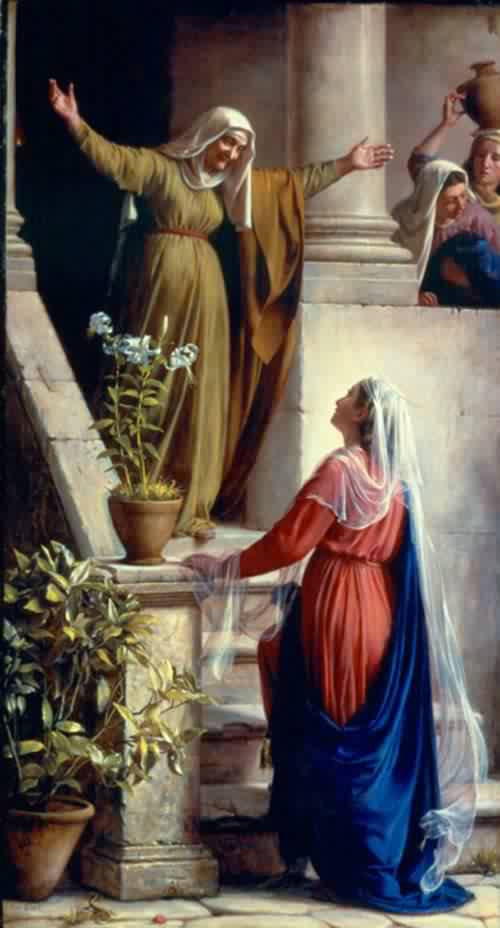
Elizabeth greets Mary Luke 1:41-42
Blessed are you among women  Luke 1:41 (Blessed are you among women)  Elizabeth is filled with the Holy Spirit; she is inspired by the 3rd person of the Blessed Trinity to proclaim that Mary is the most blessed among all women. 

And blessed is
the fruit of thy womb Jesus  Luke 1:42 (and blessed is the fruit of your womb)  Elizabeth still inspired by the Holy Spirit proclaims that the fruit of Mary’s womb, the developing Jesus, is blessed. The text doesn’t say “Jesus” after womb, but it is implied, the fruit of her womb is Jesus. 

Our Lady of Mt. Carmel


Holy Mary, Mother of God  Luke 1:43 (And why is this granted me, that the mother of my Lord should come to me?)  Mary is full of God’s grace; this would make her holy. Mary is the mother of the Lord Jesus Christ who is the 2nd person of the Holy Trinity. Since Jesus is God this makes her the mother of God. She is the mother of the God-Man Jesus, not the mother of the Trinity.

Pray for us sinners, now and at the hour of our death  James 5:16 (Therefore confess your sins to one another, and pray for one another, that you may be healed. The prayer of a righteous man has great power in its effects)  

The Madonna in Sorrow
St. James tells Christians to pray for one another.  All the baptized are members of the body of Christ (1Cor 12:12-14), therefore it is right to pray for other members of the body.  James goes on to say that the prayers of the righteous have great power.   
What human (other than Jesus) is more righteous then the Blessed Mother? Though she is in heaven she still hears the prayers of her children on Earth and intercedes for them. 

Eucharist - One Symbolic Reason to Use Unleavened Bread


THE UNLEAVENED BREAD 
 OF SINCERITY 
           AND TRUTH

The manifest fullness of Messiah's rule and reign on earth is not without opposition. But as at the Passover exodus, God will use the enemy's schemes to bring us to the place of His promise. He is taking us from glory to glory (2 Cor. 3:18) that we might live in His gracious rest (Hebrews 4:1-11). Every testing is intended to bring us to a new place of promotion. How will you respond to your tests and trials as you're taken to your promised land? Will you unwittingly consume the "leaven of malice and wickedness" or the "unleavened bread of sincerity and truth?" 

When bread is prepared, only a tiny portion of leaven is added to it. Yet that tiny portion soon permeates and puffs up the entire loaf. Leaven inflates its host substance through the natural process of decay, a form of death. For this reason leaven is symbolic in the Scriptures of sin. On the other hand, unleavened bread resists decay. Retaining its nourishing properties, it remains fresh and alive. The unleavened bread of sincerity and truth symbolize God's Word.
 Excerpt taken from the website --- Light of Zion:  Imparting God's Prophetic Heart for Israel
http://www.lightofzion.org/04articles26.html


 The unleavened bread is a ceremonial bread used to remember a historical event. It is used and eaten to remember the Hebrew’s deliverance out of Egypt.

3You shall eat no leavened bread with it; seven days you shall eat unleavened bread with it, that is, the bread of affliction (for you came out of the land of Egypt in haste), that you may remember the day in which you came out of the land of Egypt all the days of your life. Deuteronomy 16:3

3 And Moses said to the people: "Remember this day in which you went out of Egypt, out of the house of bondage; for by strength of hand the LORD brought you out of this place. No leavened bread shall be eaten.  Exodus 12:3


The manna is all about living in the kingdom, while the unleavened bread is all about dying to or forsaking an old life style.

Christians should eat the unleavened bread of the Lord’s Supper to remember their deliverance out of sin that was accomplished through His death.

Any time God speaks to our hearts about some promise, or command, or word of encouragement, or whatever; this word is like manna to us. It sustains us on our journey with God. This implies more than just reading the Bible. It implies that the Holy Spirit uses the Bible to speak to our hearts.

Thus, the New Testament fulfillment of the unleavened bread is our deliverance out of some sin. The fulfillment of the manna is seen when we see God’s provision as we follow Him after leaving that sin. The manna is experienced after our deliverance from some sin (the sin being like living in Egypt). The manna is God’s answer to the believer’s cry, "I gave up that lifestyle for You! Now what? How am I going to survive without it? How am I going to live?" God’s reply, "Manna! I’ll feed you in the desert. Through it all, you will learn to rely upon My word." "...that He might make you know that man shall not live by bread alone; but man lives by every word that proceeds from of the mouth of the Lord." (Deuteronomy 8:3)

To summarize, the manna is all about receiving God's provision, whereas the unleavened bread is all about dying to self, or leaving sin and the world. The ultimate reason Christians confuse these two is because the real meaning of the bread of the Lord’s Supper, dying to sin, is uncomfortable. A message about life is much easier to swallow. But, the ensuing confusion is devastating. The clear picture of the Christian lifestyle as seen in the Lord’s Supper is ruined. And, the much needed message that the bread stands for is ignored. 


Unleavened bread turned into the Body and Blood of Our Lord Jesus Christ
 Excerpts taken from http://thelordssupper.org/manna.htm

What does Dogma mean in the Catholic Church?


St. Peter's Basilica in Rome   http://en.wikipedia.org/wiki/File:StPetersBasilicaEarlyMorning.jpg
Roman Catholic dogma

And I will give to thee the keys of the kingdom of heaven. And whatsoever thou shalt bind upon earth, it shall be bound also in heaven: and whatsoever thou shalt loose upon earth, it shall be loosed also in heaven. Gospel of Matthew 16,19


In the Roman Catholic Church, a dogma is an article of faith revealed by God, which the magisterium of the Church presents to be believed. The resurrection of Jesus Christ is the basic truth from which salvation and life is derived for Christians. Dogmata regulate the language, how the truth of the resurrection is to be believed and communicated. One dogma is only a small particle of the living Christian faith, from which it derives its meaning.Roman Catholic Dogma is thus: "a truth revealed by God, which the magisterium of the Church declared as binding." The Catechism of the Catholic Church states:

    "The Church's Magisterium exercises the authority it holds from Christ to the fullest extent when it defines dogmas, that is, when it proposes, in a form obliging the Christian people to an irrevocable adherence of faith, truths contained in divine Revelation or also when it proposes, in a definitive way, truths having a necessary connection with these."

The faithful are required to accept with the divine and Catholic faith all which the Church presents either as solemn decision or as general teaching. Yet not all teachings are dogma. The faithful are only required to accept those teachings as dogma, if the Church clearly and specifically identifies them as infallible dogmata.

Not all theological truths are dogmata. The Bible contains many sacred truths, which the faithful recognize and agree with, but which the Church has not defined as dogma. Most Church teachings are not dogma. Cardinal Avery Dulles pointed out that in the 800 pages of the documents of the Second Vatican Council, there is not one new statement for which infallibility is claimed.

 http://en.wikipedia.org/wiki/Roman_Catholic_dogma

Monday, 3 September 2012

Venerable Archbishop Fulton J Sheen Prophet of the Americas


 "You should so manifest Him (Jesus Christ) in your lives that as you move among others they will say of you--as the maid servant said to Peter--Thou hast been with Christ."  
 Archbishop Fulton J. Sheen


Videos of Archbishop Sheen sharing profound thoughts of Good Friday, the spectators that were with Christ at His Crucifixion and Death


Indifferent spectators.


Spectators from and by the Cross Part 1 by Fulton Sheen (His Last Words)
http://youtu.be/W4xFwSxGeH0


Indifferent spectators of the Crucifixion of Christ


Spectators from and by the Cross Part 2 by Fulton Sheen (His Last Words)
http://youtu.be/ZGahGygeJyQ


Mary Mother of God, Mary Magdalene and John


Spectators from and by the Cross  Part 3 by Fulton Sheen (His Last Words)
http://youtu.be/G4Irh-cZjXw


Mary Magdalen washes Christ's feet


Spectators from and by the Cross Part 4 by Fulton Sheen (His Last Words)
http://youtu.be/WILGS-6aMoA


Holy Mother Mary, St. John and Mary Magdalene


Spectators on and by the Cross
Part 5 by Fulton Sheen (His Last Words)

http://youtu.be/OiT9p7o0bxA