Ad

Monday, 28 July 2014

Mercy

St. Caesarius of Arles, Bishop
From a Sermon by
Saint Caesarius of Arles, bishop
 
Divine and human mercy

Blessed are the merciful, for they shall receive mercy. My brothers and sisters, sweet is the thought of mercy, but even more so is mercy itself. It is what all men hope for, but unfortunately, not what all men deserve. For while all men wish to receive it, only a few are willing to give it.
How can a man ask for himself what he refuses to give to another? If he expects to receive any mercy in heaven, he should give mercy on earth. Do we all desire to receive mercy? Let us make mercy our patroness now, and she will free us in the world to come. Yes, there is mercy in heaven, but the road to it is paved by our merciful acts on earth. As Scripture says: Lord, your mercy is in heaven.
 
There is, therefore, an earthly as well as heavenly mercy, that is to say, a human and a divine mercy. Human mercy has compassion on the miseries of the poor. Divine mercy grants forgiveness of sins. Whatever human mercy bestows her on earth, divine mercy will return to us in our homeland. In this life God feels cold and hunger in all who are stricken with poverty; for, remember, he once said: What you have done to the least of my brothers you have done to me. Yes, God who sees fit to give his mercy in heaven wishes it to be a reality here on earth.
 
What kind of people are we? When God gives, we wish to receive, but when he begs, we refuse to give. Remember, it was Christ who said: I was hungry and you gave me nothing to eat. When the poor are starving, Christ too hungers. Do not neglect to improve the unhappy conditions of the poor, if you wish to ensure that your own sins be forgiven you. Christ hungers now, my brethren; it is he who deigns to hunger and thirst in the persons of the poor. And what he will return in heaven tomorrow is what he receives here on earth today.
 
What do you wish for, what do you pray for, my dear brothers and sisters, when you come to church? Is it mercy? How can it be anything else? Show mercy, then, while you are on earth, and mercy will be shown to you in heaven. A poor person asks you for something; you ask God for something. He begs for a morsel of food; you beg for eternal life. Give to the beggar so that you may merit to receive from Christ. For he it is who says: Give and it will be given to you. It baffles me that you have the impudence to ask for what you do not want to give. Give when you come to church. Give to the poor. Give them whatever your resources will allow.
 
St. Caesarius of Arles
 
 Archbishop and church man, the first in western Europe to receive the pallium from a pope. Caesarius was born in Chalons, Burgundy, France, in 470, of a French-Roman family. He spent a brief time as a monk in Lerins but was forced to depart from the community when he became ill. His uncle, the bishop of Arles, ordained Caesarius and sent him to reform a local monastery. He succeeded his uncle, Fonus, as bishop of ArIes in 503. Caesarius instituted many reforms, brought the Divine Office into the local parishes, and founded a convent, placing his sister St. Caesaria there as abbess, In 505, Caesarius was banished by the Gothic King Alaric II because of a lie. He was restored soon after. When Theodoric the Great, King of the Ostrogoths, besieged Arles, Caesarius was arrested, but he met with Theodoric and was pardoned. He then went to Rome where Pope St. Symmachus gave him the pallium and made him the apostolic delegate to France.When the Franks captured Arles in

St. Caesarius of Arles Reliquary
536, Caesarius retired to St. John's Convent. He was revered for his more than forty years of service and for presiding over Church synods and councils, including the Council of Orange in 529. He died on August 27.


Wednesday, 23 July 2014

Storms of Life -- Trusting in God


Letting Jesus Sleep

Matthew 8:23-27
 
by Father Eamonn Shelly, LC | Source: Catholic.net
 
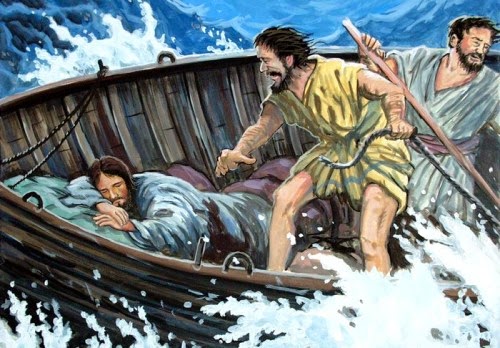
As Jesus got into the boat, his disciples followed him. A windstorm arose on the sea, so great that the boat was being swamped by the waves; but he was asleep. And they went and woke him up, saying, "Lord, save us! We are perishing!" And he said to them, "Why are you afraid, you of little faith?" Then he got up and rebuked the winds and the sea; and there was a dead calm. They were amazed, saying, "What sort of man is this, that even the winds and the sea obey him?"
 
Introductory Prayer:
Lord, I come to you in this meditation ready to do whatever it is you ask. Left to myself I often take the easy and convenient path, yet I know the way of a Christian is through the narrow gate. In you I find the reason to abandon the easy path for a more perfect mission of love. I’m ready to learn the meaning of your command: “Follow me.” Lord as worries tug at my heart, let me learn to rise above them and trust in you. Master of my life, I love the goods you have placed in my hands: my health, family, mission in life…. Grant me faith that can pass through the worst of storms and come through it profoundly enriched, humanly stronger, and more deeply united to you, my protector and guide.
 Petition: Lord, grant me the grace of a mature faith.
 
 1. God’s Silence, Man’s Faith:
We can imagine ourselves in the place of the apostles, in this poor boat tossed by the turbulent waves. The situation instantly speaks to our worst of fears; yet Jesus sleeps. Our temptation is to wake him…and too many souls do so through incessant complaining incessantly, despairing attitudes, withdrawal withdrawing from prayer, or unloaded unloading anger on others. When in a moment of trial we find life is no longer under our complete control, the option of meltdown is always at hand. But I we mustn’t take that route; instead I we must contemplate the power that emanates from the sleeping Christ. Trials are intended by God to draw us closer to him and increase our dependence on him. I We have to live from faith; otherwise all that reigns is fear, insecurity and bitterness. The “Silence of Christ” is powerful. To pass over its meaning lightly is to abandon some of the deepest lessons of Christ’s heart. The “Silence of Christ” must teach us.
 
 2. The “Silence of Christ” Speaks to Our Faith:
What is Christ’s sleep like? As a young mother, Mary watched Jesus sleep many times. Archbishop Martinez writes:
“Jesus was exceedingly beautiful when he spoke the words of eternal life, accomplished wonders, looked with love, pardoned with mercy, and caressed with tenderness. But I would like to have seen him while he was sleeping because I could have contemplated him to my heart’s content, without the fascination of his gaze distracting me, without the perfection of his beauty and the glory of his splendor dazzling my eyes and enrapturing my soul. The beauty of Jesus awake is far too great for my smallness. Who could support it? I felt it more suited to me veiled by sleep, as the glory of the sun is more adapted to my eyes when I look at it through a translucent lens” (When Jesus Sleeps, p.15).
 
May I trust the power of Christ
just as much
when He chooses
not to act -- as when He does.
 
3. God’s Eternal Pedagogy: 
Water, a boat , the apostles, and Christ… this scene repeats itself over and over again in the Gospel. Water is a symbol of the experiences of life taken on a human level; the boat is the experience of faith on a supernatural level -- it is our life with Christ. Christ’s message is that I we can never let my our experiences of life overwhelm my our experience of faith. I/We have to live not from the surface level of impressions of the moment, but open myself up to/from the deep channel of faith that reveals the action of God, the wisdom of his Providence, and the ultimate destiny of eternity.
 
Faith is what reveals Christ’s presence in our boat;
faith is what makes us believe that every wave and wind
gust are blessed invitations to confide in the One who rules all.
 
Faith is what permits God to console our hearts, calm our fears, and preserve our joy in the midst of many problems and difficulties that may take months or years to run their course.
 
Conversation Dialogue with Christ: 
Lord, I know belief makes me vulnerable. To believe is to push out from shore with you in my boat, leaving behind the security I find in my talents and plans, my friends and relatives, my financial and social standing But I know. I will not know your power if I do not know how to truly leave my whole life in your hands. that I will not know your love if I do not believe that you can make me happier than I could can be by myself. I will not know your victory if I do not face the enemies of my soul and my mission with and abandonment myself to your grace, I will not know your victory.
 
 
 Resolution: 
Today I will take a recent problem and, with complete trust and confidence in him, leave it totally in God’s hands today with complete trust and confidence in him.
 
Jesus Calms the Sea
 

Friday, 18 July 2014

Words of St. Ambrose regarding the Eucharist

From the treatise On the Mysteries by Saint Ambrose, bishop
To the newly baptized on the Eucharist
 
Fresh from the waters and resplendent in these garments, God’s holy people hasten to the altar of Christ, saying: I will go in to the altar of God, to God who gives joy to my youth. They have sloughed off the old skin of error, their youth renewed like an eagle’s, and they make haste to approach that heavenly banquet. They come and, seeing the sacred altar prepared, cry out: You have prepared a table in my sight. David puts these words into their mouths: The Lord is my shepherd and nothing will be lacking to me. He has set me down there in a place of pasture. He has brought me beside refreshing water. Further on, we read: For though I should walk in the midst of the shadow of death, I shall not be afraid of evils, for you are with me. Your rod and your staff have given me comfort. You have prepared in my sight a table against those who afflict me. You have made my head rich in oil, and your cup, which exhilarates, how excellent it is.


It is wonderful that God rained manna on our fathers and they were fed with daily food from heaven. And so it is written: Man ate the bread of angels. Yet those who ate that bread all died in the desert.


But the food that you receive, that living bread which came down from heaven, supplies the very substance of eternal life, and whoever will eat it will never die, for it is the body of Christ.
 
Consider now which is the more excellent: the bread of angels or the flesh of Christ, which is indeed the body that gives life. The first was manna from heaven, the second is above the heavens. One was of heaven, the other is of the Lord of the heavens; one subject to corruption if it was kept till the morrow, the other free from all corruption, for if anyone tastes of it with reverence he will be incapable of corruption. For our fathers, water flowed from the rock; for you, blood flows from Christ. Water satisfied their thirst for a time; blood cleanses you for ever. The Jew drinks and still thirsts, but when you drink you will be incapable of thirst. What happened in symbol is now fulfilled in reality.


If what you marvel at is a shadow, how great is the reality whose very shadow you marvel at. Listen to this, which shows that what happened in the time of our fathers was but a shadow.


They drank, it is written,
from the rock that followed them,
and the rock was Christ.
All this took place as a symbol for us.
 
You know now what is more excellent:
light is preferable to its shadow,
reality to its symbol,
the body of the Giver
to the manna he gave from heaven.


Thursday, 12 June 2014

BOOK OF REVELATION THROUGH CATHOLIC EYES

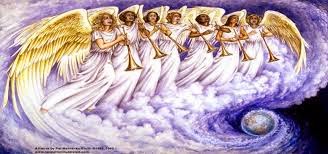
Seven Angels and Seven Trumpets of the Book of Revelation
 
A CATHOLIC STUDY OF
THE BOOK OF REVELATION

The Book of Revelation has always been a mystery to me.  What does it all mean?  Until now I had no clue as to what it meant in Catholic understanding.  Yes, I've read some of the stuff that is out there... about the 'rapture' and other stuff --  really???? Is that really the truth of the matter???  Does anyone really know what the symbolism means???  It's all a fuzzy area to me...
 
Well, I think that I have found someone who can teach us.   Karlo Broussard of Divine Child Institute www.divinechildinstitute.com
 
Here is his introduction that explains the lessons.
 
In this talk, which is lesson 1 of a 6 lesson entitled, "Unveiling the Mystery: A Catholic Study of the Book of Revelation", Karl gives a posture with which the Catholic can approach the Book of Revelation.  He introduces the Pre-70 A.D.dating theory and highlights as an introduction the themes of liturgy and judgment. 

I really can see now what the symbolism means through the eyes of the Church.  I hope that you will find this a great means of understanding by pulling back the veil to this book of the bible.

His series is on YouTube.  Here's the links.

A CATHOLIC STUDY OF THE BOOK OF REVELATION PART 1
https://www.youtube.com/watch?v=noBWDHXS_OQ
 
A CATHOLIC STUDY OF THE BOOK OF REVELATION PART 2
https://www.youtube.com/watch?v=uGVSzmhLTfM


Thank you Mr. Karlo Broussard!!!!


Wednesday, 11 June 2014

St. Chromatius, Bishop --- Shine with the Light of Truth

From a treatise on the Gospel of
Saint Matthew
by Saint Chromatius, bishop
You are the light of the world
You are the light of the world.  A city set on a hill cannot be hidden. Not do men light a lamp only to put it under a bushel basket; they put it on a stand where it gives light to all in the house.  The Lord called his disciples the sale of the earth because they seasoned with heavenly wisdom the hearts of men rendered insipid by the devil.  Now he calls them the light of the world as well, because they have been enlightened by him, the true and everlasting light, and have themselves become a light in the darkness.
Since he is the Sun of Justice, he fittingly calls his disciples the lights of the world.  The reason for this is that through them, as through shining rays, he has poured out the light of the knowledge of himself upon the entire world.  For by manifesting the light of truth, they have dispelled the darkness of error form the hearts of men.
Morever, we too have been enlightened by them.  We have been made light out of darkness as the Apostle says: For once you were darkness, but now you are light in the Lord; walk as children of light.  He says another time: For you are not sons of the night and of darkness, but you are all sons of light and of the day.
Saint John also rightly asserts in his letter: God is light, and whoever abides in God is in the light just as God himself is in the light. Therefore, because we rejoice in having been freed from the darkness of error, we should always walk in the light as children of light.  This is why the Apostle says: Among them you shine as lights in the world, holding fast to the word of life.
If we fail to live in the lights, we shall, to our condemnation and that of others, be veiling over and obscuring by our infidelity the light men so desperately need.  As we know from Scripture, the man who received the talent should have made it produce a heavenly profit, but instead he preferred to hide it away rather than put it to work and was punished as he deserved.
Consequently, that brilliant lamp which was lit for the sake of our salvation should always shine in us.  For we have the lamp of the heavenly commandment and spiritual grace, to which David referred: Your law is a lamp to my feet and a light to my path.  Solomon also ways this about it: For the command of the law is a lamp.

Therefore, we must not hide this lamp of law and faith.  Rather, we must set it up in the Church, as a lamp-stand, for the salvation of many, so that we may enjoy the light of truth itself and all believers may be enlightened.

Taken from Liturgy of the Hours, June 11


Who was St. Chromatius???


Chromatius was born in Aquileia in about 345 A.D. He was ordained a deacon, then a priest; finally, he was appointed Bishop of that Church (388). After receiving episcopal ordination from Bishop Ambrose he dedicated himself courageously and energetically to an immense task because of the vast territory entrusted to his pastoral care: the ecclesiastical jurisdiction of Aquileia, in fact, stretched from the present-day territories of Switzerland, Bavaria, Austria and Slovenia, as far as Hungary.
St Chromatius of Aquileia exercised his ministry in the ancient Church of Aquileia, a fervent centre of Christian life located in the Roman Empire's Decima regione, the Venetia et Histria. In 388 A.D., when Chromatius assumed the Episcopal throne of the city, the local Christian communities had already developed a glorious history of Gospel fidelity.
Martyrs of the Christian Faith
Between the middle of the third century and the early years of the fourth, the persecution of Decius, Valerian and Diocletian had taken a heavy toll of martyrs. Furthermore, the Church of Aquileia, like so many other Churches of that time, had had to contend with the threat of the Arian heresy. Athanasius himself - a standard-bearer of Nicene orthodoxy whom the Arians had banished to exile - had for some time been in Aquileia, where he had taken refuge. Under the guidance of its Bishops, the Christian community withstood the snares of the heresy and reinforced their own attachment to the Catholic faith.
Trinitarian Mystery
Chromatius was a wise teacher and a zealous pastor. His first and main commitment was to listen to the Word, to be able to subsequently proclaim it: he always bases his teaching on the Word of God and constantly returns to it. Certain subjects are particularly dear to him: first of all, the Trinitarian mystery, which he contemplated in its revelation throughout the history of salvation.
Then, the theme of the Holy Spirit: Chromatius constantly reminds the faithful of the presence and action in the life of the Church of the Third Person of the Most Holy Trinity. But the holy Bishop returns with special insistence to the mystery of Christ. The Incarnate Word is true God and true man: he took on humanity in its totality to endow it with his own divinity. These truths, which he also reaffirmed explicitly in order to counter Arianism, were to end up about 50 years later in the definition of the Council of Chalcedon.
Virgin Mary by Lyubomir Kanelov
The heavy emphasis on Christ's human nature led Chromatius to speak of the Virgin Mary. His Mariological doctrine is clear and precise. To him we owe evocative descriptions of the Virgin Most Holy: Mary is the "evangelical Virgin capable of accepting God"; she is the "immaculate and inviolate ewe lamb" who conceived the "Lamb clad in purple" (cf. Sermo XXIII, 3: Scrittori dell'area santambrosiana 3/1, p. 134). The Bishop of Aquileia often compares the Virgin with the Church: both, in fact, are "virgins" and "mothers".
Chromatius developed his ecclesiology above all in his commentary on Matthew. These are some of the recurring concepts: the Church is one, she is born from the Blood of Christ; she is a precious garment woven by the Holy Spirit; the Church is where the fact that Christ was born of a Virgin is proclaimed, where brotherhood and harmony flourish.
Ship in a Storm
One image of which Chromatius is especially fond is that of the ship in a storm - and his were stormy times, as we have heard: "There is no doubt", the Holy Bishop says, "that this ship represents the Church" (cf. Tractatus XLII, 5: Scrittori dell'area santambrosiana 3/2, p. 260).


Living for Christ and not the world

St. Ignatius of Antioch
From a letter to the Romans

by Saint Ignatius of Antioch,
bishop and martyr
My earthly
desires
have been crucified
 
The delights of this world and all its kingdoms will not profit me.  I would prefer to die in Jesus Christ than to rule over all the earth.  I seek him who died for us, I desire him who rose for us.  I am in the throes of being born again.  Bear with me, my brothers; do not keep me from living, do not wish me to die.  I desire to belong to God; do not give me over to the world, and do not seduce me with perishable things.  Let me see the pure light, when I am there, I shall be truly a man at last.  Let me imitate the sufferings of my God.  If anyone has God in him, let him understand what I want and have sympathy for me, knowing what drives me on.
The price of this world would snatch me away and destroy my desire to be with God.  So let none of you who will be there give him help; side rather with me, that is, with God.  Do not have Jesus Christ on your lips and the world in our hearts.  Give envy no place among you.  And if, when I get there, I should beg for your intervention, pay no attention to me; no, believe instead what I am writing to you now.  For I write to you while I yet live, but I long for death.  My early desires have been crucified, and there no long burns in me the love of perishable things, but a living water speaks within me, say: “Come to the Father.”
I take no delight in corruptible food or in the pleasures of this life.  I want the bread of God, which is the flesh of Jesus Christ, who was David’s seed, and for drink I want his blood, the sign of his imperishable love.
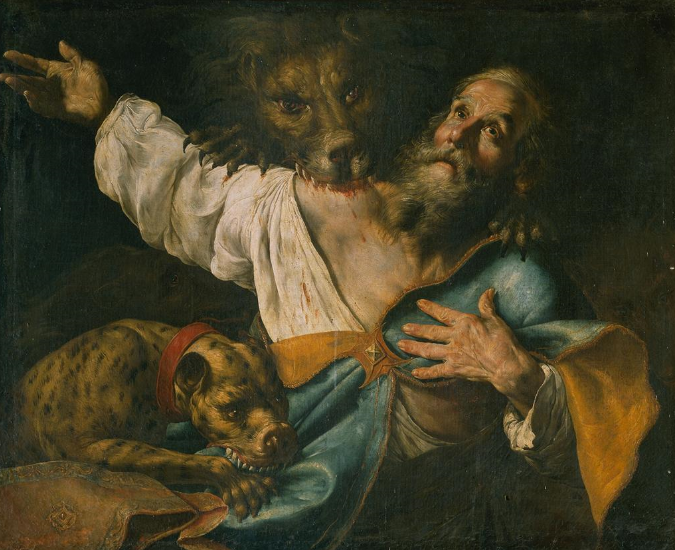
Martyrdom of St. Ignatius of Antioch by Cesar Fracanzano
I no longer wish to live, as men count life.  And I shall have my way, if you wish it so.  Wish it, then, so that you too may have God’s favor.  With these few words I beg you to believe me.  Jesus Christ will make plain to you the truth of what I say; he is the true voice that speaks the Father’s truth.  Pray for me that I may reach my goal.  I have written to you not prompted by merely human feelings and values, but by God’s purpose for me.  If I am to suffer, it will be because you loved me well; if I am rejected, it will be because you hated me.  Remember in your prayers the church of Syria: it now has God for its shepherd instead of me.  Jesus Christ alone will be its bishop, along with your love.  For myself, I am ashamed to be counted among its members, for I do not deserve it, being the least of all, born out of due time.  Yet, if I attain to God, by his mercy I shall be something.  I greet you from the heart, and so do the churches that have welcomed me in love not as a mere passerby but as the representative of Jesus Christ.  Yes, even the churches that were not on my route humanly speaking, though spiritually on the same journey, were there to meet me in city after city.
 
taken from the Liturgy of the Hours (Divine Office) June 10
 
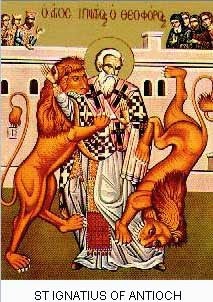
St. Ignatius of Antioch 
St. Ignatius of Antioch
 
Feast Day October 17
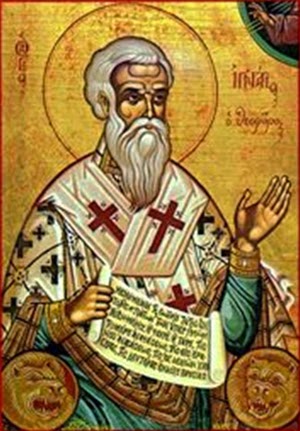
St. Ignatius of Antioch was the second bishop of Antioch, Syria.  He was the beloved disciple of John and was consecrated a Bishop around the year 69 by the Apostle Peter, the first Pope.  He was deeply loved by the faithful because of his holiness.  He defended “orthodoxy” (the right teaching) and “orthoproxy” (the right practice) among the early Christians.
He journeyed through Asia Minor and Greece and and wrote sevn letters of encouragement, instruction and inspiration to the Christians in those communities.  The letter written above is a prime example of his great faith and teachings.
St. Ignatius of Antioch was the first to use the term “Catholic” to describe the whole Church.  His letters serve as a unbroken and clear teaching of the Apostles which was given to them directly by Jesus Christ.
In the year 107, under the reign of Emperor Trajan, was sentenced to death because of his refusal to renounce the Christian faith.  He was taken under guard to Rom where he was brutally devoured by wild beasts in a public spectacle.  His holy martyrdom, the shedding of his blood, was a culmination of a life lived conformed to Jesus Christ.
“Permit me to imitate my suffering God… I am God’s wheat and I shall be ground by the teeth of beasts, that I may become the pure bread of Christ.”
Information gathered from Catholic Online

Thursday, 5 June 2014

St. Bonfice - Standing up and Defending the Church


From a letter by Saint Boniface, bishop and martyr
St. Boniface
 
The Careful Shepherd watches over Christ’s flock
 
In her voyage across the ocean of this world, the Church is like a great ship being pounded by the waves of life’s different stresses.  Our duty is not to abandon ship but to keep her on her course.
The ancient fathers showed us how we should carry out this duty.  Clement, Cornelius and many others in the city of Rome, Cyprian at Carthage, Athanasius at Alexandria.  They all lived under Emperors who were pages; they all steered the Christ’s ship—or rather his most dear spouse, the Church.  This they did by teaching and defending her, by their labors and sufferings, even to the shedding of blood.
I am terrified when I think of all this. Fear and trembling came upon me and the darkness of my sins almost covered me. I would gladly give up the task of guiding the Church which I  have accepted if I could find sucha an action warranted by the example of the fathers or by holy Scripture.
St. Boniface Icon
Since this is the case, and since the truth can be assaulted by never defeated or falsified, with our tired mind let us turn to the words of Solomon: Trust in the Lord with all your heart and dod not rely on your own prudence.  Thon on him in all your ways, and he will guide your steps.   In another place her says: The name of the Lord is an impregnable tower. The just man seeks refuge in it and he will be saved.
Let us stand fast in what is right and prepare our souls for trial.  Let us wait upon God’s strengthening aid and say to him: O Lord, you have been our refuge in all generations.
Let us trust in him who has placed this burden upon us.  What we ourselves cannot bear let us bear with the help of Christ.  For he is all-powerful and he tells us: My yoke is easy and my burden is light.
Let us continue the fight on the day of the Lord.  The days of anguish and tribulation have overtaken us; if God so wills, let us die for the holy laws of our fathers, so that we may deserve to obtain an eternal inheritance with them.
Let us be neither dogs that do not bark nor silent onlookers nor paid servants who run away before the wolf.  Instead let us be careful shepherds watching over Christ’s flock.  Let us preach the whole of God’s plan to the powerful and to the humble, to rich and to poor, to men of every rank and age, as far as God gives us the strength, in season and out of season, as Saint Gregory writes in his book of Pastoral Instruction.
 
Who is Saint Boniface?
 
(Latin: Bonifatius) (c. 675? – 5 June 754), born Winfrid, Wynfrith, or Wynfryth in the kingdom of Wessex, probably at Crediton, was an Anglo-Saxon missionary who propagated Christianity in the Frankish Empire during the 8th century. He is the patron saint of Germany, the first archbishop of Mainz and the "Apostle of the Germans". He was killed in Frisia in 754, along with 52 others. His remains were returned to Fulda, where they rest in a sarcophagus which became a site of pilgrimage. Facts about Boniface's life and death as well as his work became widely known, since there is a wealth of material available—a number of vitae, especially the near-contemporary Vita Bonifatii auctore Willibaldi, and legal documents, possibly some sermons, and above all his correspondence.
 ...Through his efforts to reorganize and regulate the church of the Franks, he helped shape Western Christianity, and many of the dioceses he proposed survive today. After his martyrdom, he was quickly hailed as a saint in Fulda and other areas in Germany and in England. His cult is still notably strong today. Boniface is celebrated as a missionary; he is regarded as a unifier of Europe, and he is seen as a German national figure.
 
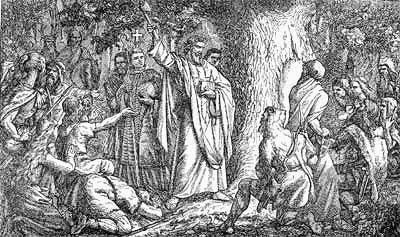
St. Boniface felling the oak tree that was venerated as a God
The Incident at Thor's Oak 
To show the heathens how utterly powerless were the gods in whom they placed their confidence, Boniface felled the oak sacred to the thunder-god Thor, at Geismar, near Fritzlar. He had a chapel built out of the wood and dedicated it to the prince of the Apostles. The heathens were astonished that no thunderbolt from the hand of Thor destroyed the offender, and many were converted. The fall of this oak marked the fall of heathenism. Tradition tells us that Boniface now passed on to the River Werra and there erected a Church of St. Vitus, around which sprang up a town which to the present day bears the name of Wannfried. At Eschwege he is said to have destroyed the statue of the idol Stuffo. Thence he went into Thuringia.
Check out this website for more detailed information regarding this great saint.